
Restaurant in Tokyo, Japan
Sushi Taichi
470ptsEdomae counter without the performance-venue pricing


About Sushi Taichi
Sushi Taichi is a Michelin Plate–recognised Edomae counter in Ginza that resists the fixed omakase format most neighbours have adopted, giving you counter access to chef Taichi Ishikawa at a ¥¥¥ price point. With OAD Top Restaurants in Japan recognition and a 4.5 Google rating, it is the most accessible serious sushi option in the neighbourhood and the right call for a date or business dinner where flexibility matters.
Verdict
Book Sushi Taichi if you want a Ginza counter that feels like old Tokyo rather than a performance venue. This is an old-school Edomae counter run by chef Taichi Ishikawa, who operates on a walk-in-friendly, à la carte basis that most of his Ginza neighbours have abandoned in favour of fixed omakase seatings. With a 4.5 Google rating across 215 reviews, a Michelin Plate (2024), and consecutive Opinionated About Dining Leading Restaurants in Japan rankings (#383 in 2024, #436 in 2025), Sushi Taichi carries real credentials at a ¥¥¥ price point that undercuts the ¥¥¥¥ tier dominating this postcode. If you are after Edomae sushi without the rigid choreography, this is one of the more accessible counters in central Tokyo.
Portrait
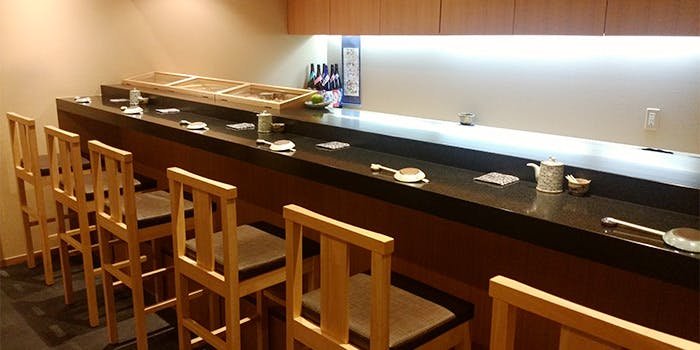
Sushi Taichi sits on the second floor of the Asagi Building in Ginza 6-chome, a few minutes from the intersection of Ginza's two main shopping streets. The setting is deliberately Edo-referencing: a shop curtain hangs above the counter, woodblock prints line the walls, and the atmosphere reads closer to a neighbourhood sushi-ya than to the hushed, ceremony-first rooms that define the trophy end of the Ginza sushi tier. This is a deliberate choice, not a budget compromise, and it shapes the entire visit.
The operating format is the key differentiator. Where venues like Harutaka and Sushi Kanesaka lock guests into timed omakase progressions, Sushi Taichi gives you the counter experience without stripping away your agency. The Michelin description notes this explicitly: Ishikawa resists the now-standard two-seating, set-only model. For guests who find the rigid omakase format uncomfortable for a business meal or a first date, this flexibility matters.
On the seasonal dimension: Edomae sushi is inherently a seasonal format, and what is worth ordering at any counter shifts considerably across the year. Spring brings kohada (gizzard shad) in peak condition, early summer is when ika (squid) and anago (conger eel) are at their leading, and autumn pushes tuna and fatty toro quality to its seasonal peak. The chef's disposition, described as agreeable and engaged with regular customers, suggests you can ask directly what is leading on a given visit rather than relying on a fixed sequence to make those decisions for you. That conversational access to the chef is genuinely useful when the answer to what to order changes every six to eight weeks.
The Opinionated About Dining ranking movement is worth reading carefully. Sushi Taichi went from Recommended status in 2023 to #383 in Japan in 2024, then to #436 in 2025. A drop in absolute ranking at this tier is not unusual in Japan's densely reviewed restaurant scene and does not indicate a quality decline; OAD rankings fluctuate as new venues enter and voter participation shifts. The Michelin Plate in 2024 is the more stable signal here: consistent quality recognised by inspectors, without the star pressure that changes how some chefs operate.
For a special occasion, Sushi Taichi works leading for two. The counter format, the Edo-period visual references, and the chef's engagement with regulars create an atmosphere that rewards unhurried dining. It is a better choice for a dinner date or a business meal where you want conversation to flow than it is for a large group celebration; counter sushi is structurally not a group format. For groups of four or more, you would need to confirm seating arrangements directly. For solo dining, the counter is the natural fit and the à la carte flexibility means you can calibrate spend without committing to a fixed menu price.
Booking is relatively easy by Ginza standards. The open-seating model and the absence of a hard omakase-only constraint means Sushi Taichi is less reservation-scarce than the top-tier counters in the same neighbourhood. Tuesday through Saturday, lunch runs 12:00 to 2:30 pm and dinner 6:00 to 10:30 pm. Monday and Sunday are closed. Compared to counters like Sukiyabashi Jiro Roppongiten, where reservations can require weeks of lead time and personal introductions, Sushi Taichi is meaningfully more accessible. A week's notice for dinner should be sufficient in most cases, though same-week bookings for Saturday evenings may be tighter.
For broader context on Tokyo's dining tier, see our full Tokyo restaurants guide. If you are building a multi-city Japan itinerary, comparable quality at the Michelin-recognised level is available at Gion Sasaki in Kyoto and HAJIME in Osaka. For sushi outside Japan at a comparable pedigree, Sushi Shikon in Hong Kong and Shoukouwa in Singapore are the regional references worth considering.
Know Before You Go
- Address: 浅黄ビル 2F, 6-4-13 Ginza, Chuo-ku, Tokyo 104-0061
- Price tier: ¥¥¥
- Cuisine: Edomae sushi, à la carte available
- Lunch: Tuesday to Saturday, 12:00–2:30 pm
- Dinner: Tuesday to Saturday, 6:00–10:30 pm
- Closed: Monday and Sunday
- Booking difficulty: Easy — more accessible than most Ginza omakase counters
- Format: Counter; à la carte and omakase options (not fixed-only)
- Leading for: Dates, business dinners, solo counter dining
- Awards: Michelin Plate (2024); Opinionated About Dining Leading Restaurants in Japan #383 (2024), #436 (2025)
- Google rating: 4.5 (215 reviews)
- Nearest area: Ginza 6-chome, Central Tokyo
How It Compares
See the comparison section below for how Sushi Taichi sits against its Ginza and Tokyo peers.
Explore More in Tokyo and Japan
- Edomae Sushi Hanabusa — another Edomae counter worth considering in Tokyo
- Hiroo Ishizaka , for a different register of Japanese fine dining
- 1000 in Yokohama , nearby day-trip dining option
- akordu in Nara and Goh in Fukuoka , if your Japan trip extends beyond Tokyo
- 6 in Okinawa , for a more remote Japan dining experience
- Tokyo hotels guide | Tokyo bars guide | Tokyo wineries | Tokyo experiences
FAQ
- What should I order at Sushi Taichi? Ask the chef what is leading on the day. Because Sushi Taichi retains an à la carte option rather than locking you into a set sequence, you have real access to the chef's current thinking on seasonal form. In practical terms: favour fish-forward pieces over roe-heavy or truffle-accented items, which belong to a different style of counter. Edomae technique centres on the rice and the cure as much as the fish itself, so pieces like kohada, anago, and well-aged maguro are the benchmarks to judge any Edomae counter by.
- Is the tasting menu worth it at Sushi Taichi? At ¥¥¥, Sushi Taichi sits a full price tier below the ¥¥¥¥ counters that dominate Ginza's recognised-sushi tier. For that price differential, you get a Michelin Plate-level counter with OAD Japan recognition and an experienced chef, in a format that is less rigid than the fixed omakase rooms charging significantly more. If you are comparing value to a ¥¥¥¥ counter like Harutaka, Sushi Taichi is the more accessible entry point to serious Ginza sushi. If your priority is the full ceremony of a structured omakase at the highest technical level, the ¥¥¥¥ tier will serve that better.
- Is Sushi Taichi good for solo dining? Yes, and it is one of the better configurations for a solo visitor. Counter sushi is structurally designed for the single diner: you sit directly in front of the chef, the à la carte format lets you calibrate your order and spend as you go, and the Edo-period atmosphere is low-pressure. For solo travellers who find the locked-in cost of a full omakase uncomfortable, Sushi Taichi's flexible format is a genuine advantage over most of the Ginza competition.
- Can Sushi Taichi accommodate groups? Counter sushi is not well suited to large groups by design, and no specific private dining or group seating information is confirmed in available data. For groups of four or more, contact the restaurant directly before booking. For groups prioritising a shared table format over a counter, a kaiseki venue like RyuGin would be a more practical choice.
- What are alternatives to Sushi Taichi in Tokyo? For a step up in price and ceremony, Harutaka is the most direct Ginza-sushi comparison at ¥¥¥¥, with a harder reservation and a more structured omakase. Sushi Kanesaka sits in the same Ginza postcode at ¥¥¥¥ and is similarly recognition-heavy. Sukiyabashi Jiro Roppongiten is the highest-profile name in the tier but is significantly harder to book and operates with strict format rules. Edomae Sushi Hanabusa is worth considering if you want to stay in the Edomae style at a comparable price point. For non-sushi alternatives at the same occasion level, Hiroo Ishizaka offers a different register of Japanese fine dining in Tokyo.
Compare Sushi Taichi
| Venue | Cuisine | Awards | Booking Difficulty | Value |
|---|---|---|---|---|
| Sushi Taichi | Sushi | This restaurant loves the chic style of Edo culture and values the human touch. Many sushi shops these days offer two time-limited seatings, serving only omakase set meals. However, Sushi Taichi shows the mettle of an old-fashioned sushi chef. The owner-chef’s agreeable disposition ensures him many regular customers. Above the counter is a shop curtain, while the walls feature woodblock prints depicting street stalls. If you like old-school sushi shops, Sushi Taichi is for you.; This restaurant loves the chic style of Edo culture and values the human touch. Many sushi shops these days offer two time-limited seatings, serving only omakase set meals. However, Sushi Taichi shows the mettle of an old-fashioned sushi chef. The owner-chef’s agreeable disposition ensures him many regular customers. Above the counter is a shop curtain, while the walls feature woodblock prints depicting street stalls. If you like old-school sushi shops, Sushi Taichi is for you.; Opinionated About Dining Top Restaurants in Japan Ranked #436 (2025); Opinionated About Dining Top Restaurants in Japan Ranked #383 (2024); Michelin Plate (2024); Opinionated About Dining Top Restaurants in Japan Recommended (2023) | Easy | — |
| Harutaka | Sushi | Michelin 3 Star, World's 50 Best | Unknown | — |
| L'Effervescence | French | Michelin 3 Star, World's 50 Best | Unknown | — |
| RyuGin | Kaiseki, Japanese | Michelin 3 Star, World's 50 Best | Unknown | — |
| HOMMAGE | Innovtive French, French | Michelin 2 Star, World's 50 Best | Unknown | — |
| Crony | Innovative, French | Michelin 2 Star, World's 50 Best | Unknown | — |
Comparing your options in Tokyo for this tier.
Frequently Asked Questions
What are alternatives to Sushi Taichi in Tokyo?
For a comparable old-school Edomae counter in Tokyo, Harutaka in Ginza is the most direct peer — slightly harder to book and priced similarly at ¥¥¥. If you want a more contemporary format with higher production values, Sushi Saito or Sushi Yoshitake operate in a different register entirely. Sushi Taichi's OAD Top Restaurants in Japan ranking (#436 in 2025) puts it in credible but approachable territory — not the most competitive table in Tokyo, but a more relaxed booking than the top-20 counters.
Can Sushi Taichi accommodate groups?
Sushi Taichi is a counter-format Edomae shop, which limits practical group size. Counter seats typically cap at 8–12, and the old-school single-sitting approach here means large parties above 4–6 will likely be split or turned away. For groups of 2–4, the counter works well; for 6 or more, confirm directly via reservation before committing.
What should I order at Sushi Taichi?
Sushi Taichi operates in an Edomae style, and unlike many Ginza counters that lock you into a fixed omakase, the old-school format here allows more interaction with chef Taichi Ishikawa. That flexibility is the point — ask what's good on the day rather than defaulting to a set menu. Specific dish recommendations are not documented in available data, so treat the chef's lead as your guide.
Is the tasting menu worth it at Sushi Taichi?
At ¥¥¥, Sushi Taichi is priced in line with serious Ginza sushi without reaching the ¥¥¥¥ tier of Tokyo's most competitive omakase rooms. The Michelin Plate recognition and consecutive OAD rankings (Recommended 2023, #383 in 2024, #436 in 2025) signal consistent quality rather than a destination-level flex. If you want a relaxed Edomae meal at a credible Ginza counter without the pressure of a timed two-sitting format, the value case is solid.
Is Sushi Taichi good for solo dining?
Yes — this is one of the stronger solo options in Ginza sushi. Chef Taichi Ishikawa has a reputation for an agreeable, approachable disposition, and the traditional counter format (noren curtain, woodblock prints, no rigid time limits) is built for direct chef-to-diner interaction. Solo diners wanting a conversational, unpretentious counter over a performance-style omakase room should prioritise this.
Hours
- Monday
- Closed
- Tuesday
- 12–2:30 pm, 6–10:30 pm
- Wednesday
- 12–2:30 pm, 6–10:30 pm
- Thursday
- 12–2:30 pm, 6–10:30 pm
- Friday
- 12–2:30 pm, 6–10:30 pm
- Saturday
- 12–2:30 pm, 6–10:30 pm
- Sunday
- Closed
Recognized By


More restaurants in Tokyo
- SézanneOccupying the seventh floor of the Four Seasons Hotel Tokyo at Marunouchi, Sézanne earned its first Michelin star within months of opening in July 2021 and now holds three. British chef Daniel Calvert applies French technique to Japanese ingredients, producing a prix-fixe format that Tabelog has recognised with Silver awards every year from 2023 through 2026. It ranked 4th in Asia's 50 Best Restaurants in 2025 and 15th globally in 2024.
- SazenkaSazenka is the address for Chinese cuisine in Tokyo at its most technically demanding. Chef Tomoya Kawada's wakon-kansai approach — Japanese seasonal ingredients applied through Chinese culinary technique — has earned consecutive Tabelog Gold Awards from 2019 to 2026, a #71 ranking on the World's 50 Best 2025, and 99 points from La Liste 2026. At JPY 50,000–59,999 per head, it is one of the hardest tables in the city to book and worth the effort.
- NarisawaNarisawa is Tokyo's most credentialled innovative tasting menu restaurant — two Michelin stars, Asia's 50 Best number 12, and a Tabelog Silver award — running at JPY 80,000–99,999 per head. Book for a milestone occasion, confirm vegetarian or vegan needs in advance, and reserve at least two to three months out. With 15 seats and reservation-only access, this is one of Tokyo's hardest tables to secure.
- FlorilègeFlorilège delivers two Michelin stars and an Asia's 50 Best #17 ranking at a dinner price of ¥22,000 — competitive for Tokyo at this level. Chef Hiroyasu Kawate's plant-forward tasting menus around an open-kitchen counter at Azabudai Hills make this the strongest choice for contemporary French dining in Tokyo if theatrical, produce-led cooking is what you want. Book well in advance; availability is near-impossible at short notice.
- DenDen holds two Michelin stars, a World's 50 Best top-25 Asia ranking, and a Tabelog Silver Award running back to 2017 — and it books out within hours of the two-month reservation window opening. Chef Zaiyu Hasegawa's daily-changing seasonal omakase runs JPY 30,000–39,999 at dinner in a relaxed house-restaurant setting near Gaiemmae. Book by phone only, noon–5 PM JST. Lunch is irregular; plan around dinner.
- MyojakuMyojaku is a 2-Michelin-star, 14-course French-leaning omakase in Nishiazabu holding a 4.47 Tabelog score, Tabelog Silver 2025–2026, and Asia's 50 Best #45 (2025). Chef Hidetoshi Nakamura's water-forward, no-dashi approach shifts meaningfully with the seasons — making timing your reservation as important as getting one. Budget JPY 50,000–59,999 per head plus 10% service charge; reservations only, near-impossible to secure.
Similar venues by awards
Related editorial
- Best Fine Dining Restaurants in ParisFrom three-Michelin-star icons to the next generation of Parisian chefs pushing boundaries, these are the restaurants that define fine dining in the world's culinary capital.
- Best Luxury Hotels in RomeFrom rooftop terraces overlooking ancient ruins to Michelin-starred hotel dining, these are the luxury hotels that make Rome unforgettable.
- Best Cocktail Bars in KyotoFrom sleek lounges to hidden speakeasies, Kyoto's cocktail scene blends Japanese precision with global influence in ways you won't find anywhere else.
Save or rate Sushi Taichi on Pearl
Keep this venue in your Pearl passport, rate it after you visit, and track it alongside every other place you collect.