
Restaurant in Tokyo, Japan
Osobano Kouga
250ptsEdo soba culture, Michelin value, evening prix fixe.

About Osobano Kouga
Osobano Kouga holds a 2024 Michelin Bib Gourmand and sits at the accessible ¥ price tier in Nishi-Azabu, making it one of the better-value Michelin-recognised evenings in Minato City. The evening prix fixe, built around sake and Edo-era soba tradition, is the reason to book. Lunch works, but dinner is the visit worth planning.
Is Osobano Kouga worth booking for a special evening in Nishi-Azabu?
Yes, with one condition: come in the evening if you want the full experience. Osobano Kouga holds a Michelin Bib Gourmand (2024), which means the inspectors rated it exceptional value for money — not a consolation prize, but a specific signal that quality-to-price ratio is the story here. At the ¥ price tier, it is among the most affordable Michelin-recognised dining in Minato City. The question is not whether the food is good. The question is whether lunch or dinner fits your visit, and the answer matters more here than at most soba shops.
The Space
The address puts you a short walk from the Nishi-Azabu Intersection, in a neighbourhood better known for high-end French and modern Japanese restaurants. The contrast is deliberate. Osobano Kouga channels the Edo-period soba shop tradition — a format that historically served as Tokyo's casual everyday dining, the equivalent of a neighbourhood tavern with craft behind the counter. The space carries that sensibility: you are not walking into a minimalist kaiseki room or a sleek omakase counter. The atmosphere is intentionally grounded, the kind of room where lingering over sake cups in the evening feels natural rather than out of place. For a date or a low-key celebration, that casual warmth works in your favour. For a formal business dinner requiring private space or a grand arrival moment, look elsewhere.
Lunch vs. Dinner: Where the Value Splits
This is the editorial angle that matters most at Osobano Kouga. The daytime and evening experiences are structurally different, and choosing the wrong one for your purpose is the most common mistake a first-timer can make.
Lunch at a traditional soba shop in Tokyo is typically a faster, simpler format: bowls of soba, perhaps tempura, efficient service. At Osobano Kouga, the daytime offering follows this logic , soba in season alongside appetisers of vegetable or fish of the day. It is a strong lunch for the price, particularly for anyone in the neighbourhood for other reasons. But it is not the reason to make a trip.
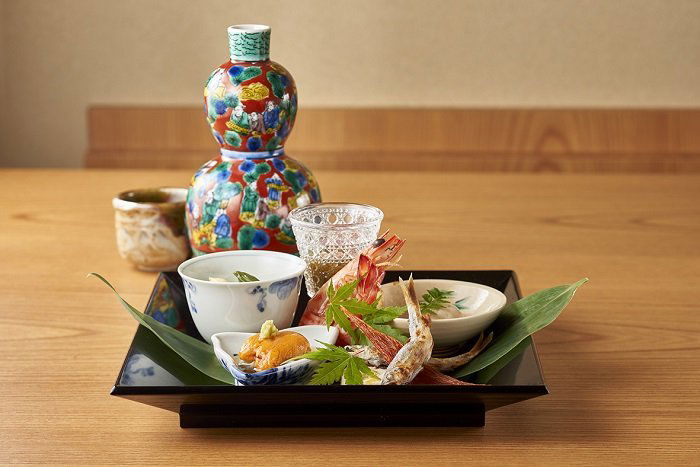
Evenings are where Osobano Kouga shifts register. The prix fixe format takes over, designed to encourage a slower pace. Sake pairing becomes the spine of the meal. Tensui , described in the venue's own framing as an old-timey snack, essentially tempura soba with the soba component removed , appears as a kind of historical reference point on the menu. This is not the kind of detail that sounds significant until you are sitting with it and a cup of sake, and suddenly the Edo popular culture framing clicks into place. The evening experience at Osobano Kouga is the one that justifies a deliberate booking. Come for dinner if this is a date, a small celebration, or simply a night where you want something genuinely considered at an accessible price.
Compared to soba specialists elsewhere in Tokyo, the evening prix fixe positioning is relatively rare. Akasaka Sunaba and Azabukawakamian are respected soba addresses, but neither frames the evening around a sake-led prix fixe in quite this way. Edosoba Hosokawa and Hamacho Kaneko are worth knowing for comparison if you are building a broader soba itinerary across the city.
Booking and Logistics
Booking difficulty is rated Easy. Given the Bib Gourmand recognition and the evening prix fixe format, advance booking is sensible , a week out should be sufficient for most dates, though popular weekend evenings may require more lead time. No website or phone number is publicly listed in Pearl's database; local booking platforms or Google Maps are your most reliable route to a reservation. Google rating stands at 4.1 across 363 reviews, which for a soba specialist in this neighbourhood represents a solid floor of consistent quality.
The ¥ price tier means this is one of the few Michelin-recognised evenings in Minato City where you will not need to plan the spend carefully. Budget accordingly for sake, which in a prix fixe format can move the final bill, but the base price remains accessible by any Tokyo dining standard.
For broader Tokyo planning, see our full Tokyo restaurants guide, our full Tokyo hotels guide, our full Tokyo bars guide, our full Tokyo wineries guide, and our full Tokyo experiences guide. If your Japan trip extends beyond Tokyo, HAJIME in Osaka, Gion Sasaki in Kyoto, akordu in Nara, Goh in Fukuoka, 1000 in Yokohama, and 6 in Okinawa are all worth considering. For soba specifically beyond Tokyo, Ayamedo in Osaka and Chikuyuan Taro no Atsumori in Kyoto are the natural comparison points. Hamadaya is also worth noting for traditional Japanese dining in Tokyo at a different price tier.
Ratings at a Glance
- Michelin: Bib Gourmand 2024
- Google: 4.1 (363 reviews)
- Price tier: ¥ (budget-accessible by Tokyo standards)
- Booking difficulty: Easy
Practical Details
| Detail | Osobano Kouga | Akasaka Sunaba | Edosoba Hosokawa |
|---|---|---|---|
| Cuisine | Soba | Soba | Soba |
| Price tier | ¥ | ¥ | ¥¥ |
| Michelin recognition | Bib Gourmand 2024 | Not listed | Not listed |
| Evening format | Prix fixe with sake | À la carte | À la carte |
| Booking difficulty | Easy | Easy | Easy |
| Neighbourhood | Nishi-Azabu, Minato | Akasaka | Ryogoku |
Compare Osobano Kouga
| Venue | Cuisine | Price | Booking Difficulty |
|---|---|---|---|
| Osobano Kouga | Soba | ¥ | Easy |
| Harutaka | Sushi | ¥¥¥¥ | Unknown |
| L'Effervescence | French | ¥¥¥¥ | Unknown |
| RyuGin | Kaiseki, Japanese | ¥¥¥¥ | Unknown |
| HOMMAGE | Innovtive French, French | ¥¥¥¥ | Unknown |
| Crony | Innovative, French | ¥¥¥¥ | Unknown |
A quick look at how Osobano Kouga measures up.
Frequently Asked Questions
Can Osobano Kouga accommodate groups?
Groups of four or fewer are the safer bet here. The soba shop format and Edo-style atmosphere suit small parties better than large ones, and the evening prix fixe is structured for an intimate pace. If your group is larger than four, check the venue's official channels before assuming they can seat everyone together.
Is Osobano Kouga good for solo dining?
Yes — a traditional soba counter is one of the better solo-dining formats in Tokyo, and the Bib Gourmand price point (¥) makes it a low-stakes visit. The evening sake pairings work just as well for one as for two. Solo diners who want a longer, more social counter experience might also consider Crony for contrast.
Can I eat at the bar at Osobano Kouga?
The venue data doesn't confirm a dedicated bar counter, but the soba shop format traditionally supports counter seating. If bar seating is important to you, confirm when booking — the evening prix fixe structure suggests seated tables are the primary format.
How far ahead should I book Osobano Kouga?
A week out should be sufficient for most evenings, though the 2024 Michelin Bib Gourmand recognition will have increased demand. For Friday and Saturday evenings, book closer to two weeks ahead. The daytime visit is a lighter commitment and likely easier to secure on shorter notice.
Does Osobano Kouga handle dietary restrictions?
The menu centres on soba, seasonal vegetables, and fish of the day, which gives some flexibility for pescatarian diners. That said, the prix fixe format limits substitutions, and soba itself contains gluten. If you have a serious allergy or restriction, call ahead — the evening format is structured enough that last-minute changes are unlikely to be accommodated easily.
What should a first-timer know about Osobano Kouga?
Come in the evening to get the full picture: the prix fixe format, the sake pairings, and the old-school Edo soba shop atmosphere are what justify the visit. The Michelin Bib Gourmand (2024) means you're getting credentialed cooking at a ¥ price point, which is genuinely rare in Nishi-Azabu. Expect to linger — this is not a quick lunch stop.
Recognized By

More restaurants in Tokyo
- SézanneOccupying the seventh floor of the Four Seasons Hotel Tokyo at Marunouchi, Sézanne earned its first Michelin star within months of opening in July 2021 and now holds three. British chef Daniel Calvert applies French technique to Japanese ingredients, producing a prix-fixe format that Tabelog has recognised with Silver awards every year from 2023 through 2026. It ranked 4th in Asia's 50 Best Restaurants in 2025 and 15th globally in 2024.
- SazenkaSazenka is the address for Chinese cuisine in Tokyo at its most technically demanding. Chef Tomoya Kawada's wakon-kansai approach — Japanese seasonal ingredients applied through Chinese culinary technique — has earned consecutive Tabelog Gold Awards from 2019 to 2026, a #71 ranking on the World's 50 Best 2025, and 99 points from La Liste 2026. At JPY 50,000–59,999 per head, it is one of the hardest tables in the city to book and worth the effort.
- NarisawaNarisawa is Tokyo's most credentialled innovative tasting menu restaurant — two Michelin stars, Asia's 50 Best number 12, and a Tabelog Silver award — running at JPY 80,000–99,999 per head. Book for a milestone occasion, confirm vegetarian or vegan needs in advance, and reserve at least two to three months out. With 15 seats and reservation-only access, this is one of Tokyo's hardest tables to secure.
- FlorilègeFlorilège delivers two Michelin stars and an Asia's 50 Best #17 ranking at a dinner price of ¥22,000 — competitive for Tokyo at this level. Chef Hiroyasu Kawate's plant-forward tasting menus around an open-kitchen counter at Azabudai Hills make this the strongest choice for contemporary French dining in Tokyo if theatrical, produce-led cooking is what you want. Book well in advance; availability is near-impossible at short notice.
- DenDen holds two Michelin stars, a World's 50 Best top-25 Asia ranking, and a Tabelog Silver Award running back to 2017 — and it books out within hours of the two-month reservation window opening. Chef Zaiyu Hasegawa's daily-changing seasonal omakase runs JPY 30,000–39,999 at dinner in a relaxed house-restaurant setting near Gaiemmae. Book by phone only, noon–5 PM JST. Lunch is irregular; plan around dinner.
- MyojakuMyojaku is a 2-Michelin-star, 14-course French-leaning omakase in Nishiazabu holding a 4.47 Tabelog score, Tabelog Silver 2025–2026, and Asia's 50 Best #45 (2025). Chef Hidetoshi Nakamura's water-forward, no-dashi approach shifts meaningfully with the seasons — making timing your reservation as important as getting one. Budget JPY 50,000–59,999 per head plus 10% service charge; reservations only, near-impossible to secure.
Related editorial
- Best Fine Dining Restaurants in ParisFrom three-Michelin-star icons to the next generation of Parisian chefs pushing boundaries, these are the restaurants that define fine dining in the world's culinary capital.
- Best Luxury Hotels in RomeFrom rooftop terraces overlooking ancient ruins to Michelin-starred hotel dining, these are the luxury hotels that make Rome unforgettable.
- Best Cocktail Bars in KyotoFrom sleek lounges to hidden speakeasies, Kyoto's cocktail scene blends Japanese precision with global influence in ways you won't find anywhere else.
Save or rate Osobano Kouga on Pearl
Keep this venue in your Pearl passport, rate it after you visit, and track it alongside every other place you collect.