
Restaurant in Tokyo, Japan
Washoku Ebihara
290ptsSeasonal Japanese done earnestly, priced accessibly.

About Washoku Ebihara
A seasonally driven washoku room in Shinjuku run by an owner-chef with chakaiseki roots — awarded a Michelin Plate in both 2024 and 2025. At ¥¥¥ pricing, it is one of the more accessible serious Japanese options in Tokyo, with a quieter, intimate atmosphere and a 4.8 Google rating. Easier to book than the city's starred kaiseki rooms and more personal in feel.
The Verdict
Washoku Ebihara is a strong choice for a seasonally driven Japanese meal in Shinjuku at ¥¥¥ pricing — more accessible than the ¥¥¥¥ kaiseki tier (Kagurazaka Ishikawa being the obvious benchmark), yet serious enough to carry a Michelin Plate in both 2024 and 2025. If you want deeply considered washoku from an owner-chef cooking with chakaiseki discipline — without the reservation gauntlet or four-figure bill of Tokyo's top-tier rooms , book here.
About Washoku Ebihara
The signage at the shopfront says it plainly: 'Enjoy the season.' That is not marketing copy , it is the operating philosophy. The owner-chef draws on a background in chakaiseki, the refined cuisine rooted in Kyoto's tea ceremony tradition, and applies that sensibility to every course: seasonings are chosen for nutritional logic as much as flavour, garnishes are inventive rather than decorative, and pickled vegetables do real work on the palate. The result is cooking that rewards attention. This is not the place for a quick business dinner; it is the place for a meal you'll think about afterwards.
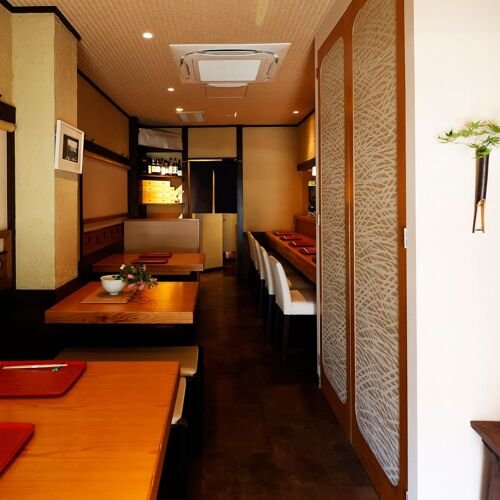
The room is run as a couple's operation , the chef in the kitchen, his wife front-of-house , and the atmosphere reflects that. Expect a quieter, more intimate energy than Tokyo's larger kaiseki institutions. The ambient feel leans calm and considered: conversation carries, the pace is unhurried, and the welcome from the proprietress gives the room a warmth that larger restaurants struggle to replicate. For food and travel enthusiasts who find the formality of a three-Michelin-star room oppressive, Ebihara offers genuine depth without the ceremony.
Chakaiseki lineage matters when thinking about the drinks question. Tea ceremony cuisine was designed around the rhythm and restraint of the tea service itself , flavours are built in subtle layers, and the seasoning philosophy actively avoids anything that overwhelms. That makes this kitchen unusually receptive to delicate pairing: light-bodied sake, aged junmai, or a restrained white wine will work far better here than a bold red or a heavily oaked expression. If you are planning a sake pairing , or asking the proprietress for a recommendation , lean toward junmai or junmai ginjo styles. The subtlety of the cooking is the frame; what you drink should fit inside it, not compete with it. Visitors interested in how Japanese regional producers approach food-friendly sake would find this kitchen a useful reference point, much as Ginza Fukuju provides a different but equally instructive lens on the pairing question.
Michelin Plate , awarded consecutively in 2024 and 2025 , signals cooking that inspires confidence without inflating expectations to starred-restaurant level. It is the right calibration for what Ebihara is: a focused, owner-operated room producing food that is genuinely accomplished. Comparable owner-chef washoku operations in Tokyo include Myojaku and Jingumae Higuchi, both of which share the same attentive, small-team character. If you are building a Tokyo itinerary around serious Japanese cooking at different price points, Ebihara slots naturally into a broader Tokyo restaurant programme alongside starred options like Azabu Kadowaki.
Address , Iwatocho, Shinjuku City , puts the restaurant in a quieter residential pocket of Shinjuku, away from the main drag. This is not a destination in a busy dining corridor; plan your evening around the meal itself rather than pre-dinner drinks nearby. For those combining a Tokyo trip with wider Japan travel, Ebihara's chakaiseki roots sit in interesting contrast to Kyoto-origin institutions like Isshisoden Nakamura or Gion Sasaki , seeing both cities' interpretations of the same tradition is genuinely instructive. You might also compare against Osaka's approach at Kashiwaya Osaka Senriyama.
Know Before You Go
- Cuisine: Washoku with chakaiseki roots
- Price range: ¥¥¥
- Awards: Michelin Plate 2024, Michelin Plate 2025
- Google rating: 4.8 (30 reviews)
- Booking difficulty: Easy
- Location: Iwatocho, Shinjuku City, Tokyo
- Format: Owner-operated couple's restaurant
- Drinks pairing: Favour delicate sake or light whites , the chakaiseki-influenced seasoning rewards restraint
- Nearest resources: Tokyo hotels | Tokyo bars | Tokyo experiences
How It Compares
See the full comparison below.
FAQ
- What should a first-timer know about Washoku Ebihara? Go in understanding the chakaiseki influence: this is restrained, seasonally precise cooking, not bold or theatrical. The room is quiet, the welcome is warm, and the pace is slow by design. At ¥¥¥ pricing it is one of the more accessible serious washoku options in Tokyo , easier to book and lighter on the wallet than Kagurazaka Ishikawa, with a 4.8 Google rating across 30 reviews backing the quality signal. Arrive hungry and plan to linger.
- What should I order at Washoku Ebihara? Specific dishes are not confirmed in available data, so follow the seasonal menu as presented. The kitchen's strength, per Michelin's own citation, is in garnishes, pickled vegetables, and layered seasoning , dishes built around those elements will show the chef's range most clearly. Ask the proprietress what is at peak season the week you visit; that is the right question in a chakaiseki-influenced room.
- Is the tasting menu worth it at Washoku Ebihara? At ¥¥¥ pricing, yes , provided you are aligned with the format. This is not a showpiece kaiseki at the level of Azabu Kadowaki, but it does not charge at that level either. The Michelin Plate (2024 and 2025) confirms consistent, credible cooking. For the price point and the intimacy of an owner-operated room, the value proposition is solid.
- Can I eat at the bar at Washoku Ebihara? Seating configuration is not confirmed in available data. Given the small-scale, couple-operated nature of the restaurant, counter seating is plausible but cannot be confirmed. Contact the venue directly to clarify before booking if this matters to your experience.
- Is Washoku Ebihara worth the price? At ¥¥¥, it sits below the ¥¥¥¥ tier occupied by RyuGin and the city's starred kaiseki rooms. For what you get , consecutive Michelin Plate recognition, chakaiseki-rooted cooking, a 4.8 Google score, and a genuinely personal dining environment , the price is well matched to the experience. It is not the cheapest meal in Shinjuku, but it is good value for its category.
- Can Washoku Ebihara accommodate groups? Capacity data is not confirmed. As a small, owner-operated restaurant, large groups are unlikely to be the format. For groups of more than four, contact the venue in advance , or consider whether a room with confirmed private dining capacity, such as those listed in our full Tokyo restaurants guide, would be a better fit.
Compare Washoku Ebihara
| Venue | Cuisine | Price | Awards | Booking Difficulty | Value |
|---|---|---|---|---|---|
| Washoku Ebihara | Japanese | ¥¥¥ | The shopfront lettering sums up this couple’s approach: ‘Enjoy the season’. The proof is in the earnest cooking of the owner-chef and the cheerful disposition of the welcoming proprietress, his wife. Taking a page from his experience as a caterer of chakaiseki (tea ceremony cuisine with its roots in Kyoto), seasonings are both delicious and nutritious. Garnishes and pickled vegetables are inventive, teaching us that true flavour is found in the subtler notes.; Michelin Plate (2025); Michelin Plate (2024) | Easy | — |
| Harutaka | Sushi | ¥¥¥¥ | Michelin 3 Star, World's 50 Best | Unknown | — |
| RyuGin | Kaiseki, Japanese | ¥¥¥¥ | Michelin 3 Star, World's 50 Best | Unknown | — |
| L'Effervescence | French | ¥¥¥¥ | Michelin 3 Star, World's 50 Best | Unknown | — |
| HOMMAGE | Innovtive French, French | ¥¥¥¥ | Michelin 2 Star, World's 50 Best | Unknown | — |
| Florilège | French | ¥¥¥ | Michelin 2 Star, World's 50 Best | Unknown | — |
Side-by-side comparison to help you decide where to book.
Frequently Asked Questions
What should a first-timer know about Washoku Ebihara?
This is a small, owner-operated room in Shinjuku's Iwatocho neighbourhood, run by the chef and his wife. The format is rooted in chakaiseki — tea ceremony cuisine with Kyoto origins — so expect restrained, seasonal cooking rather than a showpiece omakase. Michelin Plate recognition in both 2024 and 2025 signals consistent execution. Come with patience for quiet, deliberate hospitality rather than a high-energy dining room.
What should I order at Washoku Ebihara?
Specific dishes are not documented, so ordering à la carte is difficult to advise on from the outside. The kitchen's identity is built around seasonal produce, inventive pickled vegetables, and garnishes that carry real flavour — so follow the chef's selection rather than trying to direct it. At ¥¥¥, a set course is almost certainly the right format here.
Is the tasting menu worth it at Washoku Ebihara?
At ¥¥¥ pricing, Washoku Ebihara sits well below the ¥¥¥¥ kaiseki tier — venues like RyuGin charge significantly more for a comparable seasonal philosophy. Two consecutive Michelin Plate awards confirm the kitchen delivers on its promise. If chakaiseki-influenced, seasonally led cooking is what you are after, the price-to-quality ratio here is hard to argue with.
Can I eat at the bar at Washoku Ebihara?
Seating configuration is not documented in available venue data. Given the small, owner-operated scale of the restaurant, counter seating is plausible — but confirm directly before booking with that expectation.
Is Washoku Ebihara worth the price?
Yes, for what it offers. At ¥¥¥, you are getting Michelin Plate-recognised cooking with a clear, coherent philosophy — seasonally driven, nutritionally considered, and rooted in chakaiseki tradition. For the same spend, alternatives like HOMMAGE or Florilège offer French-influenced tasting menus; Washoku Ebihara is the call if you specifically want traditional Japanese cooking without paying kaiseki-tier prices.
Can Washoku Ebihara accommodate groups?
This is a small owner-operated venue, which typically limits group capacity. Parties larger than four should check the venue's official channels before assuming availability — private dining options are not confirmed in the venue record. For larger groups, a venue with a documented private room would be a safer choice.
Recognized By

More restaurants in Tokyo
- SézanneOccupying the seventh floor of the Four Seasons Hotel Tokyo at Marunouchi, Sézanne earned its first Michelin star within months of opening in July 2021 and now holds three. British chef Daniel Calvert applies French technique to Japanese ingredients, producing a prix-fixe format that Tabelog has recognised with Silver awards every year from 2023 through 2026. It ranked 4th in Asia's 50 Best Restaurants in 2025 and 15th globally in 2024.
- SazenkaSazenka is the address for Chinese cuisine in Tokyo at its most technically demanding. Chef Tomoya Kawada's wakon-kansai approach — Japanese seasonal ingredients applied through Chinese culinary technique — has earned consecutive Tabelog Gold Awards from 2019 to 2026, a #71 ranking on the World's 50 Best 2025, and 99 points from La Liste 2026. At JPY 50,000–59,999 per head, it is one of the hardest tables in the city to book and worth the effort.
- NarisawaNarisawa is Tokyo's most credentialled innovative tasting menu restaurant — two Michelin stars, Asia's 50 Best number 12, and a Tabelog Silver award — running at JPY 80,000–99,999 per head. Book for a milestone occasion, confirm vegetarian or vegan needs in advance, and reserve at least two to three months out. With 15 seats and reservation-only access, this is one of Tokyo's hardest tables to secure.
- FlorilègeFlorilège delivers two Michelin stars and an Asia's 50 Best #17 ranking at a dinner price of ¥22,000 — competitive for Tokyo at this level. Chef Hiroyasu Kawate's plant-forward tasting menus around an open-kitchen counter at Azabudai Hills make this the strongest choice for contemporary French dining in Tokyo if theatrical, produce-led cooking is what you want. Book well in advance; availability is near-impossible at short notice.
- DenDen holds two Michelin stars, a World's 50 Best top-25 Asia ranking, and a Tabelog Silver Award running back to 2017 — and it books out within hours of the two-month reservation window opening. Chef Zaiyu Hasegawa's daily-changing seasonal omakase runs JPY 30,000–39,999 at dinner in a relaxed house-restaurant setting near Gaiemmae. Book by phone only, noon–5 PM JST. Lunch is irregular; plan around dinner.
- MyojakuMyojaku is a 2-Michelin-star, 14-course French-leaning omakase in Nishiazabu holding a 4.47 Tabelog score, Tabelog Silver 2025–2026, and Asia's 50 Best #45 (2025). Chef Hidetoshi Nakamura's water-forward, no-dashi approach shifts meaningfully with the seasons — making timing your reservation as important as getting one. Budget JPY 50,000–59,999 per head plus 10% service charge; reservations only, near-impossible to secure.
Similar venues by awards
Related editorial
- Best Fine Dining Restaurants in ParisFrom three-Michelin-star icons to the next generation of Parisian chefs pushing boundaries, these are the restaurants that define fine dining in the world's culinary capital.
- Best Luxury Hotels in RomeFrom rooftop terraces overlooking ancient ruins to Michelin-starred hotel dining, these are the luxury hotels that make Rome unforgettable.
- Best Cocktail Bars in KyotoFrom sleek lounges to hidden speakeasies, Kyoto's cocktail scene blends Japanese precision with global influence in ways you won't find anywhere else.
Save or rate Washoku Ebihara on Pearl
Keep this venue in your Pearl passport, rate it after you visit, and track it alongside every other place you collect.