
Restaurant in Tokyo, Japan
Shigeyuki
450ptsCreative counter dining with real personality.

About Shigeyuki
Shigeyuki holds a Michelin star in Shibuya's Nishihara at the ¥¥¥ price tier, making it one of Tokyo's more accessible creative Japanese counters. The chef's signature heated sashimi and tailored dashi approach set it apart from conventional omakase formats. Book well in advance — the small counter and loyal regular clientele make this a hard reservation. Best for food-focused diners who want personality alongside precision.
Pearl Verdict
Shigeyuki earns its Michelin star on personality as much as precision. This is a one-star counter in Shibuya's Nishihara neighbourhood where the chef's freewheeling approach produces Japanese cooking that reads as genuinely personal rather than formally rehearsed. The price tier sits at ¥¥¥, making it meaningfully cheaper than the ¥¥¥¥ kaiseki establishments that dominate Tokyo's fine-dining conversation. If you want a creative Japanese counter with warmth, craft, and a room that feels nothing like a hotel restaurant, book Shigeyuki. If you need the full kaiseki ceremony or a globally recognised name to anchor a special trip, look elsewhere.
The Room and First Impression
The interior signals the register immediately: folk-art décor, a chest of drawers inherited from the chef's grandparents, and an atmosphere that trades on accumulated memory rather than designed coolness. Visually, it reads closer to a curated family home than a starred restaurant. That is a deliberate choice, and it shapes the entire experience. Diners who arrive expecting minimalist Japanese refinement may need a moment to recalibrate. Diners who read that shift correctly will find it disarming in the leading way. The room is small, which means booking is competitive and the evening is built around conversation with the counter rather than around you.
What the Chef Is Actually Doing
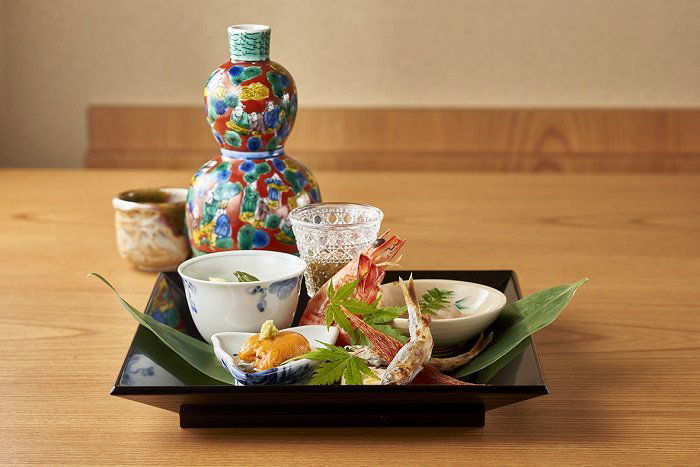
The cooking has a recognisable signature: decoratively arranged sashimi are briefly heated to draw out moisture, a technique that sits outside conventional sashimi service and signals that the menu is not running on tradition alone. The chef tailors dashi stock to individual dishes rather than serving soup courses, which reflects a level of compositional thinking that goes beyond a standard omakase structure. Michelin's own note on the venue lands on the phrase "the look surprises, the taste reassures" — which is a useful frame for what to expect. Visually creative plating that resolves into familiar, grounded flavour rather than conceptual abstraction.
Multi-Visit Strategy
Shigeyuki rewards repeat visits more than most counters at this price tier, precisely because the chef's freewheeling personality means the menu is not fixed. A first visit should be treated as orientation: read the room, let the chef lead, and pay attention to which techniques appear. The heated sashimi and the dashi approach are likely constants, but the specific expressions of those ideas will shift. A second visit is where you can begin to signal preferences and engage more directly with the chef's process. By a third visit, regulars reportedly settle into a genuine back-and-forth that changes what arrives at the counter. That progression is the point. This is not a venue where you arrive, execute the tasting menu, and leave with a complete picture. The full experience is cumulative.
Timing and Booking
Book as far ahead as you can manage. The combination of a small room, a Michelin star, and a chef with a following in Tokyo's food community means availability is genuinely limited. Weekday evenings are your leading opening — weekend seatings fill faster and the counter dynamic shifts when every seat is occupied by someone on a special occasion. If you are visiting Tokyo from outside Japan, build the booking before you finalise travel dates rather than after. The 4.7 Google rating across 24 reviews is a small sample but suggests a high conversion rate from visit to strong endorsement, which points to a loyal repeat-visitor base rather than a tourist pipeline. That matters for availability: regulars with standing reservations compress the open calendar considerably.
How to Position This Against Tokyo's Wider Scene
Tokyo's starred Japanese dining at ¥¥¥¥ tends toward either the precision ceremony of sushi counters like Harutaka or the structured ritual of kaiseki. Shigeyuki sits in a different register at ¥¥¥ , less formal, more personal, and built around a chef who actively enjoys the room rather than one who performs controlled distance. For explorers working through Tokyo's creative Japanese scene, it belongs on the same itinerary as Jingumae Higuchi and Myojaku, both of which bring their own distinct approaches to Japanese counter dining. Further afield, Gion Sasaki in Kyoto and HAJIME in Osaka represent the formal end of the spectrum for comparison. Shigeyuki is the looser, warmer counterpoint to all of them.
For broader context on Tokyo dining options at various price points and styles, see our full Tokyo restaurants guide. If you are planning a longer stay and want to pair dinner reservations with accommodation research, our full Tokyo hotels guide covers that ground. Bars and evening options are covered in our full Tokyo bars guide.
Other notable Japanese counter experiences worth knowing before you commit your Tokyo dining budget: Azabu Kadowaki, Kagurazaka Ishikawa, and Ginza Fukuju each represent distinct takes on the starred Japanese dining category. If your Japan trip extends beyond Tokyo, akordu in Nara, Goh in Fukuoka, 1000 in Yokohama, 6 in Okinawa, Isshisoden Nakamura in Kyoto, and Kashiwaya Osaka Senriyama are each worth including in a wider itinerary. For activities and cultural context around your dining, our full Tokyo experiences guide and our full Tokyo wineries guide round out the planning picture.
Quick reference: Michelin 1 Star (2024) | ¥¥¥ | Shibuya, Nishihara | Google 4.7/5 | Booking difficulty: Hard | Reserve well in advance, weekday evenings preferred.
Compare Shigeyuki
| Venue | Cuisine | Price | Booking Difficulty |
|---|---|---|---|
| Shigeyuki | Japanese | ¥¥¥ | Hard |
| Harutaka | Sushi | ¥¥¥¥ | Unknown |
| RyuGin | Kaiseki, Japanese | ¥¥¥¥ | Unknown |
| L'Effervescence | French | ¥¥¥¥ | Unknown |
| HOMMAGE | Innovtive French, French | ¥¥¥¥ | Unknown |
| Florilège | French | ¥¥¥ | Unknown |
Side-by-side comparison to help you decide where to book.
Frequently Asked Questions
What should I order at Shigeyuki?
The menu is set by the chef on the night, so you are not choosing dishes in the conventional sense. The signature move to watch for is the briefly heated decoratively arranged sashimi, a technique the chef uses to draw out moisture rather than serve fish cold in the standard way. The chef also tailors dashi stock to individual dishes rather than relying on soup courses, so the seasoning logic runs through the whole meal. Come without a fixed agenda and let the format work.
What are alternatives to Shigeyuki in Tokyo?
For more structured ceremony at a higher price point, Harutaka is the sushi counter benchmark and RyuGin covers the kaiseki end of the spectrum with serious technical ambition. If you want French-influenced creativity at a comparable ¥¥¥ tier, Florilège and L'Effervescence both deliver strong cooking with a defined point of view, while HOMMAGE sits in a similar register for intimate counter dining. Shigeyuki is the right call if personality and a looser, more improvisational evening matter to you as much as the food itself.
How far ahead should I book Shigeyuki?
Book as far ahead as possible. A Michelin star earned in 2024, a small room in Nishihara, and a chef with a following in Tokyo's food community means availability moves quickly. Treat this like any one-star counter in Tokyo: assume you need weeks, not days, and that last-minute availability will be rare.
Is Shigeyuki good for a special occasion?
Yes, but the fit depends on what kind of occasion. The folk-art interior, family furniture, and the chef's freewheeling personality make this warm and lively rather than hushed and ceremonial. If the occasion calls for a formal, white-tablecloth register, look at RyuGin or a kaiseki house instead. If you want a Michelin-starred dinner that feels personal and genuinely fun, Shigeyuki works well.
Is Shigeyuki worth the price?
At ¥¥¥ with a 2024 Michelin star, Shigeyuki sits at a price point where the competition in Tokyo is fierce. The value case is strongest if you engage with the format: a creative chef who does not repeat himself, a cooking style with a clear signature in the heated sashimi technique, and an atmosphere that is harder to find at this tier than technical precision alone. If you are paying ¥¥¥ for a more conventional or ceremonial experience, spend the money at Harutaka instead.
Recognized By

More restaurants in Tokyo
- SézanneOccupying the seventh floor of the Four Seasons Hotel Tokyo at Marunouchi, Sézanne earned its first Michelin star within months of opening in July 2021 and now holds three. British chef Daniel Calvert applies French technique to Japanese ingredients, producing a prix-fixe format that Tabelog has recognised with Silver awards every year from 2023 through 2026. It ranked 4th in Asia's 50 Best Restaurants in 2025 and 15th globally in 2024.
- SazenkaSazenka is the address for Chinese cuisine in Tokyo at its most technically demanding. Chef Tomoya Kawada's wakon-kansai approach — Japanese seasonal ingredients applied through Chinese culinary technique — has earned consecutive Tabelog Gold Awards from 2019 to 2026, a #71 ranking on the World's 50 Best 2025, and 99 points from La Liste 2026. At JPY 50,000–59,999 per head, it is one of the hardest tables in the city to book and worth the effort.
- NarisawaNarisawa is Tokyo's most credentialled innovative tasting menu restaurant — two Michelin stars, Asia's 50 Best number 12, and a Tabelog Silver award — running at JPY 80,000–99,999 per head. Book for a milestone occasion, confirm vegetarian or vegan needs in advance, and reserve at least two to three months out. With 15 seats and reservation-only access, this is one of Tokyo's hardest tables to secure.
- FlorilègeFlorilège delivers two Michelin stars and an Asia's 50 Best #17 ranking at a dinner price of ¥22,000 — competitive for Tokyo at this level. Chef Hiroyasu Kawate's plant-forward tasting menus around an open-kitchen counter at Azabudai Hills make this the strongest choice for contemporary French dining in Tokyo if theatrical, produce-led cooking is what you want. Book well in advance; availability is near-impossible at short notice.
- DenDen holds two Michelin stars, a World's 50 Best top-25 Asia ranking, and a Tabelog Silver Award running back to 2017 — and it books out within hours of the two-month reservation window opening. Chef Zaiyu Hasegawa's daily-changing seasonal omakase runs JPY 30,000–39,999 at dinner in a relaxed house-restaurant setting near Gaiemmae. Book by phone only, noon–5 PM JST. Lunch is irregular; plan around dinner.
- MyojakuMyojaku is a 2-Michelin-star, 14-course French-leaning omakase in Nishiazabu holding a 4.47 Tabelog score, Tabelog Silver 2025–2026, and Asia's 50 Best #45 (2025). Chef Hidetoshi Nakamura's water-forward, no-dashi approach shifts meaningfully with the seasons — making timing your reservation as important as getting one. Budget JPY 50,000–59,999 per head plus 10% service charge; reservations only, near-impossible to secure.
Related editorial
- Best Fine Dining Restaurants in ParisFrom three-Michelin-star icons to the next generation of Parisian chefs pushing boundaries, these are the restaurants that define fine dining in the world's culinary capital.
- Best Luxury Hotels in RomeFrom rooftop terraces overlooking ancient ruins to Michelin-starred hotel dining, these are the luxury hotels that make Rome unforgettable.
- Best Cocktail Bars in KyotoFrom sleek lounges to hidden speakeasies, Kyoto's cocktail scene blends Japanese precision with global influence in ways you won't find anywhere else.
Save or rate Shigeyuki on Pearl
Keep this venue in your Pearl passport, rate it after you visit, and track it alongside every other place you collect.