
Restaurant in Tokyo, Japan
RAMEN MATSUI
250ptsMichelin-recognised ramen without the difficulty.

About RAMEN MATSUI
Ramen Matsui is a husband-and-wife ramen counter in Yotsuya, Shinjuku City, holding a 2024 Michelin Bib Gourmand for its soy sauce and sardine-based broth built on Hokkaido ingredients. At ¥ pricing with easy booking and a Google rating of 4.3 across 410 reviews, it is the most practical high-quality ramen decision in the area. Go for lunch; no reservation stress required.
Verdict: A Michelin Bib Gourmand bowl that's easy to get into and worth every yen
Getting a seat at Ramen Matsui is not a test of patience or luck. Booking is easy by Tokyo ramen standards, and that accessibility makes it one of the more practical decisions you can make when eating well on a ¥ budget in Shinjuku. The harder question is whether the bowl justifies a deliberate trip rather than a walk-in impulse. It does — and the 2024 Michelin Bib Gourmand recognition is the clearest public signal that the kitchen consistently delivers quality beyond what the price tier would suggest.
The Kitchen
Ramen Matsui is a husband-and-wife operation in Yotsuya, Shinjuku City. Chef Takuro Yanase handles the noodles; his wife finishes each bowl with spring onion and fermented bamboo shoots. The division of labour is deliberate and visible, and it gives the kitchen a clarity of roles that shows in the bowl. The flavour foundation is soy sauce, salt, and dried sardines — a combination that places this firmly in the Tokyo-style ramen tradition rather than the richer tonkotsu territory of western Japan. Pure rice sake is added to chicken or seafood dashi stock to amplify aroma, and several types of fragrant oil are layered in to build depth. Kombu kelp, scallops, and wheat flour sourced from Hokkaido run through the recipe, reflecting Yanase's connection to that region. The result is a broth that reads as clean and precise rather than heavy, which matters if you are planning a longer eating day across Tokyo.
Atmosphere and Experience
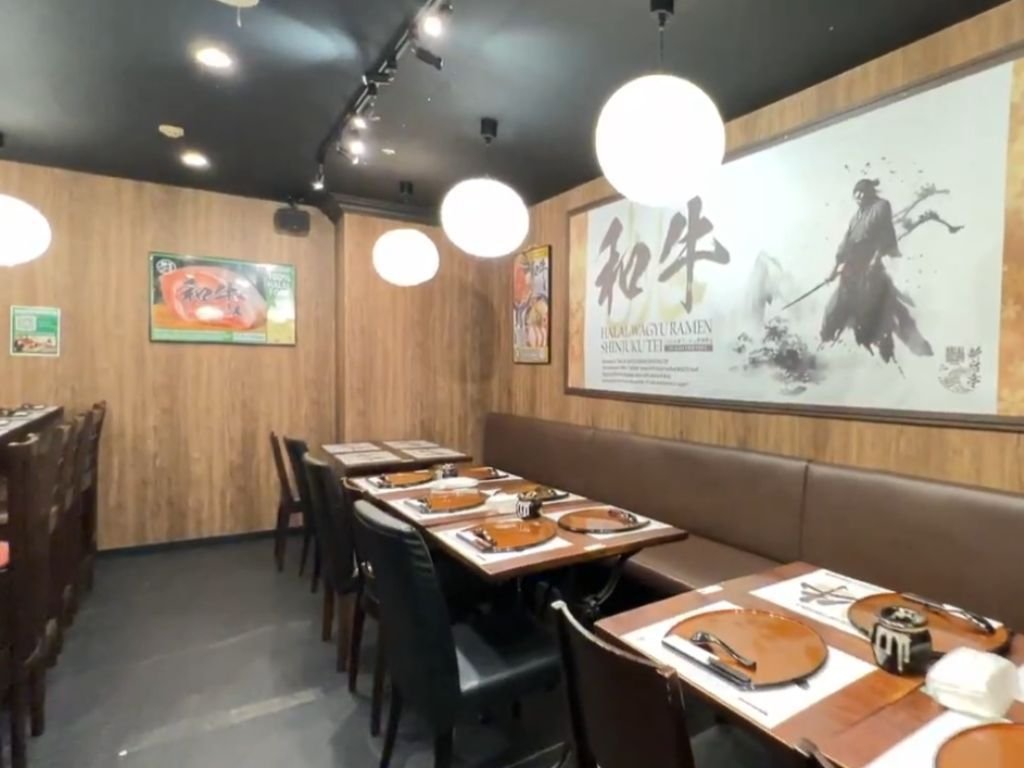
Yotsuya is a quieter residential-commercial pocket of Shinjuku, removed from the noise of Kabukicho and the density of the main station area. The setting shapes the mood at Matsui: this is not a venue where the room competes with the food for your attention. The atmosphere at a small ramen-ya like this one tends toward focused and unhurried rather than social and loud , which makes it a functional choice for a date or a solo meal, but a less obvious pick for a group celebration where ambient energy matters. If you are planning a special occasion dinner and want a room with presence, this is the bowl you eat at lunch before the main event, not the main event itself. For a solo traveller, a couple eating early, or anyone who treats ramen as a serious meal rather than a quick stop, the experience is well-suited.
Service Philosophy and Value
The Bib Gourmand designation is specifically awarded to venues offering good cooking at a price that does not require justification , and that framing fits Ramen Matsui precisely. At ¥ pricing, there is no premium service expectation to meet. What matters is whether the kitchen is consistent, the bowl is technically sound, and the experience does not feel careless. Based on a Google rating of 4.3 across 410 reviews, the consistency holds. That score, across a meaningful sample, suggests a kitchen that performs reliably rather than one that peaks on good days and drops on bad ones. The service model at a counter ramen operation is transactional by design: you order, the bowl arrives quickly, you eat and leave. That is not a criticism , it is the format. What Matsui earns through its Michelin recognition is the argument that the craft inside that transactional format is genuine. The husband-and-wife structure means there is no brigade distance between the person cooking and the person finishing your bowl, which tends to produce attentive output even in a simple setting.
How It Compares
Ramen Matsui sits in a different spending category from the rest of the Pearl Tokyo portfolio. [Harutaka](https://www.joinpearl.co/restaurants/harutaka), [RyuGin](https://www.joinpearl.co/restaurants/ryugin), [L'Effervescence](https://www.joinpearl.co/restaurants/leffervescence), [HOMMAGE](https://www.joinpearl.co/restaurants/hommage), and [Crony](https://www.joinpearl.co/restaurants/crony) all operate at ¥¥¥¥ , multiple price tiers above a ramen counter. The comparison is less about which is better and more about what you are building your day around. If you are spending a week in Tokyo eating across formats, Matsui earns its place as the high-value, low-spend anchor in the rotation. Within the ramen category specifically, [Afuri](https://www.joinpearl.co/restaurants/afuri-tokyo-restaurant) offers a lighter yuzu shio style and broader accessibility across multiple locations; [Fuunji](https://www.joinpearl.co/restaurants/fuunji-tokyo-restaurant) is a strong tsukemen option in nearby Shinjuku; and [Chukasoba Ginza Hachigou](https://www.joinpearl.co/restaurants/chukasoba-ginza-hachigou-tokyo-restaurant) and [Chukasoba KOTETSU](https://www.joinpearl.co/restaurants/chukasoba-kotetsu-tokyo-restaurant) compete in the same Michelin-recognised Tokyo-style ramen space. For diners comparing across Japanese regions, [HAJIME in Osaka](https://www.joinpearl.co/restaurants/hajime-osaka-restaurant), [Gion Sasaki in Kyoto](https://www.joinpearl.co/restaurants/gion-sasaki-kyoto-restaurant), and [Goh in Fukuoka](https://www.joinpearl.co/restaurants/goh-fukuoka-restaurant) represent the fine-dining tier of Japanese cooking if your trip extends beyond Tokyo. Outside Japan, [Akahoshi Ramen in Chicago](https://www.joinpearl.co/restaurants/akahoshi-ramen-chicago-restaurant) and [Afuri Ramen in Portland](https://www.joinpearl.co/restaurants/afuri-ramen-portland-restaurant) offer reference points for how Tokyo-style ramen translates internationally , useful context if you want to understand what makes a bowl like Matsui's worth travelling to Yotsuya for specifically.
Practical Details
Ramen Matsui is located at 4 Chome-25-10 Daiapalace Gyo-enmae B-2, Yotsuya, Shinjuku City, Tokyo. The ¥ price range means a meal here will not strain any travel budget. Booking is easy , this is not a venue requiring weeks of advance planning or complex reservation systems. Hours and booking method are not publicly listed in our data; confirm directly before visiting. Phone and website details are not available in our current records. For solo diners or couples, the counter format is standard for ramen-ya of this size. The Yotsuya address puts it within Shinjuku City, accessible from Yotsuya Station on the JR Chuo and Sobu Lines. Dress code is casual , there is no expectation otherwise at a counter ramen operation.
For more Tokyo dining options across formats and price points, see our full Tokyo restaurants guide. For where to stay, our full Tokyo hotels guide covers the city's key neighbourhoods. If you are building a broader Japan itinerary, akordu in Nara, 1000 in Yokohama, and 6 in Okinawa are worth adding to the list. Tokyo's bar and experience scene is covered in our full Tokyo bars guide and our full Tokyo experiences guide. Wine travellers can find relevant listings at our full Tokyo wineries guide. For a similar neighbourhood-scale ramen experience, Chuogo Hanten Mita is worth a look.
Quick reference: Ramen Matsui , ¥ pricing, Michelin Bib Gourmand 2024, easy booking, Yotsuya, Shinjuku City, Tokyo.
FAQs
- Can I eat at the bar at Ramen Matsui? Counter seating is the standard format at a ramen-ya of this type. Seat configuration details are not confirmed in our current data, but walk-in counter dining is typical for venues like this in Tokyo. Check directly before visiting if you need to confirm seating arrangements.
- What should a first-timer know about Ramen Matsui? Go knowing this is a soy sauce and sardine-based broth , clean and aromatic, not rich or heavy. The Michelin Bib Gourmand recognition tells you the kitchen punches above its ¥ price point. It is in Yotsuya, a quieter part of Shinjuku City, so factor in travel time from central areas. Booking is easy, and the format is fast: order, eat, leave. That is a feature, not a flaw.
- Does Ramen Matsui handle dietary restrictions? The broth relies on chicken or seafood dashi stock, dried sardines, and multiple types of fragrant oil. This is not a venue with obvious flexibility for vegetarian, vegan, or allergen-sensitive diets based on the ingredient structure described. Phone and website details are not available in our records, so contact the venue directly to confirm before visiting.
- What are alternatives to Ramen Matsui in Tokyo? Within the same ¥ price bracket and Michelin-recognised ramen category: Chukasoba Ginza Hachigou and Chukasoba KOTETSU are direct competitors in Tokyo-style ramen. Afuri is a lighter yuzu shio option with easier multi-location access. Fuunji in Shinjuku is the strongest tsukemen alternative in the same neighbourhood area.
- Is the tasting menu worth it at Ramen Matsui? Ramen Matsui does not operate a tasting menu format. This is a ramen counter: you order a bowl, and the value question is whether that bowl justifies a deliberate visit. At ¥ pricing with a 2024 Michelin Bib Gourmand, the answer is yes for anyone eating in Tokyo across multiple formats and price points.
- Is Ramen Matsui worth the price? Yes, clearly. Michelin Bib Gourmand is awarded specifically for good food at a price that does not need justifying , and at ¥, Matsui requires no budget calculation at all. The 4.3 Google rating across 410 reviews confirms the kitchen is consistent. The only honest caveat: if you are visiting Tokyo primarily for high-end dining, this is a complementary meal, not a destination in itself. As a deliberate lunch or early dinner in Yotsuya, it delivers well above what the price point would suggest.
Compare RAMEN MATSUI
| Venue | Price | Booking Difficulty | Value |
|---|---|---|---|
| RAMEN MATSUI | ¥ | Easy | — |
| Harutaka | ¥¥¥¥ | Unknown | — |
| L'Effervescence | ¥¥¥¥ | Unknown | — |
| RyuGin | ¥¥¥¥ | Unknown | — |
| HOMMAGE | ¥¥¥¥ | Unknown | — |
| Crony | ¥¥¥¥ | Unknown | — |
A quick look at how RAMEN MATSUI measures up.
Frequently Asked Questions
Can I eat at the bar at RAMEN MATSUI?
Counter seating is typical for a Tokyo ramen operation of this scale, but the exact seating layout is not documented in available venue data. Given the husband-and-wife format and the basement location at Daiapalace Gyo-enmae B-2 in Yotsuya, the room is almost certainly small. Arrive early or check directly with the venue to confirm counter availability.
What should a first-timer know about RAMEN MATSUI?
The bowl is built around soy sauce, salt, and dried sardines, with chicken or seafood dashi stock finished with pure rice sake for aroma and several fragrant oils for depth — so expect a clean, layered broth rather than a heavy tonkotsu style. Chef Takuro Yanase handles the noodles; his wife finishes each bowl with spring onion and fermented bamboo shoots. The Michelin Bib Gourmand (2024) signals serious cooking at a price that won't require justification. This is a ¥-range meal, not a splurge.
Does RAMEN MATSUI handle dietary restrictions?
The menu is built on a dashi foundation using chicken, seafood, and dried sardines, which means the broth is not vegetarian or pescatarian-friendly by default. Specific allergy or dietary accommodation details are not documented. Given the small, two-person operation, flexibility is likely limited — check the venue's official channels before visiting if restrictions are a concern.
What are alternatives to RAMEN MATSUI in Tokyo?
If you want to stay in the Bib Gourmand tier and keep costs at ¥, Ramen Matsui is a strong anchor point in the Pearl Tokyo portfolio. For a significant step up in spend and format, RyuGin and Harutaka operate in a completely different category: multi-course, high-commitment, and priced accordingly. HOMMAGE and L'Effervescence are French-leaning fine dining options. Crony is the closest in terms of neighbourhood accessibility and value orientation, though the cuisine formats differ.
Is the tasting menu worth it at RAMEN MATSUI?
Ramen Matsui does not operate a tasting menu format. This is a ramen counter: you come for the bowl, built around soy, salt, dried sardines, and Hokkaido ingredients. If a multi-course progression is what you want, Harutaka or L'Effervescence in the Pearl Tokyo portfolio serve that purpose. Matsui is the right choice when the goal is a single, precisely executed bowl at a ¥ price point.
Is RAMEN MATSUI worth the price?
Yes, without much qualification. The Michelin Bib Gourmand is awarded specifically for good cooking at a price that doesn't need defending, and Ramen Matsui earned it in 2024. At ¥ pricing, the sardine-and-soy broth finished with rice sake and fragrant oils represents one of the higher-credential bowls you can get in Tokyo at that spend level. The main trade-off is format: this is a single bowl, not a meal you'll linger over.
Recognized By

More restaurants in Tokyo
- SézanneOccupying the seventh floor of the Four Seasons Hotel Tokyo at Marunouchi, Sézanne earned its first Michelin star within months of opening in July 2021 and now holds three. British chef Daniel Calvert applies French technique to Japanese ingredients, producing a prix-fixe format that Tabelog has recognised with Silver awards every year from 2023 through 2026. It ranked 4th in Asia's 50 Best Restaurants in 2025 and 15th globally in 2024.
- SazenkaSazenka is the address for Chinese cuisine in Tokyo at its most technically demanding. Chef Tomoya Kawada's wakon-kansai approach — Japanese seasonal ingredients applied through Chinese culinary technique — has earned consecutive Tabelog Gold Awards from 2019 to 2026, a #71 ranking on the World's 50 Best 2025, and 99 points from La Liste 2026. At JPY 50,000–59,999 per head, it is one of the hardest tables in the city to book and worth the effort.
- NarisawaNarisawa is Tokyo's most credentialled innovative tasting menu restaurant — two Michelin stars, Asia's 50 Best number 12, and a Tabelog Silver award — running at JPY 80,000–99,999 per head. Book for a milestone occasion, confirm vegetarian or vegan needs in advance, and reserve at least two to three months out. With 15 seats and reservation-only access, this is one of Tokyo's hardest tables to secure.
- FlorilègeFlorilège delivers two Michelin stars and an Asia's 50 Best #17 ranking at a dinner price of ¥22,000 — competitive for Tokyo at this level. Chef Hiroyasu Kawate's plant-forward tasting menus around an open-kitchen counter at Azabudai Hills make this the strongest choice for contemporary French dining in Tokyo if theatrical, produce-led cooking is what you want. Book well in advance; availability is near-impossible at short notice.
- DenDen holds two Michelin stars, a World's 50 Best top-25 Asia ranking, and a Tabelog Silver Award running back to 2017 — and it books out within hours of the two-month reservation window opening. Chef Zaiyu Hasegawa's daily-changing seasonal omakase runs JPY 30,000–39,999 at dinner in a relaxed house-restaurant setting near Gaiemmae. Book by phone only, noon–5 PM JST. Lunch is irregular; plan around dinner.
- MyojakuMyojaku is a 2-Michelin-star, 14-course French-leaning omakase in Nishiazabu holding a 4.47 Tabelog score, Tabelog Silver 2025–2026, and Asia's 50 Best #45 (2025). Chef Hidetoshi Nakamura's water-forward, no-dashi approach shifts meaningfully with the seasons — making timing your reservation as important as getting one. Budget JPY 50,000–59,999 per head plus 10% service charge; reservations only, near-impossible to secure.
Related editorial
- Best Fine Dining Restaurants in ParisFrom three-Michelin-star icons to the next generation of Parisian chefs pushing boundaries, these are the restaurants that define fine dining in the world's culinary capital.
- Best Luxury Hotels in RomeFrom rooftop terraces overlooking ancient ruins to Michelin-starred hotel dining, these are the luxury hotels that make Rome unforgettable.
- Best Cocktail Bars in KyotoFrom sleek lounges to hidden speakeasies, Kyoto's cocktail scene blends Japanese precision with global influence in ways you won't find anywhere else.
Save or rate RAMEN MATSUI on Pearl
Keep this venue in your Pearl passport, rate it after you visit, and track it alongside every other place you collect.