
Restaurant in Tokyo, Japan
Hei Fung Terrace
565ptsSerious Cantonese dim sum, Imperial Palace views.



About Hei Fung Terrace
A Hong Kong-lineage Cantonese kitchen in Yurakucho with views over the Imperial Palace garden. Michelin Plate recognition in 2024 and 2025, a dedicated dim sum specialist, and iron-pot roasted meats make this the most considered Cantonese option in Tokyo at ¥¥¥. Booking is easy, the customisable cooking-style format suits groups and returning diners, and the garden-view tables are worth requesting.
Verdict
Hei Fung Terrace is not a Japanese restaurant that happens to serve dim sum on the side. It is a dedicated Cantonese kitchen operating inside Yurakucho, with a garden-facing setting that gives it a character most Chinese restaurants in Tokyo cannot match. If you have been once and came primarily for the xiaolongbao or the gyoza, go back and focus on the iron-pot roasted meats and the made-to-order stir-fries — that is where the kitchen's identity is clearest. Booking is easy by Tokyo fine-dining standards, the price sits at ¥¥¥ rather than the ¥¥¥¥ of most serious competition, and the Michelin Plate recognition in both 2024 and 2025 signals consistent kitchen quality without the full-star hype. For Cantonese food specifically in Tokyo, this is the most considered option you will find.
What You Are Actually Booking
The most common misconception about Hei Fung Terrace is that it functions as a hotel Chinese restaurant in the generic, safe-for-all-palates sense. It does not. The kitchen has a clear Hong Kong lineage, and the menu reflects Cantonese sourcing logic: the quality of a dish here depends on the quality and provenance of the core ingredient, not on elaborate saucing or kitchen theatrics. That philosophy is most visible at the table when you choose your own seasoning and cooking method. Oyster sauce stir-fries and XO-sauce preparations sit alongside black bean options, and the kitchen's ability to execute each cleanly is a direct test of ingredient quality. If the base ingredient is weak, those preparations expose it immediately.
The dim sum programme is specialist-led. A dedicated xiaolongbao and gyoza maker handles the dumpling work separately from the main kitchen — a division of labour that matters because the texture and skin thickness of hand-folded dim sum degrades fast when it comes off a general production line. That structural detail is worth knowing before you order: this is not the place to rush through dim sum as a starter. Give it the time it deserves and order enough to make the craft visible.
Iron-pot chicken and pork from the grill master represent the other anchor of the menu. Baked in iron pots rather than on an open grill, the cooking method retains moisture differently and produces a result that is harder to replicate outside of a kitchen set up specifically for it. If you visited before and stayed primarily in the dim sum section of the menu, the iron-pot dishes are the obvious next step.
Setting and Atmosphere
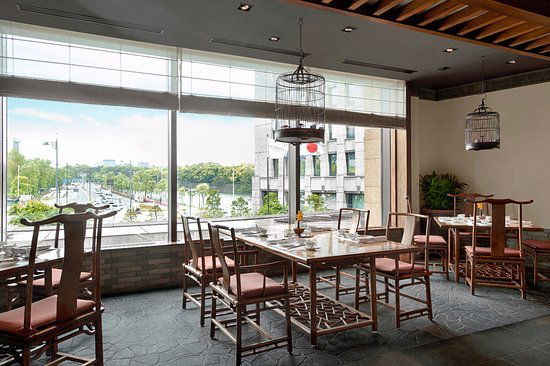
Room is described as evoking a Chinese garden, and the specific draw is the view over the outer garden of the Imperial Palace. That is a positioning detail that matters practically: request a table overlooking the garden when you book. The atmosphere is formal enough to read as a special-occasion room but not stiff. The energy during lunch service, when dim sum is the main business, sits at a different register from dinner , quieter, more focused, and better suited to conversation. If noise level matters to you, lunch is the call. Evening service, particularly later in the sitting, moves toward a fuller room and a louder ambient level.
Wine list leans on California and France, with 215 selections and a total inventory of 735 bottles across a $$$ pricing tier, meaning a meaningful share of the list runs above the ¥10,000+ bottle range. For Cantonese food, a lighter red Burgundy or a white Burgundy with some weight behind it works better than the California-heavy end of the list, but the list is broad enough to find options at both ends. If wine is a priority, the depth is there; if you are drinking tea or sake, the food programme does not require the wine list to justify the visit.
Sourcing and the Price Justification
At ¥¥¥, Hei Fung Terrace occupies a tier below the ¥¥¥¥ restaurants that dominate Tokyo's serious dining conversation. The price is appropriate given that the kitchen's sourcing investment is concentrated in a smaller set of ingredients: quality proteins for the iron-pot preparations, fresh wrappers and filling for dim sum, and the condiment bases (XO sauce, fermented black bean, oyster sauce) that define Cantonese cooking at this level. The menu is not expansive in the way that multi-concept Chinese restaurants in Hong Kong or London tend to be, and that focus is a feature rather than a limitation. You are paying for execution depth on a defined set of dishes, not breadth.
The guest customisation model , choosing seasoning and cooking style from the available ingredients , is a practical expression of that sourcing confidence. Kitchens that source well let the ingredient lead. Kitchens that source poorly hide behind fixed preparations. Hei Fung Terrace's decision to let guests direct the cooking is a tell.
Practical Details
The restaurant is at 1 Chome-8-1 Yurakucho, Chiyoda City, which places it within easy walking distance of Yurakucho Station. Booking is rated Easy, which is a meaningful advantage in Tokyo's dining calendar , you do not need to plan weeks out for this one, though calling ahead for a garden-view table is worth doing. The Google rating sits at 4.2 from 234 reviews, which is a solid but not inflated signal. Michelin Plate recognition for 2024 and 2025 confirms the kitchen is performing at a consistent level that Michelin's inspectors consider worth flagging without awarding a full star. The price at ¥¥¥ is below the typical starred restaurant in Tokyo. For Cantonese food in this city, this is the more accessible price point with a credible quality signal behind it.
Quick reference: Cantonese, ¥¥¥, Yurakucho, easy booking, Michelin Plate 2024/2025, lunch or dinner, garden-view tables available on request.
Tokyo Chinese Dining Context
For other Cantonese and Chinese options in Tokyo, Chugoku Hanten Fureika and Chugoku Hanten Kohakukyu (Amber Palace) represent the Cantonese-Chinese end of the spectrum with their own distinct approaches, while Ippei Hanten covers a broader Chinese menu if you want more range. If you are planning a wider Tokyo dining trip, itsuka and Koshikiryori Koki are worth adding to the itinerary for Japanese cuisine. Our full Tokyo restaurants guide covers the complete picture, and if you need hotels or bars around Yurakucho, the Tokyo hotels guide and Tokyo bars guide are the practical starting points. Beyond Tokyo, HAJIME in Osaka and Gion Sasaki in Kyoto are worth the trip if you are extending into the Kansai region. For Chinese cuisine at a similar quality level in other cities, Restaurant Tim Raue in Berlin and Mister Jiu's in San Francisco are the obvious international comparators. You can also explore akordu in Nara, Goh in Fukuoka, 1000 in Yokohama, and 6 in Okinawa for serious dining across Japan. Our Tokyo wineries guide and Tokyo experiences guide round out the full picture.
FAQ
Can Hei Fung Terrace accommodate groups?
- Yes, and it is a practical group choice at this price point. At ¥¥¥, the per-head cost is manageable for a group dinner by Tokyo standards, and the customisable cooking-style format suits tables where guests have different preferences. Larger groups should request seating with garden views when booking, as the room configuration around the Imperial Palace garden is the main atmospheric asset. For parties focused on dim sum, lunch service is the cleaner option; evening works better for the full iron-pot and stir-fry menu.
Is Hei Fung Terrace good for solo dining?
- It works for solo dining, particularly at lunch when the atmosphere is calmer and the dim sum menu lets you order in smaller quantities. The customisable seasoning format is less of an advantage solo since you are ordering for one, but the dim sum programme , with a specialist making xiaolongbao and gyoza , is worth experiencing even in a single sitting. At ¥¥¥ in Tokyo, this is a reasonable solo spend for the quality on offer. If you want a solo counter experience with more engagement, a sushi counter like Harutaka offers a different format, but Hei Fung Terrace is the better call for Cantonese specifically.
What should I wear to Hei Fung Terrace?
- No dress code is listed, but the Michelin Plate recognition and Imperial Palace garden setting put this firmly in smart-casual territory. A suit or equivalent for dinner is appropriate and will not feel out of place. Overly casual dress (shorts, trainers) reads as mismatched for the room's tone. For lunch dim sum, the bar is slightly lower, but the setting warrants making an effort. Tokyo dining at the ¥¥¥ level generally expects smart presentation, and that applies here.
Compare Hei Fung Terrace
| Venue | Price | Booking Difficulty | Value |
|---|---|---|---|
| Hei Fung Terrace | ¥¥¥ | Easy | — |
| Harutaka | ¥¥¥¥ | Unknown | — |
| L'Effervescence | ¥¥¥¥ | Unknown | — |
| RyuGin | ¥¥¥¥ | Unknown | — |
| HOMMAGE | ¥¥¥¥ | Unknown | — |
| Crony | ¥¥¥¥ | Unknown | — |
Side-by-side comparison to help you decide where to book.
Frequently Asked Questions
Can Hei Fung Terrace accommodate groups?
Groups are a reasonable fit here. The Cantonese format — shared dim sum, iron pot grills, customisable sauces and cooking styles — is designed for the table rather than the individual plate. At ¥¥¥ pricing with a Michelin Plate recognition, it sits at a tier that works for business dinners or celebratory gatherings without the formality of a tasting-menu room. Book ahead; this is not a walk-in venue for parties.
Is Hei Fung Terrace good for solo dining?
It works for solo diners, but you will get less value from the format. The menu is built around shared Cantonese dishes — dim sum, grill items, customisable sauces — and ordering a full spread alone at ¥¥¥ adds up quickly. The view over the outer garden of the Imperial Palace from the dining room is worth the visit regardless of party size, but two diners will cover more of the menu for the same spend.
What should I wear to Hei Fung Terrace?
The room evokes a Chinese garden and overlooks the outer garden of the Imperial Palace, which sets a considered tone. As a ¥¥¥ Cantonese restaurant in a Tokyo hotel setting, neat, presentable clothing is appropriate — overly casual attire would feel out of place. There is no published dress code in the venue data, but erring toward business casual is the practical choice for this price point and setting.
What is Hei Fung Terrace known for?
Hei Fung Terrace is primarily known for Chinese in Tokyo.
Recognized By


More restaurants in Tokyo
- SézanneOccupying the seventh floor of the Four Seasons Hotel Tokyo at Marunouchi, Sézanne earned its first Michelin star within months of opening in July 2021 and now holds three. British chef Daniel Calvert applies French technique to Japanese ingredients, producing a prix-fixe format that Tabelog has recognised with Silver awards every year from 2023 through 2026. It ranked 4th in Asia's 50 Best Restaurants in 2025 and 15th globally in 2024.
- SazenkaSazenka is the address for Chinese cuisine in Tokyo at its most technically demanding. Chef Tomoya Kawada's wakon-kansai approach — Japanese seasonal ingredients applied through Chinese culinary technique — has earned consecutive Tabelog Gold Awards from 2019 to 2026, a #71 ranking on the World's 50 Best 2025, and 99 points from La Liste 2026. At JPY 50,000–59,999 per head, it is one of the hardest tables in the city to book and worth the effort.
- NarisawaNarisawa is Tokyo's most credentialled innovative tasting menu restaurant — two Michelin stars, Asia's 50 Best number 12, and a Tabelog Silver award — running at JPY 80,000–99,999 per head. Book for a milestone occasion, confirm vegetarian or vegan needs in advance, and reserve at least two to three months out. With 15 seats and reservation-only access, this is one of Tokyo's hardest tables to secure.
- FlorilègeFlorilège delivers two Michelin stars and an Asia's 50 Best #17 ranking at a dinner price of ¥22,000 — competitive for Tokyo at this level. Chef Hiroyasu Kawate's plant-forward tasting menus around an open-kitchen counter at Azabudai Hills make this the strongest choice for contemporary French dining in Tokyo if theatrical, produce-led cooking is what you want. Book well in advance; availability is near-impossible at short notice.
- DenDen holds two Michelin stars, a World's 50 Best top-25 Asia ranking, and a Tabelog Silver Award running back to 2017 — and it books out within hours of the two-month reservation window opening. Chef Zaiyu Hasegawa's daily-changing seasonal omakase runs JPY 30,000–39,999 at dinner in a relaxed house-restaurant setting near Gaiemmae. Book by phone only, noon–5 PM JST. Lunch is irregular; plan around dinner.
- QuintessenceQuintessence is Tokyo's most consistently decorated French restaurant: three Michelin stars held through 2025, a La Liste score of 96.5 points, and a Tabelog Gold run from 2017 to 2024. Dinner runs ¥60,000–¥79,999 all in with wine. Book the first seating (5 PM) well ahead — Near Impossible to secure — and come for classical French cooking executed with sustained precision in a secluded Gotenyama setting.
Similar venues by awards
Related editorial
- Asia's 50 Best Restaurants 2026: The Chairman and Wing Go 1-2 from the Same BuildingThe Chairman takes No. 1 and Wing climbs to No. 2 at Asia's 50 Best Restaurants 2026. Both operate from the same Hong Kong building. Here's what it means.
- Four Seasons Yachts Debut: 95 Suites, 11 Restaurants, and a March 2026 Maiden VoyageFour Seasons I launches March 20, 2026, with 95 suites, a one-to-one staff ratio, and 11 onboard restaurants. Worth tracking if you want hotel-grade service at sea.
- LA Michelin Guide 2026: Seven New Restaurants from Tlayudas to Uzbek DumplingsMichelin's March 2026 California Guide update adds six LA restaurants and one Montecito newcomer, spanning Oaxacan tlayudas, Uzbek manti, and Korean-Italian pasta.
Save or rate Hei Fung Terrace on Pearl
Keep this venue in your Pearl passport, rate it after you visit, and track it alongside every other place you collect.