
Restaurant in Washington DC, United States
The Bombay Club
190ptsPolished Indian food, real Beltway power room.

About The Bombay Club
A Michelin Plate-recognised fixture on Connecticut Avenue, The Bombay Club has spent decades as D.C.'s most politically connected Indian dining room. Chef Nilesh Singhvi's menu spans Northern grilled meats to Southern seafood and coconut dishes at the $$$ tier. Book it for classical Indian cooking with real atmosphere; look to Rasika if technical ambition is the priority.
The Bombay Club, Washington D.C.: Verdict
The half-moon banquettes fill fast at The Bombay Club, and that tells you something about how this place works. A 2024 Michelin Plate holder on Connecticut Avenue, this is one of D.C.'s most enduring Indian restaurants — a polished, politically connected room where the cooking spans the subcontinent and the atmosphere rewards those who know what they're walking into. Book it if you want refined Indian cuisine in a room with real character, backed by decades of consistency. Skip it if you're looking for boundary-pushing modernism; the strength here is classical execution, not experimentation.
Portrait
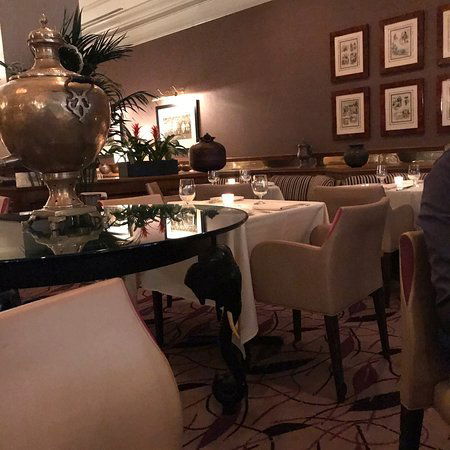
Seats at The Bombay Club are not impossible to get, but the better tables — the curved banquettes that have hosted senators, lobbyists, and White House adjacents for decades , go to regulars and those who plan ahead. Owned by Ashok Bajaj, whose hospitality group has shaped a significant portion of D.C.'s upscale dining for years, the room is a deliberate reference to the gentlemen's clubs of the British Raj: dark wood, measured lighting, white tablecloths, and a formality that feels earned rather than affected.
The scent that greets you when you step in is warm and spiced without being aggressive , cardamom and toasted cumin underneath something richer, probably the slow-braised preparations coming from the kitchen. It is one of the more telling first impressions in D.C. dining: composed, confident, and specific in a way that generic Indian-American restaurants are not.
Chef Nilesh Singhvi's menu reads like a geographic survey of Indian cooking rather than a regional deep-dive. Northern grilled meats share space with Southern seafood preparations and coconut-inflected dishes that would feel at home on the Malabar Coast. That breadth is intentional and, depending on your expectations, either a strength or a limitation. For a group with varied preferences, it is genuinely useful. For a diner seeking the precision of a single regional tradition, you may want to look at Rasika, which focuses more narrowly and pushes the cooking further technically.
The bar seating at The Bombay Club rewards a specific kind of visit. If you are dining solo or arriving early before a full dinner reservation, the bar area offers a lower-commitment way to experience the kitchen's range. The cocktail list incorporates Indian spice profiles without leaning into gimmick, and the bar itself functions as an informal anteroom to the main dining room's more deliberate pacing. For solo diners, this is arguably the better seat in the house , you see more, you can order across the menu without the social architecture of a full table, and the service tends to be more immediate. This is not a counter-experience in the omakase sense, but the bar at Bombay Club has an attentiveness that the main room, at full capacity, occasionally loses.
The Michelin Plate recognition for 2024 positions the restaurant clearly: this is cooking worth noting, not cooking chasing a star. That framing is accurate. The polished Indian cuisine here does not disappoint, to borrow the language used by the guide itself, but the ambition is calibration and consistency rather than innovation. A braised lamb curry with subtle sweet notes, kulcha served as an opener , these are dishes built to please reliably, and they do. For the food-focused traveler who wants to understand where Indian cuisine sits in D.C.'s dining conversation, The Bombay Club is a useful reference point, not the final word.
For broader context on Indian cooking at this level globally, Trèsind Studio in Dubai and Opheem in Birmingham represent where the cuisine goes when chefs push into tasting-menu territory. The Bombay Club is not chasing that direction, and it is better for knowing what it is. Locally, Daru and Karma Modern Indian take more risks with the format; Rania offers a different entry point into South Asian cooking in the city.
The political texture of the room is not incidental , it is part of what makes The Bombay Club a specific experience. Dining here during a weekday lunch or early dinner means you are likely sharing the room with people who shape policy, and that ambient energy is something D.C. restaurants either have or don't. Bombay Club has it in quantity. Whether that matters to your evening depends on your disposition, but for an explorer interested in D.C. as a city rather than just a dining destination, it adds a layer of context that no amount of plating artistry can replicate.
At the $$$ price tier, The Bombay Club sits at a reasonable position for what it delivers: a formal room, a broad menu with geographic range, Michelin recognition, and a service team that understands the rhythm of a political dining room. It is not the cheapest way to eat Indian food in D.C., nor is it the most technically adventurous. It is, however, one of the most consistent and atmospherically coherent , and in a city where restaurants come and go with administration cycles, that consistency over decades carries real weight.
For more on eating and drinking in the capital, see our full Washington, D.C. restaurants guide, our D.C. bars guide, our D.C. hotels guide, our D.C. wineries guide, and our D.C. experiences guide.
Know Before You Go
- Address: 815 Connecticut Ave NW, Washington, DC 20006
- Cuisine: Indian , spanning Northern grilled preparations and Southern seafood and coconut dishes
- Price range: $$$ (moderate-to-upscale; expect a formal dining spend)
- Awards: Michelin Plate 2024
- Google rating: 3.9 / 5 (1,114 reviews)
- Booking difficulty: Moderate , prime tables and peak times fill ahead; book at least a week out, two weeks for weekend evenings
- Dress code: Smart casual at minimum; the room skews formal and the clientele dresses accordingly
- Leading seat: Bar seating for solo diners or early arrivals; banquette tables for groups wanting the full room experience
- Neighbourhood context: Connecticut Avenue NW, close to the White House , part of D.C.'s power-lunch corridor
How It Compares
Related Reading
- Rasika , Indian, D.C.'s most technically ambitious Indian kitchen
- Daru , Indian-influenced, more experimental in format
- Karma Modern Indian , contemporary Indian in D.C.
- Rania , South Asian cooking, different register
- Albi , Middle Eastern, if you want to compare across cuisines at a higher price point
- Trèsind Studio, Dubai , where Indian fine dining goes at its most ambitious
- Opheem, Birmingham , Indian tasting-menu format in the UK
- Le Bernardin, New York , benchmark for what formal dining polish looks like at the leading
- The French Laundry, Napa , reference point for tasting-menu commitment
- Smyth, Chicago , if creative tasting menus are the draw
Compare The Bombay Club
| Venue | Price | Booking Difficulty | Value |
|---|---|---|---|
| The Bombay Club | $$$ | Moderate | — |
| Oyster Oyster | $$$ | Unknown | — |
| Albi | $$$$ | Unknown | — |
| Causa | $$$$ | Unknown | — |
| Rooster & Owl | $$$ | Unknown | — |
| Rose’s Luxury | $$$$ | Unknown | — |
Key differences to consider before you reserve.
Frequently Asked Questions
Can The Bombay Club accommodate groups?
The Bombay Club's layout — half-moon banquettes and a polished dining room — suits groups of four to six comfortably. Larger parties should call ahead to arrange seating; the room's club-style setup means demand for the better tables is consistent, and groups arriving without a plan will get whatever's left. At $$$, this is a practical choice for a business dinner or a political-adjacent celebration where the room itself carries weight.
What should a first-timer know about The Bombay Club?
Go in knowing this is a 2024 Michelin Plate restaurant with a decades-long foothold on Connecticut Ave, not a trendy newcomer. The menu spans Northern grilled meats and Southern seafood and coconut-inflected dishes, so there's range across the subcontinent. Owned by Ashok Bajaj, the room skews toward Beltway regulars and has the feel of a private club — expect polished service and a quieter, more formal pace than most D.C. Indian spots.
What should I wear to The Bombay Club?
The Bombay Club draws senators and lobbyists to its banquettes, and the room is styled as a nod to the clubs of the British Raj — so dress accordingly. Business casual is the floor; anything closer to business formal will fit right in. Shorts or athleisure will feel out of place and may draw the kind of attention you don't want at a table next to a senator.
What are alternatives to The Bombay Club in Washington, D.C.?
For a different cuisine at a similar price point, Albi (Mid-Atlantic Arabic) and Causa (Peruvian) both offer more contemporary cooking with stronger tasting-menu credentials. If you want Indian specifically but a livelier, less formal atmosphere, D.C. has solid options in the suburbs. The Bombay Club is the pick when the room and the occasion matter as much as what's on the plate — it's harder to replicate that Beltway-insider atmosphere elsewhere.
How far ahead should I book The Bombay Club?
Book at least one to two weeks out for a standard dinner reservation, more if you want a specific banquette or are visiting around a major political or cultural event. The Bombay Club has been a D.C. fixture for decades and maintains a steady insider crowd, which means prime tables — the half-moon banquettes in particular — move quickly. Walk-in availability exists but is not reliable for a $$$-per-head meal you're planning around.
Is The Bombay Club good for solo dining?
Possible, but not the format this room is designed for. The club-style layout and banquette seating favor pairs and small groups; solo diners can expect to be seated at smaller tables away from the prime spots. If solo dining is your preference, a seat at the bar — if available — gives you more flexibility. For solo Indian dining in D.C. at this price level, the experience is solid given the 2024 Michelin Plate recognition, but the room doesn't particularly reward eating alone.
Recognized By

More restaurants in Washington DC
- JôntWashington D.C.'s most credentialed tasting counter: two Michelin stars, a No. 13 OAD North America ranking, and a 360-selection wine program led by Wine Director Gabriel Corbett. The open-kitchen counter format and Japanese luxury ingredient focus make it the strongest special-occasion booking in the city — but reserve months in advance.
- minibarminibar holds two Michelin stars, a La Liste score of 92, and the #8 ranking in Opinionated About Dining's North America list for 2025. The counter-only tasting menu runs Tuesday through Saturday evenings only, and reservations are among the hardest to secure in Washington, D.C. Book as far ahead as possible and opt into the beverage pairing — the format is built for it.
Similar venues by awards
Related editorial
- Best Fine Dining Restaurants in ParisFrom three-Michelin-star icons to the next generation of Parisian chefs pushing boundaries, these are the restaurants that define fine dining in the world's culinary capital.
- Best Luxury Hotels in RomeFrom rooftop terraces overlooking ancient ruins to Michelin-starred hotel dining, these are the luxury hotels that make Rome unforgettable.
- Best Cocktail Bars in KyotoFrom sleek lounges to hidden speakeasies, Kyoto's cocktail scene blends Japanese precision with global influence in ways you won't find anywhere else.
Save or rate The Bombay Club on Pearl
Keep this venue in your Pearl passport, rate it after you visit, and track it alongside every other place you collect.