
Restaurant in Tokyo, Japan
Orchestra
290ptsMichelin-recognised Italian with a concept that holds.

About Orchestra
A Michelin Plate Italian in Yoyogi built around a classical music concept rooted in the chef's training in Emilia-Romagna. At the ¥¥¥ tier with two consecutive Michelin Plates and a 4.8 Google rating, it is the strongest case for Italian fine dining in Tokyo that does not require a ¥¥¥¥ budget. Easy to book and well-suited to date nights or small celebrations.
Orchestra, Tokyo: The Verdict
At the ¥¥¥ price tier, Orchestra in Yoyogi delivers a focused Italian dining experience built around a concept that is more coherent than most: the restaurant as ensemble performance. For a special occasion dinner where you want something distinctive without paying ¥¥¥¥ prices, it earns a confident recommendation. Two consecutive Michelin Plates (2024 and 2025) confirm it is operating at a recognised level of quality, and a Google rating of 4.8 from verified diners backs that up. If you are weighing this against Tokyo's heavier-hitting Italian rooms, the price differential is real and meaningful.
The Space and the Concept
Orchestra occupies the ground floor of the Morita Building in Yoyogi, Shibuya — a neighbourhood that sits a step removed from the tourist circuits of Shinjuku and Harajuku, but is thoroughly woven into the daily fabric of west-central Tokyo. That location matters: this is not a destination restaurant chasing overseas press, but a room that has built its reputation among people who actually live and eat in this part of the city. The 4.8 Google rating, while drawn from a modest sample, is the kind of score that accumulates through repeat local visits rather than one-off tourist traffic.
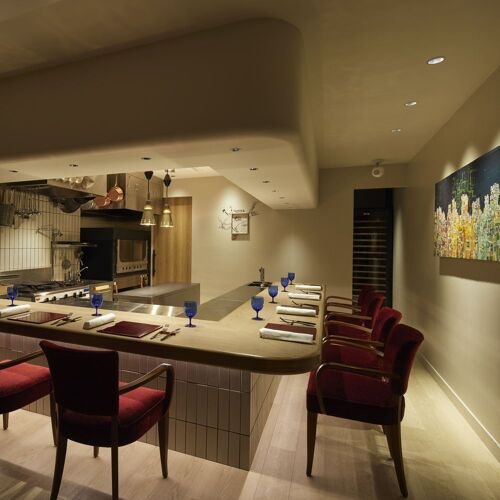
The physical space carries the restaurant's central theme through in deliberate detail. Plates are decorated with musical instrument motifs, and classical music runs through the dining room throughout service. The concept traces back to Imola, the city in Italy's Emilia-Romagna region where the chef trained — a place that happens to house one of Italy's notable music academies. The friendships he formed with students there produced a conviction that a restaurant, like an orchestra, depends on a wide range of contributors working in precise coordination. That idea is not just branding; it shapes how the room feels. The atmosphere is considered and controlled rather than loud or performative, which makes it a credible choice for a date dinner or a business meal where conversation matters.
For spatial framing: this is a ground-floor room in a low-rise building, which tends toward intimacy rather than grandeur. If you are expecting the soaring ceilings of a Roppongi fine-dining address, recalibrate. The scale here suits couples and small groups better than large parties celebrating loudly. That is not a limitation so much as a design decision , Orchestra is set up for occasions where focus and attention to detail are the point.
The Food and the Positioning
The cuisine is Italian, shaped by the chef's time in Emilia-Romagna , a region that produces some of Italy's most technically demanding and ingredient-led cooking. What arrives on those musically decorated plates reflects that training: this is not a Tokyo-inflected fusion take on Italian food, but a kitchen that takes its European reference point seriously. Two Michelin Plates in consecutive years signal consistent execution, not a single inspired season.
For context on where Orchestra sits in Tokyo's Italian category: Aroma Fresca and PRISMA operate at the higher end of the city's Italian tier, while Principio and AlCeppo offer additional reference points across the price range. Gucci Osteria da Massimo Bottura Tokyo brings a high-profile Italian name to the city at a premium price. Orchestra's ¥¥¥ positioning means it undercuts most of those rooms while maintaining Michelin-recognised quality , a combination that is harder to find than it sounds in this city.
For Italian dining elsewhere in Japan, cenci in Kyoto is worth knowing if your trip extends beyond Tokyo, and 8½ Otto e Mezzo Bombana in Hong Kong is the regional benchmark if you are travelling more broadly.
Booking and Logistics
Booking difficulty is rated Easy, which is a meaningful advantage in Tokyo's dining market, where the most-talked-about rooms require weeks of advance planning. Orchestra's relative accessibility does not signal a drop in quality , it reflects its neighbourhood positioning and the fact that it has not been swept into the international reservation frenzy. Book a week or so ahead for weekends to be safe, but this is not a room where you need to set a calendar reminder months out. The address , 4 Chome-1-7 Morita Building 1F, Yoyogi, Shibuya , is direct to reach via the Yoyogi area's rail connections.
Phone and website details are not currently listed in our database; check current booking channels through Google Maps or a hotel concierge. Hours are similarly unconfirmed in our records, so verify before you go.
Who Should Book Orchestra
Orchestra is the right call for a date dinner or small celebratory meal where you want a room with genuine personality and Michelin-recognised cooking, without committing to a ¥¥¥¥ spend. The musical concept gives the evening a narrative arc that most Italian restaurants in this city do not offer, and the Yoyogi setting makes it feel like a discovery rather than a tick on a tourist list. If you are planning a broader Tokyo itinerary, pair it with exploration via our full Tokyo restaurants guide, our Tokyo hotels guide, our Tokyo bars guide, our Tokyo wineries guide, and our Tokyo experiences guide.
For diners extending their Japan trip, notable restaurants worth considering include HAJIME in Osaka, Gion Sasaki in Kyoto, akordu in Nara, Goh in Fukuoka, 1000 in Yokohama, and 6 in Okinawa.
Compare Orchestra
Frequently Asked Questions
Is Orchestra worth the price?
At the ¥¥¥ tier, Orchestra delivers solid value for Tokyo's Italian dining market. Two consecutive Michelin Plate awards (2024 and 2025) confirm the kitchen is operating at a recognised standard, and the booking difficulty is rated Easy — meaning you're not paying a premium just to get through the door. If you want Emilia-Romagna-rooted Italian cooking with a coherent concept in a room that has genuine personality, the price is justified. For pure value-per-plate, it sits comfortably below the pressure of Tokyo's hardest-to-book Italian rooms.
Is the tasting menu worth it at Orchestra?
The menu format and specific pricing are not publicly confirmed in available venue data, so specific course counts cannot be verified here. What is documented is that the cuisine is shaped by the chef's apprenticeship in Emilia-Romagna, a region defined by technical discipline and ingredient-led cooking — the kind of background that tends to suit a structured tasting format. With a Michelin Plate in 2024 and 2025, the kitchen has enough recognition to make a multi-course commitment reasonable at the ¥¥¥ price point.
Is Orchestra good for solo dining?
Orchestra is a credible solo option. The Yoyogi address keeps it off the main tourist circuit, the booking difficulty is rated Easy so there's no anxiety about securing a single seat, and the classical music concept and musical-motif tableware give you something to engage with without needing a companion to carry the experience. It works better as a solo dinner than most ¥¥¥ rooms in Tokyo where the format is built around groups.
Can I eat at the bar at Orchestra?
Bar seating details are not confirmed in Orchestra's venue record. What is known is that the restaurant occupies the ground floor of the Morita Building in Yoyogi — a relatively compact setting — and bookings are rated Easy, which suggests flexibility in how seating is arranged. check the venue's official channels to confirm counter or bar options before assuming availability.
Recognized By

More restaurants in Tokyo
- SézanneOccupying the seventh floor of the Four Seasons Hotel Tokyo at Marunouchi, Sézanne earned its first Michelin star within months of opening in July 2021 and now holds three. British chef Daniel Calvert applies French technique to Japanese ingredients, producing a prix-fixe format that Tabelog has recognised with Silver awards every year from 2023 through 2026. It ranked 4th in Asia's 50 Best Restaurants in 2025 and 15th globally in 2024.
- SazenkaSazenka is the address for Chinese cuisine in Tokyo at its most technically demanding. Chef Tomoya Kawada's wakon-kansai approach — Japanese seasonal ingredients applied through Chinese culinary technique — has earned consecutive Tabelog Gold Awards from 2019 to 2026, a #71 ranking on the World's 50 Best 2025, and 99 points from La Liste 2026. At JPY 50,000–59,999 per head, it is one of the hardest tables in the city to book and worth the effort.
- NarisawaNarisawa is Tokyo's most credentialled innovative tasting menu restaurant — two Michelin stars, Asia's 50 Best number 12, and a Tabelog Silver award — running at JPY 80,000–99,999 per head. Book for a milestone occasion, confirm vegetarian or vegan needs in advance, and reserve at least two to three months out. With 15 seats and reservation-only access, this is one of Tokyo's hardest tables to secure.
- FlorilègeFlorilège delivers two Michelin stars and an Asia's 50 Best #17 ranking at a dinner price of ¥22,000 — competitive for Tokyo at this level. Chef Hiroyasu Kawate's plant-forward tasting menus around an open-kitchen counter at Azabudai Hills make this the strongest choice for contemporary French dining in Tokyo if theatrical, produce-led cooking is what you want. Book well in advance; availability is near-impossible at short notice.
- DenDen holds two Michelin stars, a World's 50 Best top-25 Asia ranking, and a Tabelog Silver Award running back to 2017 — and it books out within hours of the two-month reservation window opening. Chef Zaiyu Hasegawa's daily-changing seasonal omakase runs JPY 30,000–39,999 at dinner in a relaxed house-restaurant setting near Gaiemmae. Book by phone only, noon–5 PM JST. Lunch is irregular; plan around dinner.
- MyojakuMyojaku is a 2-Michelin-star, 14-course French-leaning omakase in Nishiazabu holding a 4.47 Tabelog score, Tabelog Silver 2025–2026, and Asia's 50 Best #45 (2025). Chef Hidetoshi Nakamura's water-forward, no-dashi approach shifts meaningfully with the seasons — making timing your reservation as important as getting one. Budget JPY 50,000–59,999 per head plus 10% service charge; reservations only, near-impossible to secure.
Similar venues by awards
Related editorial
- Best Fine Dining Restaurants in ParisFrom three-Michelin-star icons to the next generation of Parisian chefs pushing boundaries, these are the restaurants that define fine dining in the world's culinary capital.
- Best Luxury Hotels in RomeFrom rooftop terraces overlooking ancient ruins to Michelin-starred hotel dining, these are the luxury hotels that make Rome unforgettable.
- Best Cocktail Bars in KyotoFrom sleek lounges to hidden speakeasies, Kyoto's cocktail scene blends Japanese precision with global influence in ways you won't find anywhere else.
Save or rate Orchestra on Pearl
Keep this venue in your Pearl passport, rate it after you visit, and track it alongside every other place you collect.