
Restaurant in Tokyo, Japan
Maeshiba Ryoriten
390ptsOne chef, one cut, serious technique.


About Maeshiba Ryoriten
A Michelin Plate French restaurant in Futako-Tamagawa, Setagaya, built entirely around charcoal-grilled beef and classical French sauces. Named producers, meticulous flame technique, and a ¥¥¥ price point make it one of the more focused value propositions in Tokyo's French dining category. Easy to book, low-key in atmosphere, and worth it for a special occasion without a ¥¥¥¥ budget.
The Verdict
Maeshiba Ryoriten is one of the more focused restaurants operating in Tokyo's French dining category, and that focus is the entire point. Chef Taira Maeshiba has built his menu around a single speciality: charcoal-grilled beef, finished with sauces that reflect classical French technique applied with genuine precision. If that proposition sounds narrow, it is — and deliberately so. This is a restaurant that has traded range for depth, and the result is a ¥¥¥ French counter in Setagaya's Futako-Tamagawa neighbourhood that delivers quality well above what its price tier and out-of-centre address might suggest. For a focused, occasion-worthy dinner that doesn't require a ¥¥¥¥ budget, book it.
Portrait
Most Tokyo French restaurants spread their identity across foie gras, fish courses, soufflés, and a cheese trolley. Maeshiba Ryoriten does none of that. The kitchen's entire creative energy is directed at two things: the behaviour of charcoal flame and the construction of sauces. Named producers supply the beef, which means the sourcing chain is traceable and the kitchen is accountable to specific quality standards rather than generic market purchasing. That kind of ingredient transparency is more common in kaiseki and high-end sushi than in French dining, and its presence here signals something about how seriously the kitchen takes its narrow brief.
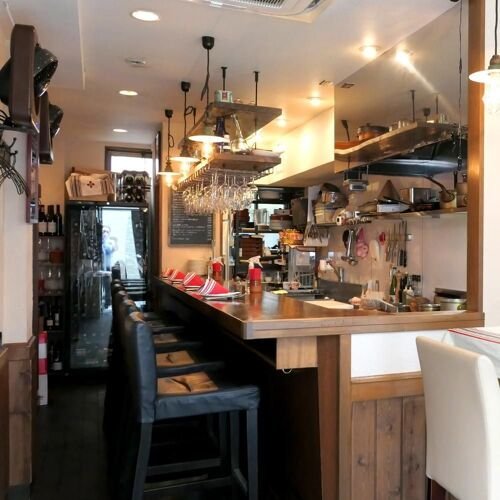
The atmosphere sits in useful contrast to the food's seriousness. Futako-Tamagawa is a residential, family-oriented pocket of Setagaya — not the Ginza or Minami-Aoyama addresses that Tokyo's more performatively prestigious French restaurants occupy. The dining room in Luminous Futako-tamagawa B1 carries that neighbourhood register: the energy is composed rather than charged, the noise level low enough for conversation, the mood closer to a well-run local restaurant than a destination dining event. That combination , careful, serious cooking in an unpretentious room , is the core of what Maeshiba Ryoriten offers, and for a celebratory dinner or a date where you want the food to matter more than the theatre of the room, it's a good trade.
The 2025 Michelin Plate recognition confirms that the Guide's inspectors have taken note. A Plate (rather than a star) signals a restaurant the Guide considers worth eating at , technically proficient, consistent, with a clear identity , without the booking frenzy and price escalation that a star brings. For diners, that's practically useful: it means you get a credentialled kitchen without the three-month reservation queue or the ¥¥¥¥ price tag. At the ¥¥¥ tier, Maeshiba sits in a competitive bracket, but the specificity of its offer , charcoal beef, named producers, classical sauces , gives it a clearer identity than many restaurants at the same price point.
Chef Maeshiba's menus are described in the Michelin record as compositions only he could produce: the fare simple, the work meticulous. That framing matters for how you should approach the booking. This is not a restaurant where the menu rotates constantly or where novelty is the selling point. The pleasure is in precision , the same narrow category executed with more attention than anyone else is giving it. If you are looking for a wide-tasting-menu format with multiple proteins, multiple cuisines, and a parade of courses, this is the wrong choice. If you want French technique applied rigorously to a single, well-sourced subject, it is the right one.
For Tokyo restaurant comparisons across the French category, see our coverage of L'Effervescence, Sézanne, ESqUISSE, Florilège, and Château Restaurant Joël Robuchon. For broader context on the city, our full Tokyo restaurants guide covers the category in depth, alongside our Tokyo hotels guide, Tokyo bars guide, Tokyo wineries guide, and Tokyo experiences guide.
If you are travelling beyond Tokyo, comparable precision-focused French and European dining can be found at HAJIME in Osaka, Gion Sasaki in Kyoto, akordu in Nara, and Goh in Fukuoka. For regional options, 1000 in Yokohama and 6 in Okinawa are worth considering. Outside Japan, Les Amis in Singapore and Hotel de Ville Crissier represent the French fine dining category at its most accomplished.
Practical Details
Reservations: Booking difficulty is rated easy, which is one of the genuine advantages over starred competition in the same city , plan 1 to 2 weeks ahead for weekend evenings to be safe, though last-minute availability is more realistic here than at most Michelin-recognised Tokyo addresses. Budget: ¥¥¥ price range positions this below the ¥¥¥¥ tier occupied by most of Tokyo's French fine dining; expect meaningful savings versus L'Effervescence or Sézanne for a comparable occasion meal. Location: Luminous Futako-tamagawa B1, Tamagawa, Setagaya , accessible via the Tokyu Den-en-toshi and Oimachi lines at Futako-Tamagawa Station. Google rating: 4.3 from 102 reviews. Dress: No dress code confirmed in available data; smart casual is consistent with the neighbourhood register and the room's tone. Groups: Seat count is not published; contact the restaurant directly to confirm capacity for parties larger than four.
FAQ
- Is Maeshiba Ryoriten good for solo dining? Yes, and it may suit solo diners particularly well. The kitchen's focus on a single speciality means there is no multi-course pageantry that benefits from being shared across a table; the pleasure is in the cooking's precision, which reads just as clearly for one as for two. The composed, low-key atmosphere , a residential neighbourhood room rather than a scene , makes solo visits comfortable rather than awkward. At ¥¥¥, the spend is manageable for a solo occasion meal.
- What should I order at Maeshiba Ryoriten? The menu is built around charcoal-grilled beef and classical French sauces , that is the kitchen's entire focus, and the Michelin record confirms it is the only thing worth ordering. Named producers supply the beef, so the quality of the core ingredient is a deliberate choice, not a variable. Do not come expecting fish courses, a wide protein rotation, or à la carte flexibility if the kitchen runs a set format; the value here is in surrendering to the focused menu rather than building your own selection.
- Is the tasting menu worth it at Maeshiba Ryoriten? At ¥¥¥, yes , particularly if charcoal beef and classical sauce work is what you want from a French dinner. The Michelin Plate signals consistent technical quality from the Guide's inspectors, and the price sits one tier below Tokyo's starred French addresses. You are not getting the breadth of a full tasting menu at L'Effervescence or Sézanne, but you are getting a more focused, producer-led version of the same technical tradition for less money and without the booking difficulty. For value within the French fine dining bracket in Tokyo, this is a reasonable trade.
- What are alternatives to Maeshiba Ryoriten in Tokyo? For French dining at a higher budget with more range, L'Effervescence and Sézanne are the benchmark ¥¥¥¥ options. Florilège sits at the same ¥¥¥ tier and is worth comparing directly , it takes a more contemporary, vegetable-forward approach versus Maeshiba's beef-centred classicism, so the right choice depends on what you want the meal to centre on. For innovative French at ¥¥¥¥, HOMMAGE is a peer comparison worth making. If you want to move outside the French category entirely, RyuGin is the kaiseki equivalent for technical precision at a higher price point.
- Can Maeshiba Ryoriten accommodate groups? Seat count is not published in available data, and no phone or booking portal is confirmed. The Futako-Tamagawa location and the kitchen's single-speciality format suggest an intimate room rather than a large-group venue. For parties of more than four, contact the restaurant directly before assuming availability; the focused, counter-style French format common to restaurants of this type in Tokyo typically suits tables of two to four more naturally than large group bookings.
Compare Maeshiba Ryoriten
| Venue | Cuisine | Awards | Booking Difficulty | Value |
|---|---|---|---|---|
| Maeshiba Ryoriten | French | The speciality is charcoal-grilled beef and sauce only. On this, the French cuisine of Taira Maeshiba is focused. Ingredients whose producers are listed by name, finely disciplined flame-tending techniques, and traditional yet distinctive sauces combine to form menus only Chef Maeshiba could compose. The fare is simple, the work meticulous.; Michelin Plate (2025); The speciality is charcoal-grilled beef and sauce only. On this, the French cuisine of Taira Maeshiba is focused. Ingredients whose producers are listed by name, finely disciplined flame-tending techniques, and traditional yet distinctive sauces combine to form menus only Chef Maeshiba could compose. The fare is simple, the work meticulous. | Easy | — |
| Harutaka | Sushi | Michelin 3 Star, World's 50 Best | Unknown | — |
| RyuGin | Kaiseki, Japanese | Michelin 3 Star, World's 50 Best | Unknown | — |
| L'Effervescence | French | Michelin 3 Star, World's 50 Best | Unknown | — |
| HOMMAGE | Innovtive French, French | Michelin 2 Star, World's 50 Best | Unknown | — |
| Florilège | French | Michelin 2 Star, World's 50 Best | Unknown | — |
What to weigh when choosing between Maeshiba Ryoriten and alternatives.
Frequently Asked Questions
Is Maeshiba Ryoriten good for solo dining?
Yes — the focused, single-specialist format at ¥¥¥ suits solo diners well. There is no wide-ranging menu to negotiate, and the precision of Chef Maeshiba's charcoal-grilled beef and sauce work rewards attentive, unhurried eating. If you want a high-energy room with group dynamics, look elsewhere; if you want to eat seriously, solo works here.
What should I order at Maeshiba Ryoriten?
The menu is built around charcoal-grilled beef and sauce — that is the entire point of the restaurant, and there is no meaningful decision to make beyond committing to the chef's menu. Producer names are listed for the key ingredients, so expect transparency rather than theatre. Do not come expecting foie gras courses or a cheese trolley.
Is the tasting menu worth it at Maeshiba Ryoriten?
At ¥¥¥ and with a 2025 Michelin Plate to its name, Maeshiba Ryoriten delivers value if the charcoal-beef format is what you are after. The fare is described as simple and the technique meticulous — so you are paying for discipline and focus, not a sprawling multi-course production. If you want more format variety, Florilège or L'Effervescence offer broader French tasting menus at a comparable or higher price point.
What are alternatives to Maeshiba Ryoriten in Tokyo?
For broader French tasting menus, Florilège and L'Effervescence are the obvious comparisons and carry stronger star-level recognition. HOMMAGE and RyuGin suit diners who want a more theatrical, multi-element experience. Harutaka covers the high-precision, ingredient-focused angle but in the Japanese rather than French tradition. Maeshiba Ryoriten is the right pick only if charcoal-beef is specifically what you want from a French kitchen.
Can Maeshiba Ryoriten accommodate groups?
The basement location in Luminous Futako-Tamagawa and the restaurant's specialist format suggest an intimate scale rather than a group-friendly room. No private dining or group booking policies are documented in available records. For groups of four or more, check availability before committing — and have an alternative ready if capacity is limited.
Recognized By


More restaurants in Tokyo
- SézanneOccupying the seventh floor of the Four Seasons Hotel Tokyo at Marunouchi, Sézanne earned its first Michelin star within months of opening in July 2021 and now holds three. British chef Daniel Calvert applies French technique to Japanese ingredients, producing a prix-fixe format that Tabelog has recognised with Silver awards every year from 2023 through 2026. It ranked 4th in Asia's 50 Best Restaurants in 2025 and 15th globally in 2024.
- SazenkaSazenka is the address for Chinese cuisine in Tokyo at its most technically demanding. Chef Tomoya Kawada's wakon-kansai approach — Japanese seasonal ingredients applied through Chinese culinary technique — has earned consecutive Tabelog Gold Awards from 2019 to 2026, a #71 ranking on the World's 50 Best 2025, and 99 points from La Liste 2026. At JPY 50,000–59,999 per head, it is one of the hardest tables in the city to book and worth the effort.
- NarisawaNarisawa is Tokyo's most credentialled innovative tasting menu restaurant — two Michelin stars, Asia's 50 Best number 12, and a Tabelog Silver award — running at JPY 80,000–99,999 per head. Book for a milestone occasion, confirm vegetarian or vegan needs in advance, and reserve at least two to three months out. With 15 seats and reservation-only access, this is one of Tokyo's hardest tables to secure.
- FlorilègeFlorilège delivers two Michelin stars and an Asia's 50 Best #17 ranking at a dinner price of ¥22,000 — competitive for Tokyo at this level. Chef Hiroyasu Kawate's plant-forward tasting menus around an open-kitchen counter at Azabudai Hills make this the strongest choice for contemporary French dining in Tokyo if theatrical, produce-led cooking is what you want. Book well in advance; availability is near-impossible at short notice.
- DenDen holds two Michelin stars, a World's 50 Best top-25 Asia ranking, and a Tabelog Silver Award running back to 2017 — and it books out within hours of the two-month reservation window opening. Chef Zaiyu Hasegawa's daily-changing seasonal omakase runs JPY 30,000–39,999 at dinner in a relaxed house-restaurant setting near Gaiemmae. Book by phone only, noon–5 PM JST. Lunch is irregular; plan around dinner.
- QuintessenceQuintessence is Tokyo's most consistently decorated French restaurant: three Michelin stars held through 2025, a La Liste score of 96.5 points, and a Tabelog Gold run from 2017 to 2024. Dinner runs ¥60,000–¥79,999 all in with wine. Book the first seating (5 PM) well ahead — Near Impossible to secure — and come for classical French cooking executed with sustained precision in a secluded Gotenyama setting.
Similar venues by awards
Related editorial
- Asia's 50 Best Restaurants 2026: The Chairman and Wing Go 1-2 from the Same BuildingThe Chairman takes No. 1 and Wing climbs to No. 2 at Asia's 50 Best Restaurants 2026. Both operate from the same Hong Kong building. Here's what it means.
- Four Seasons Yachts Debut: 95 Suites, 11 Restaurants, and a March 2026 Maiden VoyageFour Seasons I launches March 20, 2026, with 95 suites, a one-to-one staff ratio, and 11 onboard restaurants. Worth tracking if you want hotel-grade service at sea.
- LA Michelin Guide 2026: Seven New Restaurants from Tlayudas to Uzbek DumplingsMichelin's March 2026 California Guide update adds six LA restaurants and one Montecito newcomer, spanning Oaxacan tlayudas, Uzbek manti, and Korean-Italian pasta.
Save or rate Maeshiba Ryoriten on Pearl
Keep this venue in your Pearl passport, rate it after you visit, and track it alongside every other place you collect.