
Restaurant in Tokyo, Japan
La Paix
250ptsFrench technique, Japanese restraint. Book it.

About La Paix
La Paix is a concept-driven French tasting menu restaurant in Nihonbashimuromachi, Tokyo, built around five thematic elements including Wakayama sourcing and a Tartary Buckwheat Blancmange found nowhere else on the circuit. At the ¥¥¥ tier, it is more accessible than Tokyo's top French rooms and easier to book, making it the right call for food-focused diners who want rigour without the ¥¥¥¥ commitment.
Verdict
La Paix is the right book if you want French technique applied with genuine Japanese restraint — not fusion for its own sake, but a tasting menu built around a coherent set of ideas that the Nihombashi address makes sense of. At the ¥¥¥ price tier, it sits below the top-end Tokyo French rooms and is easier to secure than most. If your priority is a rigorous, concept-driven progression with ingredients you will not encounter elsewhere, book it. If you want the full Parisian-in-Tokyo spectacle with deep wine list depth and grand-room energy, look instead at L'Effervescence or Patous.
Portrait
La Paix operates from a basement floor in Nihonbashimuromachi — a Chuo City address that positions it squarely between the old merchant Tokyo of Edo-era Nihombashi and the commercial energy of the contemporary city above. The location is not incidental: the restaurant's five stated thematic elements , Japan, harmony, spirit, connection, and the senses , are answered by a menu that moves through each course with a clear point of view rather than a sequence of isolated showpieces.
The structural anchor of that point of view is sourcing from Wakayama Prefecture. Kishu Ume, the tart, aromatic plum variety native to that region, appears in a house-made butter that opens the meal's flavour vocabulary before the first savoury plate arrives. The scent is quieter than a citrus note but more persistent , a low, slightly fermented warmth that signals where the kitchen's priorities lie. This is not decoration. It functions as the menu's first statement about the relationship between French form and Japanese ingredient logic.
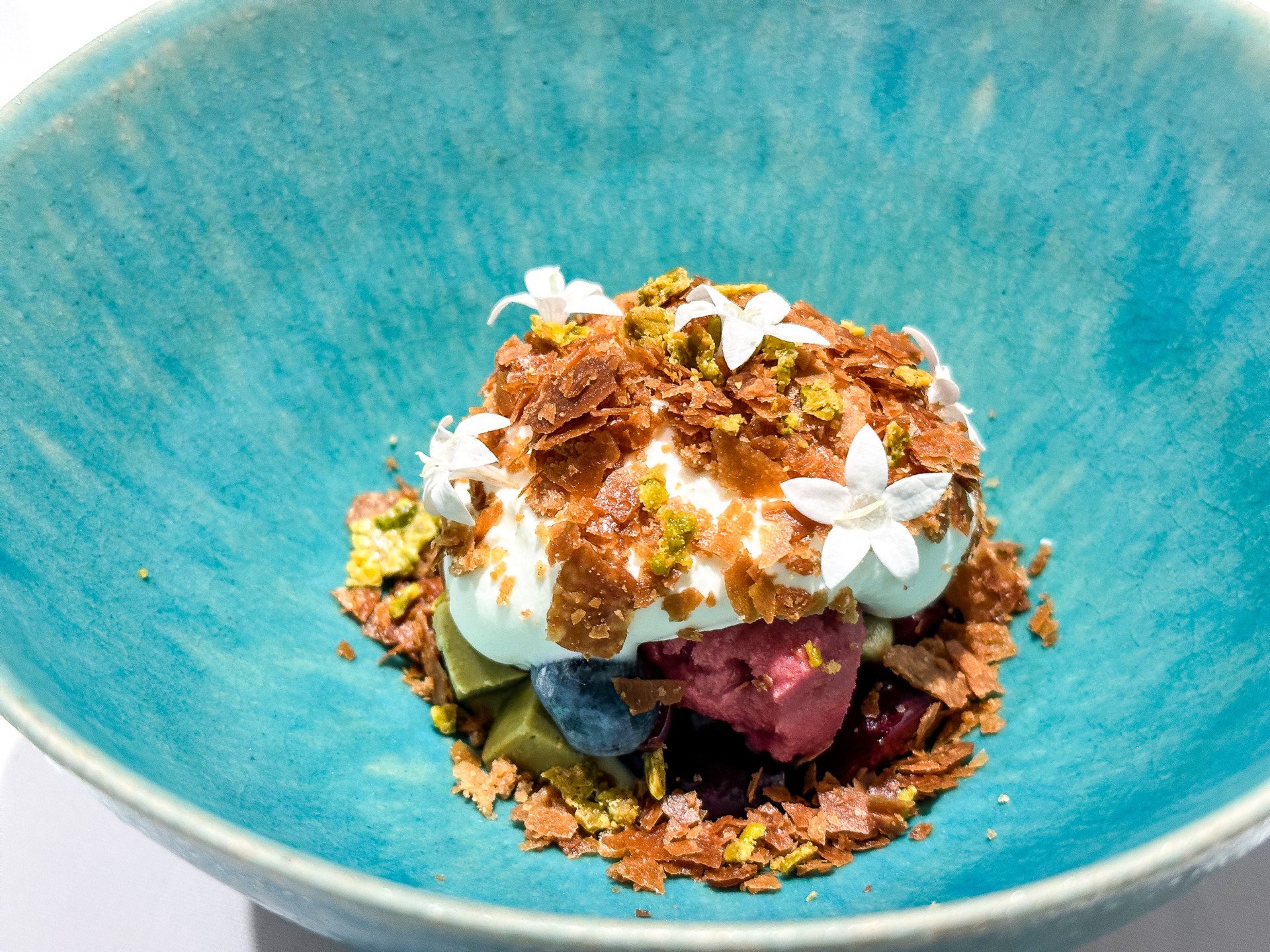
The most structurally distinctive course is the Blancmange of Tartary Buckwheat , a preparation that exists nowhere else on the Tokyo French circuit as far as the venue's own documentation indicates. Tartary buckwheat is more intensely flavoured than the common variety, with a faintly mineral, almost earthy register. Rendering it as a blancmange , a classical French cold-set preparation , pulls the tension between the two culinary traditions into a single dish rather than alternating between them course by course. That approach characterises the menu's architecture: the Japanese references are structural, not garnish.
For diners coming from outside Japan, the Nihombashi area is accessible from the Ginza, Mitsukoshi-mae, or Shin-Nihombashi stations, and the restaurant's B1F address is the only navigation note worth holding. Nihombashi itself rewards time before or after , it has a concentration of specialist food retailers, long-standing merchants, and a street character distinct from Shinjuku or Shibuya. If you are building a longer Tokyo itinerary around food, the full Tokyo restaurants guide covers the wider range, and the Tokyo hotels guide covers properties close enough to walk from this neighbourhood.
The ¥¥¥ tier means La Paix is accessible relative to the ¥¥¥¥ rooms that dominate serious French dining in Tokyo. That gap matters for planning: you can afford to book this alongside another high-commitment dinner on the same trip without the total spend becoming unreasonable. For reference, France-trained tasting menu restaurants operating at comparable depth in other Japanese cities include HAJIME in Osaka and akordu in Nara, both of which share the same interest in local Japanese sourcing within Western culinary structures.
Booking difficulty is rated Easy. That should not read as a signal about quality , it reflects the current reservation environment rather than the kitchen's ambition. Book 1 to 2 weeks out as a working assumption for a standard weekday booking, though peak travel periods and holiday windows will compress that. Confirm directly through the restaurant's current booking channel, as phone and online booking details are not published in this record.
The underground setting means the dining room is quiet and contained. Conversation carries without effort, which matters if you are here for a business dinner or a long meal with someone you want to talk to. The room's character is closer to focused than atmospheric , this is a place to pay attention to what is on the plate.
Quick reference: French tasting menu with Japanese ingredient sourcing, Nihonbashimuromachi B1F, ¥¥¥ tier, booking difficulty Easy, Chuo City Tokyo.
How It Compares
Booking
Booking difficulty is Easy. Aim to reserve 1 to 2 weeks in advance for most dates. During Golden Week, Obon, and the year-end holiday period, extend that window. No phone or website is published in this record , check current booking platforms or the venue directly for reservation access.
Practical Details
- Cuisine: French with Japanese sourcing (¥¥¥)
- Location: 1 Chome-9-4 Nihonbashimuromachi, Chuo City, Tokyo , B1F
- Nearest access: Mitsukoshi-mae, Shin-Nihombashi, or Ginza line stations
- Booking: Easy , 1 to 2 weeks out for standard dates
- Leading for: Concept-driven tasting menus, solo diners, couples, business dinners in a quiet room
- Also consider: au deco, Madame Toki, L'Effervescence
Explore More in Tokyo and Beyond
- Harutaka (Sushi) , for high-precision sushi in Tokyo
- Our full Tokyo bars guide
- Our full Tokyo wineries guide
- Our full Tokyo experiences guide
- Gion Sasaki in Kyoto , if you are extending the trip
- Goh in Fukuoka , similarly rigorous regional sourcing in a French frame
- 1000 in Yokohama , day-trip distance from Tokyo
- 6 in Okinawa , for a different regional Japanese ingredient perspective
- Le Bernardin in New York City , French tasting menu benchmark for comparison
- Lazy Bear in San Francisco , another counter-format tasting menu with strong sourcing identity
FAQ
- Is La Paix good for solo dining? Yes. The basement room and tasting menu format suit solo diners well , you are there to follow the menu's progression, and a single seat is easier to book than a table for two or more. At the ¥¥¥ tier, the per-head spend is lower than Tokyo's leading French rooms, which makes it a reasonable solo splurge.
- Can I eat at the bar at La Paix? Bar seating details are not confirmed in available data. Given the B1F basement setting and tasting menu format, counter or bar seating may exist, but it is worth confirming directly when you book rather than assuming walk-in counter access.
- How far ahead should I book La Paix? One to two weeks out is a workable window for standard weekday bookings. Booking difficulty is rated Easy, but Tokyo's holiday periods , Golden Week in late April to early May, Obon in August, and late December , will tighten availability. Book earlier for those windows.
- Is lunch or dinner better at La Paix? Hours are not published in this record, so it is not confirmed whether both services are offered. Tasting menu restaurants in Tokyo at this tier frequently run dinner only or offer a shorter lunch menu at a lower price point. Confirm service times directly , if a lunch option exists, it is typically the better value entry point for a first visit.
- Can La Paix accommodate groups? Seat count is not published, but the basement venue and tasting menu format suggest a small dining room. Groups larger than four should enquire in advance about configuration. For a private event or a group of six or more, confirm availability directly , tasting menu restaurants at this scale in Tokyo often have limits on large-party bookings without prior arrangement.
Compare La Paix
| Venue | Cuisine | Price | Booking Difficulty |
|---|---|---|---|
| La Paix | ¥¥¥ · French | Easy | |
| Harutaka | Sushi | ¥¥¥¥ | Unknown |
| RyuGin | Kaiseki, Japanese | ¥¥¥¥ | Unknown |
| L'Effervescence | French | ¥¥¥¥ | Unknown |
| HOMMAGE | Innovtive French, French | ¥¥¥¥ | Unknown |
| Florilège | French | ¥¥¥ | Unknown |
How La Paix stacks up against the competition.
Frequently Asked Questions
Is La Paix good for solo dining?
Yes, La Paix suits solo diners well. The basement setting in Nihonbashimuromachi and tasting menu format mean you eat at a set pace without the pressure of a shared-order dynamic. Solo diners at counter seats, if available, tend to get more engagement with service than those at tables — worth requesting when you book.
Can I eat at the bar at La Paix?
Counter seating exists at La Paix, though availability varies by booking. Request it explicitly when reserving — it is the better seat for watching the kitchen and the format that works best for solo diners. The tasting menu runs the same regardless of where you sit.
How far ahead should I book La Paix?
One to two weeks in advance covers most dates. Push that to three or four weeks if you are travelling during Golden Week, Obon, or the year-end holiday window, when restaurant bookings across Tokyo tighten significantly. La Paix is not in the hardest tier of Tokyo reservations, so last-minute is possible outside peak periods.
Is lunch or dinner better at La Paix?
The database does not confirm separate lunch and dinner menus, so the format distinction is unclear. What is documented is that the tasting menu draws on Kishu Ume sourced from Wakayama and dishes like Blancmange of Tartary Buckwheat — menu items tied to the overall concept rather than a time-of-day variation. If scheduling flexibility exists, evening typically allows more unhurried pacing at this price tier.
Can La Paix accommodate groups?
Groups of two to four are the natural fit for a basement tasting menu venue in Nihonbashi. Larger parties should check the venue's official channels before booking — the format and space make groups of six or more a logistical question worth confirming in advance. La Paix is not a group dining destination in the way a larger brasserie would be.
Hours
Location
Recognized By

More restaurants in Tokyo
- SézanneOccupying the seventh floor of the Four Seasons Hotel Tokyo at Marunouchi, Sézanne earned its first Michelin star within months of opening in July 2021 and now holds three. British chef Daniel Calvert applies French technique to Japanese ingredients, producing a prix-fixe format that Tabelog has recognised with Silver awards every year from 2023 through 2026. It ranked 4th in Asia's 50 Best Restaurants in 2025 and 15th globally in 2024.
- SazenkaSazenka is the address for Chinese cuisine in Tokyo at its most technically demanding. Chef Tomoya Kawada's wakon-kansai approach — Japanese seasonal ingredients applied through Chinese culinary technique — has earned consecutive Tabelog Gold Awards from 2019 to 2026, a #71 ranking on the World's 50 Best 2025, and 99 points from La Liste 2026. At JPY 50,000–59,999 per head, it is one of the hardest tables in the city to book and worth the effort.
- NarisawaNarisawa is Tokyo's most credentialled innovative tasting menu restaurant — two Michelin stars, Asia's 50 Best number 12, and a Tabelog Silver award — running at JPY 80,000–99,999 per head. Book for a milestone occasion, confirm vegetarian or vegan needs in advance, and reserve at least two to three months out. With 15 seats and reservation-only access, this is one of Tokyo's hardest tables to secure.
- FlorilègeFlorilège delivers two Michelin stars and an Asia's 50 Best #17 ranking at a dinner price of ¥22,000 — competitive for Tokyo at this level. Chef Hiroyasu Kawate's plant-forward tasting menus around an open-kitchen counter at Azabudai Hills make this the strongest choice for contemporary French dining in Tokyo if theatrical, produce-led cooking is what you want. Book well in advance; availability is near-impossible at short notice.
- DenDen holds two Michelin stars, a World's 50 Best top-25 Asia ranking, and a Tabelog Silver Award running back to 2017 — and it books out within hours of the two-month reservation window opening. Chef Zaiyu Hasegawa's daily-changing seasonal omakase runs JPY 30,000–39,999 at dinner in a relaxed house-restaurant setting near Gaiemmae. Book by phone only, noon–5 PM JST. Lunch is irregular; plan around dinner.
- MyojakuMyojaku is a 2-Michelin-star, 14-course French-leaning omakase in Nishiazabu holding a 4.47 Tabelog score, Tabelog Silver 2025–2026, and Asia's 50 Best #45 (2025). Chef Hidetoshi Nakamura's water-forward, no-dashi approach shifts meaningfully with the seasons — making timing your reservation as important as getting one. Budget JPY 50,000–59,999 per head plus 10% service charge; reservations only, near-impossible to secure.
Related editorial
- Best Fine Dining Restaurants in ParisFrom three-Michelin-star icons to the next generation of Parisian chefs pushing boundaries, these are the restaurants that define fine dining in the world's culinary capital.
- Best Luxury Hotels in RomeFrom rooftop terraces overlooking ancient ruins to Michelin-starred hotel dining, these are the luxury hotels that make Rome unforgettable.
- Best Cocktail Bars in KyotoFrom sleek lounges to hidden speakeasies, Kyoto's cocktail scene blends Japanese precision with global influence in ways you won't find anywhere else.
Save or rate La Paix on Pearl
Keep this venue in your Pearl passport, rate it after you visit, and track it alongside every other place you collect.