
Restaurant in Marseille, France
Kin
210Pearl PointsFortnightly Congolese set menu, Michelin-noted.
.png?width=144&height=144&quality=80)
About Kin
Kin is Marseille's most focused tasting menu in the African fine-dining space: a fortnightly-rotating set menu built around Congolese culinary tradition, earning a Michelin Plate in 2025 and a 4.9 Google rating across 307 reviews. At €€€, it sits below the city's starred competition in price while delivering genuine culinary specificity. Book dinner for the full experience.
Verdict
Kin is not a restaurant about Africa in the abstract. It is a precise, fortnightly-rotating tasting menu built around Congolese culinary tradition, executed by a chef who trained in that tradition and is now applying it with serious technical ambition in central Marseille. The Michelin Plate recognition in 2025 confirms what its 4.9 Google rating across 307 reviews has been saying for some time: this is one of the most purposeful tasting menu restaurants in the city, and at €€€ it sits below the price point of Marseille's starred dining circuit. Book it.
About Kin
The most common misconception about Kin is that it functions as a casual pan-African dining concept. It does not. At dinner, Kin operates as a single set menu, multiple courses, no alternative. Chef Hugues Mbenda, originally from Kinshasa in the Democratic Republic of the Congo, has built the restaurant around a specific culinary inheritance: the ingredients, techniques, and flavour logic of Congolese cooking, refined through a French fine-dining lens. That distinction matters when you are deciding whether to book. If you want à la carte flexibility or a broadly global menu, Kin is the wrong room. If you want a structured progression through a cuisine that almost no tasting menu restaurant in France is working with, it is the right one.
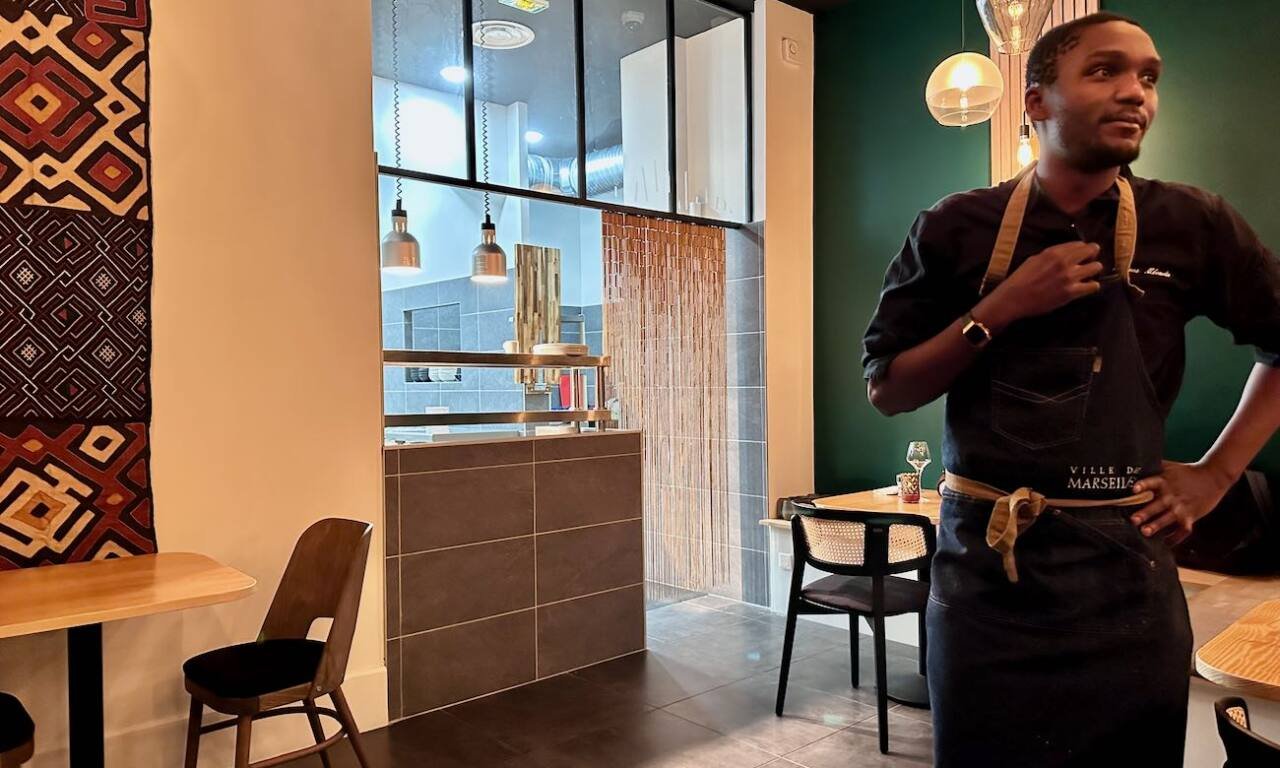
The physical space at 10 Rue Francis Davso reinforces that sense of intention. Rue Francis Davso is a pedestrian street in the 1st arrondissement, walkable from the Vieux-Port, which places Kin firmly in the tourist-accessible centre of Marseille without feeling like it is trading on that footfall. The dining room is intimate in scale, which is what you should expect from a tasting menu operation of this kind. The format demands that the kitchen controls the pace and the room supports it. There is no evidence of a large, high-turnover layout here. What that means practically: if you are arriving as a group of four or more, contact the restaurant in advance to confirm seating configuration. For two, the standard reservation process should be sufficient.
Menu's architecture is where Kin earns its recommendation. Mbenda changes the menu every fortnight, which is a meaningful commitment for a kitchen of this size and an important signal for repeat visitors. A menu documented in the restaurant's Michelin record includes manioc crisps with sweet chilli and burnt onion cream as an opener, which gives you the structural logic immediately: a recognisable West and Central African starch ingredient, treated with precision, paired with a sauce that delivers acidity and sweetness in calibrated proportion. The progression moves toward dishes such as crispy Angus beef onglet with dibi sauce, white asparagus, and puffed thiéré. Dibi is a West African spiced meat preparation; thiéré is Senegalese couscous made from millet. The fact that Mbenda is drawing on culinary grammar beyond Congolese cooking specifically and into a broader Central and West African register is a deliberate choice, not a lack of focus. It extends the menu's range across a single coherent cultural region rather than collapsing it into a single national cuisine.
What the tasting menu format does here that an à la carte format could not is build a narrative. Each course positions you to understand the next one. The manioc crisps are not just a snack; they establish that you are in a kitchen comfortable with fermented, roasted, and dried starch preparations as primary flavour vehicles. By the time you reach the onglet, the dibi sauce reads as a continuation of that logic rather than an unfamiliar element. This is tasting menu architecture done with genuine intentionality, not a prix-fixe assembled from separate à la carte dishes.
At lunchtime, Kin operates under a different format. Libala, described as the chef's first cross-cultural street food restaurant, occupies the same address with a simpler, less formal menu. If the full dinner tasting menu is beyond your budget or timing, Libala offers a lower-commitment entry point to Mbenda's cooking. For the complete experience of what Kin is, however, dinner is the format that justifies the visit.
On the value question: at €€€, Kin is cheaper than the three Michelin-starred AM par Alexandre Mazzia and the starred Le Petit Nice, both of which sit at €€€€. It is priced in the same tier as Une Table, au Sud but without the starred premium, which means the price-to-experience ratio is strong. For the broader context of what high-ambition tasting menus in France look like, the country's reference points include Mirazur in Menton, Troisgros in Ouches, and Bras in Laguiole. Kin is not in that company in terms of institutional recognition, but it is doing something none of those restaurants are doing: building a French tasting menu around Central and West African culinary tradition at a price point that does not require a special occasion justification. Internationally, the closest comparable concepts are Chishuru in London and Dōgon in Washington D.C., both of which are operating in a similar space of fine-dining frameworks applied to African culinary traditions.
Booking is direct. Kin does not appear to have the weeks-in-advance pressure of starred restaurants in Marseille. Given the fortnightly menu rotation, timing your visit around a specific menu iteration is not practical. Go when you can get a table. The ingredient-driven, seasonally responsive format means the menu will be coherent whenever you arrive.
For explorers looking to understand Marseille's restaurant range beyond Provençal and Mediterranean cooking, Kin is the most compelling argument in the city. See our full Marseille restaurants guide for broader context, and if you are planning a longer stay, our Marseille hotels guide, bars guide, and experiences guide cover the rest of the city.
Frequently Asked Questions
Is the tasting menu worth it at Kin?
- Yes, at the €€€ price point, the fortnightly-rotating set menu delivers a level of culinary specificity and technical execution that is rare in Marseille at this price tier. The Michelin Plate (2025) and a 4.9 Google rating across 307 reviews support that verdict. If tasting menus are your preferred format, book dinner rather than the Libala lunch offering.
Is Kin worth the price?
- At €€€, Kin is priced below the starred restaurants in Marseille (Le Petit Nice, AM par Alexandre Mazzia, Une Table au Sud all sit at €€€€) while offering a focused tasting menu format and Michelin Plate recognition. The value case is strong, particularly given the fortnightly menu rotation, which signals ongoing kitchen investment.
What should I order at Kin?
- There is no ordering decision at dinner: Kin serves a single set menu only. The menu rotates every fortnight, so the specific dishes available on your visit will differ from published examples. Known dishes from the Michelin record include manioc crisps with sweet chilli and burnt onion cream, and crispy Angus beef onglet with dibi sauce, white asparagus, and puffed thiéré. Trust the progression rather than arriving with specific dish expectations.
Is Kin good for a special occasion?
- Yes, with one qualification. The intimate room and structured tasting menu format make it well-suited to a dinner occasion. At €€€ it is more accessible than Marseille's starred alternatives. If you need guaranteed private space or a fully à la carte menu for a group with varied preferences, a larger venue would serve better. For two people who are both open to tasting menus, Kin is a strong special occasion choice.
Is Kin good for solo dining?
- The tasting menu format works well for solo diners: no group coordination required, and the set menu removes any decision friction. The intimate scale of the room means a solo table is unlikely to feel awkward. Contact the restaurant in advance to confirm solo seating options, as counter or bar seating arrangements are not confirmed in available data.
Can I eat at the bar at Kin?
- Bar seating specifics are not confirmed in available data. Contact the restaurant directly at 10 Rue Francis Davso to ask. Note that the lunch format at Libala (same address) is more casual and may offer more flexible seating options than the dinner tasting menu service.
What are alternatives to Kin in Marseille?
- For fine dining with higher institutional recognition: AM par Alexandre Mazzia (three Michelin stars, €€€€) or Le Petit Nice (starred, seafood focus, €€€€). For modern cuisine at a comparable price: Une Table, au Sud. For Mediterranean cooking at a lower price point: Alivetu or Auffo. No other restaurant in Marseille is working in the same Congolese and West African tasting menu format as Kin.
Frequently Asked Questions
What are alternatives to Kin in Marseille?
For Michelin-level cooking in Marseille, AM par Alexandre Mazzia (three stars) is the city's reference point for serious tasting menus, though at a significantly higher price. Une Table, au Sud offers refined French Mediterranean cuisine at a comparable price tier to Kin. If you want a more casual, local Marseille experience, Chez Fonfon is the go-to for bouillabaisse. None of them offer what Kin does: a rotating Congolese-rooted set menu from a chef with a specific cultural point of view.
Is Kin good for solo dining?
A fortnightly-changing set menu format at Kin suits solo diners well — you order nothing, there are no shared-plate logistics, and the progression is self-contained. At €€€, it is a considered solo spend but not unreasonable for a Michelin Plate restaurant. Check whether counter or bar seating is available when booking, as that tends to make solo tasting-menu dining more comfortable.
What should I order at Kin?
There is no à la carte at dinner — Kin runs a single set menu only, and it changes every two weeks. Documented dishes include manioc crisps with sweet chilli and burnt onion cream, and crispy Angus beef onglet with dibi sauce, white asparagus, and puffed thiéré. At lunchtime, the adjacent Libala concept offers a simpler, more accessible street-food-influenced menu if you want a lower-commitment introduction to Chef Hugues Mbenda's cooking.
Is Kin good for a special occasion?
Yes, with a specific caveat: Kin suits occasions where the dining format itself is part of the gesture. A multi-course Congolese tasting menu from a Michelin Plate chef is a clear statement of intent, and the meticulous presentation supports a celebratory meal. It is a better fit for two people who eat adventurously than for a group with mixed dietary preferences, since there is no à la carte fallback at dinner.
Can I eat at the bar at Kin?
Bar or counter seating availability at Kin is not confirmed in available data. What is documented is that the dinner format is a single set menu for all guests, so the experience is consistent regardless of where you sit. For a more casual counter-style visit to Chef Mbenda's cooking, the lunchtime Libala concept at the same address is the more accessible option.
Is the tasting menu worth it at Kin?
For the specific format, yes. A fortnightly-rotating Congolese set menu — Michelin Plate recognised in 2025 — is genuinely rare in France, and the documented dishes show technical precision alongside a clear cultural identity. The value case holds if you are there for the tasting menu format and Chef Hugues Mbenda's Congolese-rooted cooking specifically. If you want à la carte flexibility or a Mediterranean-French frame, Une Table, au Sud is a closer match at a similar price tier.
Is Kin worth the price?
At €€€ with a Michelin Plate (2025) and a set menu that rotates every fortnight, Kin prices in line with other serious tasting-menu restaurants in Marseille without reaching the upper end of the market. The value is strongest if you engage with the format: multi-course, no substitutions, Congolese culinary tradition as the throughline. If you want a more flexible or lower-stakes introduction, the lunchtime Libala menu at the same address is the practical entry point.
Location
10 Rue Francis Davso, 13001 Marseille, France
Compare Kin
| Venue | Cuisine | Awards | Booking Difficulty | Value |
|---|---|---|---|---|
| Kin | African | Michelin Plate (2025); Chef Hugues Mbenda from Kinshasa (Democratic Republic of the Congo) delivers his Congolese cuisine in the form of a single set menu comprising several courses. This menu changes every fortnight and includes creations such as manioc crisps with sweet chilli and burnt onion cream; crispy Angus beef onglet, dibi sauce, white asparagus and puffed thiéré (Senegalese couscous). The ingredients are fresh, the presentation is meticulous and the flavours are sure to transport you. At lunchtime, Libala, the chef's first cross-cultural street food restaurant, has a simpler menu. | Easy | — |
| AM par Alexandre Mazzia | French, Creative | Michelin 3 Star | Unknown | — |
| Une Table, au Sud | Modern Cuisine | Michelin 1 Star | Unknown | — |
| Chez Fonfon | French Bistro, Seafood | Unknown | — | |
| Le Petit Nice | French Seafood, Seafood | Michelin 3 Star | Unknown | — |
| Chez Etienne | Provencal | Unknown | — |
What to weigh when choosing between Kin and alternatives.
Also Consider
- AM par Alexandre Mazzia — French, Creative, €€€€
- Une Table, au Sud — Modern Cuisine, €€€€
- Chez Fonfon — French Bistro, Seafood, €€€
- Le Petit Nice — French Seafood, Seafood, €€€€
- Chez Etienne — Provencal, Provencal
Kin sits at €€€, which immediately separates it from most of Marseille's serious tasting menu restaurants. AM par Alexandre Mazzia (three Michelin stars, €€€€) and Le Petit Nice (starred, seafood-led, €€€€) are both operating at a higher price point and a higher institutional level. If your priority is the most decorated restaurant in Marseille and price is secondary, AM par Alexandre Mazzia is the answer. If you want the best seafood tasting experience the city offers, Le Petit Nice is the booking. Kin competes on neither of those grounds and does not need to: it is doing something categorically different.
Une Table, au Sud (€€€€, modern cuisine) is the closest in format to Kin in terms of a structured dining experience, but it is priced a tier higher and works within a French-Mediterranean register rather than a Central and West African one. For diners choosing between the two on value, Kin wins on price. For diners who want the most refined Mediterranean expression of Marseille's culinary identity, Une Table, au Sud is the stronger call. Chez Fonfon (€€€, French bistro and seafood) offers the classic Marseille bouillabaisse experience and is the right booking if you want a Provençal seafood meal rather than a tasting menu. These two are not in direct competition: one is about place, the other about a specific culinary tradition.
For the food-focused traveller who wants to eat something in Marseille that is not available anywhere else in the city, and who is comfortable with a set menu format, Kin is the clearest recommendation in its price tier. It books more easily than the starred options and delivers a more singular experience than the bistro alternatives. If you are already planning a trip that includes AM par Alexandre Mazzia for your headline meal, Kin works well as a second dinner that covers completely different ground.
Recognized By

Explore Marseille
Save or rate Kin on Pearl
Keep this venue in your Pearl passport, rate it after you visit, and track it alongside every other place you collect.