
Restaurant in Faaa, French Polynesia
Restaurant Te Tiare
100ptsPacific Hotel Dining
About Restaurant Te Tiare
Set within the InterContinental Tahiti in Faaa, Restaurant Te Tiare sits at the intersection of French Polynesian hospitality and island-sourced dining. The restaurant draws on the surrounding Pacific environment, positioning it within a small tier of Tahiti-area dining rooms where geography shapes what arrives on the plate. For visitors arriving into or departing from Faaa, it offers a grounded introduction to the food culture of the Windward Islands.
Where the Pacific Sets the Table
In French Polynesia, the question of what to eat is almost always answered by where you are standing. The islands that make up the Windward group, including Tahiti itself, sit in one of the most ingredient-rich marine environments on the planet: lagoon fish pulled the same morning, breadfruit grown in volcanic soil, vanilla from nearby Taha'a, and taro cultivated in valleys that have been farmed for centuries. Restaurant Te Tiare, situated within the InterContinental Tahiti in Faaa, operates inside that context. The hotel's waterfront position on the western edge of Tahiti, facing Moorea across the Sea of the Moon, means the kitchen is geographically close to the sourcing that defines this cuisine at its most direct.
That proximity matters more here than it might in a continental city. French Polynesia's supply chains are constrained by distance from major import hubs, which has historically pushed hotel kitchens in either direction: toward expensive flown-in ingredients that signal international prestige, or toward the local market, which rewards cooks willing to work with what the islands actually produce. The restaurants in Tahiti that tend to hold their position over time, places like L'O A La Bouche in Papeete and Blue Banana in Punaauia, have generally leaned toward the latter. The logic is direct: in a place where the ocean is this close, the argument for local sourcing writes itself.
The Setting and What It Signals
The InterContinental Tahiti is one of the larger hotel properties on the island, which places Te Tiare in a specific dining tier: a full-service restaurant attached to an internationally flagged hotel, operating for a guest base that includes both leisure travelers and transit visitors moving through Faaa's nearby international airport. That context shapes the room's register. Unlike the smaller, more intimate dining formats found at properties on outer islands, such as Le Taha'a in Tahaa or Restaurant Te Honu Iti in Moorea Maiao, a hotel dining room of this scale carries the practical demands of volume and consistency alongside any culinary ambition.
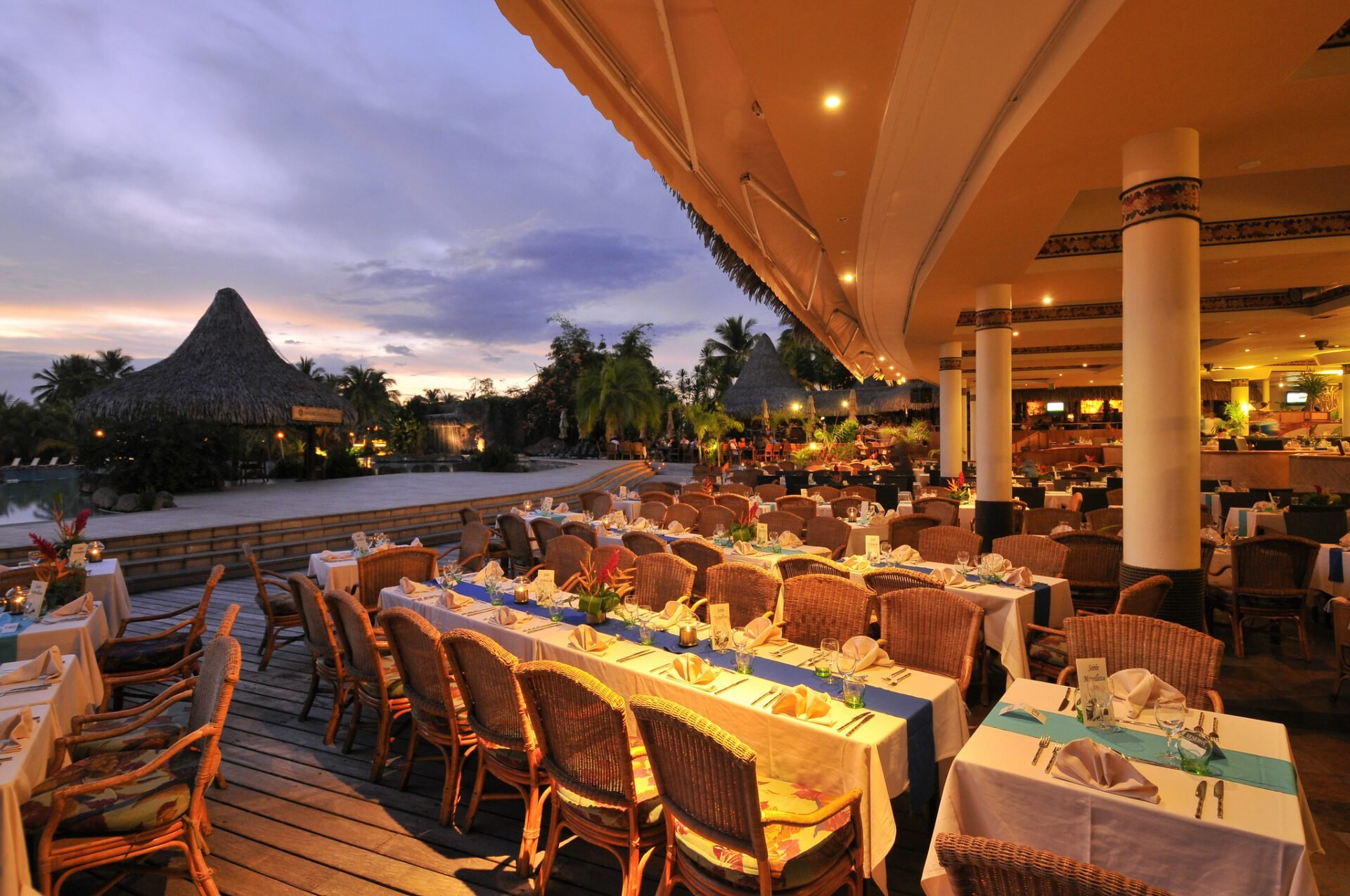
Approached from the hotel's open-air lobby, the setting orients itself toward the water. The lagoon view across to Moorea is the room's defining feature, and in French Polynesia, architecture and environment have long been understood as a single system rather than separate concerns. Overwater bungalows, open-sided dining pavilions, the persistent trade winds moving through interior spaces: these are not decorative choices but structural ones. A restaurant that sits facing Moorea at dusk is making a claim about what kind of experience it offers before the menu arrives.
Ingredient Geography in French Polynesia
The raw ingredient map of the Windward Islands rewards attention. Tahitian vanilla is among the most documented agricultural products in the Pacific, grown primarily on Taha'a but traded and used across the island group. Lagoon fish, including parrotfish, grouper, and surgeonfish, form the protein backbone of local cooking, prepared in styles that range from poisson cru, the lime-and-coconut-milk preparation that functions as French Polynesia's most recognizable dish, to grilled preparations borrowed from the French culinary tradition that has been embedded here since the mid-nineteenth century.
That French influence is not superficial. French Polynesia has been a collectivity of France since 1946, and the culinary vocabulary that came with that relationship, the sauces, the bread culture, the wine service, the formal dining room conventions, sits alongside older Polynesian food traditions in a way that has produced a genuinely distinct regional cuisine. The most considered restaurants in the territory tend to treat this duality as a resource rather than a tension. Comparable patterns exist at high-altitude or geographically remote restaurants elsewhere, where isolation from global supply chains pushes kitchens toward creativity with local ingredients: a dynamic visible at places like Atelier Moessmer Norbert Niederkofler in Brunico, which has built its entire program around Alpine sourcing, or Dal Pescatore in Runate, where regional specificity is the primary editorial argument. In French Polynesia, the equivalent argument centers on the lagoon, the volcanic soil, and the vanilla trade.
Positioning Within Tahiti's Dining Scene
Faaa itself is primarily known as the location of Tahiti Faa'a International Airport rather than as a dining destination in its own right. The concentration of notable restaurants on Tahiti sits in Papeete to the east and in smaller communities along the western coastline toward Punaauia. Te Tiare's position within the InterContinental Tahiti means it operates somewhat apart from that independent restaurant scene, drawing primarily from the hotel's captive audience rather than from Tahiti residents seeking out a specific kitchen.
That distinction matters for how to read the restaurant relative to peers. Across the outer islands, hotel dining has increasingly been where the most considered cooking happens, simply because the resources of a full hotel operation, consistent staffing, cold-chain logistics, maintained wine programs, can support a kitchen in ways a small independent cannot. Otemanu in Vaitape and The Lucky House Fare Manuia Restaurant in Bora Bora illustrate how hotel-adjacent dining formats distribute across the archipelago. Te Tiare occupies a similar structural position on the main island, within a property that can support the infrastructure a larger dining room requires. For a broader picture of where this fits within the territory's dining geography, see our full Faaa restaurants guide.
Visitors with time to extend beyond Faaa will find the outer-island comparisons instructive. Loula et Rémy in Taiarapu Est, Le Kenae in Taiohae in the Marquesas, and O Belvédère in Pira E each represent a different configuration of French Polynesian dining, from the remote and ingredient-driven to the scenically spectacular. Against that spread, Te Tiare sits at the more accessible end: a hotel dining room with lagoon views, positioned for the kind of meal that works as an arrival or departure experience rather than a standalone destination.
Planning a Visit
The InterContinental Tahiti sits in Faaa, a short drive from the international airport and roughly fifteen to twenty minutes from central Papeete depending on traffic. For travelers connecting through Tahiti on the way to Bora Bora, Moorea, or the Marquesas, the hotel is a logical first or last night, and Te Tiare operates as the property's primary dining room. Given the hotel's international profile, reservations for non-hotel guests are worth confirming in advance, particularly during peak travel periods between July and August and around the December holiday window when visitor volume across the territory increases. Dress expectations at this tier of hotel dining in French Polynesia tend toward smart-casual; the open-air or semi-open settings common to the region mean formal attire is rarely required or practical.
Frequently Asked Questions
- Can I bring kids to Restaurant Te Tiare?
- As a hotel dining room in Faaa, Te Tiare is generally more accommodating of families than the smaller, more format-driven restaurants found elsewhere in French Polynesia, though the pricing at an InterContinental property will reflect that hotel tier.
- What is the overall feel of Restaurant Te Tiare?
- The room reads as a lagoon-facing hotel dining room within one of Tahiti's larger international properties, closer in register to a polished resort restaurant than to the independent kitchens of Papeete. The Moorea view and open setting give it a sense of place that smaller hotel dining rooms on the island sometimes lack.
- What do people recommend at Restaurant Te Tiare?
- French Polynesian hotel dining rooms at this level typically anchor their menus around local fish preparations and poisson cru, the territory's most central dish. Without confirmed menu data, the safest expectation is a format that moves between local ingredient-led dishes and internationally legible French-inflected options, consistent with what kitchens of this type offer across the archipelago.
- Is Restaurant Te Tiare a good option for a meal before or after a flight from Faaa?
- Given its location within the InterContinental Tahiti, which sits close to Tahiti Faa'a International Airport, the restaurant is logistically well-placed for a pre- or post-flight meal. Hotel dining rooms in this configuration across French Polynesia, from the main island to outer archipelagos, tend to offer broader operating hours than independent restaurants, making them practical for travelers working around flight schedules rather than dining-room service windows.
Related editorial
- Best Fine Dining Restaurants in ParisFrom three-Michelin-star icons to the next generation of Parisian chefs pushing boundaries, these are the restaurants that define fine dining in the world's culinary capital.
- Best Luxury Hotels in RomeFrom rooftop terraces overlooking ancient ruins to Michelin-starred hotel dining, these are the luxury hotels that make Rome unforgettable.
- Best Cocktail Bars in KyotoFrom sleek lounges to hidden speakeasies, Kyoto's cocktail scene blends Japanese precision with global influence in ways you won't find anywhere else.
Save or rate Restaurant Te Tiare on Pearl
Keep this venue in your Pearl passport, rate it after you visit, and track it alongside every other place you collect.