
Restaurant in Weesen, Switzerland
Paradiesli
150ptsHillside Provenance Kitchen

About Paradiesli
Paradiesli sits above the village of Betlis on a single-lane mountain road that controls traffic in five-minute windows, and the deliberate friction of getting there is part of what defines the experience. The menu draws on named organic producers, with dishes like pork cheeks from Uelihof framing sourcing as the central editorial statement. A terrace with Lake Walen views and warm wooden interiors make the journey worthwhile for anyone willing to plan accordingly.
A Road That Makes You Earn the View
Swiss alpine dining has a habit of using geography as a filter. The most committed restaurants in the country's eastern cantons sit at the end of roads that discourage the casual visitor, and Paradiesli, above the village of Betlis outside Weesen, takes that principle to a literal extreme. The single road connecting Weesen to Betlis operates on a time-share system: traffic is released for five minutes at the half hour and the hour, in alternating directions. Arrive outside that window and you wait. The system is mundane logistics for locals but, for visiting diners, it functions as an accidental ritual — a pause before the meal, a moment where the mountain landscape stops being background and becomes foreground.
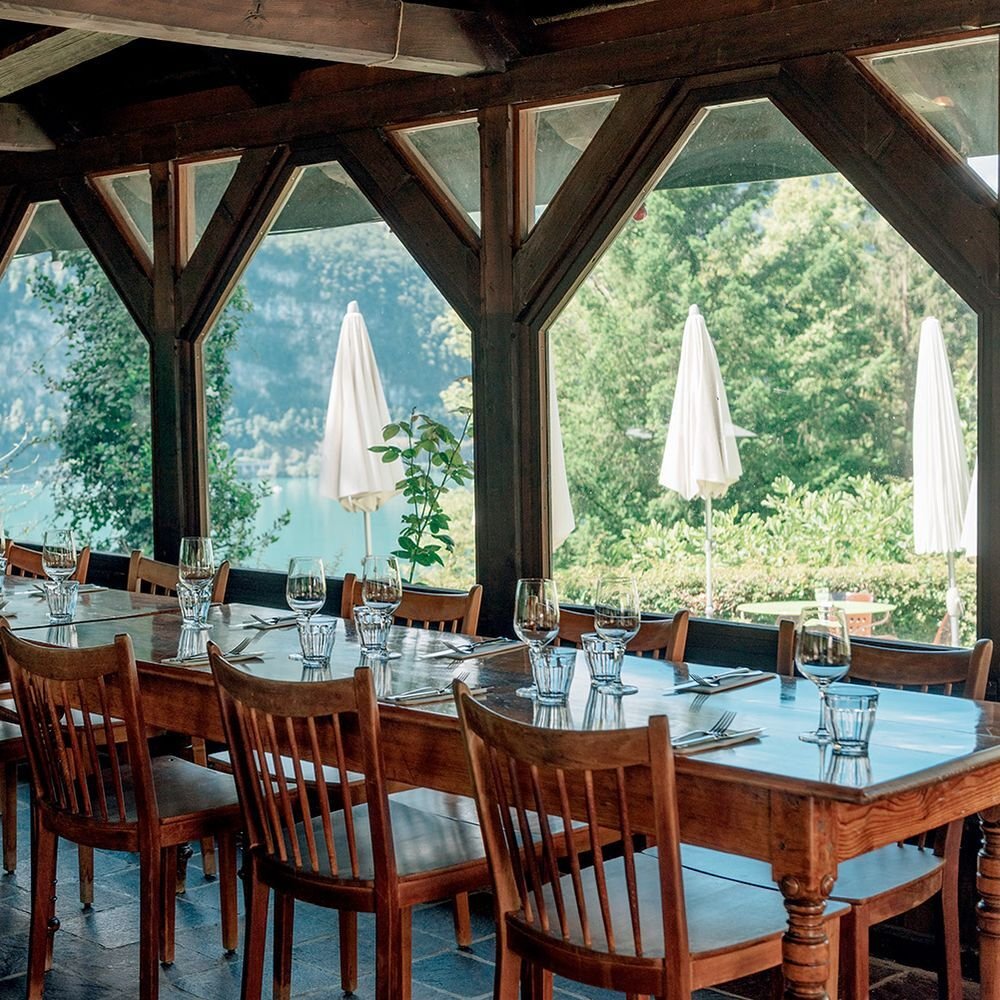
That landscape, once you reach Paradiesli, does a great deal of work. The terrace looks across to Lake Walen, the long glacial lake that sits between the Glarus Alps and the Churfirsten range, with greenery pressing in from every side. The phrase "corner of paradise" is not a marketing flourish here — it is the direct translation of the restaurant's name, and the location earns it without ambiguity. For context, the broader Weesen area sits at the western end of Lake Walen, roughly equidistant from the high-altitude dining of Memories in Bad Ragaz and the creative ambitions of Schloss Schauenstein in Fürstenau. Paradiesli operates at a different register from both , less formally driven, more rooted in the immediate terrain.
The Interior as an Extension of the Hillside
Inside, Paradiesli's wooden decor reads as an honest continuation of the landscape rather than a stylistic decision bolted onto a standard dining room. The material choice aligns with a broader tendency in alpine Swiss hospitality to use local timber as a structural and decorative element, creating spaces that feel continuous with the forests outside rather than insulated from them. The result here is an atmosphere that sits somewhere between a well-run country restaurant and a considered modern dining room: unpretentious in register, but not indifferent to detail.
This balance matters in the context of Swiss regional dining, where the gap between high-formality establishments , the kind that occupy the same peer group as Cheval Blanc by Peter Knogl in Basel or Hotel de Ville Crissier in Crissier , and genuinely relaxed regional kitchens is often wider than visitors expect. Paradiesli occupies the relaxed end of that spectrum without surrendering quality. The same kitchen group also operates Wirtschaft im FRANZ in Zurich, which provides a useful urban reference point: the Zurich sibling suggests a consistent culinary sensibility across both locations rather than an isolated rural project.
Sourcing as the Kitchen's Central Argument
The menu at Paradiesli is where the editorial angle becomes clearest. In a country where provenance labelling has become standard even at mid-range restaurants, the specificity of named producers on a menu carries more weight than the gesture alone. Listing organic pork cheeks from Uelihof is not decorative , it connects the dish to a particular farm, a particular raising standard, and implicitly to the agricultural geography of the Swiss plateau. That kind of named sourcing places the kitchen in a lineage of Swiss regional cooking that takes the link between landscape and plate seriously, distinct from the internationalist menus of focus ATELIER in Vitznau or the technically ambitious programmes at 7132 Silver in Vals.
The dish construction reinforces this. Pork cheeks from a named organic farm, served with Serviettenknödel , a traditional bread dumpling , and raw fennel salad is not a menu entry trying to impress through technique. It is a menu entry trying to impress through coherence: a cut that requires long, patient cooking, a bread-based accompaniment with deep roots in German-speaking alpine kitchens, and a raw element that provides textural contrast without complicating the sourcing story. The same logic runs through the smaller plates. Pickled vegetables and a combination of lettuce leaves, herb quark, and popped buckwheat are built from accessible, seasonal, and largely local ingredients. The buckwheat in particular is worth noting: it is a crop with genuine historical significance in alpine farming regions, used here in a popped form that adds crunch without importing ingredient ambition from outside the region's culinary vocabulary.
Menu structure itself reflects an inclusive approach to dietary preference that Swiss regional kitchens have adopted with increasing conviction over the past decade. Three versions of the set menu , meat and fish, vegetarian, and vegan , are offered alongside the à la carte small and large plates. This is not a tokenistic accommodation but a structural commitment: building separate coherent menus for each dietary path requires a kitchen that thinks about sourcing and composition from multiple starting points simultaneously. Restaurants across eastern Switzerland, from the valley floors to higher elevations, have been moving in this direction, and Paradiesli's three-track set menu sits within that regional pattern.
Where Paradiesli Sits in the Regional Picture
Eastern Switzerland's dining scene outside its major cities tends to be read, by international visitors, through the lens of its few formally recognised restaurants. The Michelin-level ambition of Memories in Bad Ragaz or the creative rigour of Schloss Schauenstein are genuine reference points, but they describe only one register of what the region produces. Paradiesli describes a different one: a kitchen that prioritises coherence between place, ingredient, and atmosphere over technical ambition or formal ceremony. For visitors spending time around Lake Walen or moving through the Glarus valley, this distinction matters. The formal restaurants require planning months in advance and demand a specific kind of attention from the diner. Paradiesli asks only for a willingness to time your arrival to the road's schedule.
For those interested in exploring the broader Weesen area, Fischerstube offers a useful counterpoint, with its focus on local fish from the lake. The two restaurants together sketch out the range of what the Weesen area produces at table. Beyond restaurants, the full Weesen restaurants guide, hotels guide, bars guide, wineries guide, and experiences guide provide fuller coverage of the area. For those with wider Swiss itineraries, the kitchens at Colonnade in Lucerne, Da Vittorio in St. Moritz, and L'Atelier Robuchon in Geneva each represent distinct poles of Switzerland's formal dining spectrum. Further afield, Le Bernardin in New York City and Emeril's in New Orleans offer context for how sourcing-led kitchens operate at a different scale entirely.
Planning Your Visit
The Betlis road runs on its five-minute alternating schedule, which means that arriving at the right moment requires checking conditions locally before departure. The address is Obere Betliserstrasse 12, Weesen, and the restaurant is the kind of place that rewards booking ahead rather than arriving speculatively, particularly for terrace seating during warmer months when the Lake Walen view is at its most arresting. The connection to Wirtschaft im FRANZ in Zurich means that visitors already familiar with that urban sibling will find the culinary register consistent, though the setting at Paradiesli is the stronger draw of the two. The set menu structure , with meat and fish, vegetarian, and vegan tracks , makes advance communication of dietary preferences direct rather than an afterthought.
Frequently Asked Questions
Would Paradiesli be comfortable with kids?
Yes, the relaxed and unpretentious atmosphere makes it a reasonable choice for families visiting the Weesen area, though the road access logistics require adult planning and patience before arrival.
What's the vibe at Paradiesli?
If you appreciate a setting where the physical environment carries as much weight as the food on the plate, Paradiesli delivers that combination with conviction. The wooden interior is warm rather than rustic-for-show, the terrace over Lake Walen is the kind of view that justifies the drive, and the kitchen's approach to sourcing gives the meal a grounded, place-specific quality that distinguishes it from the formally driven kitchens elsewhere in eastern Switzerland. If you want ceremony or technical display, look to the region's Michelin-recognised addresses. If you want coherence between landscape, ingredient, and atmosphere at a more accessible register, this is where to come.
What should I eat at Paradiesli?
Order the pork cheeks from Uelihof if they appear on the menu: it is the dish that most directly articulates what the kitchen is arguing for, with named organic sourcing, a traditional alpine accompaniment in the Serviettenknödel, and a raw fennel element that keeps the plate from feeling heavy. If you prefer a structured approach, the set menu's three-track format means the vegetarian and vegan versions are built with the same sourcing logic rather than assembled as an afterthought to the meat programme.
Recognized By

Similar venues by awards
Related editorial
- Best Fine Dining Restaurants in ParisFrom three-Michelin-star icons to the next generation of Parisian chefs pushing boundaries, these are the restaurants that define fine dining in the world's culinary capital.
- Best Luxury Hotels in RomeFrom rooftop terraces overlooking ancient ruins to Michelin-starred hotel dining, these are the luxury hotels that make Rome unforgettable.
- Best Cocktail Bars in KyotoFrom sleek lounges to hidden speakeasies, Kyoto's cocktail scene blends Japanese precision with global influence in ways you won't find anywhere else.
Save or rate Paradiesli on Pearl
Keep this venue in your Pearl passport, rate it after you visit, and track it alongside every other place you collect.