
Restaurant in New York City, United States
Oda House
100ptsSouth Caucasus Table Dining

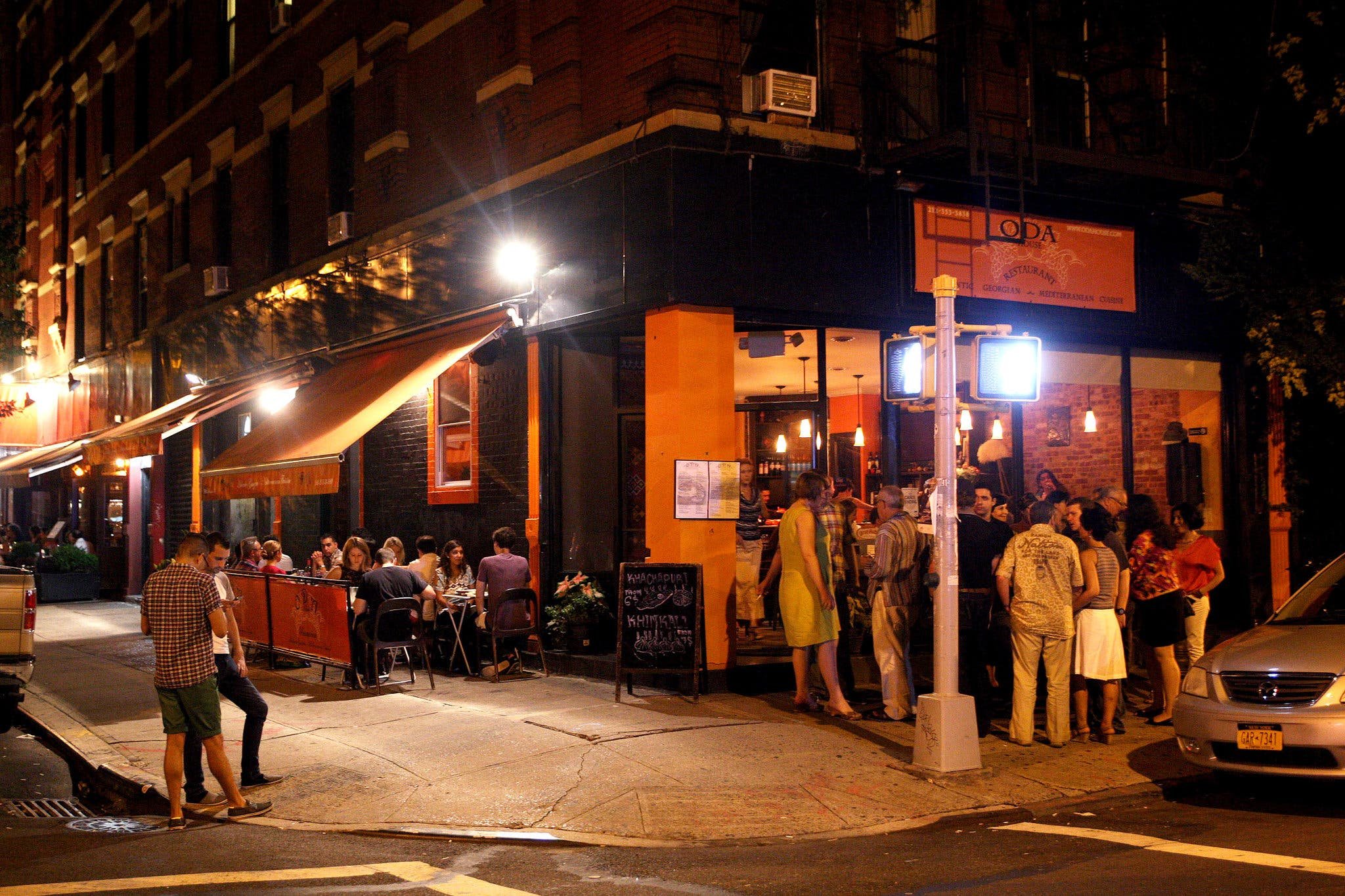
About Oda House
Oda House on East 73rd Street has served Georgian cuisine to the Upper East Side for years, holding a place on Opinionated About Dining's 2025 casual North America ranking with a 4.6 Google rating across more than 1,700 reviews. The kitchen works through the full register of the Caucasus table, from walnut-laden cold dishes to clay-pot braises, in a neighbourhood that otherwise skews Italian or French.
Georgian Cooking on the Upper East Side
New York's relationship with the cuisines of the South Caucasus has been quietly deepening for two decades. What began as a handful of Brighton Beach restaurants serving a largely immigrant clientele has gradually pushed into Manhattan, carried by a growing awareness that Georgian food, with its walnut pastes, tart pomegranate reductions, and herb-saturated salads, sits comfortably alongside any of the city's more established ethnic dining traditions. The Upper East Side is not where you would expect this shift to surface, but Oda House, on East 73rd Street, has occupied that address long enough to become a neighbourhood fixture rather than a novelty. Its 2025 Opinionated About Dining casual North America ranking, at position 560, places it inside a recognised peer set of serious casual restaurants, and its 4.6-star Google score across more than 1,700 reviews suggests a consistency that outlasts early enthusiasm.
For context on where Georgian sits in New York's broader restaurant scene, the city's prestige end is dominated by French and Japanese formats: Le Bernardin, Masa, Eleven Madison Park, and Atomix define the upper tier. Georgian dining operates in a different register entirely, one where the measure of quality is fidelity to a centuries-old table tradition rather than tasting-menu innovation. Oda House holds that position in Manhattan with more conviction than most.
How a Georgian Meal Sequences
The architecture of a traditional Georgian meal follows a logic that Western diners sometimes find disorienting at first: cold dishes arrive in number before hot food appears, wine flows throughout rather than being selected course by course, and bread, specifically the blistered, canoe-shaped shoti or the skillet-browned mchadi, is less an accompaniment than a structural element of the table. Understanding that sequence matters at Oda House, because the menu rewards those who order across its full range rather than defaulting to a single main.
The cold dishes carry much of the kitchen's identity. Walnut-based preparations are central to Georgian cooking, appearing in a compressed form packed around green beans or spinach in dishes like pkhali, or as a thick sauce coating fried eggplant rolls. These are not appetisers in the European sense; they are flavour anchors for the meal, introducing the bitter-sweet walnut note that recurs through the evening. Ordering three or four of these alongside good Georgian wine sets a tempo for the table that a single-dish approach cannot replicate.
Transition to hot dishes typically moves through bread to the stuffed dumplings called khinkali, which are among the most technique-dependent items in Georgian cooking. The pleated dough must hold a soup pocket of spiced meat or mushroom filling, and eating them correctly, pinching the knot, tilting to drink the broth before biting through the dough, is a small ritual that veteran diners at Oda House tend to coach first-timers through without prompting. After khinkali, the heavier dishes arrive: clay-pot preparations, bean stews, grilled meats, and the cheese-filled bread boat called adjarian khachapuri, whose egg-and-butter centre is stirred into the molten cheese before serving. That dish alone has become a marker of Georgian restaurant quality in New York, and versions vary considerably across the city's options.
Chef Maia Acquaviva leads the kitchen, and the menu reflects the kind of home-cook fluency with this cuisine that distinguishes restaurants rooted in a tradition from those approximating it. That distinction matters in a city where fusion interpretations of Caucasian food have appeared with increasing frequency. Oda House does not fold the cuisine toward Western comfort expectations.
The Upper East Side Context
East 73rd Street sits a few blocks from the park in a stretch of the Upper East Side where the dining options have historically leaned conservative: white-tablecloth Italian, old-school French, and neighbourhood American. That context makes Oda House's longevity here something worth noting. The restaurant has not survived by softening its programme; it has survived because the neighbourhood, which contains a sizeable community of residents with ties to the former Soviet states, has provided a loyal local base that the wider city has gradually joined.
The comparison that comes up most often in the Manhattan Georgian conversation is Chama Mama, which operates with a slightly different format and downtown energy. The two restaurants serve the same culinary tradition but pull from slightly different parts of the Georgian menu, and both have earned their place on the OAD casual list. For a visitor trying to understand the cuisine in depth, eating at both across a trip is a more instructive exercise than any single visit could provide.
New York's casual dining scene at this level sits in a recognisably different tier from the big-ticket rooms. The OAD casual North America ranking, which placed Oda House at 560 in 2025, is a peer group that includes serious regional specialists across the country, from neighbourhood-anchored rooms in New Orleans to dedicated format restaurants in San Francisco and Chicago. That Oda House holds a position there as the city's Georgian representative reflects both the quality of its execution and the relative scarcity of strong competition in this niche. For broader context on what the city offers across price points and cuisines, see our full New York City restaurants guide.
Georgian Wine at the Table
Any serious engagement with Georgian food requires engaging with Georgian wine, and Oda House's wine list is where this pairing tradition becomes concrete. Georgia's claim to be among the world's oldest wine-producing regions is well-documented; the qvevri clay-vessel fermentation method, used there for at least 8,000 years, was added to UNESCO's Intangible Cultural Heritage list in 2013. The amber wines produced by this method, sometimes called orange wines in Western markets, carry tannin and oxidative character that cuts through the walnut richness of Georgian cold dishes in a way that conventional white wine cannot. That pairing logic is embedded in the cuisine, and a restaurant serving Georgian food without a considered approach to these wines is missing a structural element of the table.
Planning Your Visit
Oda House is at 406 E 73rd Street in the Upper East Side. The 4.6-star rating across 1,700-plus Google reviews suggests reservations are worth making in advance for weekend evenings, though the restaurant's neighbourhood character means midweek visits tend to be more relaxed. For anyone building a broader New York itinerary, the New York City hotels guide, bars guide, and experiences guide cover the full city picture.
Quick reference: Oda House, 406 E 73rd St, Upper East Side, Manhattan. Georgian cuisine, OAD Casual North America 2025 ranked, 4.6 stars (1,700+ reviews).
Frequently Asked Questions
What should I eat at Oda House?
Order across the full Georgian table rather than treating it like a Western restaurant with a single main. Start with two or three cold walnut-based dishes, add khinkali dumplings as a mid-course, and move toward adjarian khachapuri and one clay-pot or grilled meat preparation. The OAD casual ranking and the kitchen's Georgian focus under Chef Maia Acquaviva both point to a programme where depth across the menu, not a single signature, is the correct approach. Pair with Georgian amber wine if available.
Can I walk in to Oda House?
With a 4.6 Google score across more than 1,700 reviews and a position on the 2025 OAD casual North America list, Oda House draws a consistent crowd. Walk-ins are more likely to succeed on weekday evenings than on Friday or Saturday nights. The Upper East Side location means the room tends to fill with regulars and neighbourhood diners who book ahead. If you are visiting from out of town, a reservation removes the uncertainty.
What's the signature at Oda House?
In the context of Georgian cuisine, the adjarian khachapuri, the cheese-filled bread boat finished with egg and butter, functions as the dish most diners point to as the measure of a kitchen's commitment to the tradition. At Oda House, the OAD casual recognition and the 4.6-star volume suggest consistent execution across the full menu rather than a single showpiece. Chef Acquaviva's programme leans on the walnut-based cold dishes and khinkali as much as the bread preparations, which places it in line with how the cuisine is understood in Georgia itself rather than how it is often abbreviated for Western markets. For comparison with other serious casual rooms in the city, see our New York City restaurants guide.
Recognized By

More restaurants in New York City
- Le BernardinLe Bernardin is one of the most consistently awarded seafood restaurants in the world — three Michelin stars, 99.5 points from La Liste, and four New York Times stars held for over 30 years. At $157 for four courses at dinner ($225 for the tasting menu), it is the right call for a formal occasion or a serious seafood meal in Midtown Manhattan, provided you book well in advance.
- AtomixAtomix is the No. 1 restaurant in North America (50 Best, 2025) and one of the hardest reservations in New York: 14 seats, one seating per night, three Michelin stars. Junghyun and Ellia Park's Korean tasting menu pairs precision-sourced ingredients with Korean culinary heritage, explained course by course through hand-designed cards. Book months ahead or plan around a cancellation.
- Eleven Madison ParkEleven Madison Park is the definitive case for plant-based fine dining in New York City: three Michelin stars, a 22,000-bottle wine cellar, and an eight-to-ten course tasting menu in a landmark Art Deco room. Book it for a special occasion with a plant-forward appetite and three hours to spare. Reservations open on the 1st of each month and go within hours.
- Jungsik New YorkJungsik is the restaurant that put progressive Korean fine dining on the New York map, and over a decade in, it still holds that position. With two Michelin stars, a 2025 James Beard Award for Outstanding Chef, and a seasonally rotating nine-course tasting menu in a quietly formal Tribeca room, it earns its $$$$ price point for special occasions and serious dining. Book well in advance.
- DanielDaniel is the benchmark for classic French fine dining in New York: three Michelin stars, a 10,000-bottle cellar, and formal Upper East Side service that has stayed consistent for over 30 years. Book four to six weeks out minimum. At $$$$, it is a genuine special-occasion restaurant, but the wine program alone — 2,000 selections with particular depth in Burgundy and Bordeaux — makes it the strongest wine-and-food pairing destination in its category.
- Per SePer Se is one of New York's two or three most complete special-occasion restaurants: three Michelin stars, Central Park views, and two nine-course tasting menus that change daily at $425 per person. Book exactly one month out — the window fills fast. The salon accepts walk-ins for à la carte if you miss the main dining room.
Related editorial
- How travel will be redefined by 2040By 2040, Travel Will Stop Being a Place You Go and Become a State You Inhabit Thesis: The defining shift in travel by 2040 will not be faster planes or smarter hotels — it will be the collapse of the
- How travel will be redefined by 2040By 2040, Travel Won't Be an Industry — It Will Be Infrastructure My thesis is simple and, I suspect, unfashionable: by 2040 travel will stop behaving like a discretionary consumer category and start
- How travel will be redefined by 2040By 2040, Travel Won't Be a Trip — It Will Be a Stack My thesis is simple and, I think, uncomfortable: by 2040, "travel" will no longer describe a discrete journey from point A to point B.
Save or rate Oda House on Pearl
Keep this venue in your Pearl passport, rate it after you visit, and track it alongside every other place you collect.