
Restaurant in Quebec City, Canada
Le Clocher Penché
200ptsBoreal Regional Sourcing


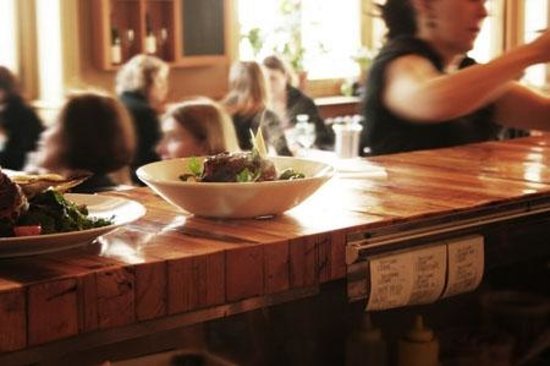
About Le Clocher Penché
Le Clocher Penché earned a Michelin Plate in 2025, placing it among a select tier of Québec City restaurants recognized for consistent kitchen quality. Sitting on Rue Saint-Joseph Est in the Saint-Roch neighbourhood, the restaurant works within a regional cuisine framework, drawing on local and seasonal sourcing. Google reviewers rate it 4.8 across more than 1,600 submissions — an unusually high volume for a mid-price dining room in this city.
Saint-Roch's Dining Identity and Where Le Clocher Penché Fits
Rue Saint-Joseph Est runs through Saint-Roch, a neighbourhood that shed its post-industrial vacancy over the past two decades and rebuilt itself around independent food businesses, small studios, and a working-class permanence that the Old City's tourism corridor never quite had. The restaurants that took root here tend to read differently from those clustered near the Château Frontenac: less theatrical, more ingredient-focused, drawing a clientele that lives and works in the city rather than passing through it. Le Clocher Penché, at 203 Rue Saint-Joseph Est, sits inside this pattern. The building itself carries the neighbourhood's architectural character — the name references the leaning bell tower visible nearby — and the dining room operates at a register that matches the street: accessible without being casual, considered without performing exclusivity.
For readers planning a broader stay, our full Québec City restaurants guide maps the city's dining across price points and neighbourhoods. The hotels guide, bars guide, and experiences guide cover the rest of the city's offer in the same depth.
Regional Cuisine and the Sourcing Logic Behind It
Québec's regional cuisine movement draws from a specific and well-documented larder: boreal forests that supply fiddleheads, chanterelles, and game; river systems that yield eel and freshwater fish; farms in the Île d'Orléans and Charlevoix that have supplied city kitchens for generations. The regional cuisine designation at Le Clocher Penché is not a marketing frame , it points to a sourcing discipline that connects the menu to place in ways that hold up under scrutiny. In a province where terroir is taken seriously at the table as well as in the vineyard, restaurants operating under this designation are implicitly making a claim about their supply chain and their kitchen's relationship to seasonal availability.
This matters more than it might seem. The distance between a restaurant that lists local suppliers on its menu and one that genuinely builds its menu around what those suppliers can deliver at a given time is large, and it shows in the cooking. At the $$$ price tier, Le Clocher Penché sits below the $$$$-rated creative and modernist kitchens in the city , places like Tanière³ and ARVI , but it occupies a distinct position rather than a lower one. The register here is bistro-adjacent, with the seasonal menu functioning as a running record of what the region produces rather than a fixed document around which a theatrical dining experience is constructed.
A Michelin Plate in Context
The 2025 Michelin Plate is the Guide's signal that a kitchen merits attention , not a star, but a consistent quality designation that separates recommended tables from the broader pool. In Québec City, where the Michelin Guide's arrival brought new international visibility to a dining scene that had been operating at high quality without that external framing, the Plate places Le Clocher Penché in a recognized tier of restaurants worth seeking out. The 4.8 rating across 1,630 Google reviews adds a different data layer: that volume at that score is harder to sustain than a single strong season, and it suggests a kitchen and service floor performing reliably over time rather than peaking occasionally.
For comparison within the city's recognized dining set, Le Clan and Kebec Club Privé occupy the creative end of Québec City's recognized tables, while Buvette Scott operates in a more casual, wine-bar-adjacent format. Le Clocher Penché sits between these poles , more structured than a buvette, less conceptually driven than the city's leading creative kitchens , and that positioning gives it a practical utility for repeat visitors and residents that the high-end tasting menu format cannot replicate.
How This Fits Into Canada's Regional Dining Conversation
The argument for regional cuisine as a serious culinary category rather than a provincial consolation prize has been made steadily across Canada over the past decade. Kitchens like AnnaLena in Vancouver, Alo in Toronto, and Restaurant Pearl Morissette in Lincoln have each, in different ways, made the case that Canadian ingredients and growing seasons can anchor cooking at a high level. In Québec specifically, Jérôme Ferrer's Europea in Montréal represents a longer-standing version of refined regional ambition, while Narval in Rimouski shows how the framework extends beyond the province's two major cities.
The international comparison is instructive too. Regional cuisine restaurants operating from a strong local larder in places like Künten-Sulz and Innervillgraten in the Alpine corridor have shown that deep sourcing from a specific geography can produce cooking that reads clearly as a place rather than a style. Le Clocher Penché operates in that same conceptual tradition, applied to Québec's particular range of boreal and agricultural supply. The Pine in Creemore offers another Canadian reference point for what this looks like when executed with conviction outside a major urban centre.
Planning Your Visit
Le Clocher Penché is at 203 Rue Saint-Joseph Est in Saint-Roch, a direct walk or short taxi from the Old City and well-connected by the city's main transit routes along Saint-Joseph. The $$$ pricing positions it as a dinner you plan for rather than a spontaneous drop-in, though the neighbourhood's accessibility and the restaurant's consistent review scores suggest a table is more achievable here than at Québec City's small-seat tasting menu counters. Given the Michelin Plate recognition from 2025 and the review volume, reservations are advisable, particularly on weekend evenings and during the summer tourist season when the city's dining capacity is under pressure. The Québec City wineries guide is worth consulting if you want to extend the regional sourcing logic into the glass, as the province's wine production has matured considerably and some producers now supply city restaurants directly.
Frequently Asked Questions
What dish is Le Clocher Penché famous for?
Le Clocher Penché operates within a regional cuisine framework, which means the menu tracks seasonal and local availability rather than anchoring to fixed signature dishes. The kitchen's Michelin Plate recognition in 2025 and its 4.8 score across more than 1,600 reviews point to consistent execution across the menu rather than a single standout preparation. Dishes built around Québec's boreal and agricultural larder , game, freshwater fish, foraged ingredients, Charlevoix-region produce , represent the kitchen's area of focus, but specific preparations vary with what the season and its suppliers deliver.
Recognized By


Similar venues by awards
Related editorial
- Asia's 50 Best Restaurants 2026: The Chairman and Wing Go 1-2 from the Same BuildingThe Chairman takes No. 1 and Wing climbs to No. 2 at Asia's 50 Best Restaurants 2026. Both operate from the same Hong Kong building. Here's what it means.
- Four Seasons Yachts Debut: 95 Suites, 11 Restaurants, and a March 2026 Maiden VoyageFour Seasons I launches March 20, 2026, with 95 suites, a one-to-one staff ratio, and 11 onboard restaurants. Worth tracking if you want hotel-grade service at sea.
- LA Michelin Guide 2026: Seven New Restaurants from Tlayudas to Uzbek DumplingsMichelin's March 2026 California Guide update adds six LA restaurants and one Montecito newcomer, spanning Oaxacan tlayudas, Uzbek manti, and Korean-Italian pasta.
Save or rate Le Clocher Penché on Pearl
Keep this venue in your Pearl passport, rate it after you visit, and track it alongside every other place you collect.