
Restaurant in Regensburg, Germany
Historische Wurstkuchl
100ptsCharcoal-Grilled Riverbank Tradition
About Historische Wurstkuchl
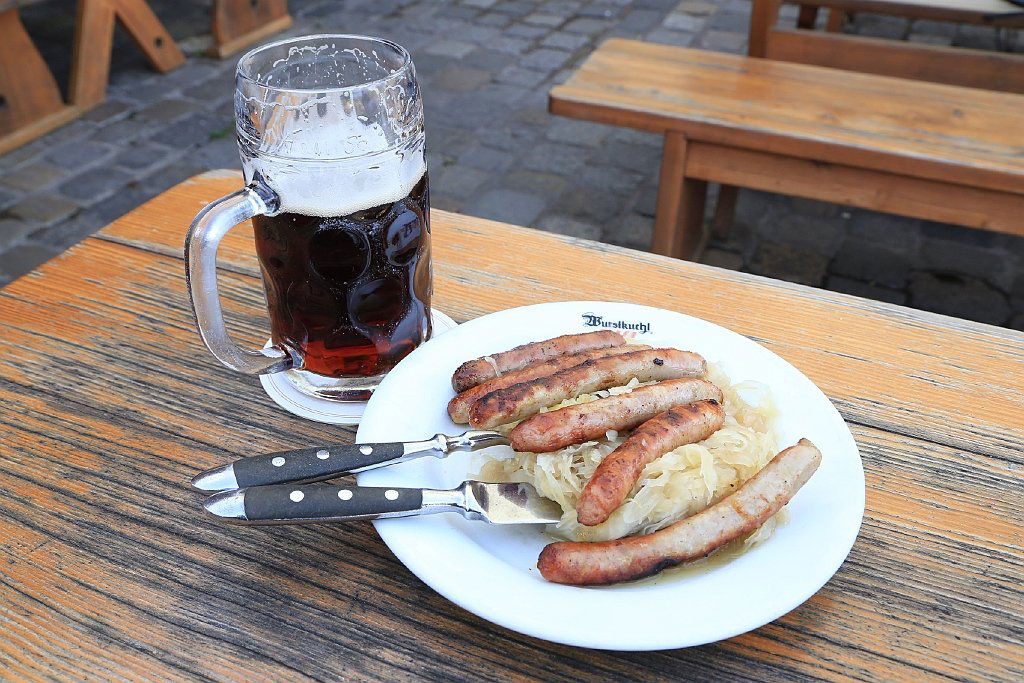
Few places in Germany eat as close to medieval riverbank history as the Historische Wurstkuchl on the Danube in Regensburg. Operating from a stone building beside the old Roman wall, this sausage kitchen has fed stonemasons, river traders, and travellers for centuries. The format remains unchanged: charcoal-grilled pork sausages, stone-ground mustard, and sauerkraut, eaten at wooden tables with the river in view.
Where the Danube Sets the Table
Approach the Historische Wurstkuchl from the old stone bridge at Regensburg and the scene arrives before the food does. The building sits almost at water level on the Danube bank, pressed against the remnants of a Roman porticus wall that predates the medieval city above it. On cooler mornings, smoke from the charcoal grills drifts low over the river. By midday, wooden benches fill with a cross-section of Regensburg that no restaurant interior could replicate: construction workers on lunch breaks, tourists navigating UNESCO-listed cobblestones, elderly locals who treat the visit as an established routine. The setting is not picturesque in a curated sense. It is something harder to manufacture — a place that has simply been here, doing the same thing, long enough that the city grew up around it.
The Sourcing Logic Behind a Six-Hundred-Year Menu
Germany's artisan butchery tradition runs deepest in Bavaria, where pork processing has been a civic institution since the medieval period. The Wurstkuchl sits squarely inside that tradition. The sausages served here follow a regional recipe tied to Regensburg's historical role as a trading hub on the Danube corridor — a route that brought spices, salt, and preserved goods through the city's stone warehouses. What distinguishes this kitchen's sourcing approach is its resistance to the kind of menu diversification that has crept into most heritage food establishments. The product list is short because the sourcing criteria are strict: pork, seasoning, wood, fire. Each component traces back to the same Bavarian agricultural and craft networks that supplied the original kitchen.
This matters in the context of contemporary German food culture, where provenance language has become a marketing reflex rather than an operational commitment. At the Wurstkuchl, the shortness of the menu is itself the provenance signal. There is nothing on the plate that requires explanation because there is nothing on the plate that needs to be justified. Sauerkraut fermented in the regional style, stone-ground mustard from local mills, and pork from Bavarian producers: these are not sourcing decisions framed for a tasting menu narrative. They are continuations of a supply chain that predates the concept of farm-to-table rhetoric by several centuries.
That framing places the Wurstkuchl in an interesting comparative position. Regensburg's contemporary fine dining offer includes Storstad and Ontra's Gourmetstube, both operating at the upper end of the city's creative register, and ROTER HAHN by Maximilian Schmidt, which brings modern technique to Bavarian ingredients. The Wurstkuchl operates in an entirely different register , not as a counterpoint to those kitchens, but as a category unto itself. Comparing it to fine dining venues is like comparing a 12th-century cathedral to a contemporary gallery: both are serious, both have audiences, but the criteria for evaluation are entirely different.
Fire, Fat, and the Absence of Complexity
The cooking method at the Wurstkuchl is charcoal grilling, which is not incidental. It is the technique. Pork sausages at this diameter and fat content require direct heat management that a gas range cannot replicate , the char, the rendered casing, the interior texture all depend on the specific heat curve of burning hardwood charcoal. Germany's broader sausage tradition involves dozens of regional variants, from the thin Nuremberg Rostbratwurst to the larger Thuringian styles, each with their own casing gauge, spice profile, and cooking discipline. Regensburg's version occupies its own position in that taxonomy, defined by the Wurstkuchl's particular ratios and the river-adjacent smoke that has seasoned the kitchen's walls for generations.
In an era when German restaurant ambition tends to look toward Schwarzwaldstube in Baiersbronn, Aqua in Wolfsburg, or Vendôme in Bergisch Gladbach for reference points, the Wurstkuchl's refusal to evolve its format reads not as complacency but as a kind of institutional confidence. The same logic governs places like Waldhotel Sonnora in Dreis at the fine dining end , decades of consistency in a single direction. The Wurstkuchl's consistency is just expressed in charcoal and mustard rather than butter and truffles.
The Regensburg Context
Regensburg's old town is one of the better-preserved medieval urban cores in Central Europe, which partly explains why the Wurstkuchl's physical presence feels continuous rather than anachronistic. The city has not been extensively rebuilt or bombed flat and reconstructed, so the stone fabric around the sausage kitchen carries genuine age. The Roman wall section behind the building is archaeologically significant. Visitors arriving from the train station on foot pass through street-level evidence of two thousand years of settlement before reaching the river. That walk is part of the experience. The Wurstkuchl is not a standalone attraction; it is the endpoint of a route through layered urban history.
For visitors building a broader Regensburg food itinerary, the contrast between the Wurstkuchl and the city's current restaurant generation is instructive. Bella Tandoori Regensburg signals the city's growing international dining range, while the fine dining venues listed above show how younger Bavarian chefs are working with the same regional pantry at a different technical level. The Wurstkuchl sits outside that conversation entirely, which is precisely where it should sit. See our full Regensburg restaurants guide for the complete picture across price points and styles.
For reference to what high-heat, ingredient-disciplined cooking looks like at the other end of the ambition spectrum, the programming at JAN in Munich or the technique-led approaches at ES:SENZ in Grassau and Schanz in Piesport illustrate how seriously Bavaria and its surrounding regions now take ingredient provenance at the fine end. The Wurstkuchl preceded that conversation by several centuries. Internationally, the commitment to a single, sourced format finds parallels at venues like Le Bernardin in New York City and Lazy Bear in San Francisco , both known for format discipline applied over time , though the price tiers and audiences could not be more different. Further afield, Aska and CODA Dessert Dining in Berlin demonstrate how a constrained format, committed to fully, builds identity. The Wurstkuchl arrived at that conclusion before most of those kitchens existed. Similarly, Victor's Fine Dining by Christian Bau in Perl and Restaurant Haerlin in Hamburg each demonstrate what long-run commitment to a defined kitchen identity produces over decades. The Wurstkuchl measures that commitment in centuries.
Planning Your Visit
The Wurstkuchl operates from its address at Thundorferstraße 3, directly on the Danube riverbank, and is accessible on foot from Regensburg's old town in under ten minutes from most central points. Outdoor seating along the river fills quickly on warm days and during the weekend lunch window; arriving before noon or after the midday peak gives a better chance of settling without a wait. The format requires no booking and no dress consideration beyond whatever suits a riverside bench. Portions are priced accessibly by any measure, making this one of the few historical food institutions in Germany where cost is genuinely not a variable in the decision. Payment and service customs are informal and fast, consistent with a kitchen that has always prioritised throughput and simplicity over ceremony.
Frequently Asked Questions
- Is Historische Wurstkuchl good for families?
- For families visiting Regensburg, the Wurstkuchl's outdoor bench seating, accessible pricing, and simple format make it a practical stop rather than a logistical challenge. Children familiar with grilled sausages will find the menu immediately recognisable, and the riverside setting keeps the experience from feeling like a sit-down obligation. The informal service pace also means there is no pressure around timing or behaviour.
- What is the atmosphere like at Historische Wurstkuchl?
- The atmosphere is defined by the Danube riverbank rather than any interior design decision. Smoke from the charcoal grills, the sound of the river, and wooden bench seating create a setting that is genuinely historic without being staged. Unlike Regensburg's fine dining venues, which operate in curated interiors, the Wurstkuchl puts its atmosphere entirely outdoors and entirely in the hands of the city's geography. The mix of locals and visitors at any given time reflects the breadth of the city's food culture rather than a specific dining demographic.
- What do regulars order at Historische Wurstkuchl?
- The menu is short enough that the question almost answers itself. Charcoal-grilled pork sausages with stone-ground mustard and sauerkraut form the core of what is served, and regulars move through the limited format without needing a menu in hand. The discipline of the kitchen's offer, consistent with Regensburg's Bavarian sausage tradition, means repeat visitors are not choosing between options so much as choosing how many.
- How old is the Historische Wurstkuchl, and does that history affect the experience?
- The Wurstkuchl's origins are documented to the 12th century, making it one of the oldest continuously operating food establishments in the German-speaking world. That age is not incidental to the visit. The building sits against a section of Roman wall that predates the medieval kitchen itself, and the position on the Danube bank reflects the site's original function serving stonemasons and river workers. Visiting with that context in mind shifts the experience from a simple meal into a direct encounter with Bavarian food history at a specific, verifiable location.
Related editorial
- Asia's 50 Best Restaurants 2026: The Chairman and Wing Go 1-2 from the Same BuildingThe Chairman takes No. 1 and Wing climbs to No. 2 at Asia's 50 Best Restaurants 2026. Both operate from the same Hong Kong building. Here's what it means.
- Four Seasons Yachts Debut: 95 Suites, 11 Restaurants, and a March 2026 Maiden VoyageFour Seasons I launches March 20, 2026, with 95 suites, a one-to-one staff ratio, and 11 onboard restaurants. Worth tracking if you want hotel-grade service at sea.
- LA Michelin Guide 2026: Seven New Restaurants from Tlayudas to Uzbek DumplingsMichelin's March 2026 California Guide update adds six LA restaurants and one Montecito newcomer, spanning Oaxacan tlayudas, Uzbek manti, and Korean-Italian pasta.
Save or rate Historische Wurstkuchl on Pearl
Keep this venue in your Pearl passport, rate it after you visit, and track it alongside every other place you collect.