
Restaurant in Santa Cruz Do Sul, Brazil
Casa Gaspar Galeteria
100ptsRio Grande do Sul Galeteria Tradition
About Casa Gaspar Galeteria
Galeterias and the Rio Grande do Sul Table In the interior of Rio Grande do Sul, the galeteria is not a restaurant category so much as a social institution. The format traces directly to the waves of Italian immigration that reshaped the state's...
Galeterias and the Rio Grande do Sul Table
In the interior of Rio Grande do Sul, the galeteria is not a restaurant category so much as a social institution. The format traces directly to the waves of Italian immigration that reshaped the state's foodways in the nineteenth century, when northern Italian settlers brought with them a repertoire built around poultry, polenta, and the long Sunday table. Over generations, the galeteria became the default setting for family gatherings, civic lunches, and the particular kind of unhurried eating that the region's German and Italian descendants treat as a weekly obligation rather than an occasional luxury. Santa Cruz do Sul, a city whose economy pivots around tobacco cultivation and a deeply rooted European heritage, sustains that tradition with some consistency. Casa Gaspar Galeteria, addressed on Rua Gaspar Silveira Martins in the Santo Inácio neighbourhood, sits inside that tradition rather than commenting on it from outside.
The Galeteria Format, Placed in Context
Understanding what a galeteria offers requires separating it from the broader category of churrascaria, with which outside visitors sometimes confuse it. Where the churrascaria centres on beef and the rodízio service rhythm, the galeteria pivots around galeto, a young cockerel typically prepared on a spit or grill and served with the canonical accompaniments of polenta, salad, and farofa. The format is inherently communal: portions arrive for the table rather than the individual, the pace is set by conversation rather than by courses, and the register is domestic rather than theatrical. Across Rio Grande do Sul, galeterias function as a kind of culinary common ground, accessible to multiple income brackets and social contexts in a way that the state's more formal dining rooms are not. For visitors arriving in Santa Cruz do Sul from the dining scenes of Oteque in Rio de Janeiro or D.O.M. in São Paulo, the galeteria represents a deliberate gear change: no tasting menus, no wine pairings, no brigade service.
Santo Inácio and the Street Address
Rua Gaspar Silveira Martins is named for a nineteenth-century Rio Grande do Sul politician whose legacy runs through the region's infrastructure and civic memory. The street itself serves as a navigational spine through Santo Inácio, a neighbourhood that sits within a city of roughly 130,000 people and carries the mid-sized Brazilian interior's characteristic mix of commerce, residential blocks, and local institutions. Santa Cruz do Sul is roughly 150 kilometres west of Porto Alegre and is most commonly reached by road; the city has no commercial airport of its own. Visitors travelling from Porto Alegre typically find the drive manageable in under two hours, depending on traffic on the BR-290 and connecting routes. That access pattern matters for the galeteria context: most of Casa Gaspar Galeteria's clientele arrives by car, often in groups, which aligns with the format's communal logic. The venue's positioning on a named street in an established neighbourhood rather than in a shopping centre or hotel complex signals alignment with the traditional galeteria model, where the address itself communicates a degree of local rootedness.
Galeteria Dining Across Rio Grande do Sul
The regional table in Rio Grande do Sul has drawn increasing attention from Brazil's food press as the country's dining culture broadens beyond the São Paulo and Rio axis. Properties like Castelo Saint Andrews in Gramado and Primrose in Gramado represent the more formal end of the state's European-heritage dining, while Manu in Curitiba works in a modernist register. The galeteria occupies a different tier entirely: it is where the region's food culture is most direct and least performed. In that sense, a venue like Casa Gaspar Galeteria operates closer to the tradition's source than the polished restaurants that reference it from a distance. Comparable communal-table traditions elsewhere in Brazil, such as the shared plates at Birosca S2 in Belo Horizonte, share the sociability logic without the specific galeto format. The galeteria remains substantially a Rio Grande do Sul phenomenon, which gives the format a regional specificity that touring visitors from other parts of Brazil often cite as one of the more grounding food experiences the state offers.
What to Order and How to Approach It
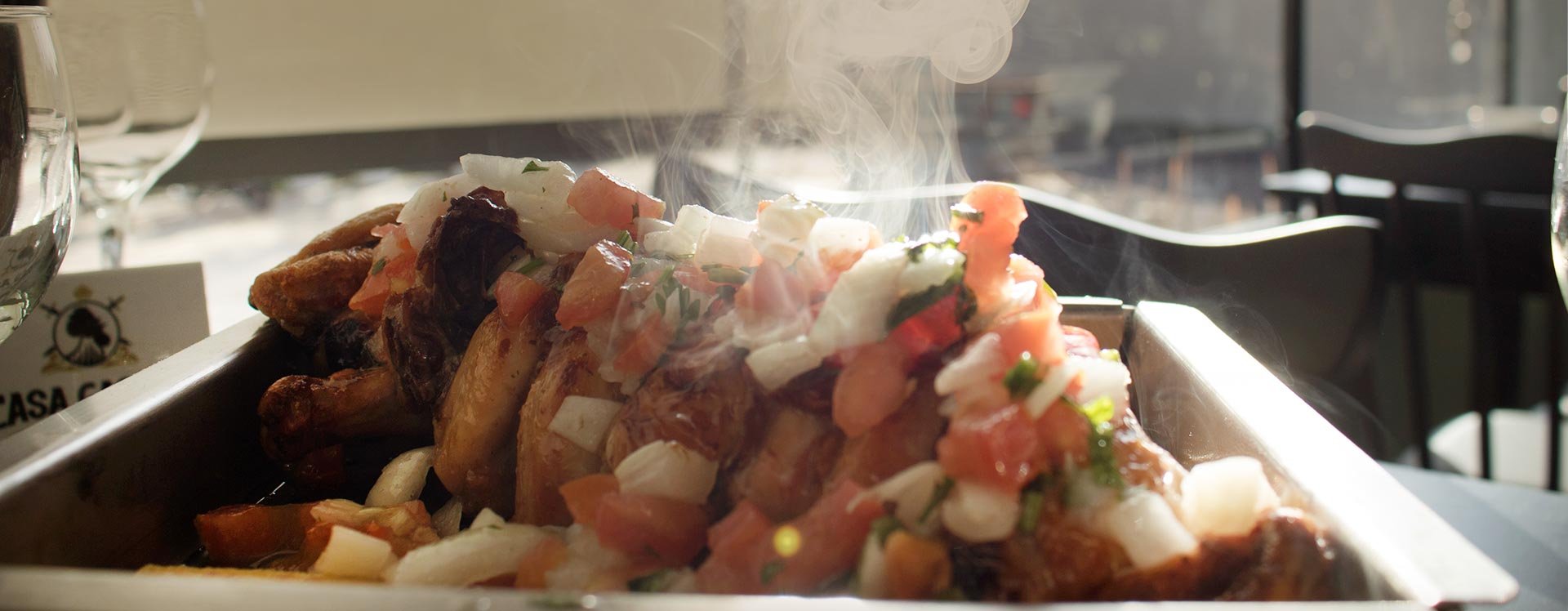
The galeto is the anchor of any galeteria visit, and the surrounding dishes function as support rather than competition. Polenta arrives either creamy or set and grilled depending on the kitchen's preference and the timing of the meal. Salads tend toward the simple and fresh rather than the elaborate, and farofa provides textural contrast. The overall architecture of the meal is one of repetition and abundance rather than progression; the expectation is that the table will be replenished rather than cleared between courses. For visitors more accustomed to the structured tasting formats of places like Lazy Bear in San Francisco or Le Bernardin in New York City, the informality requires a recalibration. The galeteria rewards the reader who approaches it as a local does: without urgency, with a group, and without a fixed end time. Santa Cruz do Sul's other dining options, including 360 Terra e Mar, Aero Burguer e Grill, Thomas Burger, and Mundo Animal Lanchonete Temática, operate in different registers and are leading understood in the context of the city's broader options covered in our full Santa Cruz do Sul restaurants guide.
Planning Your Visit
Specific hours, pricing, and reservation requirements for Casa Gaspar Galeteria are not confirmed in EP Club's current data. Galeterias in Rio Grande do Sul typically operate for lunch and dinner service, with Sunday lunch being the busiest session of the week; arriving early or calling ahead on weekends is advisable regardless of the specific venue. The format is generally walk-in friendly during weekday service but can see significant demand on weekends, particularly during family occasions and local holidays. The address at R. Gaspar Silveira Martins, 754, Santo Inácio, Santa Cruz do Sul, RS 96820-002 is the reference point for navigation. No dress code expectations apply in the galeteria format; the category's social function is inclusion rather than formality. For broader context on the regional tradition, the dining scenes at Mina in Campos do Jordão, Manga in Salvador, Orixás in Itacaré, and Olivetto in Campinas each illustrate how Brazilian regional food cultures develop distinct institutional formats that resist easy national categorisation.
Frequently Asked Questions
- What should I eat at Casa Gaspar Galeteria?
- The galeto, a young grilled cockerel, is the structural centre of the galeteria meal and the reference point against which everything else is measured. In the Rio Grande do Sul tradition, it arrives alongside polenta, fresh salad, and farofa; the logic is abundance and sharing rather than individual plating. The cuisine's roots are in northern Italian immigrant cooking filtered through more than a century of regional adaptation, which means the accompanying dishes carry as much cultural weight as the bird itself.
- Do I need a reservation for Casa Gaspar Galeteria?
- EP Club does not hold confirmed booking data for this venue. In the galeteria format generally, weekday lunches tend to be accessible without advance arrangements, while Sunday lunch, the week's social anchor in much of Rio Grande do Sul, attracts sustained demand. If you are visiting Santa Cruz do Sul on a weekend or travelling in a group, contacting the venue directly before arrival is the practical approach regardless of formal reservation requirements.
- What is the defining dish or idea at Casa Gaspar Galeteria?
- The defining idea is the galeteria as a social form rather than any single dish. The format encodes a particular relationship to time, company, and eating that differentiates Rio Grande do Sul's interior dining culture from the metropolitan dining rooms of São Paulo or Rio. The galeto is the culinary anchor, but the extended table, the communal portions, and the absence of theatrical service are what the format is actually delivering. In that sense, the meal is structured around participation rather than consumption.
- How does Casa Gaspar Galeteria fit into Santa Cruz do Sul's food identity?
- Santa Cruz do Sul's food culture reflects the city's European settlement history, particularly the Italian and German immigration patterns that shaped interior Rio Grande do Sul from the mid-nineteenth century onward. A galeteria on Rua Gaspar Silveira Martins, a street named for a figure central to the state's nineteenth-century political history, sits at the intersection of that heritage and everyday local dining. The venue operates within a city that treats the galeteria not as a nostalgic reference but as an active and ongoing social institution.
Related editorial
- Best Fine Dining Restaurants in ParisFrom three-Michelin-star icons to the next generation of Parisian chefs pushing boundaries, these are the restaurants that define fine dining in the world's culinary capital.
- Best Luxury Hotels in RomeFrom rooftop terraces overlooking ancient ruins to Michelin-starred hotel dining, these are the luxury hotels that make Rome unforgettable.
- Best Cocktail Bars in KyotoFrom sleek lounges to hidden speakeasies, Kyoto's cocktail scene blends Japanese precision with global influence in ways you won't find anywhere else.
Save or rate Casa Gaspar Galeteria on Pearl
Keep this venue in your Pearl passport, rate it after you visit, and track it alongside every other place you collect.