
Restaurant in Stockport, United Kingdom
Bombay to Mumbai
125ptsRegional Indian Depth

About Bombay to Mumbai
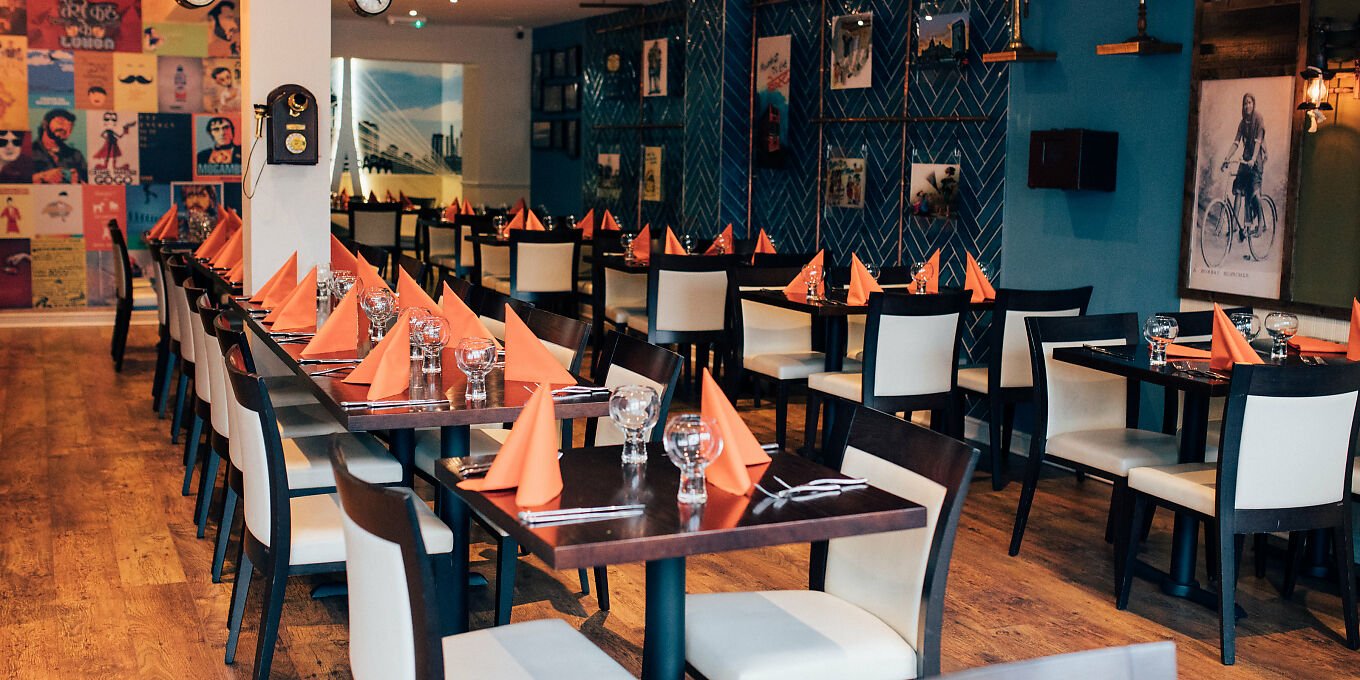
A residential Bramhall address belies the reach of Bombay to Mumbai, which draws diners from well beyond the SK7 postcode with a menu that spans Indo-Chinese specialities, Sindhi regional cooking, and Bollywood-named dishes built from distinct ingredient combinations. The interior runs to murals, framed photographs, and bright orange napkins, while the kitchen works a range that takes in charcoal-hung kebabs, masala dosa, and the crowd-favourite Mumbai sizzler.
Suburban address, serious cooking
Indian restaurants in Greater Manchester tend to cluster around city-centre corridors or the Rusholme Curry Mile, where proximity to footfall drives the economics and menus converge toward a recognisable north Indian standard. Bombay to Mumbai operates on a different logic. Situated on Fir Road in Bramhall, a residential pocket of Stockport, the restaurant sits in a neighbourhood of semi-detached houses and local shops, not a dining quarter. That geographical remove has, paradoxically, protected it: the clientele is locally rooted, repeat visits are high, and the kitchen has no commercial pressure to sand down its more particular regional edges in pursuit of passing trade.
For context on how this fits within Stockport's broader food scene, our full Stockport restaurants guide maps the range from neighbourhood locals to destination dining. The city also has strong offerings in bars, hotels, wineries, and experiences.
The room: colour as intent
Walk in and the interior makes its position clear immediately. Bollywood film posters share wall space with framed photographs and hand-painted murals; orange napkins sit on tables that fill a room designed to feel like a celebration rather than a dining exercise. This is not the stripped-back aesthetic of contemporary South Asian cooking rooms in London, where venues like The Ledbury or the modern British register of Moor Hall in Aughton operate in spaces of deliberate restraint. Bombay to Mumbai is closer to the tradition of the Indian family restaurant as social event, where the environment signals generosity rather than minimalism. Staff are consistently described as welcoming and willing to guide first-time visitors through the menu, which matters given the range on offer.
Where the food comes from — and why the geography matters
The menu's distinctiveness derives from its refusal to collapse India's regional cooking into a single idiom. Indian restaurant menus in the UK have historically converged around a north Indian-Mughal framework: butter chicken, rogan josh, korma, balti. That framework has its own logic and audience, but it represents one strand of a much wider cuisine. Bombay to Mumbai pulls from at least three distinct registers that require different ingredient traditions and techniques.
The first is Sindhi cooking, rooted in the region now largely in Pakistan, which co-owner Sandeep Gursahani's background connects the kitchen to directly. Sindhi cuisine is characterised by a different spice grammar than Punjabi cooking: tamarind features prominently, as does the combination of sweet and sour alongside savoury, and the proteins and preparations reflect a landlocked, agricultural heritage. Dishes from this tradition are rarely seen on mainstream UK Indian menus, which makes their presence here a meaningful point of difference.
Second register is Indo-Chinese, the cooking style that developed in Kolkata's Chinese community and spread through urban India during the 20th century. Indo-Chinese dishes work with Chinese techniques and ingredient frameworks but run them through Indian spicing: wok-fried proteins with chilli and soy, fried rice with Indian spices, noodles with cumin-forward sauces. The flavour profile is distinct from both Chinese cooking and Indian cooking and represents a genuine culinary tradition rather than a fusion experiment. It is also almost entirely absent from the standard UK Indian restaurant repertoire.
Third register is a broader all-India range of regional winners that includes dishes with established track records across the subcontinent. The Lai Bhaari, for instance, is a lamb preparation that draws on a specific combination of jaggery, tamarind, and peanuts, ingredients that appear together in western and central Indian cooking where sweet-sour-savoury balance is a structural principle rather than an accent. This is not a curry-house adaptation; the sauce architecture requires correct sourcing and proportioning of those three components to work.
Charcoal element in the kitchen, used for hanging kebabs over smouldering coals, reflects the tandoor and live-fire traditions of north Indian street cooking. The technique produces smoke penetration that gas or electric cooking cannot replicate, and its presence in a suburban Stockport restaurant signals the kind of operational commitment to method that goes beyond standard kitchen setup.
For comparison, venues like Where The Light Gets In and Cantaloupe represent Stockport's modern British and contemporary dining registers. Bombay to Mumbai occupies a distinct lane, one where the measure of quality is fidelity to regional Indian cooking traditions rather than alignment with European fine dining codes. The two modes of cooking ask for entirely different things from a kitchen, and the comparison is illustrative rather than competitive.
The menu in practice
The range runs from masala dosa with coconut chutney — a South Indian staple that requires correct fermentation of the rice and lentil batter and proper seasoning of the potato filling , to the Mumbai sizzler, which arrives on a fiercely hot cast-iron skillet with paneer, onions, stuffed pepper, makhani sauce, and rice. The sizzler format is an Indian restaurant theatrical tradition with deep roots in Bombay's café culture, and the accompanying onion and chilli kulcha is the correct bread pairing for makhani-based dishes.
Bollywood film titles and character names appear as dish names across the menu, a piece of cultural framing that reflects the co-owners' commitment to a specific vision of Indian urban food culture rather than a generic subcontinental presentation. Regulars report knowing much of the repertoire well, though occasional specials introduce new preparations.
Drinks run to Indian beer and a set of Bollywood-themed cocktails, both appropriate to the register of the food and the room.
For those interested in how Indian cooking sits within the wider field of destination dining in the UK, comparisons might be made with the kind of ingredient-driven precision found at venues like L'Enclume in Cartmel, Le Manoir aux Quat' Saisons in Great Milton, or Midsummer House in Cambridge, though the price points and formats are entirely different. The point is that fidelity to a specific culinary tradition, whether French classical or Sindhi regional, requires sourcing and technique decisions that push against the easiest and cheapest path. Gidleigh Park in Chagford, Hand and Flowers in Marlow, hide and fox in Saltwood, Waterside Inn in Bray, Le Bernardin in New York City, and Emeril's in New Orleans all occupy different price tiers and cooking traditions, but share the same underlying logic: the food reflects where it comes from and who is cooking it.
Planning your visit
Bombay to Mumbai is at 10 Fir Road, Bramhall, Stockport SK7 2NP. The residential location means it is not on a restaurant strip, so arriving by car is practical for most visitors. The restaurant's reputation has spread well beyond the immediate postcode, which means booking ahead is advisable, particularly on weekends. The room and staff are explicitly family-friendly: children are welcomed with the same attention given to adult diners, making this one of the more comfortable options for family groups in the area. No price range is listed in available data, but the neighbourhood positioning and local-restaurant model suggest pricing that reflects the Stockport suburban market rather than Manchester city-centre rates.
Frequently asked questions
- Would Bombay to Mumbai be comfortable with kids?
- Yes , the owners are known for welcoming children warmly, and the relaxed, colourful room suits family dining without reservation.
- What kind of setting is Bombay to Mumbai?
- A neighbourhood Indian restaurant in residential Bramhall, Stockport, with a colourful interior of Bollywood posters, murals, and bright table settings. It operates firmly in the local-favourite register, drawing repeat visitors from across Greater Manchester rather than positioning itself as a destination fine-dining room.
- What's the must-try dish at Bombay to Mumbai?
- Order the Lai Bhaari , the lamb dish built around jaggery, tamarind, and peanuts , to understand what separates this kitchen from the standard UK Indian restaurant repertoire. The Mumbai sizzler and the charcoal-hung chicken kebab are also frequently cited by regulars as the dishes that define the kitchen's range.
- Can I walk in to Bombay to Mumbai?
- The restaurant's fame has spread well beyond the SK7 postcode, so if you are visiting on a Friday or Saturday evening, booking ahead is the safer approach. For quieter midweek sessions, walk-ins may be possible, but given the neighbourhood setting and loyal regular base, availability is not guaranteed.
Recognized By

Related editorial
- Best Fine Dining Restaurants in ParisFrom three-Michelin-star icons to the next generation of Parisian chefs pushing boundaries, these are the restaurants that define fine dining in the world's culinary capital.
- Best Luxury Hotels in RomeFrom rooftop terraces overlooking ancient ruins to Michelin-starred hotel dining, these are the luxury hotels that make Rome unforgettable.
- Best Cocktail Bars in KyotoFrom sleek lounges to hidden speakeasies, Kyoto's cocktail scene blends Japanese precision with global influence in ways you won't find anywhere else.
Save or rate Bombay to Mumbai on Pearl
Keep this venue in your Pearl passport, rate it after you visit, and track it alongside every other place you collect.