
Restaurant in Wiesbaden, Germany
BENNER's Bistronomie
100ptsFine-Dining Instincts, Bistro Format
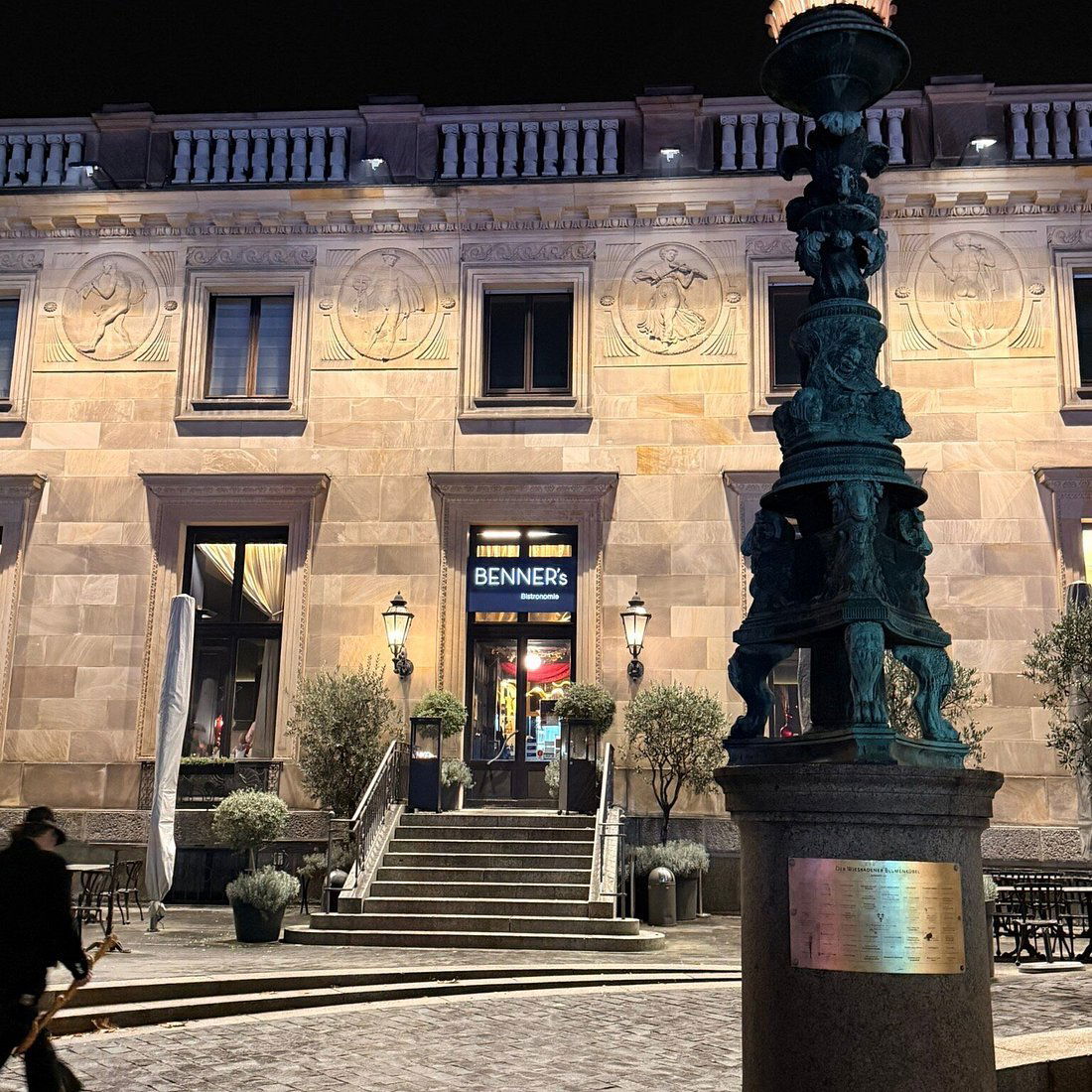
About BENNER's Bistronomie
BENNER's Bistronomie occupies one of Wiesbaden's most historically charged addresses, Kurhausplatz 1, placing it at the civic and architectural heart of a city that has always taken its pleasures seriously. The bistronomie format positions it between the white-tablecloth formality of Wiesbaden's established fine dining tier and the more casual end of the local restaurant scene — a gap that the German dining public has increasingly embraced over the past decade.
Kurhausplatz and the Bistronomie Argument
There are addresses in a city that carry weight before you cross the threshold, and Kurhausplatz 1 in Wiesbaden is one of them. The square anchors the spa quarter — colonnaded, wide, and arranged around the Kurhaus, a Wilhelmine palace of recreation that has hosted concert seasons, casino evenings, and political gatherings for over two centuries. Arriving here for dinner means arriving somewhere that the city considers its formal centre. The expectation set by the architecture is high, which makes the bistronomie proposition at BENNER's worth examining closely: in a square that invites grandeur, a format built around relaxed precision and seasonal cooking asks the room to carry two registers at once.
Bistronomie as a concept emerged from Paris in the 1990s and early 2000s, when a generation of chefs trained in three-star kitchens made a deliberate choice to shed ceremony and plate serious food in simpler rooms at accessible prices. The format crossed into Germany gradually, and it has found particular traction in cities with an existing fine dining infrastructure but a dining public increasingly resistant to its rituals. Wiesbaden fits that profile. The city has long supported a serious restaurant tier — Ente (Creative) operates at the €€€€ level, and DAS GOLDSTEIN BY GOLLNER'S (Seasonal Cuisine) takes a seasonal approach at a more accessible price point , and BENNER's positions itself in the space between those poles, where technique is visible but the occasion is not manufactured.
What the Bistronomie Format Delivers
The word bistronomie is doing specific work here. It signals a kitchen with fine dining instincts operating without the infrastructure costs and service choreography that push covers into the upper price brackets. In practice, that means sourcing decisions carry more weight than room décor, and the plate has to argue its own case without ceremony to soften the judgment. Across Germany's current restaurant generation , from JAN in Munich to the more experimental formats represented by CODA Dessert Dining in Berlin , the shared pressure is the same: the technique needs to be legible on the plate, because the theatre of service is not there to frame it.
In Wiesbaden specifically, the bistronomie tier is not crowded. Chez Mamie and Comeback occupy adjacent territory in the city's more relaxed dining register, while Di Gregorio pulls in a different direction with Italian-leaning cooking. BENNER's sits at the intersection of market-driven sourcing and accessible format in a way that gives it a distinct position rather than a crowded competitive lane.
Ingredient Sourcing and the Seasonal Logic
The bistronomie model is only as strong as its sourcing discipline. The format depends on the kitchen buying well and rotating often, because the stripped-back service structure means there is nowhere to hide when the produce is not at its peak. This is the opposite of the long-menu, stable-stocklist approach that lower-tier restaurants often rely on. In Germany's Hessian corridor, which runs through wine-producing Rhine regions and agricultural land with genuine seasonal variation, a kitchen committed to market-sourced cooking has access to a calendar of ingredients that shifts meaningfully across the year , white asparagus in late spring, game in autumn, root vegetables and brassicas through winter.
The Rhineland and Mosel regions that surround Wiesbaden have long supplied serious German kitchens with produce that reaches its leading when cooked close to source. Restaurants operating at BENNER's price tier in comparable German cities , Schanz in Piesport uses Mosel proximity deliberately, and Waldhotel Sonnora in Dreis has built its reputation on regional produce handled at the highest level , demonstrate that sourcing geography is not incidental to culinary identity in this part of Germany. For a bistronomie kitchen on Kurhausplatz, the argument for local and seasonal sourcing is both logistical and reputational: it is what the format demands, and it is what the region can actually supply.
Where BENNER's Sits in the Wiesbaden Scene
Wiesbaden's restaurant scene is smaller than Frankfurt's but more cohesive. The city's wealth, its spa-town heritage, and its relatively compact geography have produced a dining culture that supports a handful of serious kitchens without the volume and noise of a major urban centre. The fine dining end is anchored by places like Ente, which operates at the leading price tier, while the bistronomie and mid-market tier has historically been thinner. BENNER's at Kurhausplatz 1 occupies premium real estate in that context: the address carries cultural authority, the format pitches at a different register than the white-tablecloth establishments, and the name signals a proprietorial identity rather than a group or chain structure.
For comparison against Germany's broader fine dining geography, the distance between BENNER's format and the Michelin-weighted restaurants of the region is informative. Schwarzwaldstube in Baiersbronn, Aqua in Wolfsburg, and Vendôme in Bergisch Gladbach define one end of the German fine dining spectrum; Victor's Fine Dining by christian bau in Perl, ES:SENZ in Grassau, and Restaurant Haerlin in Hamburg belong to the same tier. BENNER's is not competing in that bracket, and it is not trying to. The bistronomie position is a deliberate step away from that world, oriented toward a guest who wants serious cooking without the commitment of a four-hour tasting menu evening.
Internationally, the format is not unusual. Lazy Bear in San Francisco and Le Bernardin in New York City represent opposite ends of the formality spectrum in the same broad category of ingredient-serious cooking; the bistronomie tier sits closer to Lazy Bear's communal intentionality than to Le Bernardin's precision-and-ceremony model.
For visitors building a broader Wiesbaden itinerary, our full Wiesbaden restaurants guide maps the city's dining scene by price tier and neighbourhood, which is the more useful frame when the Kurhaus quarter is your base.
Planning a Visit
BENNER's Bistronomie is located at Kurhausplatz 1, 65189 Wiesbaden, in the heart of the spa and civic quarter. The address is walkable from the city's main hotel cluster and within reasonable distance of the Hauptbahnhof. Given the bistronomie format and Kurhausplatz setting, booking ahead is advisable, particularly for weekends when the square draws both locals and visitors from the Frankfurt metropolitan area, which sits approximately 40 kilometres east. For the most current booking information, hours, and any seasonal menu details, contacting the venue directly or checking current listings is the reliable approach, as operational details at this tier can shift with the season.
Frequently Asked Questions
What should I order at BENNER's Bistronomie?
The bistronomie format means the menu rotates with sourcing and season rather than anchoring on fixed signature dishes. The most reliable approach is to follow the chef's current market selections rather than looking for consistent staples. Dishes built around regional Hessian and Rhineland produce will reflect the kitchen's sourcing logic most clearly.
Can I walk in to BENNER's Bistronomie?
The Kurhausplatz address and Wiesbaden's compact but active dining scene suggest demand is real, particularly on weekend evenings when the spa quarter is at its busiest. Walk-in availability cannot be guaranteed; contacting the venue directly before arriving is the direct way to avoid a wasted journey in a city where the fine and mid-range dining options are spread across a manageable but not infinitely flexible set of rooms.
What is BENNER's Bistronomie leading at?
Bistronomie format positions the kitchen's strength in the intersection of technique and accessible presentation: food that carries fine dining instincts without the ceremony that typically surrounds them. In a Wiesbaden scene where the alternatives at the serious end of the market tend toward either full fine dining formality or more casual eating, that calibration is where BENNER's is most distinctively placed.
Can BENNER's Bistronomie accommodate dietary restrictions?
If dietary requirements are a consideration, contact the venue directly before booking. Bistronomie kitchens with rotating, market-led menus can sometimes accommodate requests more flexibly than fixed tasting menu formats, but the practical limits depend on the week's produce and preparation. Wiesbaden's broader dining scene, including the options listed in our city guide, gives alternatives if specific requirements cannot be met.
Is eating at BENNER's Bistronomie worth the cost?
The value argument for bistronomie broadly is that the price-to-technique ratio is more favourable than full fine dining, with sourcing discipline that justifies the step up from casual eating. In Wiesbaden, where the gap between the €€€€ tier represented by Ente and the lower mid-market is real, BENNER's occupies a position that is harder to replicate elsewhere in the city. Whether the specific execution on any given visit delivers against that structural argument is a question current visits will answer better than any general assessment.
How does BENNER's Bistronomie reflect the character of Kurhausplatz as a dining address?
Kurhausplatz has historically attracted the city's more formal hospitality operations, given its architectural prestige and central position in Wiesbaden's spa and civic life. A bistronomie format at this address is a considered counter-position: it uses the square's cultural weight without replicating its traditional service register. For diners, that means a room with a serious address and a kitchen operating with genuine ambition, in a format designed to lower the threshold for a mid-week dinner rather than reserve the space for special occasions only.
Related editorial
- Asia's 50 Best Restaurants 2026: The Chairman and Wing Go 1-2 from the Same BuildingThe Chairman takes No. 1 and Wing climbs to No. 2 at Asia's 50 Best Restaurants 2026. Both operate from the same Hong Kong building. Here's what it means.
- Four Seasons Yachts Debut: 95 Suites, 11 Restaurants, and a March 2026 Maiden VoyageFour Seasons I launches March 20, 2026, with 95 suites, a one-to-one staff ratio, and 11 onboard restaurants. Worth tracking if you want hotel-grade service at sea.
- LA Michelin Guide 2026: Seven New Restaurants from Tlayudas to Uzbek DumplingsMichelin's March 2026 California Guide update adds six LA restaurants and one Montecito newcomer, spanning Oaxacan tlayudas, Uzbek manti, and Korean-Italian pasta.
Save or rate BENNER's Bistronomie on Pearl
Keep this venue in your Pearl passport, rate it after you visit, and track it alongside every other place you collect.