
Restaurant in Graz, Austria
aiola upstairs
100ptsElevated Clifftop Table
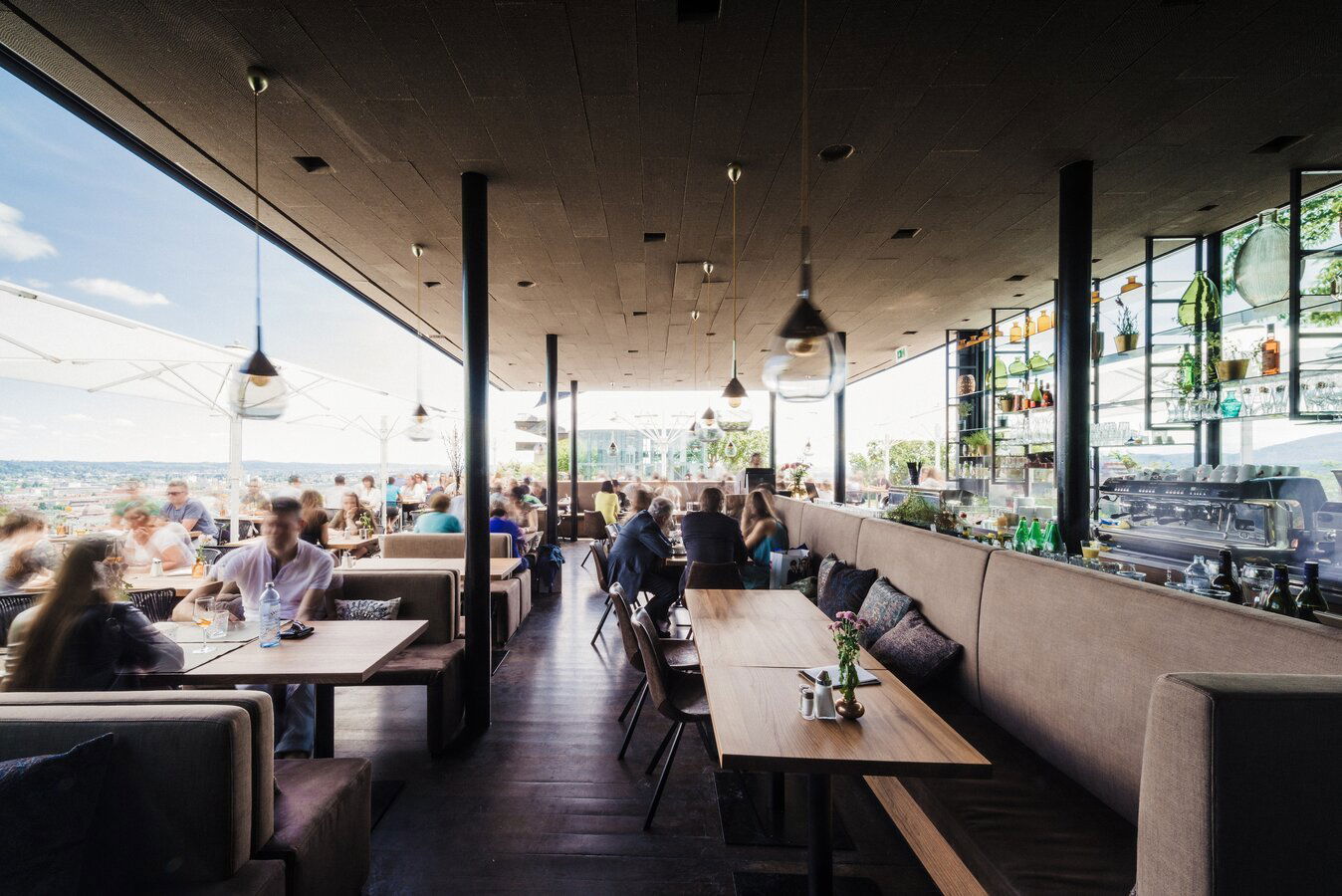
About aiola upstairs
High Ground: Dining on the Schlossberg The Schlossberg, the forested rock that rises above Graz's red-tiled roofline, has long been the city's most legible landmark. Reaching its summit by the glass-walled funicular or the carved stone steps...
High Ground: Dining on the Schlossberg
The Schlossberg, the forested rock that rises above Graz's red-tiled roofline, has long been the city's most legible landmark. Reaching its summit by the glass-walled funicular or the carved stone steps, visitors trade the cobblestone rhythm of the Altstadt for a wider, quieter register. aiola upstairs occupies this elevation at Schloßberg 2, positioning itself where the view itself becomes part of the dining proposition. In a city that takes its Styrian food traditions with genuine seriousness, a restaurant that frames its offer against that panorama is making an architectural argument before a single dish arrives.
Graz operates within a distinctive culinary identity. Styria's larder, running from pumpkin-seed oil and Vulcano ham to the region's Schilcher rosé, shapes how the city's more considered restaurants build their menus. That identity is visible at aiola upstairs as much through what gets placed on the plate as through the elevation at which it is served. Across the city, restaurants like Aiola im Schloss and Arravané approach Styrian ingredients from different editorial positions, and the broader Graz scene has developed sufficient range that choosing a venue now requires reading what each kitchen is actually saying through its structure and sourcing rather than simply its price point.
How the Menu Is Built Here
Editorial angle matters in a restaurant kitchen as much as it does in print. A menu communicates its logic through sequencing, ingredient philosophy, and the relationship between portions and pacing. At aiola upstairs, the rooftop setting inflects what that logic can credibly be. A room with a view of this scale, over the old city and the Mur valley beyond, demands a menu that respects the occasion without burying the food under ceremony. The most effective mountain-and-skyline dining rooms internationally, from the format used by Le Bernardin in New York City in its treatment of occasion dining to the communal ritual encoded by Lazy Bear in San Francisco, demonstrate that architecture and menu architecture succeed together when they share a point of view.
In the Austrian context, the most instructive comparison is the tension between classical formality and regionality. Houses like Steirereck im Stadtpark in Vienna or Obauer in Werfen resolved that tension decisively toward rigorous seasonal sourcing framed within a technically exacting kitchen. Graz venues at the upper end of the price register have broadly followed a similar logic, treating Styrian produce as both content and credential. Where aiola upstairs sits within that spectrum, and how closely its menu architecture adheres to that regional-seasonal model, is the practical question for a visitor choosing between it and peers like Artis or Adelphia.
Atmosphere and What the Setting Does to a Meal
The Schlossberg location fundamentally alters the atmosphere register available to a kitchen. At street level, Graz restaurants operate within the visual grammar of Baroque courtyards and narrow Herrengasse sightlines. The rooftop at Schloßberg 2 removes those constraints and replaces them with open sky and horizon. The effect on pacing is real: meals here extend because the view gives diners permission to stay. In warmer months, that outdoor dimension shifts the atmosphere from formal to celebratory without reducing the occasion's weight. Austrian restaurant culture at this level tends to reward that celebratory register with confident wine lists, and Styria's own wine output, white Sauvignon Blanc and Morillon in particular, provides an obvious pairing logic that a venue in this position would be expected to hold seriously.
Across Graz, atmospheric diversity has increased considerably. Bellys operates at a different register entirely, and venues like Artis have built a creative identity that places atmosphere in service of a menu concept. The Schlossberg setting places aiola upstairs in a distinct sub-category: it is as much a destination for what happens before the food as for the food itself. That is neither a criticism nor a concession. Terrain-defined dining has its own logic, and when it works, the meal is inseparable from the location. Other Austrian venues that have made this integration successfully include Gourmetrestaurant Tannenhof in Sankt Anton am Arlberg and Stüva in Ischgl, both of which use Alpine altitude as part of their hospitality argument.
Planning Your Visit
The Schlossberg is reachable by cable car from Kaiser-Franz-Josef-Kai or on foot via the Schlossbergtreppe, a staircase cut directly into the cliff. For visitors staying in the Altstadt, neither option requires a vehicle or significant time. aiola upstairs sits at Schloßberg 2, meaning the walk from the Hauptplatz takes under fifteen minutes at a measured pace. Given the location's function as a sunset and evening destination for local Grazer as well as visitors, arriving before the dinner hour shifts and booking ahead during summer and public holiday weekends represents basic logistical caution. Graz's restaurant season concentrates event-level demand in June through September, when the open terrace at this altitude is at its most effective. For context on the wider Graz dining picture before deciding on aiola upstairs specifically, the full Graz restaurants guide maps the city's tiers and neighbourhoods in more detail.
Austria's dining circuit beyond Graz is worth noting for visitors building a regional itinerary. Döllerer in Golling an der Salzach, Landhaus Bacher in Mautern an der Donau, Ois in Neufelden, Schwarzer Adler in Hall in Tirol, Kräuterreich by Vitus Winkler in Sankt Veit im Pongau, and Restaurant 141 by Joachim Jaud in Mieming all demonstrate how Austria's regional restaurant culture distributes quality well outside Vienna. Graz, sitting at Styria's culinary centre, is a logical anchor point for that wider circuit.
Frequently Asked Questions
- Is aiola upstairs suitable for children?
- At this price tier and setting in Graz, aiola upstairs reads as an adult occasion venue rather than a family dining destination.
- What should I expect atmosphere-wise at aiola upstairs?
- The Schlossberg position defines the experience as much as anything inside. Graz's refined restaurant tier does not lean toward theatrical formality in the way Vienna's traditional Beisl-to-fine-dining spectrum does; the atmosphere here is more accurately described as occasion-specific, shaped by the skyline, the outdoor terrace in season, and the remove from the street-level city. Expect a room oriented around the view rather than around itself.
- What should I eat at aiola upstairs?
- Without confirmed dish data, the directional answer is to follow Styrian seasonality: the regional kitchen's most identifiable output runs through pumpkin, game, local freshwater fish, and the area's distinctive vinegar and oil traditions. A kitchen at this address and altitude would be expected to anchor its menu in that regional logic. If a tasting format is available, it will typically be the most coherent reading of what the kitchen is doing.
- How does aiola upstairs compare to other Schlossberg and Graz hilltop dining options?
- Within Graz's refined dining tier, aiola upstairs shares its Schlossberg address with Aiola im Schloss, which occupies a different format and register on the same rock. The two venues share an address reference and likely an operator connection, but serve different occasions: aiola upstairs positions toward the rooftop-with-view format, while Aiola im Schloss operates within the castle structure itself. Both sit in Graz's upper hospitality tier alongside venues like Artis, though the competitive comparison is more atmospheric than culinary given the location's defining role.
Related editorial
- Best Fine Dining Restaurants in ParisFrom three-Michelin-star icons to the next generation of Parisian chefs pushing boundaries, these are the restaurants that define fine dining in the world's culinary capital.
- Best Luxury Hotels in RomeFrom rooftop terraces overlooking ancient ruins to Michelin-starred hotel dining, these are the luxury hotels that make Rome unforgettable.
- Best Cocktail Bars in KyotoFrom sleek lounges to hidden speakeasies, Kyoto's cocktail scene blends Japanese precision with global influence in ways you won't find anywhere else.
Save or rate aiola upstairs on Pearl
Keep this venue in your Pearl passport, rate it after you visit, and track it alongside every other place you collect.