
Restaurant in Grado, Italy
Agli Artisti
100ptsLagoon-Rooted Campiello Table
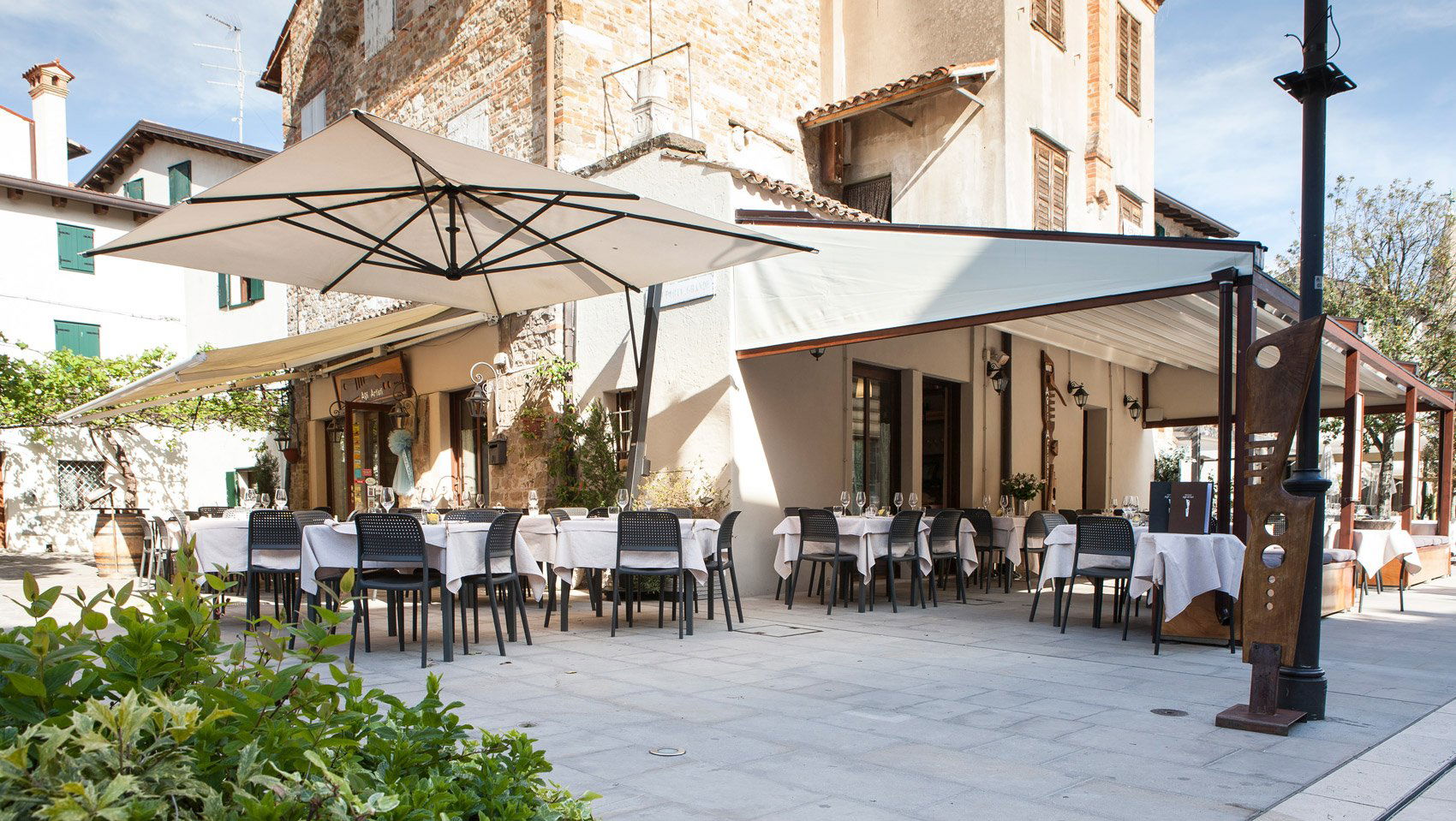
About Agli Artisti
Lively piazza meeting place with friendly service
A Campiello in Grado's Old Town
Grado's historic island core is built around a network of small squares, or campielli, that open unexpectedly between narrow lanes of ochre and terracotta. Agli Artisti occupies one of these compressed public spaces at Campiello Porta Grande, a location that says something immediate about how dining works in this part of the northern Adriatic. You arrive on foot, almost certainly having taken a wrong turn, and the square announces itself before the restaurant does. The experience of eating here begins in the approach, not at the table.
This pattern is common to Grado's smaller restaurants, where geography does the first work of framing an evening. The island sits in the Laguna di Grado, a shallow body of water that separates it from the Friuli Venezia Giulia mainland, and that physical isolation has historically shaped what ends up on local plates. The lagoon's fish and shellfish, the clams pulled from its beds, the grey mullet and eel that have been part of the local diet for centuries, form the backbone of an ingredient tradition that defines this stretch of coastline in ways that mainland Italian fish cooking simply does not replicate.
What the Lagoon Supplies
Grado's cooking sits at the intersection of Venetian and Friulian culinary traditions, with the lagoon acting as the primary filter. The sardoni in savor, the sweet-and-sour preparation that preserves small fish under a layer of vinegar-softened onion, and the various preparations of bisato (eel) reflect a geography-driven food culture built around what was locally abundant and needed to keep. This is not a cuisine that travelled; it developed in place, constrained and enriched by the same water that surrounds the island.
Restaurants on the island that hold close to these ingredient sources are operating in a meaningful tradition. The proximity to the lagoon is not a marketing gesture here; it is structural. The fishing boats working the Laguna di Grado supply a product with short transit times, and the difference between that and the distributed supply chains feeding larger urban fish restaurants is perceptible at the table. In Italian coastal cooking broadly, the closer the kitchen sits to the source, the narrower the menu tends to be, and the more honest the pricing becomes relative to what the diner is actually receiving.
Within Grado's restaurant scene, venues like Al Canevon, Al Casone, Al Pontil de' Tripoli, Alla Buona Vite, and Bruno Masaneta - Trattoria Cicchetteria form the reference set against which any table on the island is measured. This is a small, relationship-driven dining scene, not a competitive one in the metropolitan sense. The question for a visitor is less about hierarchy and more about which rooms and which cooking approaches align with how they want to spend an evening in this particular place.
Agli Artisti in Context
A venue positioned on a historic campiello in Grado's centro storico is, almost by definition, working within constraints that shape its offer. The old town's dense layout limits both logistics and kitchen scale, which tends to push menus toward quality over volume and service toward the personal over the procedural. Across this part of the Adriatic, the trattoria and osteria formats that operate in buildings with centuries of use behind them rarely compete on spectacle; they compete on consistency and on the integrity of what they put on the table.
To understand where a restaurant like this fits within Italian coastal fine dining more broadly, it helps to place it on a national map. Italy's most formally recognised seafood-driven cooking, from Uliassi in Senigallia to Quattro Passi in Marina del Cantone, operates at a level of investment and technical complexity that is deliberately removed from the day-to-day reality of eating in a small coastal town. The distance between those two registers is not a failure of ambition; it reflects how Italian dining culture actually functions, with a wide band of serious, place-specific cooking sitting below the Michelin tier and often delivering more accurately on what a given location actually tastes like.
The broader Italian fine dining spectrum, encompassing rooms like Osteria Francescana in Modena, Piazza Duomo in Alba, Le Calandre in Rubano, Enrico Bartolini in Milan, and Enoteca Pinchiorri in Florence, as well as the more rural investment exemplified by Dal Pescatore in Runate, Reale in Castel di Sangro, and Atelier Moessmer Norbert Niederkofler in Brunico, represents one end of a very long spectrum. Agli Artisti occupies a different register entirely, one rooted in neighbourhood, season, and the particular character of a lagoon town that has been feeding visitors and residents with the same basic ingredients for several hundred years.
For international reference, the kind of place-specific, ingredient-led cooking that defines Grado's better restaurants finds loose parallels in the way coastal tasting format restaurants like Le Bernardin in New York City or community-rooted concepts like Lazy Bear in San Francisco have built their identity around a coherent point of view about where food comes from and why that origin matters. The methods differ radically, but the underlying logic of sourcing as argument is shared.
Planning a Visit
Agli Artisti is located at Campiello Porta Grande, 2, in the historic centre of Grado, accessible on foot from anywhere in the old town. Grado itself is reached by road across a causeway from the mainland, with the nearest rail connection at Cervignano del Friuli, from which local buses serve the island. The campiello setting means the restaurant has no dedicated parking and is not suited to vehicle access; arriving by foot or bicycle is both practical and appropriate to the setting. Specific details on booking, hours, and current pricing are not confirmed in our data at this time, and direct contact with the venue before visiting is advisable. For a broader survey of where to eat across the island, the EP Club full Grado restaurants guide maps the scene in full.
Frequently Asked Questions
- Is Agli Artisti okay for children?
- Grado is a family-oriented resort town at its core, and the campiello setting at Agli Artisti is informal enough that children are not out of place, though diners should confirm current format and service style directly with the venue before booking with young children in tow.
- What is the vibe at Agli Artisti?
- If you are arriving expecting a metropolitan dining room with formal service, a recalibration is worth making before you reach Campiello Porta Grande. Grado's historic centre runs at a slower register than Italian urban dining, and a restaurant on one of its quiet squares will reflect that pace; this is a setting where the square itself is part of the atmosphere. Award recognition and price positioning are not confirmed in current data, so the leading framing is to arrive with the expectation of a characterful, place-specific meal rather than a benchmarked fine dining event.
- What is the leading thing to order at Agli Artisti?
- Without confirmed menu data or verified dish descriptions in our records, we cannot name specific plates. What the location argues for, given the proximity to the Laguna di Grado and the ingredient traditions of this part of Friuli Venezia Giulia, is that any kitchen operating here with integrity will lean on local fish and shellfish. Asking what came in from the lagoon that day is a reasonable and culturally appropriate starting point in any Grado restaurant.
- Does Agli Artisti have outdoor seating on the campiello?
- The address at Campiello Porta Grande places the venue directly on one of Grado's characteristic small squares, and outdoor seating in these spaces is common practice among the old town's restaurants, particularly during the warmer months when the island's visitor numbers peak between June and August. Specific seating configurations are not confirmed in our data, and arrangements may vary seasonally, so verifying directly with the restaurant before your visit is recommended.
Related editorial
- Best Fine Dining Restaurants in ParisFrom three-Michelin-star icons to the next generation of Parisian chefs pushing boundaries, these are the restaurants that define fine dining in the world's culinary capital.
- Best Luxury Hotels in RomeFrom rooftop terraces overlooking ancient ruins to Michelin-starred hotel dining, these are the luxury hotels that make Rome unforgettable.
- Best Cocktail Bars in KyotoFrom sleek lounges to hidden speakeasies, Kyoto's cocktail scene blends Japanese precision with global influence in ways you won't find anywhere else.
Save or rate Agli Artisti on Pearl
Keep this venue in your Pearl passport, rate it after you visit, and track it alongside every other place you collect.