
Hotel in Łeba, Poland
Zamek Łeba
500ptsPeriod Baltic Castle

About Zamek Łeba
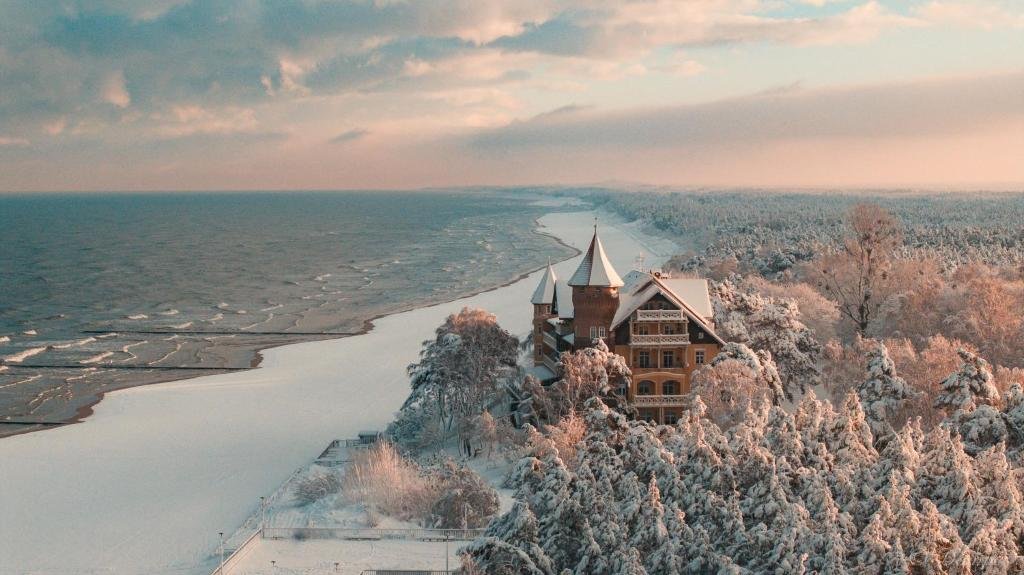
A early twentieth-century castle on Poland's Baltic coast, Zamek Łeba sits between the shoreline and the shifting dunes of Słowiński National Park with 40 individually decorated rooms priced from $159 per night. The building's history as a wellness retreat shapes the experience: no elevator, vintage tubs, and a restaurant serving Polish classics like smoked sturgeon and red borscht. Winter bonfires on the snow-covered beach are among the more arresting details.
A Baltic Castle That Earns Its Setting
Poland's northern coastline does not accumulate luxury properties at the rate of its mountain resorts or city-centre addresses. Łeba, a small seaside town about two hours' drive northwest of the Gdańsk hotel corridor, sits at the edge of Słowiński National Park, where coastal dunes shift several metres per year and the Baltic runs cold for most of the calendar. It is an unusual setting for a storybook castle hotel, and that disjunction is exactly the point. Zamek Łeba occupies a position in the Polish hospitality market that few properties share: historic architecture with genuine age, a coastal natural park on one side and open sea on the other, and a price point around $159 per night that places it well below the international castle-conversion category while delivering the atmospheric substance that category promises.
The building dates to the early 1900s and spent a substantial part of its life as a wellness retreat before transitioning to its current hotel function. That history is not incidental. It explains the absence of a lift, the retention of vintage-style tubs in the bathrooms rather than contemporary walk-in showers, and a general sense that the architecture was never surrendered to a full modernisation programme. In an era when Polish luxury hospitality has increasingly followed the template of urban design hotels, from Łódź to Poznań, Zamek Łeba represents a different instinct: preserve the original shell, refresh the interiors, and let the setting carry the experience.
The Interior Logic of a Period Property
Historic hotel design in Central Europe tends to split between two approaches. The first strips the building back and inserts a contemporary interior that contrasts with the facade. The second layers new decoration over old bones without committing fully to either. Zamek Łeba takes a third path that is less common and considerably harder to execute: it leans into the period character while mixing in midcentury modern furniture as counterpoint. The result is 40 individually decorated rooms that share a sensibility without being identical, a meaningful distinction in a category where standardisation is the economic default.
The decorative range across the rooms is deliberate. Some lean toward bold floral wallpaper and velvet sofas; others introduce crystal chandeliers alongside lilac accent walls and geometric headboards. The antique-and-midcentury combination is not an accident of budget or indecision but a designed tension, the kind of interior approach that properties like Castello di Reschio apply at a higher price tier to similar effect. At Zamek Łeba, the approach functions at a fraction of the cost, partly because the building itself provides context that no amount of furniture spending can manufacture.
Larger suites add private balconies or terraces facing the water, a detail that shifts their value proposition substantially. The Baltic in winter is not a soft or decorative sea, and watching it from an enclosed private terrace while the dunes move in the distance is a different experience from any urban equivalent. For the room category, this is where the property's argument is strongest.
Where the Building Meets the Land
The physical relationship between Zamek Łeba and its immediate environment is the editorial centrepiece here, and it is one that the architecture actively frames rather than passively occupies. The outdoor pool faces the water and operates in warmer months. The spa's outdoor Jacuzzi maintains the same orientation. The quiet beach directly in front of the hotel is accessible in every season, which matters because the seasonal range at this location is exceptional: summer delivers the expected Baltic coast experience shared with beach towns along the German and Danish coasts, while winter produces something far less common in European hospitality. When snow covers the sand and staff build bonfires on the beach, the property is operating in a register that has no real equivalent among Baltic coast hotels at this price level.
Słowiński National Park, a UNESCO Biosphere Reserve, is not a backdrop in the brochure sense but a functioning natural landscape immediately adjacent to the property. The migrating dunes in the park are among the few genuinely dynamic landforms accessible from a hotel in Northern Europe, and their scale, rising to 30 metres in places, changes the surrounding visual context in a way that static natural features cannot. Properties that can credibly reference a UNESCO-designated natural site as a neighbouring amenity are rarer than the designation frequency might suggest; at Zamek Łeba, the geography is not borrowed from a distance.
For comparison, the Baltic coast wellness resort segment includes larger-scale operations like Hotel GLAR in Świnoujście and countryside palace properties such as Pałac Ciekocinko to the east. Zamek Łeba is smaller and more architecturally specific than either, and its 40-room scale means the beach and grounds do not carry the guest-volume pressure of a conference-capable resort.
The Restaurant and the Kitchen Tradition
Polish hotel restaurants in resort settings often default to international menus that minimise friction for international guests. The restaurant at Zamek Łeba moves in the opposite direction, anchoring its offer in Polish classics: smoked sturgeon and red borscht appear as reference points in the kitchen's identity. Both dishes carry regional weight. Smoked sturgeon is historically associated with the Baltic fishing tradition, and borscht in its Polish form, czysty barszcz czerwony, is a clear, concentrated broth distinct from its Ukrainian and Russian counterparts. Neither is a gesture toward local colour; both require sourcing and technique that a kitchen either commits to or abandons for simpler substitutes.
This kitchen orientation connects the property to the broader narrative of Polish culinary identity that has strengthened across the country's premium hospitality sector over the last decade, visible in properties from Hotel Stary in Kraków to Copernicus in Toruń. For guests arriving from outside Poland, the restaurant functions as an argument for the cuisine rather than an accommodation of unfamiliarity.
Planning a Stay
Zamek Łeba is located at Sosnowa 1 in Łeba, accessible by car from Gdańsk or by regional train with onward connection. Rooms are priced from $159 per night across 40 individually decorated units, with larger suites offering private balconies or terraces facing the Baltic. The property has no lift, which is a relevant accessibility consideration. Summer brings the outdoor pool and standard beach season; winter visits, particularly when the beach bonfires are active, offer a quieter and climatically more dramatic version of the same property. For other design-led options in Poland's mountain and urban markets, see Bachleda Residence in Zakopane, H15 Boutique Hotel in Warsaw, H15 Palace in Kraków, Hotel Altus Palace in Wrocław, and Hotel Monopol in Katowice. For Baltic coast context, Quadrille in Gdynia operates in the same northern coastal market. Our full Łeba restaurants guide covers the broader local dining scene for those extending their stay into the town. For those benchmarking against European castle conversions at higher price tiers, Badrutt's Palace in St. Moritz and Jaskolka Dom i SPA in Szklarska Poręba represent different calibrations of the historic-property format. For mountain spa alternatives, Hotel Galery69 in Stawiguda Masuria offers a lakeland setting to the east.
Frequently Asked Questions
How would you describe the overall feel of Zamek Łeba?
The property reads as a preserved period building rather than a renovated one. The absence of a lift, the vintage-style tubs, and the individual room decoration create an atmosphere that sits closer to a private house than a branded hotel. At $159 per night in a coastal national park setting, the value equation for that atmosphere is direct.
What is the leading room type at Zamek Łeba?
The larger suites with private balconies or terraces facing the Baltic make the strongest case for the location. The sea view from an enclosed private outdoor space in winter, when the beach is snow-covered and the dunes are in full Baltic light, is the property's clearest differentiator from other options in its price range. The 40-room total means these suites are limited in number.
What is the standout thing about Zamek Łeba?
Winter beach bonfire experience is the detail that separates this property from every other hotel in its price bracket along the Polish Baltic coast. It is an operationally simple gesture that the location makes possible and that no amount of interior design budget can replicate elsewhere. Combined with the UNESCO Biosphere Reserve next door and a kitchen committed to Polish regional cooking, the property makes a coherent case for itself that goes well beyond its architecture.
Recognized By

Related editorial
- Best Fine Dining Restaurants in ParisFrom three-Michelin-star icons to the next generation of Parisian chefs pushing boundaries, these are the restaurants that define fine dining in the world's culinary capital.
- Best Luxury Hotels in RomeFrom rooftop terraces overlooking ancient ruins to Michelin-starred hotel dining, these are the luxury hotels that make Rome unforgettable.
- Best Cocktail Bars in KyotoFrom sleek lounges to hidden speakeasies, Kyoto's cocktail scene blends Japanese precision with global influence in ways you won't find anywhere else.
Save or rate Zamek Łeba on Pearl
Keep this venue in your Pearl passport, rate it after you visit, and track it alongside every other place you collect.