
Hotel in Cabo San Lucas, Mexico
Waldorf Astoria Los Cabos Pedregal
1,835ptsCliff-Side Tunnel Arrival





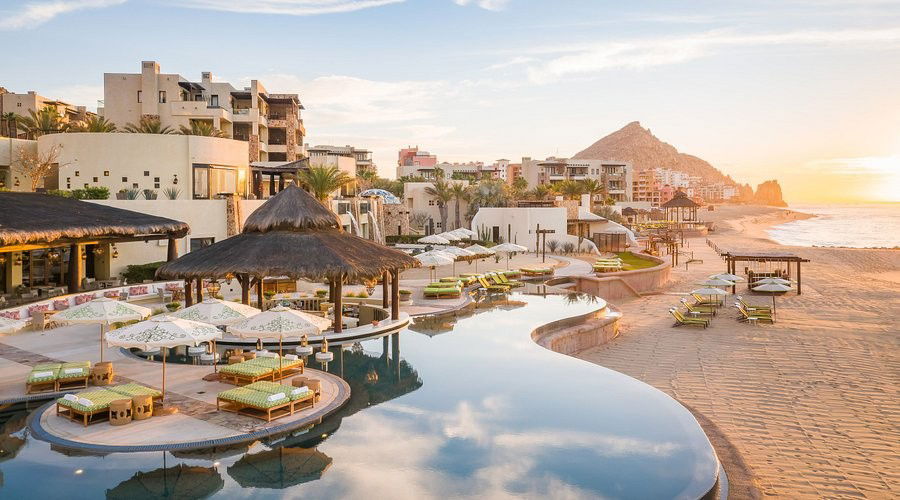
About Waldorf Astoria Los Cabos Pedregal
Reached through a tunnel blasted through the cliffs of the Baja Peninsula, Waldorf Astoria Los Cabos Pedregal earned Michelin 2 Keys in 2024 and 99 points from La Liste Top Hotels in 2026. The 112-room resort sits at the convergence of the Pacific Ocean and the Sea of Cortez, with private plunge pools, cliff-side dining, and a spa rooted in Baja folk healing traditions.
Where the Peninsula Ends and the Resort Begins
The approach sets the register immediately. To reach Waldorf Astoria Los Cabos Pedregal, guests pass through a tunnel carved directly into the cliffs that define the southern tip of the Baja California Peninsula — a piece of infrastructure that doubles as a threshold between two different versions of Cabo San Lucas. On one side: the marina-facing resort sprawl and the tourist corridor that gives the destination its spring-break reputation. On the other: 112 rooms and suites arrayed across dramatic cliff faces, a private stretch of Pacific beach, and a service architecture that assigns each guest a personal assistant before arrival. The tunnel is not a gimmick. It signals, architecturally, that the property operates at a remove from the broader Cabo market.
That positioning is reflected in its recognition. The property holds Michelin 2 Keys (awarded 2024), sits at 99 points on the La Liste Leading Hotels ranking for 2026, and appeared at number 41 on Condé Nast's Leading Resorts list in 2025 — a set of credentials that places it in the same tier as properties like Las Ventanas al Paraíso, A Rosewood Resort and Zadun, A Ritz-Carlton Reserve along the Los Cabos corridor. Google reviewers back this up with a 4.8 score across 1,868 reviews. Among Cabo properties, the Pedregal competes on physical drama and service depth rather than scale or brand ubiquity.
A Setting Built Around Natural Convergence
The geography here is the editorial story. Pedregal sits at the precise point where the Pacific Ocean and the Sea of Cortez meet , a convergence that shapes both the visual experience and the ecological context of the property. The meeting of two major bodies of water at a single headland produces sea conditions, light, and wildlife patterns that differ markedly from properties further up the corridor toward San José del Cabo. Whales move through these waters seasonally, and the marine diversity associated with the Sea of Cortez , one of the most species-rich bodies of water on the planet , is accessible from the property's own shoreline.
The design responds to this environment rather than overriding it. Rooms and suites are distributed across cliff terrain in a configuration that preserves sightlines and integrates private terraces with Pacific views. Beachfront Suites open directly onto the resort's sand. Villas and casitas add fire pits and private breakfasts prepared on-site. The resort has been operating in this format since 2012, which, in the context of Cabo's rapid luxury development over the past decade, represents meaningful continuity with the site's original intent.
Dining as Connection to Place
Food program at Pedregal operates across distinct venues, each anchored to a different relationship with the physical site. El Farallon is the property's cliff-side seafood restaurant, built into the rock face above the water. Guests select from the day's catch , a format that makes the supply chain legible and ties the meal directly to local fishing rather than to a static menu. The Beach Club and Crudo position guests closer to the surf and the pool, respectively, operating at a more casual register.
Don Manuel's functions as the property's hacienda-style main restaurant. During the day, the kitchen runs cooking demonstrations focused on traditional Mexican specialties. By evening, the space shifts to tapas and aperitifs, creating a natural gathering rhythm that distinguishes it from the fixed-format fine dining found at comparable properties. This approach , moving between instruction, demonstration, and social dining across the day , reflects a broader trend in Mexican resort hospitality toward showcasing technique and sourcing rather than presenting food as ambient luxury.
The produce sourcing model extends to an organic farm component: guests can visit the farm and contribute to selecting ingredients for that evening's dinner service. This kind of closed-loop sourcing, where guests participate in the supply chain before sitting down to eat, reflects a hospitality approach that has become increasingly common across Mexico's premium market. Properties like Chablé Yucatán and Hotel Esencia in Tulum have made similar commitments to land-connected dining. At Pedregal, the practice is embedded in the guest activities program rather than treated as a separate sustainability credential.
The Spa and the Baja Healing Tradition
Waldorf Astoria Spa Luna y Mar draws explicitly on Baja folk healing traditions rather than importing a generic luxury spa menu. Treatments are organized around the lunar cycle, and the program includes sessions with a curandera , a practitioner of traditional Mexican plant-based healing whose ingredients are sourced from a garden on the property. This is a meaningful distinction from spa programs at comparable resorts, which tend toward globally standardized treatment menus. The use of plants grown on-site, interpreted through a healing tradition native to the region, connects the spa to the same place-specific ethos that governs the food program.
Among Mexican properties with this kind of community-rooted programming, Pedregal occupies a particular niche: the format is embedded within a global luxury brand infrastructure (the property is part of Hilton Worldwide's Waldorf Astoria portfolio) rather than originating from an independent or boutique context. Properties like One&Only; Mandarina in Riviera Nayarit or Xinalani in Quimixto operate from an independent or small-group base, which shapes how their regional commitments are expressed. At Pedregal, the regional specificity exists within a brand framework that also delivers consistent service standards across 112 keys.
Service Architecture and the Personal Assistant Model
The service model at Pedregal is structured around pre-arrival assignment of a personal assistant to every guest. This goes beyond the butler or concierge model common at properties like Montage Los Cabos or Chileno Bay Resort. The personal assistant function covers both pre-arrival planning and on-property logistics, operating as a single point of contact across the stay. Villas and casitas layer an additional majordomo on leading of this structure , a staffing model that places those categories in the upper bracket of Los Cabos hospitality.
Practical details for planning: the property sits at Cam. del Mar 1 in the Pedregal district of Cabo San Lucas, accessible via the tunnel approach off the main road. The resort's 112-key count is small relative to the branded competition in the corridor, which supports the service-to-guest ratio the property maintains. Guests seeking comparable scale at a more design-led format might consider Esperanza, Auberge Resorts Collection or The Cape, A Thompson Hotel. For travellers interested in exploring the broader Los Cabos dining and hotel scene, our full Cabo San Lucas guide covers the corridor in depth.
The Pedregal Within Mexico's Premium Resort Tier
Mexico's upper-end resort market now extends well beyond Los Cabos, with strong properties operating in Riviera Maya, Riviera Nayarit, and the Yucatán. Maroma in Riviera Maya, Four Seasons Resort Punta Mita, and Etéreo, Auberge Resorts Collection each offer different versions of place-connected luxury. What distinguishes Pedregal within this peer set is the physical drama of the site: the cliffs, the tunnel, the cliff-face dining, and the water convergence are geological facts rather than design constructs. The property cannot be replicated elsewhere along the Baja coastline, because the specific landform at the peninsula's tip does not repeat. Among Mexico's premium options, this degree of site-specificity is genuinely rare. Travellers also comparing independent properties in Mexico might look at Las Alamandas in Costalegre or Casa Silencio for a contrast in scale and operating philosophy.
FAQ
How would you describe the overall feel of Waldorf Astoria Los Cabos Pedregal?
The property reads as quiet and geographically specific rather than conventionally resort-like. The 112-key count, the tunnel approach, the cliff-side setting between two bodies of water, and the personal assistant model combine to produce an atmosphere closer to a private compound than a full-service hotel. Recognition from La Liste (99 points, 2026), Michelin (2 Keys, 2024), and Condé Nast (#41 Best Resorts, 2025) confirms the positioning within the upper tier of global luxury hospitality, but the feel on the ground is shaped more by the site's geology than by brand signage.
What's the leading suite at Waldorf Astoria Los Cabos Pedregal?
The property's most configured accommodations are the villas and casitas, which add fire pits, private breakfasts, and a dedicated majordomo to the personal assistant already assigned to all guests. Beachfront Suites open directly onto the resort's sand with Pacific Ocean frontage. Award recognition across La Liste, Michelin, and Condé Nast applies to the property as a whole, and the Michelin 2 Keys designation reflects the overall service and accommodation standard rather than any single room category. Specific suite configurations and current availability are leading confirmed directly with the property.
Recognized By


Related editorial
- Best Fine Dining Restaurants in ParisFrom three-Michelin-star icons to the next generation of Parisian chefs pushing boundaries, these are the restaurants that define fine dining in the world's culinary capital.
- Best Luxury Hotels in RomeFrom rooftop terraces overlooking ancient ruins to Michelin-starred hotel dining, these are the luxury hotels that make Rome unforgettable.
- Best Cocktail Bars in KyotoFrom sleek lounges to hidden speakeasies, Kyoto's cocktail scene blends Japanese precision with global influence in ways you won't find anywhere else.
Save or rate Waldorf Astoria Los Cabos Pedregal on Pearl
Keep this venue in your Pearl passport, rate it after you visit, and track it alongside every other place you collect.