
Hotel in Amsterdam, Netherlands
Sofitel Legend The Grand Amsterdam
375ptsHistoric Canal House Hospitality


About Sofitel Legend The Grand Amsterdam
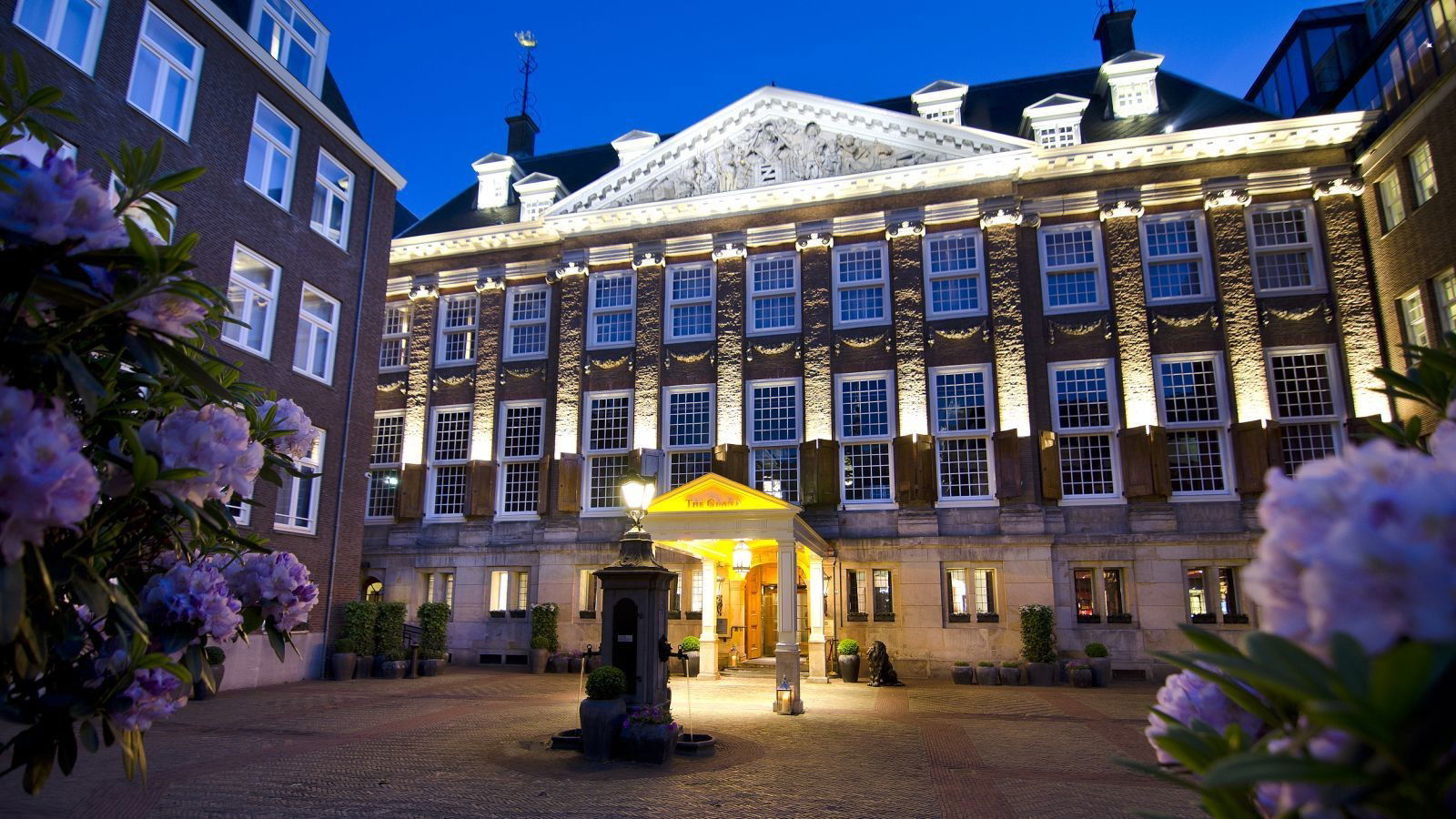
Occupying a site that has served as a convent, city hall, and official residence since the 15th century, Sofitel Legend The Grand Amsterdam translates centuries of civic history into a 177-room hotel on the Oudezijds Voorburgwal. Its award-winning fish restaurant Bridges, a traditional Dutch brown café, and a two-floor spa give the property a layered identity that extends well beyond a place to sleep.
A Building That Has Always Had a Role to Play
On the Oudezijds Voorburgwal, one of Amsterdam's oldest canal streets, the façade of Sofitel Legend The Grand Amsterdam registers less as a hotel entrance and more as a civic threshold. That reading is historically accurate. The site moved through successive institutional lives — Carmelite convent, military affairs office, city hall — before its current function, and those layers of public purpose are still visible in the architecture: the Marriage Chamber with its Chris Lebeau frescos and stained windows, the palatial courtyard now re-landscaped as a garden terrace, the lobby where the Library 'Or' occupies space once trafficked by municipal officials. Sybille de Margerie's interior design for that library draws on the dark greys of Amsterdam's klinker street stones and the deep colours of the city's flower market, which is the right kind of referencing , local and specific rather than generically "Dutch."
This matters as context for understanding where Sofitel Legend The Grand Amsterdam positions itself among Amsterdam's upper-tier hotels. The city's luxury accommodation splits broadly between two models: the design-led canal house conversion, scaled to 20 or 30 rooms and oriented around aesthetic restraint, and the grand-historic property with full amenity infrastructure. The Grand belongs firmly to the second category, with 177 rooms, 52 suites, 17 meeting rooms covering 1,400 square metres, and a spa that occupies two floors. For comparison, properties such as Canal House and Breitner House operate at the intimate canal-house end of that spectrum, while Conservatorium and De L'Europe Amsterdam occupy the same full-service tier as The Grand. What distinguishes The Grand within that group is the depth of its institutional history and the breadth of its food and beverage program.
How the Dining Program Is Structured
The dining ritual at a large historic hotel often collapses into a single restaurant designed to absorb all guest occasions , breakfast, business lunch, anniversary dinner , with a menu broad enough to offend no one. Sofitel Legend The Grand Amsterdam takes a different approach, segmenting its food and beverage spaces by register and cuisine tradition, so each outlet has a defined moment in the day and a distinct culinary logic.
Bridges, the flagship restaurant, concentrates on fish. Chef de Cuisine Raoul Meuwese frames the kitchen's output as classic French with international references and a modern approach, which places Bridges in a recognizable French-technique lineage that has become the dominant idiom for ambitious fish cookery in Western Europe. The restaurant has built a reputation as one of Amsterdam's more serious destinations for fish-focused dining, which, in a city whose geography and trading history have always connected it to the sea, is a credible and appropriate specialisation. If you are visiting Bridges specifically, the à la carte and Chef's menu formats give you two different pacing options , the à la carte allows a shorter, more selective meal, while the Chef's menu commits you to the kitchen's sequencing for the evening.
Oriole operates as the bistro counterpart: a Mediterranean-focused room with a seasonally rotating menu built around recognizable dishes rather than technical novelty. The rotation signals an ingredient-led approach, which for Mediterranean cuisine means the menu responds to what is available rather than maintaining year-round consistency. The Flying Dutchman functions as the hotel's brown café , a format that is genuinely Dutch, characterized by dark wood interiors, a focused beer selection, and a pace that encourages lingering over Dutch beers, spirits, and snacks. This is not a hotel bar dressed up in Dutch iconography; the brown café format has its own social grammar, and The Flying Dutchman adheres to it.
The Garden Terrace, positioned in the re-landscaped courtyard, provides the outdoor alternative when Amsterdam's weather cooperates, which is worth noting because the courtyard's separation from the canal street gives it a stillness that is genuinely rare in the city centre. Daily guided hotel tours at 11 a.m. give guests a structured way to move through the history of the building, and for guests who book the Royal Breakfast, that meal takes place on the balcony of the Marriage Chamber overlooking the garden , a format that converts a historical space into a functional dining occasion rather than simply displaying it behind a velvet rope.
Rooms Across a Wide Range
The 177 rooms span from a 269-square-foot Classic Room to a 1,076-square-foot two-bedroom Imperial Suite, with the Royal Suite occupying a former canal house on the third floor, complete with wood-beamed ceilings, a living room with lounge, and a private balcony facing the courtyard. The suite range also includes three Opera Suites and sixteen Suite Apartments, which blend period detailing with current amenities. Canal-facing rooms deliver views over the Oudezijds Voorburgwal; courtyard-facing rooms trade the water view for the quieter garden aspect. The hotel includes one room on the third floor specifically designed for guests with disabilities.
Every room includes a Sofitel MyBed configuration and a bathroom with a walk-in rain shower. The Royal Breakfast service, butler service, horse carriage availability, and hotel boat and bike tours are available across room categories, which means the differentiation between room types is primarily spatial rather than tied to access to services.
Spa and the Practical Logic of a City-Centre Property
The Sofitel SPA runs across two floors and includes an indoor heated pool with jet stream and jacuzzi, a Turkish steam bath (hammam), sauna, relaxation room, and the Sofitel FITNESS exercise room. For a hotel positioned in the older, denser part of Amsterdam's centre, this is a substantial wellness footprint. The surrounding streets are walkable to major museums and the main canal ring, but the density of the neighbourhood means the spa functions as genuine decompression space rather than an amenity most guests skip.
Parking in central Amsterdam is persistently difficult. The hotel addresses this with 24-hour, seven-day valet service , a practical advantage for guests arriving by car that removes one of the more friction-heavy elements of visiting the city centre by vehicle.
For other accommodation options across Amsterdam's range, Andaz Amsterdam Prinsengracht offers a design-led alternative on the main canal ring, while Décor Canal House and De Pijp Boutique Hotel represent the smaller, neighbourhood-embedded end of the market. Guests with a preference for sustainability-led properties can consider Conscious Hotel Amsterdam City (The Tire Station). For dining context beyond the hotel, see our full Amsterdam restaurants guide.
Elsewhere in the Netherlands, comparable grand-hotel experiences are available at Château Neercanne in Maastricht and Château St. Gerlach in Valkenburg aan de Geul, while Grand Hotel Huis ter Duin in Noordwijk aan Zee offers a coastal equivalent. For extended Netherlands travel, De Librije in Zwolle, Posthoorn in Monnickendam, Inntel Hotels Amsterdam Zaandam, citizenM Rotterdam, citizenM Schiphol Airport, 2L de Blend Hotel in Utrecht, Bij Jef in Den Hoorn, Central Park Voorburg, De Plesman Hotel The Hague, and Landgoed Hotel Het Roode Koper in Leuvenum cover a range of formats and price points. For international reference points in the grand-historic category, Aman Venice, Aman New York, and The Fifth Avenue Hotel in New York City represent how other cities handle the intersection of historical property and contemporary hospitality expectations.
Frequently Asked Questions
- Which room offers the leading experience at Sofitel Legend The Grand Amsterdam?
- The Royal Suite is the most architecturally distinct option: located on the third floor of a former canal house, it has wood-beamed ceilings, a private balcony overlooking the courtyard, and a separate living room with lounge. For guests who want canal views rather than courtyard views, the canal-facing rooms and suites on upper floors offer a different but equally credible spatial experience. The Opera Suites and Suite Apartments are the practical middle ground between standard rooms and the full suite tier.
- Why do people stay at Sofitel Legend The Grand Amsterdam?
- The combination of institutional history , the site has been in public use since the 15th century , and a full amenity program (177 rooms, multiple restaurants, a two-floor spa, 24-hour valet) is difficult to find at a single address in Amsterdam. Guests rate the property 4.7 across 2,544 Google reviews, which reflects consistent delivery across a wide guest base. The Bridges restaurant's reputation for fish adds a dining reason to stay that is independent of the room booking.
- How far ahead should I plan for Sofitel Legend The Grand Amsterdam?
- For peak Amsterdam periods , spring tulip season (April to May), summer (July to August), and major events , booking 2 to 3 months in advance for preferred room categories is a reasonable approach for a 177-room property at this tier. The Bridges restaurant, given its standalone reputation for fish dining, may require separate advance reservations, particularly on weekends. The hotel's suite inventory of 52 units books faster than standard rooms, so suite requests warrant earlier planning.
- Does Sofitel Legend The Grand Amsterdam have a notable dining option beyond its main restaurant?
- The Flying Dutchman brown café is the property's most culturally specific food and beverage space, operating in a format that is genuinely rooted in Dutch hospitality tradition: dark wood interiors, a focused selection of Dutch beers, and an extensive spirits list. For visitors interested in how Amsterdam's café culture intersects with hotel stays, it provides a more locally grounded experience than a standard hotel bar, sitting alongside the award-recognised Bridges restaurant and the Mediterranean-focused Oriole bistro within the same property.
Recognized By

Related editorial
- Best Fine Dining Restaurants in ParisFrom three-Michelin-star icons to the next generation of Parisian chefs pushing boundaries, these are the restaurants that define fine dining in the world's culinary capital.
- Best Luxury Hotels in RomeFrom rooftop terraces overlooking ancient ruins to Michelin-starred hotel dining, these are the luxury hotels that make Rome unforgettable.
- Best Cocktail Bars in KyotoFrom sleek lounges to hidden speakeasies, Kyoto's cocktail scene blends Japanese precision with global influence in ways you won't find anywhere else.
Save or rate Sofitel Legend The Grand Amsterdam on Pearl
Keep this venue in your Pearl passport, rate it after you visit, and track it alongside every other place you collect.