
Hotel in Serengeti, Tanzania
Singita - Singita Grumeti
150ptsConservation-Concession Safari

About Singita - Singita Grumeti
Singita Grumeti occupies the Western Corridor of the Serengeti, operating six distinct lodges and camps across a private concession that spans well beyond typical reserve boundaries. The property set — ranging from the grand colonial architecture of Sasakwa Lodge to the river-facing Faru Faru and the mobile Explore camps — represents one of East Africa's most considered approaches to conservation-integrated luxury accommodation.
Six Structures, One Concession: How Singita Grumeti Reads the Serengeti
The Western Corridor of the Serengeti is not where most first-time safari travellers land. The migration passes through on its way north toward the Mara River, lion densities in the Grumeti zone are high, and the tsetse fly presence keeps casual visitors away. That combination has, over time, created the conditions for a different kind of safari operation: lower volumes, longer stays, and a concession model where the land itself becomes the primary asset. Singita Grumeti operates within this context, running six distinct properties across a private reserve that functions as a buffer and wildlife corridor for the broader Serengeti ecosystem.
What separates the Grumeti concession from the cluster of lodges along the more-trafficked Eastern and Central Serengeti circuits is not simply scale, but the relationship between built form and terrain. Each of the six properties — Singita Sasakwa Lodge, Singita Faru Faru, Singita Serengeti House, Sabora Tented Camp, Singita Explore, and Singita Milele — occupies a specific ecological position on the concession, and each has been designed to make that position legible to guests. This is not a resort campus with a safari attached. It is a concession with architecture distributed across it.
Architecture as Orientation: Reading Each Property
East African luxury safari has moved through several distinct design phases over the past three decades. The first wave favoured heavy colonial pastiche: dark timber, kilim rugs, and hunting-lodge references. The second wave reacted against this with a modernist, glass-and-steel vocabulary that looked imported rather than grown from the land. Singita Grumeti's properties occupy a more considered position, where design vocabulary is chosen to interpret the specific site rather than impose a universal house style.
Sasakwa Lodge is the oldest and most formally European of the set, with a turn-of-the-century colonial idiom that reads deliberately grand from its refined hill position. The lodge accommodates 34 guests across ten cottages and one Hillside Suite , a mix of one, two, three, and four-bedroom configurations that makes it functional for both couples and multigenerational groups. The elevation is the design's central argument: from here, the plains read as they would from a colonial-era farmhouse, and that framing is intentional rather than incidental.
Faru Faru takes a contrasting approach. Positioned to overlook the Grumeti River, the lodge's eight suites and one family suite are arranged to bring the riverbank into the sightlines of the interior. Where Sasakwa imposes grandeur, Faru Faru operates with a more informal, contemporary logic , described within the property set as unconventional and quirky, with the river wildlife cycle functioning as the primary spectacle rather than the architectural envelope.
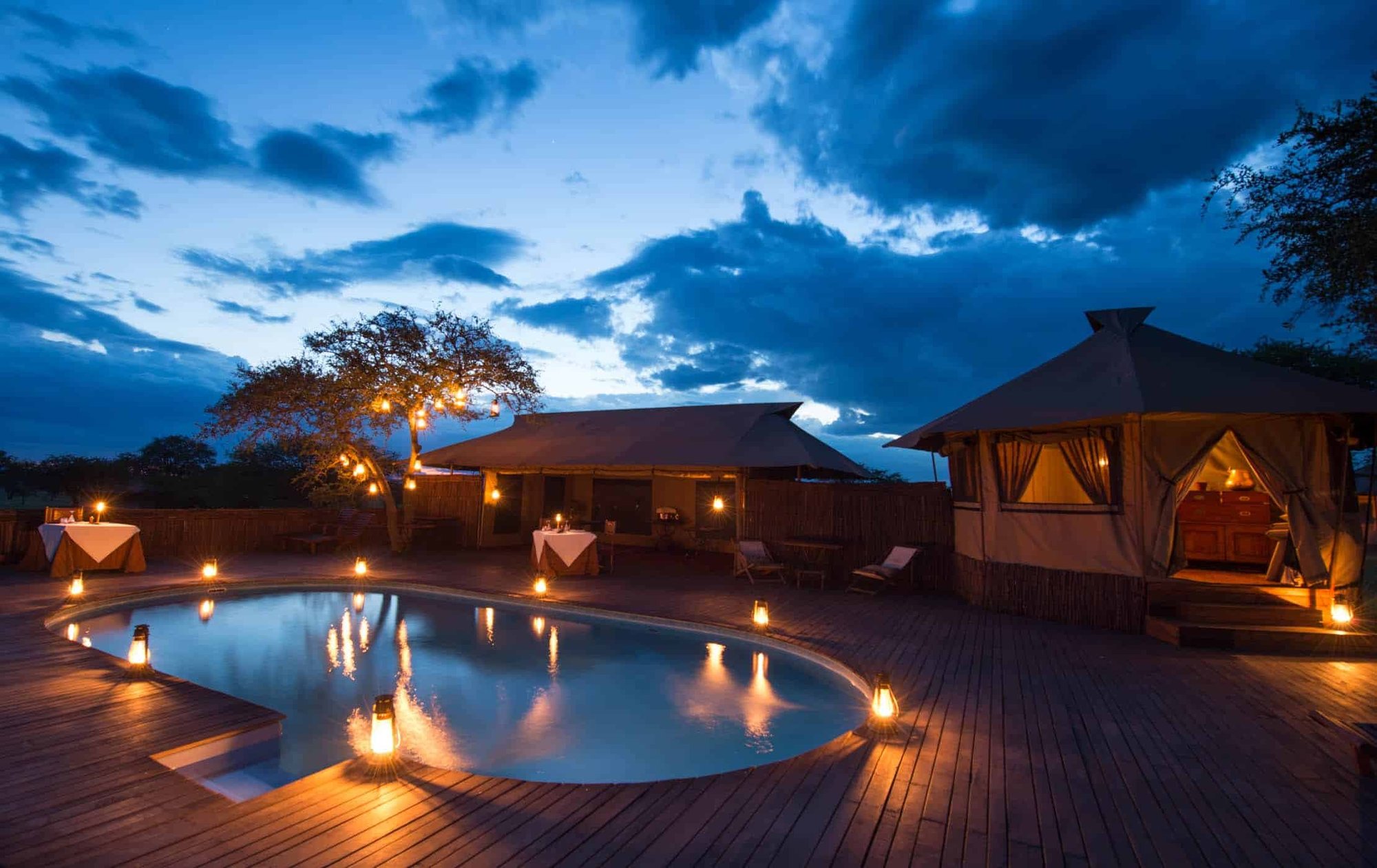
Sabora Tented Camp sits in the safari-under-canvas tradition that East Africa has practised since the early twentieth century, but the execution is contemporary. Nine tents accommodate 18 guests in a configuration that references classic campaign safari while incorporating the indoor-outdoor spatial transitions that define current luxury camp design. The textures and tones are drawn from the surrounding bush rather than imported, which places Sabora in a design lineage that has more in common with contemporary landscape architecture than with nostalgic tent-safari recreation.
For an alternative canvas experience in the broader Serengeti region, andBeyond Serengeti Under Canvas operates a comparable tented format, while andBeyond Grumeti Serengeti River Lodge provides a river-adjacent alternative on the same Western Corridor.
Private-Use Formats and the Architecture of Exclusivity
Three of the six Grumeti properties function as exclusive-use or private-use structures, which represents a distinct planning philosophy. Singita Serengeti House accommodates eight guests across four suites , two in the main house, two separate external suites , and operates with fully customised itineraries, meals, and activities. The design intention is a private home rather than a lodge, with the spatial organisation reinforcing that domestic quality rather than the communal orientation of Sasakwa or Faru Faru.
Singita Milele takes the private-use format further: five individually designed en-suite suites with terraces, dressing rooms, and outdoor showers, accommodating up to ten guests. The individual suite design in Milele , each distinct rather than replicated , reflects the direction that high-end exclusive-use properties across East Africa have taken, where sameness is replaced by a curated differentiation that reinforces the sense of a private retreat rather than a scaled lodge.
Singita Explore operates differently again. Two mobile sites, each accommodating twelve guests in six tents, move to track the migration and game patterns across the concession. The architecture here is deliberately minimal and temporary , the argument being that the landscape does the work, and the built structure should not compete with it. This positions Explore within a growing segment of luxury safari that frames discomfort-adjacent simplicity as the most sophisticated option available.
Conservation Concession as the Larger Frame
Singita Grumeti's eco-philanthropic orientation is not a marketing layer applied to a conventional lodge operation. The concession model means that a proportion of the land is managed for wildlife and habitat rather than for maximising guest numbers. Across all six properties, the combined accommodation capacity is carefully limited: roughly 34 at Sasakwa, 18 at Sabora, 22 at Faru Faru, 8 at Serengeti House, 24 across the two Explore sites, and 10 at Milele. The Western Corridor as a result carries a fraction of the guest load that the busier central and eastern Serengeti circuits handle at equivalent price points. For context on where Grumeti sits within Tanzania's broader luxury circuit, see our full Serengeti guide, and consider how properties like andBeyond Ngorongoro Crater Lodge, Chem Chem Lodge, and Kuro Tarangire position themselves within the wider northern Tanzania ecosystem.
Planning Your Stay
Booking across all six properties is handled centrally through Singita's reservations system. Children are welcome at most properties, though Sabora Tented Camp specifies a minimum age of ten, and participation in game activities for children between two and sixteen years is subject to guide discretion. Children aged two to sixteen sharing a standard suite are accommodated at fifty percent of the adult rate. The Western Corridor's migration timing peaks from approximately June through August, when the herds push north through the Grumeti and toward the Mara River crossings , though resident game including lion and hippo make the concession productive across the full calendar year. Guests arriving from Zanzibar might consider connecting through Park Hyatt Zanzibar or Amani Boutique Hotel before flying to the airstrip, while those routing through Arusha can use Arusha Coffee Lodge as a staging point. For those extending into other parks, Jabali Ridge in Ruaha and andBeyond Lake Manyara Tree Lodge represent well-matched options within Tanzania's southern and Rift Valley circuits.
Frequently Asked Questions
- What room category do guests prefer at Singita Grumeti?
- Guest preference at Singita Grumeti tends to divide by travel group rather than by a single consensus choice. Couples and pairs consistently gravitate toward the river-facing suites at Faru Faru, where the game-viewing from the accommodation itself is continuous. Families and multigenerational groups more often opt for the multi-bedroom cottages at Sasakwa Lodge, particularly the three and four-bedroom configurations. For groups seeking full-property privacy, Singita Serengeti House and Singita Milele are the appropriate formats, with the latter offering five individually designed suites for up to ten guests.
- What makes Singita Grumeti worth visiting?
- The Western Corridor location is the primary argument. The Grumeti concession operates at guest volumes significantly lower than the central and eastern Serengeti circuits, and the private-concession model means the land between lodges functions as wildlife territory rather than shared reserve. The migration passes through on its northward route, but resident predator and game populations make the area productive year-round. The architectural variety across six properties also means a multi-night stay can move between quite different spatial experiences , from the refined formality of Sasakwa to the riverside informality of Faru Faru to the mobile simplicity of Explore , without leaving the concession.
- How hard is it to get in to Singita Grumeti?
- Securing dates at Singita Grumeti requires planning well ahead of intended travel. The combined accommodation capacity across all six properties is deliberately limited, and peak migration season from June through August books out substantially in advance , often six months to a year out for preferred dates. The exclusive-use properties, particularly Serengeti House and Milele, require the most lead time given their small capacities. Booking is handled centrally through Singita's reservations platform; there is no walk-in or short-notice availability at the Western Corridor concession during high season.
Recognized By

Related editorial
- Best Fine Dining Restaurants in ParisFrom three-Michelin-star icons to the next generation of Parisian chefs pushing boundaries, these are the restaurants that define fine dining in the world's culinary capital.
- Best Luxury Hotels in RomeFrom rooftop terraces overlooking ancient ruins to Michelin-starred hotel dining, these are the luxury hotels that make Rome unforgettable.
- Best Cocktail Bars in KyotoFrom sleek lounges to hidden speakeasies, Kyoto's cocktail scene blends Japanese precision with global influence in ways you won't find anywhere else.
Save or rate Singita - Singita Grumeti on Pearl
Keep this venue in your Pearl passport, rate it after you visit, and track it alongside every other place you collect.