
Hotel in Buccament, Saint Vincent and the Grenadines
Sandals St. Vincent and the Grenadines
150ptsSecluded Cove All-Inclusive

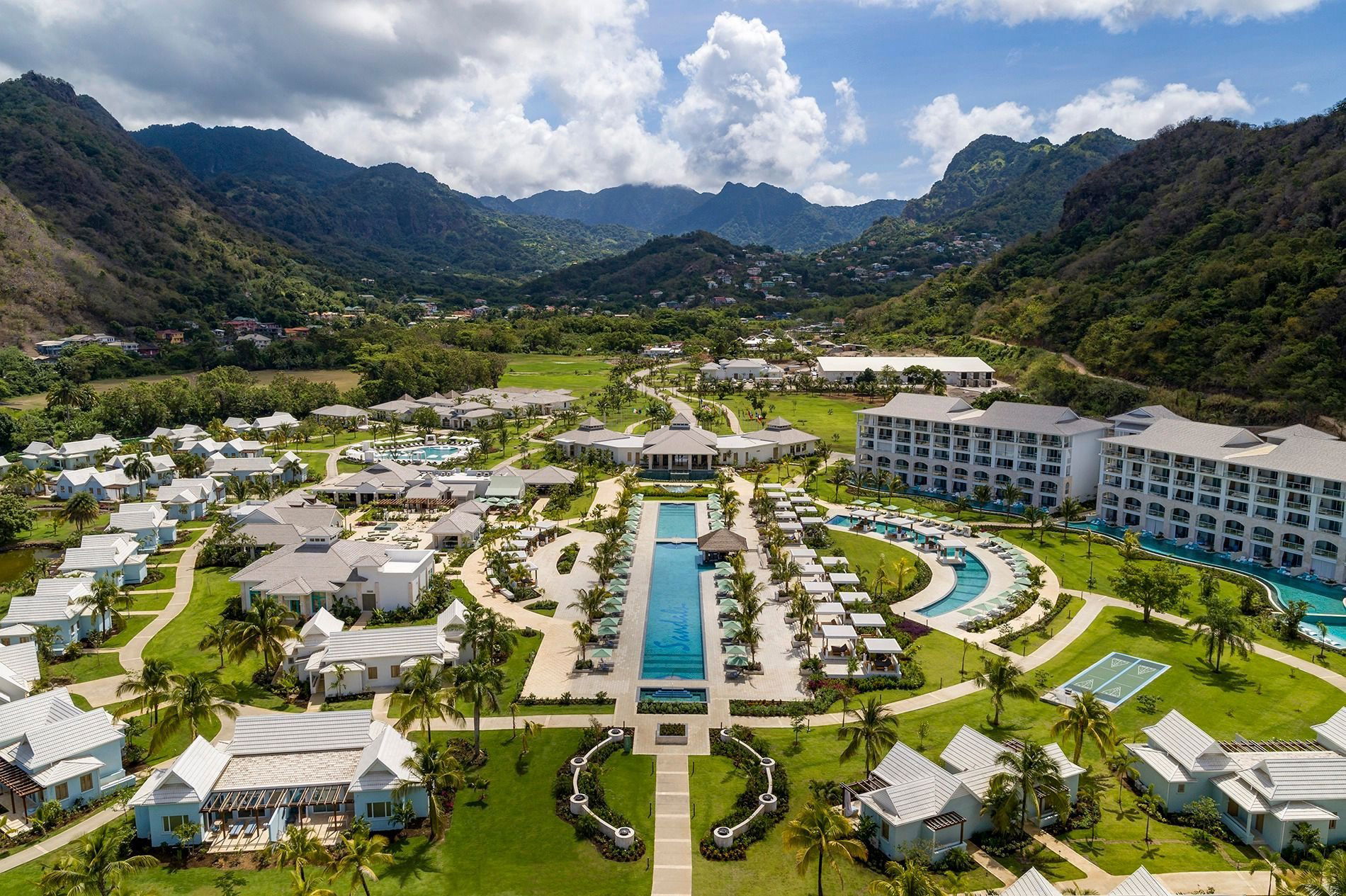
About Sandals St. Vincent and the Grenadines
Sandals St. Vincent and the Grenadines occupies a private cove at Buccament Bay, positioning itself within the quieter, less-trafficked end of Caribbean all-inclusive travel. The property features two-story Overwater Villas and beachfront suites with private plunge pools, set against forested hillsides meeting calm blue water. For travelers choosing between the Grenadines' scattered island options, this is among the few all-inclusive formats in the archipelago.
A Private Cove at the Edge of the Grenadines
The approach to Buccament Bay establishes the terms of what follows. St. Vincent's leeward coast is not the Caribbean of cruise terminals and duty-free strips. The road descends through forest before the bay opens below, a compact crescent of dark volcanic sand edged by water that reads somewhere between green and blue depending on the light. The resort sits at the base of that descent, framed by hillside vegetation on three sides and open to the Caribbean Sea on the fourth. As an architectural proposition, the site does most of the work before a guest sets foot inside a room.
Within the broader Grenadines accommodation market, the property occupies a specific position. The Grenadines archipelago has developed a reputation for low-key, design-conscious properties: places like Petit St. Vincent, Bequia Beach Hotel, and Canouan Estate Resort & Villas that compete on restraint and intimacy. Sandals operates in a different register entirely: the all-inclusive format, with its bundled dining, water sports, and spa access, appeals to travelers who want comprehensiveness over curation. That distinction matters when placing this property in context. It is not trying to be Petit St. Vincent, and the comparison is neither useful nor fair.
The Architecture of Seclusion
The physical layout of the resort is built around the logic of the cove itself. Beachfront suites with private plunge pools read as a natural extension of that shoreline logic, where the transition between accommodation and water is compressed to a few meters. The two-story Overwater Villas extend that thinking further, positioning guests above the waterline in a format that has migrated from Southeast Asia and the Maldives into Caribbean resort design over the past two decades. That shift reflects a broader hospitality trend: the overwater villa has become a category signal in the premium all-inclusive market, functioning as the highest-tier room type in much the same way a rooftop suite signals position at a city hotel.
The surrounding forest is not incidental to the design. Caribbean resorts on more intensively developed coastlines use landscaping to simulate natural seclusion; here, the vegetation is the landscape, and the resort is built around it rather than the reverse. That relationship between built structure and existing ecology is what gives Buccament Bay its particular character. Properties with comparable site conditions in the region, such as Soho Beach House Canouan, have pursued a similar logic, treating the natural environment as a design asset rather than a backdrop.
Dining, Water Sports, and What the All-Inclusive Format Delivers
All-inclusive resorts are sometimes discussed as though the format itself were a compromise. In practice, the format eliminates a specific kind of friction: the per-meal calculation that shapes decisions at non-inclusive properties. For guests planning to spend significant time on-site, that removal of transactional friction has real value. The resort's dining offer covers multiple outlets, and water sports including scuba diving are included, which positions the property well for guests whose primary objective is time in the water. St. Vincent and the Grenadines has well-documented dive sites, and access to that through a resort infrastructure rather than through separate third-party operators is a logistical advantage.
For guests approaching the Grenadines with a more island-hopping itinerary, the Anchorage Yacht Club in Clifton and Firefly Estate Bequia serve as complementary reference points: properties oriented around maritime access and independent movement rather than a contained resort experience. Both approaches suit different travel styles, and the choice between them is less about quality than about what kind of trip the visitor is structuring.
Placing Buccament in the Wider Caribbean Conversation
St. Vincent itself receives considerably less international visitor traffic than Barbados, St. Lucia, or Antigua. That lower volume is partly infrastructural: the Argyle International Airport opened in 2017, improving connections, but the island remains outside the main Caribbean tourism circuit. For travelers who have worked through the more heavily promoted Caribbean destinations and are looking for a quieter geography, that relative obscurity is part of the appeal. Buccament Bay does not have the beach infrastructure, restaurant strip, or nightlife density of a resort town; the resort is, to a significant degree, what is there.
That context explains why the all-inclusive format makes particular sense for this location. A property positioned in isolation from a functioning town infrastructure needs to provide its own dining and activity program. The format is not a compromise here, it is the appropriate response to the site. Compare this to how Palm Island Resort & Spa operates on its private island: the all-inclusive or near-self-contained model becomes almost logistically inevitable when the surrounding area offers limited alternatives.
Travelers calibrating across the Grenadines' wider accommodation range can also look further afield for contrast. Properties like Amangiri or Castello di Reschio represent a different design-led seclusion model in different geographies, but the underlying logic of a contained, self-sufficient property in a remote setting is shared. See our full Buccament restaurants guide for context on the wider area.
Planning a Stay
Access to Buccament Bay runs through E.T. Joshua Airport at Kingstown or the newer Argyle International Airport, with connections typically routing through Barbados, Trinidad, or Miami. The resort's all-inclusive pricing structure means that the upfront cost covers accommodation, dining, drinks, and most activity programming, including water sports. Guests planning to incorporate wider island exploration should factor in that St. Vincent's road network is mountainous and driving times between points are longer than distances suggest. The spa facility is on-site, as is the dive program, which reduces the need for off-property logistics for guests whose primary interests are water-based. Booking through the Sandals direct channel or a specialist Caribbean travel agent provides access to the full room category breakdown, which matters given the range from standard suites to Overwater Villas.
Frequently Asked Questions
What's the vibe at Sandals St. Vincent and the Grenadines?
The atmosphere is defined by the site rather than by programming density. Buccament Bay is a contained cove with forest on three sides and ocean on the fourth, and the resort's tone follows from that geography: quieter and more removed than Sandals properties on busier islands. This is a Caribbean all-inclusive for travelers who want the format's convenience without the density of a resort town around them. The trade-off is that off-property dining and nightlife options are limited, making the resort's internal offer the primary source of variety.
Which room category should I book at Sandals St. Vincent and the Grenadines?
The two-story Overwater Villas represent the property's architectural statement: rooms positioned above the waterline in the format that has become the prestige category signal across Caribbean premium all-inclusives. Beachfront suites with private plunge pools sit below them in tier but are directly on the sand, which for some guests is preferable to the overwater position. The decision between the two comes down to whether you want the visual drama of water below the villa floor or the tactile immediacy of beach access from a private terrace. Both categories include the plunge pool, which in this climate is less a luxury than a functional design choice.
What makes Sandals St. Vincent and the Grenadines worth visiting?
Case rests on the combination of site and format. St. Vincent and the Grenadines sits outside the main Caribbean tourism circuit, and Buccament Bay in particular is a geography that has not been developed to the point of saturation. The all-inclusive format, which can feel redundant in destinations with rich independent restaurant and beach scenes, makes clear sense here: it delivers a complete offer in a location where the surrounding area does not. For travelers who have worked through the busier Grenadines options, including Sandals Saint Vincent and the Grenadines at Buccament Bay represents one of the few resorts in the archipelago operating at this category and format level.
Recognized By

Related editorial
- Best Fine Dining Restaurants in ParisFrom three-Michelin-star icons to the next generation of Parisian chefs pushing boundaries, these are the restaurants that define fine dining in the world's culinary capital.
- Best Luxury Hotels in RomeFrom rooftop terraces overlooking ancient ruins to Michelin-starred hotel dining, these are the luxury hotels that make Rome unforgettable.
- Best Cocktail Bars in KyotoFrom sleek lounges to hidden speakeasies, Kyoto's cocktail scene blends Japanese precision with global influence in ways you won't find anywhere else.
Save or rate Sandals St. Vincent and the Grenadines on Pearl
Keep this venue in your Pearl passport, rate it after you visit, and track it alongside every other place you collect.