
Hotel in Hof bei Salzburg, Austria
Rosewood Schloss Fuschl
1,575pts15th-Century Alpine Castle Hospitality




About Rosewood Schloss Fuschl
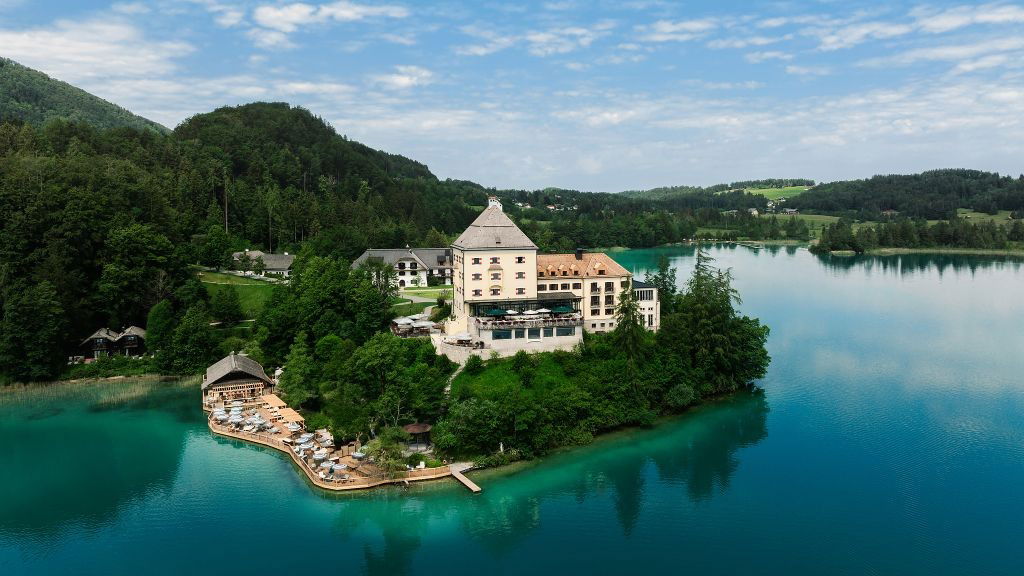
Reopened in July 2024 after a careful restoration, Rosewood Schloss Fuschl occupies a 15th-century lakeside castle on the shores of Lake Fuschl, roughly 30 minutes from Salzburg. The property holds Michelin 3 Keys (2024) and a 98-point score from La Liste Top Hotels (2026), with 98 rooms, suites, and freestanding chalets spanning both period interiors and contemporary lakeside design.
Stone, Water, and Six Centuries of Austrian Hospitality
Approaching Rosewood Schloss Fuschl from the lakeside road, the castle reads less like a hotel arrival and more like a historical fact: a 15th-century structure that has absorbed centuries of Austrian political and cultural life, and now presents itself to guests who arrive expecting luxury but often find something more disorienting — the sense that the building itself has opinions about how a property should be run. The turrets are not decorative gestures. The stonework carries genuine age. The lake, Fuschlsee, presses close to the foundations on one side while the Salzkammergut mountains frame the opposite view. Before a guest enters the lobby, the architecture has already established the terms of the stay.
That physical authority is precisely what makes Rosewood's stewardship here consequential. The group reopened the property in July 2024 following a comprehensive restoration, and the question that restoration projects of this kind always face is whether the intervention respects the structure or merely decorates it. At Schloss Fuschl, the answer appears to be the former: Rosewood's stated approach under its A Sense of Place concept commits to protecting existing heritage while modernising the guest experience, and the 98 rooms, suites, and chalets span enough typological range — castle rooms with period detailing, contemporary lakeside suites, freestanding chalets in the grounds , to suggest that the design team made deliberate choices rather than applying a single template throughout.
What the Restoration Actually Did
Heritage hotel restoration in Austria operates within a specific tradition. The country's castle-hotel category, from Carinthian lakeside properties like Falkensteiner Schlosshotel Velden in Velden am Wörthersee to the urban concentration of Schloss Mönchstein in Salzburg, has learned that authentic historic fabric and contemporary comfort are not naturally compatible and that the gap between them is where most projects fail. The properties that work are those that treat the original structure as a constraint to design within rather than a backdrop to design against.
Schloss Fuschl has at least 500 years of continuous occupation to work with, and the restoration had to account for spaces that have served radically different purposes across different centuries. The Great Hall and library, now available as guest spaces, retain the proportional logic of rooms built for a different social order , high ceilings, material thickness, light admitted in deliberate quantities. That these spaces now function as areas for relaxation rather than administration or assembly does not diminish the architectural argument they make; it just changes the audience. The property's 37-acre grounds, which include formal gardens and walking trails along the lakeshore, provide a further layer of spatial generosity that is harder to manufacture than interior design.
The 42 suites and 6 chalets within the 98-room count give the property a higher-than-average proportion of large-format accommodation for its category. The chalets in particular represent a typology that castle hotels in the Alps have increasingly adopted: freestanding structures within the grounds that offer residential-scale privacy without the full autonomy of a villa rental. For guests who find the castle's communal corridors and shared spaces to be the point of staying in a historic property, the rooms and suites inside the main structure will read correctly. For those who want proximity to the setting with more spatial separation, the chalets answer that preference.
The Salzkammergut Position
Lake Fuschl sits within the Salzkammergut, the Austrian lake district that extends east of Salzburg into the Styrian Alps. It is a smaller, quieter lake than the Wolfgangsee or the Attersee, which means the immediate environment around the property carries less tourist infrastructure and more unmediated landscape. The drive from Salzburg takes under 30 minutes, which places Schloss Fuschl in the category of properties close enough to the city to use it as a resource without being embedded in it , a structural advantage that separates it from urban castle hotels like Hotel Sacher Wien in Vienna, which operate within a very different set of urban pressures.
Salzburg's density of cultural programming, particularly around the festival season in July and August, makes proximity to the city commercially significant. Guests attending the Salzburg Festival have historically required accommodation across a wide radius, and a property of Schloss Fuschl's calibre, 30 minutes out, represents a legitimate alternative to city-centre options. The seasonal calendar extends further: hiking in the surrounding mountains is a spring and summer activity, while skiing access and Christmas markets become relevant draws between November and February. The private beach and marina add water sports and boat excursions to the activity inventory during warmer months.
For context within the Austrian alpine hotel category, Schloss Fuschl sits in a peer set that includes wellness-led mountain properties like Alpen-Wellness Resort Hochfirst in Obergurgl, Aktiv & Wellnesshotel Bergfried in Tux, and DAS EDELWEISS in Grossarl. What distinguishes the castle-hotel format from those properties is the weight of architectural authority: a mountain wellness resort can be rebuilt; a 15th-century lakeside castle cannot be replicated. The comparative advantage is structural, not programmatic.
Dining and Wellness in a Historic Frame
The dining programme at Schloss Fuschl operates across multiple venues, with the direction oriented toward Austrian culinary traditions. In the Salzkammergut region, that means a cuisine built around freshwater fish from the surrounding lakes, game from the alpine forests, and dairy from mountain farms , a larder that is geographically coherent and seasonally legible. The property's dining offering spans fine dining focused on Austrian specialties and more casual lakeside formats, a split that matches the range of guest motivations at a resort of this scale.
The Asaya spa, Rosewood's integrative wellness concept, is present here in both indoor and outdoor configurations, including an infinity pool positioned relative to the lake. Alpine wellness traditions in Austria have a documented history , the region's thermal and hydrotherapy culture predates modern spa programming by centuries , and the Asaya concept at properties like Schloss Fuschl attempts to locate contemporary wellness practice within that regional context rather than import a generic international format.
Combination of Michelin 3 Keys recognition (2024) and a 98-point score from La Liste Leading Hotels (2026) places Schloss Fuschl in the upper tier of Austrian hotel recognition. For comparison, properties like Grand Tirolia Kitzbühel and Hotel Schloss Seefels in Techelsberg operate in adjacent segments of the Austrian luxury lake and alpine hotel market. Internationally, Rosewood's castle restoration approach finds parallels in how groups like Aman treat heritage structures: compare the brand's handling of Aman Venice, where a historic palazzo functions as a framework for contemporary luxury.
Planning a Stay
Schloss Fuschl sits at Schloss-Straße 19, 5322 Hof bei Salzburg, approximately 25 to 30 minutes by car from Salzburg's city centre and Salzburg Airport. Given its position within the Rosewood portfolio, booking through Rosewood's central reservation system or directly via the property's website is the standard approach; the hotel carries no room availability at certain periods, particularly during peak festival season, which means advance planning is necessary for summer visits. The 98-room count, while substantial for a castle property, fills against strong seasonal demand. The 42 suites and 6 chalets represent the higher-capacity accommodation options and will attract longer leads on booking windows. Guests considering Austrian alternatives in different formats can reference Hotel Almhof Schneider in Lech, Naturhotel Waldklause in Längenfeld, or for a different kind of architectural property, Augarten Art Hotel in Graz. Our full Hof bei Salzburg restaurants guide covers the broader regional dining context for guests who want to extend beyond the property's own dining programme.
Frequently Asked Questions
What is the general atmosphere at Rosewood Schloss Fuschl?
The property reads as a historic castle that has been carefully updated rather than a modern hotel dressed in period detail. Public spaces like the Great Hall and library carry genuine architectural weight from the 15th-century structure. The lakeside setting adds a quieter register than you would find at a Salzburg city-centre property: the Salzkammergut is not a high-traffic tourist corridor. If the awards recognition matters to your decision, both the Michelin 3 Keys (2024) and La Liste Leading Hotels 98-point score (2026) confirm it operates at the upper end of Austrian luxury hospitality.
What room type should I choose at Rosewood Schloss Fuschl?
The choice maps onto two distinct experiences. Rooms and suites inside the castle proper , particularly those with period detailing , put you directly inside the historic fabric of a 15th-century structure, with views over the lake or the Salzkammergut mountains. The six freestanding chalets in the 37-acre grounds offer more separation and residential-scale space, closer to a private villa format. The 42 suites within the 98-room count provide a middle option: more space than a standard room, still within the main building. Given the La Liste and Michelin recognition, the property likely prices at the upper end of the Austrian lake hotel tier; no public room rates are currently listed.
What is the most notable thing about Rosewood Schloss Fuschl?
Age and authenticity of the structure. A 15th-century lakeside castle in the Salzkammergut is not a category that can be manufactured, and Rosewood's July 2024 reopening followed a restoration that preserved the existing historic fabric rather than replacing it with approximations. The Michelin 3 Keys recognition in 2024, awarded in the scheme's first year of hotel ratings, confirms the quality of the physical and service offering. The combination of that architectural specificity with the Asaya spa and a multi-venue dining programme places it in a different register from purpose-built alpine luxury properties.
How difficult is it to secure a reservation at Rosewood Schloss Fuschl?
Property has 98 rooms across three accommodation formats, which provides reasonable overall capacity, but demand concentrates heavily around the Salzburg Festival season (July to August) and the winter period. The Michelin 3 Keys status and La Liste 98-point score increase its visibility among international travel planners, which tightens availability further at peak times. Booking directly through Rosewood Hotels and Resorts is the standard channel. For guests with flexible travel dates, shoulder season visits , May to June and September to October , will face fewer constraints and offer cooler, less crowded access to the surrounding lake and mountain activities.
Recognized By


Related editorial
- Best Fine Dining Restaurants in ParisFrom three-Michelin-star icons to the next generation of Parisian chefs pushing boundaries, these are the restaurants that define fine dining in the world's culinary capital.
- Best Luxury Hotels in RomeFrom rooftop terraces overlooking ancient ruins to Michelin-starred hotel dining, these are the luxury hotels that make Rome unforgettable.
- Best Cocktail Bars in KyotoFrom sleek lounges to hidden speakeasies, Kyoto's cocktail scene blends Japanese precision with global influence in ways you won't find anywhere else.
Save or rate Rosewood Schloss Fuschl on Pearl
Keep this venue in your Pearl passport, rate it after you visit, and track it alongside every other place you collect.