
Hotel in Kobarid, Slovenia
Nebesa Chalets
500ptsAbove-Cloud Minimalism

About Nebesa Chalets
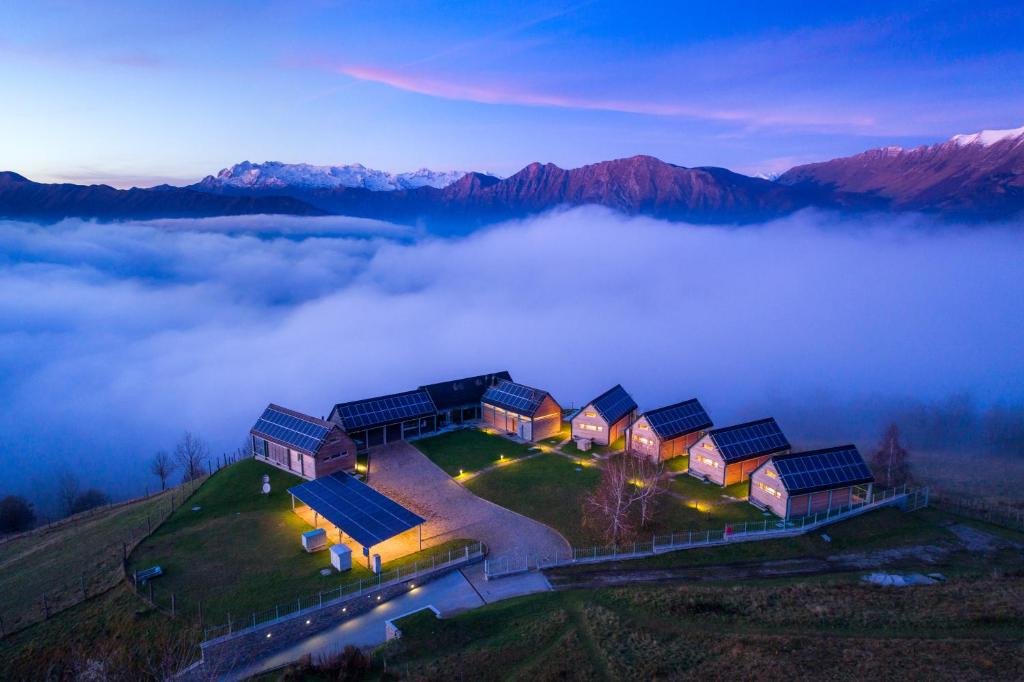
Perched nearly 1,000 metres above the Soča Valley, Nebesa Chalets is a four-chalet solar-powered retreat where views stretch from the Julian Alps to the Adriatic and clouds sit below the window line. At around $419 per night, the property offers two-person seclusion, a sauna, and deep Alpine quiet with no restaurant and no crowds — a deliberate subtraction that defines the experience.
Where the Cloud Line Becomes Your Floor Plan
At close to 1,000 metres above the Soča Valley, the approach to Nebesa already signals what kind of place this is. The road climbs through beech forest above Kobarid, the valley floor receding into a turquoise thread, and by the time the chalets come into view, the surrounding Alps feel lateral rather than towering. On cloud-heavy mornings, the valley below disappears entirely, and the sensation of being above the weather rather than inside it is not a marketing metaphor — it is the architectural fact the retreat is built around.
Nebesa sits at Livek 39, a hamlet on the ridge above Kobarid, a small Slovenian town whose position at the confluence of the Soča and Učja rivers has made it a reference point for serious hikers, fly-fishing travellers, and those arriving via the Alpe-Adria Trail. The ridge location is not incidental. The chalets were designed to occupy it in a specific way: four structures, each sized for two guests, set into the hillside so that the profile reads as a continuation of the terrain rather than an imposition on it. This approach to site integration places Nebesa within a wider European tradition of mountain architecture that prizes disappearance over statement.
The Design Logic of Subtraction
The chalets were constructed on the site of a former ski hut, which gives the project a material and historical grounding that purely new-build retreats rarely achieve. The design operates through reduction: stripped-back interiors, solar power as the sole energy source, no restaurant, no lobby, no programme. The effect is that the panoramic view becomes the primary spatial event. From the Julian Alps in the east to the Adriatic coast in the southwest, the sightline on clear days spans two distinct geographies, a visual range that most mountain properties in the eastern Alps cannot match from equivalent elevations.
This approach to design as an act of restraint has a meaningful context in Alpine hospitality more broadly. The European mountain retreat category has split between high-amenity ski-resort properties and a smaller cohort of minimalist, low-capacity places that prioritise silence and setting over service density. Nebesa belongs firmly to the second group, and with only four chalets, capacity is not a constraint imposed by budget — it is a design position. Compare that structure with properties like Chalet Sofija in Kranjska Gora or Vila Planinka in Zgornje Jezersko, where mountain settings meet slightly broader service formats: Nebesa is the more austere option, and deliberately so.
The solar-powered infrastructure deserves more than a footnote. Off-grid operation at close to 1,000 metres in a valley that receives significant precipitation through autumn and winter requires a system designed for continuous reliability, not seasonal sufficiency. That technical commitment shapes how the property presents itself: this is not a boutique hotel that has added sustainability language to its marketing, but a retreat whose entire operational model is built around energy independence.
What the Absence of a Restaurant Means in Practice
The decision not to include a restaurant is the most consequential design choice at Nebesa, and it deserves to be read as a design choice rather than a limitation. Kobarid is not a town where the absence of in-house dining represents a hardship. The town sits about 12 kilometres from the Italian border and has sustained a disproportionate concentration of serious food for its size, driven partly by its proximity to Friulian wine country, partly by the Soča River's pull on a particular kind of traveller. Kobarid's restaurant scene, covered in our full Kobarid restaurants guide, includes options that make the short drive down the ridge a natural part of the evening rather than a reluctant necessity.
What the property does offer in place of dining , wine, a sauna, and the panoramic terrace , frames the guest experience as one of deliberate reduction. The sauna-and-view combination at altitude is a format familiar from Scandinavian and Austrian mountain retreats, but Nebesa's position above the Soča Valley gives it a geographic drama that most of those properties cannot replicate. The Adriatic is visible in the far southwest on clear days, which means the sightline covers roughly 150 kilometres of varied terrain from a single fixed vantage point.
Kobarid as a Context for This Kind of Property
Kobarid carries a specific historical weight that distinguishes it from other Alpine valley towns. The First World War's Isonzo Front ran through the Soča Valley, and the Kobarid Museum, which holds the European Museum of the Year award, documents twelve battles fought in this landscape. That history has shaped how the town presents itself: seriously, without overstatement, with attention to the physicality of the terrain. Nebesa fits that register. It is not a property that performs wellness or performs luxury in the usual ways. It is a place built for people who understand why altitude and quiet are worth seeking out.
Within the wider Slovenian accommodation landscape, Nebesa occupies a niche that properties like Grand Hotel Toplice in Bled or Hotel Grad Otočec in Otočec do not address. Both of those properties offer considerably more service depth and historical grandeur, while Kendov Dvorec in Spodnja Idrija occupies a similarly intimate scale but within a manor-house format rather than an Alpine one. Nebesa's peer set in the regional context is narrow, and that narrowness is part of its appeal to travellers who have already worked through the more conventional Slovenian property types.
For those building a wider Slovenian itinerary, the western edge of the country contains concentrations of interest that reward deliberate routing. The Peterc Vineyard Estate in Kojsko is positioned in the Brda wine region roughly an hour southwest, offering a contrasting format , vineyard immersion at lower elevation , that pairs logistically well with a stay at Nebesa. Further afield, Ljubljana's more urban accommodation options, including the design-led Hostel Celica, sit about two hours east by road.
Planning the Stay
At approximately $419 per night, Nebesa prices as a premium retreat in the Slovenian context, where the combination of four-chalet exclusivity, solar infrastructure, and ridge-leading access justifies a rate well above the regional average for comparable accommodation categories. The property does not operate a restaurant, so guests should factor in transportation to Kobarid or plan provisions accordingly. The summer months bring the clearest long-range views toward the Adriatic, while shoulder season in September and October offers the advantage of lower valley haze and the turning of the beech forest below. Winter access will depend on road conditions on the ridge above Kobarid, and prospective guests should verify accessibility directly with the property for stays between December and March. Given four-chalet capacity, availability is constrained year-round and advance planning is advisable.
Frequently Asked Questions
What should I expect atmosphere-wise at Nebesa Chalets?
The atmosphere is defined by elevation and silence. At nearly 1,000 metres above the Soča Valley, the property sits above the cloud line on most mornings, which produces a particular sense of detachment from the world below. There is no background noise from other guests , four chalets means eight people at maximum occupancy , and no ambient restaurant or lobby activity. The dominant sensory experience is wind, mountain light, and the view. Travellers who find that combination restorative will appreciate it immediately; those who require structured activity or service interaction should consider a property with a fuller programme.
What room category do guests prefer at Nebesa Chalets?
With only four chalets, all designed for two guests and set at the same ridge-leading elevation, the property does not operate a tiered room category structure. Each chalet accesses the same panoramic view and the same suite of amenities , wine, sauna, terrace. The relevant choice is not between room types but between dates: the view varies considerably with season and weather, and clear autumn days tend to produce the widest visible range toward the Adriatic coast.
What's the main draw of Nebesa Chalets?
The primary draw is the view combined with the commitment to minimal intervention. The sightline from the Julian Alps to the Adriatic, available from a solar-powered chalet on a ridge above one of western Slovenia's most historically layered towns, is a combination that the regional accommodation market does not duplicate at this scale or price point. Guests at around $419 per night are paying for access to a specific geography, and the property has been designed to deliver that geography without distraction.
Recognized By

Related editorial
- Best Fine Dining Restaurants in ParisFrom three-Michelin-star icons to the next generation of Parisian chefs pushing boundaries, these are the restaurants that define fine dining in the world's culinary capital.
- Best Luxury Hotels in RomeFrom rooftop terraces overlooking ancient ruins to Michelin-starred hotel dining, these are the luxury hotels that make Rome unforgettable.
- Best Cocktail Bars in KyotoFrom sleek lounges to hidden speakeasies, Kyoto's cocktail scene blends Japanese precision with global influence in ways you won't find anywhere else.
Save or rate Nebesa Chalets on Pearl
Keep this venue in your Pearl passport, rate it after you visit, and track it alongside every other place you collect.