
Hotel in Taipei, Taiwan
Mandarin Oriental, Taipei
1,275ptsArt Deco Institutional Scale




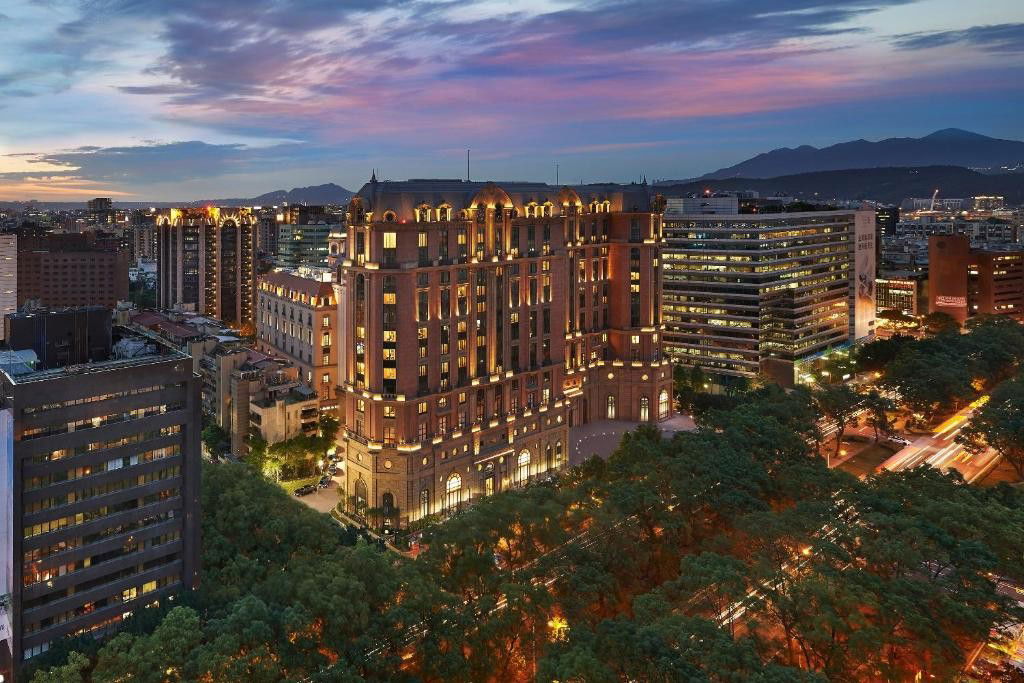
About Mandarin Oriental, Taipei
Mandarin Oriental, Taipei sits on tree-lined Dunhua North Road in Songshan District, scoring 97.5 points on the 2026 La Liste Top Hotels ranking. Its 303 rooms are among the most spacious in the city, rates start from around USD 361, and the two-floor spa is the largest hotel spa in Taiwan. The property's Art Deco interiors and 1,700 collected artworks place it in a distinct tier among Taipei luxury hotels.
Arriving on Dunhua North Road
The approach along Dunhua North Road — one of Taipei's older, tree-canopied arteries in the Songshan District — sets a different register from the glass-tower hotels that cluster around Xinyi. Before you reach the entrance, the building's proportions signal something deliberately formal: arched doorways, marble floors visible through the glass, a chandelier so large it reads as architecture rather than decoration. That chandelier, a 50,000-piece crystal installation completed over nine months by Czech artist Tafana Dvorakova, is the first evidence that the property's relationship with craft runs deeper than a standard luxury brief. The lobby does not rush you toward a check-in desk; it presents itself as a room worth standing in.
Taipei's upper tier of international hotels divides between properties that read as functional business infrastructure with luxury finishes, and a smaller group that operate as destinations in their own right. Mandarin Oriental, Taipei belongs firmly to the second category, and its 2026 La Liste Leading Hotels score of 97.5 points places it at the serious end of the regional peer set , comparable in recognition terms to the kinds of properties reviewed alongside Aman New York or Aman Venice in global ranking conversations.
The Visual Register: Art Deco Without Apology
Luxury hotel design in Asia has spent two decades competing on modernity: higher towers, cleaner lines, lobby installations that gesture toward contemporary art. The Mandarin Oriental, Taipei takes the opposite position. Its interiors draw from European Art Deco and classical Oriental detail without softening either influence into something more neutral. Marble floors, cathedral ceilings, and chandeliers appear not as nostalgic reference points but as load-bearing elements of the aesthetic. The property houses 1,700 art pieces and antiques, with works by artists including Jae-Hyo Lee and Wei Zhu distributed across the interior.
The specificity extends to individual materials: guest room walls carry peony-patterned leather paneling hand-crafted by Helen Amy Murray, a detail that requires proximity to read fully. Restaurants were designed by Tony Chi, whose work in the international luxury hotel sector tends toward theatrical restraint. The cumulative effect is an interior that rewards attention , each space has been composed rather than furnished.
Among Taipei's comparable properties, this design depth sets the hotel apart from the more corporate execution at Grand Hyatt Taipei and from the contemporary residential approach taken by Capella Taipei. Properties like Eslite Hotel pursue a culture-led aesthetic in a different direction entirely. The Mandarin Oriental's position is its own.
Rooms, Suites, and Scale
The hotel holds 303 rooms and suites , 256 rooms and 47 suites , described as the most spacious in Taipei. Entering rates start from around USD 361. At the suite level, the offer includes a Presidential Suite and a Mandarin Suite, along with the full range between. Suites feature heated marble floors; all rooms come with marble bathrooms, walk-in closets, and separate powder rooms. The wallpaper in each room, designed by Elli Popp, functions as a finishing detail rather than background pattern. Room amenities include premium local teas and Diptyque bath products.
Club floor guests access the Oriental Club, which provides complimentary garment pressing, a meeting space, and an outdoor courtyard with breakfast, afternoon tea, and evening cocktail service , a practical asset for guests whose schedules require working space outside the room without moving to a full business center.
Dining Across Several Registers
The dining program spans six formats, which gives the property unusual range for a hotel of this size. Ya Ge handles fine dining Chinese cuisine with private rooms available for groups. Bencotto covers Italian with what the hotel describes as rustic elegance. Café Un Deux Trois runs all-day with an international menu. The M.O. Bar anchors the cocktail offering in Art Deco surroundings. The Jade Lounge serves afternoon tea alongside artisan teas and coffees, and the Mandarin Cake Shop handles pastries, breads, and pralines separately.
The segmentation matters practically: guests who want a formal dinner, a working lunch, a quick breakfast, or a late drink do not need to use the same space twice. For a full picture of where this hotel's restaurants sit relative to Taipei's independent dining scene, the EP Club Taipei restaurants guide provides the broader context.
The Spa: Two Floors, the Largest in Taiwan
Hotel spas in the international luxury tier have largely standardized around the same template: a branded treatment menu, a pool, a steam room, and a fitness center. What distinguishes the Mandarin Oriental, Taipei's spa is scale. Spread across two floors, it holds 12 treatment suites , including four Couple's Suites and two VIP Double Suites , alongside a Beauty Salon, crystal steam showers, a plunge pool sequence, a 20-metre outdoor swimming pool, a fully equipped fitness center, Kinesis technology equipment, and a Yoga Studio. The treatment rooms are marble-clad and described as large by spa standards; the lounge between treatments is dimly lit and designed for recovery rather than circulation. It is the largest hotel spa in Taiwan, a credential that holds regardless of competitive context.
Location and Getting There
Dunhua North Road places the hotel in Songshan District, within the business infrastructure that has surrounded this corridor for decades. The Xinyi shopping and business district, including Taipei 101, sits 10 to 15 minutes by car. Songshan International Airport is five minutes by car; Taoyuan International Airport, the main international gateway, is approximately 40 minutes. Taipei Arena is within walking distance, and Nanjing East Road MRT station is seven minutes on foot, connecting the hotel to the broader transit network without requiring a taxi for every journey.
For guests extending their stay into Taiwan's wider geography, the contrast in tone from this property to resort-oriented destinations is significant. Properties such as Hoshinoya Guguan in Taichung, Hotel Beore Sun Moon Lake in Nantou, or Gloria Manor in Kenting National Park represent the island's landscape-driven end of the spectrum, while Evergreen Resort Hotel in Yilan, Volando Urai Spring Spa and Resort in Wulai, Hotel Indigo Alishan, Grand Cosmos Resort Ruisui in Hualien, Grasse Grace Manor in Miaoli, YOHO Beach Resort in Pingtung, and Hotel Indigo Kaohsiung Central Park cover the island's range from mountain to coast.
Taipei's Luxury Hotel Field in Brief
Within Taipei itself, the upper segment is not crowded, but it is varied. Design-focused boutique properties such as amba Taipei Songshan and amba Taipei Zhongshan operate at a different scale and price point. Grand Mayfull Hotel Taipei, Grand Victoria Hotel, and Hotel East Taipei each occupy parts of the full-service segment. Villa 32 and Something Easy Inn in New Taipei represent the boutique end. Against this field, the Mandarin Oriental's combination of spatial scale, curated interiors, the two-floor spa, and a La Liste score of 97.5 places it at the formal high end of what the city offers.
Planning Your Stay
Rooms start from approximately USD 361 per night. The hotel's 303 rooms and suites, described as the largest in Taipei, are at No. 158, Dunhua North Road, Songshan District. Club floor access to the Oriental Club, with its outdoor courtyard, meeting space, and multi-period food and drink service, is worth factoring into the room category decision. For guests arriving from Taoyuan, the 40-minute transfer by car is the standard approach; the Nanjing East Road MRT connection handles city movement once settled. No occupancy charge applies for children under 12.
Frequently Asked Questions
What is the leading suite at Mandarin Oriental, Taipei?
The Presidential Suite sits at the leading of the hotel's 47-suite range, above the Mandarin Suite. All suites include heated marble floors, marble bathrooms, walk-in closets, and separate powder rooms with wallpaper designed by Elli Popp. The hotel's La Liste 2026 score of 97.5 points and its starting room rate of around USD 361 frame the suite pricing tier; specific suite rates require direct inquiry. Club floor suites additionally access the Oriental Club's courtyard and complimentary services.
What makes Mandarin Oriental, Taipei worth visiting?
Within Taipei's upper hotel segment, the combination of verified scale , 303 rooms described as the city's largest, Taiwan's largest hotel spa across two floors, a La Liste 2026 score of 97.5 , and an interior program involving 1,700 collected artworks and named designers from Tony Chi to Helen Amy Murray places the property in a category most Taipei hotels do not reach. Its Songshan District address, five minutes from the domestic airport and 10 to 15 minutes from Xinyi, makes the formal experience practically accessible rather than remote. For guests whose priorities include spatial generosity, craft-led interiors, and a full spa of genuine scope, the case is direct.
Recognized By


More hotels in Taipei
- The Westin Yilan ResortThe Westin Yuanshan is the right call if you want Marriott Bonvoy reliability with a genuine resort setting in Yilan County — roughly an hour from Taipei. It works best as a post-work decompression stay or special-occasion escape rather than a base for city meetings. Booking is easy via Marriott's platform, and loyalty redemptions apply.
- amba Taipei Songshanamba Taipei Songshan is a design-focused mid-range hotel in Nangang District — the right call if your trip is anchored to Taipei Nangang Exhibition Center, and a harder sell if you want central city access. Returning amba guests will find the same brand aesthetic; first-timers should weigh location carefully against the Zhongshan property before booking.
- amba Taipei Zhongshan 台北中山意舍酒店amba Taipei Zhongshan is a design-led hotel in a walkable Zhongshan District address that suits first-timers who want personality over amenity lists. Booking is easy, the neighbourhood is genuinely explorable on foot, and the interiors are the main draw. Skip it if a pool, spa, or full-service concierge are priorities.
Related editorial
- Best Fine Dining Restaurants in ParisFrom three-Michelin-star icons to the next generation of Parisian chefs pushing boundaries, these are the restaurants that define fine dining in the world's culinary capital.
- Best Luxury Hotels in RomeFrom rooftop terraces overlooking ancient ruins to Michelin-starred hotel dining, these are the luxury hotels that make Rome unforgettable.
- Best Cocktail Bars in KyotoFrom sleek lounges to hidden speakeasies, Kyoto's cocktail scene blends Japanese precision with global influence in ways you won't find anywhere else.
Save or rate Mandarin Oriental, Taipei on Pearl
Keep this venue in your Pearl passport, rate it after you visit, and track it alongside every other place you collect.