
Hotel in Budapest, Hungary
Kempinski Hotel Corvinus Budapest
850ptsGastronomy Quarter Anchor




About Kempinski Hotel Corvinus Budapest
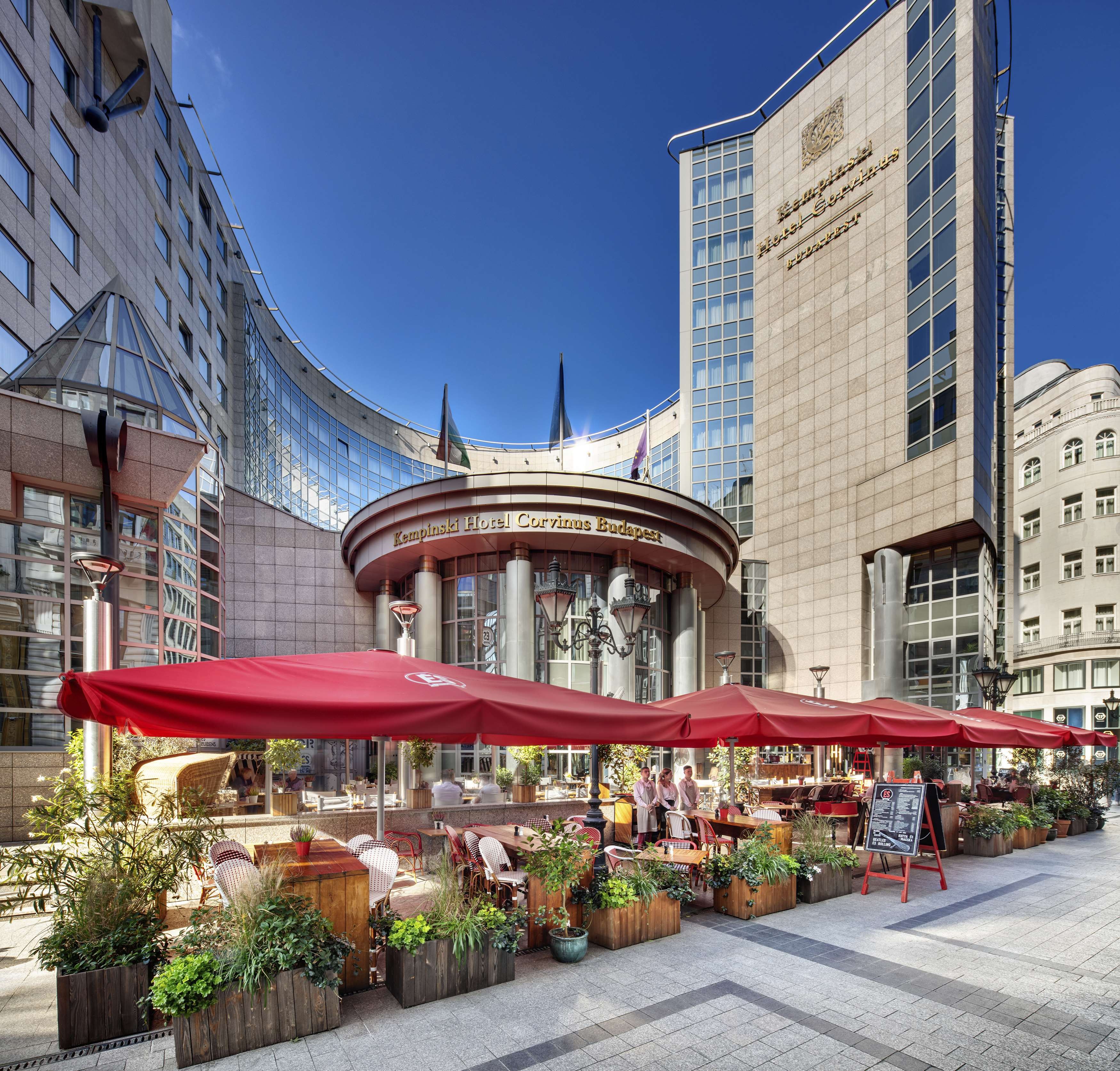
On Erzsébet tér in the heart of downtown Budapest, the Kempinski Hotel Corvinus occupies a curved glass structure that has anchored the city's luxury hotel scene for decades. Its ground-floor Gastronomy Quarter houses the first Central European Nobu alongside a contemporary Hungarian-Viennese brasserie, a Kaffeehaus-inspired living room, and a cocktail bar. A 91.5-point La Liste Top Hotels score and the 2025 World Travel Awards Hungary's Leading Luxury Hotel title confirm its competitive position.
Budapest's Downtown Luxury Tier and Where Corvinus Sits Within It
Budapest's top-tier hotel market has consolidated around a handful of addresses that compete less on location — most sit within minutes of the Danube or the inner ring — and more on the coherence of what they offer inside. The Anantara New York Palace Budapest Hotel leans into architectural grandeur; the Aria Hotel Budapest by Library Hotel Collection trades on a music-themed design identity; and properties like the Baltazár Boutique Hotel occupy a smaller, more personal tier altogether. The Kempinski Hotel Corvinus Budapest belongs to a different bracket: a full-service luxury property where the ground floor functions as a destination in its own right, not merely as a lobby passage to the lifts above.
The building itself announces this ambition before you enter. Its glass-clad facade follows the curve of the letter C, a formal gesture that gives the structure an unusual silhouette on Erzsébet tér. The terrace faces onto what locals call Fashion Street, placing the hotel inside the city's most commercially active pedestrian corridor. In terms of immediate urban positioning, few addresses in Budapest carry more foot-traffic visibility at this price point.
The Gastronomy Quarter: Four Formats, One Floor
Central European hotel F&B; has historically underperformed relative to what the cities themselves offer in standalone restaurants. The Kempinski Corvinus has made a deliberate structural argument against that pattern. The ground floor operates as what the hotel calls the Gastronomy Quarter Downtown Budapest, housing four distinct formats that each address a different dining register.
The most internationally significant is Nobu Budapest, the first Nobu restaurant in Central Europe. Nobu's global franchise model is well-documented: the kitchen operates within a standardised framework of new-style Japanese cuisine developed by chef Nobuyuki Matsuhisa, but local teams adapt execution to regional context. What matters for a hotel guest is that Nobu dishes are available 24 hours a day via in-room dining, making this one of the few hotels in Budapest where the room service menu carries genuine culinary credibility at any hour.
ÉS Bisztró sits alongside as a contemporary brasserie focusing on updated Hungarian-Viennese specialities. This pairing reflects something real about Budapest's culinary inheritance: the city spent long decades within the Habsburg orbit, and the local kitchen absorbed Viennese technique alongside Ottoman spice influence and Hungarian peasant tradition. A brasserie format that holds both sides of that duality is a more honest representation of the city's food culture than the themed Hungarian folklore restaurants that still occupy parts of the tourist circuit.
The Living Room draws from the Kaffeehaus tradition that shaped Central European intellectual and social life from Vienna to Prague to Budapest for two centuries. The format here is a hotel-lobby interpretation of that culture rather than a preservation of it, but the reference point matters. Blue Fox The Bar completes the quartet with a cocktail program that balances classic builds with more contemporary constructions. For context on how Budapest's bar scene has developed, our full Budapest restaurants guide covers the broader picture across the city's drinking culture.
The Front-of-House Architecture: Coordinating Across Four Concepts
Running four distinct food and beverage formats under a single roof requires a level of operational coordination that most hotel properties do not attempt. The editorial angle here is less about any individual team member and more about what this structure demands: a front-of-house that can field questions about Nobu's omakase offerings, the provenance of Hungarian wines on the brasserie list, the cocktail program at Blue Fox, and the afternoon coffee service in The Living Room, often simultaneously. Hotels that attempt this kind of multi-format integration usually reveal the strain at handover points , when a guest moves from one concept to another and the service register resets awkwardly.
The 24-hour Nobu room service arrangement is the most operationally complex element. Sustaining kitchen quality at 3am for an in-room order requires a different staffing logic than running a dinner service, and the decision to extend Nobu's menu rather than defaulting to a generic room service alternative reflects a deliberate service-architecture choice. Whether the execution holds consistently is the kind of question that only repeated stays can answer, but the structural commitment is clear.
The Spa: Positioning and Program
Kempinski The Spa has undergone a comprehensive redesign, and the program now positions itself as what the hotel describes as the go-to spa in Budapest. That is a competitive claim in a city where thermal bathing is a civic institution rather than a hotel amenity, and where the Széchenyi and Gellért baths operate at a cultural register that no hotel spa can replicate. What a hotel spa can offer that the public baths cannot is privacy, appointment-based access, and a treatment menu that extends beyond thermal soaking.
The Corvinus spa delivers on those differentiators. The facility includes a heated pool with counter-current jets, a Jacuzzi, aromatherapy and Finnish saunas, a steam bath, a tepidarium, and a Kneipp bench. The signature treatment is the Hungarian Holistic Journey, a mud wrap using Hungarian thermal mud that addresses both skin rejuvenation and joint relief, followed by a choice of scalp massage or express facial. The VOYA product partnership grounds the treatment menu in a recognisable luxury wellness framework. The minimum age for the gym and wellness area is 16; children under 14 may use the pool and relaxation area when accompanied by an adult.
Art Collection and Room Design
The Corvinus Art Collection is one of the more considered elements of the property's identity. Most luxury hotels in Budapest deploy art as decoration; the Corvinus has built a corporate collection of Hungarian contemporary work that is distributed across rooms, suites, and public areas. The Gallery on the Promenade shows curated modern Hungarian art around the clock. Five suites in the Corvinus Art Collection carry distinct design identities drawn from Hungarian cultural reference points , the Herend Suite, for instance, incorporates Herend porcelain, the hand-painted fine china that has been produced in western Hungary since 1826 and remains one of the country's most internationally recognised craft exports.
Recently redesigned Corvinus Rooms and junior suites use a contemporary palette of gold, platinum, and grey with large windows. Superior rooms include entertainment systems and minibar access; Deluxe category and above add a Nespresso machine. All accommodations come with Salvatore Ferragamo toiletries. Each Art Collection suite provides a full living space, dining room, and two bathrooms.
Awards, Ratings, and Competitive Context
Property holds a 91.5-point score in the La Liste Leading Hotels 2026 ranking and won the 2025 World Travel Awards as Hungary's Leading Luxury Hotel. A Google review score of 4.7 across 3,799 ratings provides a volume-weighted confirmation of sustained guest satisfaction, a more meaningful signal than a smaller sample would be.
Within Budapest's luxury tier, the Corvinus competes against properties with stronger architectural heritage narratives , the Corinthia's grand ballroom, the Anantara New York Palace's gilded café. What the Corvinus answers with is a coherent contemporary offer: the art collection, the multi-format F&B; program, the redesigned spa, and a ground-floor energy that operates as a lifestyle hub rather than a holding area. For travellers comparing options at this price tier, properties like the Bohem Art Hotel or Brody House offer an entirely different register , smaller, more idiosyncratic, less operationally complete , which clarifies what the Corvinus is and is not. For those exploring beyond the capital, BOTANIQ Castle of Tura and Hotel Palota Lillafüred represent Hungary's country-house luxury offer, while Hotel Petit Bois in Balatonfüred and Platán Manor in Tata serve as lakeside and countryside alternatives.
On a global comparison grid, the Corvinus sits in a category of city-centre flagship luxury properties that includes Cheval Blanc Paris and Hôtel de Paris Monte-Carlo at the highest end, and The Fifth Avenue Hotel in New York City or Bvlgari Hotel Tokyo as reference points for design-led F&B; integration. The Budapest property does not compete at that price tier, but the structural ambition of its ground-floor F&B; program and its approach to the art collection reflect the same logic.
Planning Your Stay
The hotel is at Erzsébet tér 7-8, 1051 Budapest, in the first district's commercial core, within walking distance of the Danube embankment and the main pedestrian shopping streets. An underground car park accommodates 210 vehicles, with an electric vehicle charging station available , a practical consideration for guests arriving by car from Vienna or other Central European cities. The Clefs d'Or concierge desk and a dedicated Lady in Red customer service contact handle guest requests. A gift and flower shop operates on-site. Children under six share their parents' room at no extra charge, with complimentary breakfast; children between 6 and 12 receive a 50% discount on both the extra bed and breakfast charges.
Frequently Asked Questions
- What's the most popular room type at Kempinski Hotel Corvinus Budapest?
- The Corvinus Art Collection suites attract guests who want accommodation that goes beyond standard luxury conventions. Each of the five suites carries a distinct design identity rooted in Hungarian cultural history , the Herend Suite being the most referenced , with a full living space, dining room, and two bathrooms. The recently redesigned Corvinus Rooms and junior suites, with their contemporary gold, platinum, and grey palette, serve guests who prefer a cleaner modern aesthetic. Both tiers were acknowledged in the hotel's 2025 World Travel Awards recognition as Hungary's Leading Luxury Hotel.
- What should I know about Kempinski Hotel Corvinus Budapest before I go?
- The hotel operates four food and beverage formats on its ground floor, including the first Nobu restaurant in Central Europe, which also runs 24-hour in-room dining. The spa requires guests to be at least 16 to use the gym and wellness area; under-14s may access the pool when accompanied by an adult. The hotel holds a 91.5-point La Liste Leading Hotels 2026 score, which helps calibrate what price tier and service standard to expect when comparing it with other Budapest properties like the Al Habtoor Palace Budapest or BoHo Hotel Budapest.
- Is Kempinski Hotel Corvinus Budapest reservation-only?
- Hotel rooms require advance booking, and given the property's award recognition and central location on Erzsébet tér, peak-season availability tightens early. The Gastronomy Quarter venues , including Nobu Budapest , typically accept reservations, and for the spa, appointment booking is standard practice for treatments. Guests who prefer to confirm dining and spa access before arrival should contact the hotel's concierge desk directly.
- Does Kempinski Hotel Corvinus Budapest have a notable art program distinct from standard hotel decoration?
- The Corvinus Art Collection is a corporate collection of Hungarian contemporary art that functions as a curated program rather than decorative wallpaper. Works are distributed throughout rooms and suites, and the Gallery on the Promenade displays rotating selections around the clock, accessible to all guests. The five Art Collection suites each carry design themes drawn from Hungarian cultural heritage, with the Herend Suite incorporating Herend fine porcelain , a craft tradition with a documented history stretching back to 1826. This positions the hotel within a small group of city properties, alongside names like Aria Hotel Budapest, that treat cultural programming as a structural part of the guest experience rather than an afterthought.
Recognized By


Related editorial
- Best Fine Dining Restaurants in ParisFrom three-Michelin-star icons to the next generation of Parisian chefs pushing boundaries, these are the restaurants that define fine dining in the world's culinary capital.
- Best Luxury Hotels in RomeFrom rooftop terraces overlooking ancient ruins to Michelin-starred hotel dining, these are the luxury hotels that make Rome unforgettable.
- Best Cocktail Bars in KyotoFrom sleek lounges to hidden speakeasies, Kyoto's cocktail scene blends Japanese precision with global influence in ways you won't find anywhere else.
Save or rate Kempinski Hotel Corvinus Budapest on Pearl
Keep this venue in your Pearl passport, rate it after you visit, and track it alongside every other place you collect.