
Hotel in Seville, Spain
Hotel Mercer Sevilla
625ptsPalacio-Scale Minimalism

About Hotel Mercer Sevilla
An 11-room boutique property in Seville's Casco Antiguo, Hotel Mercer Sevilla earned a Michelin Key in 2024 and rates from $528 per night. Structured around a central courtyard in the manner of an Andalusian palacio, it pairs 19th-century architecture with considered modern design and a rooftop pool. Four rooms and eight suites occupy the building, making it one of the more intimate luxury options in the city centre.
Where Andalusian Architecture Meets Small-Scale Luxury
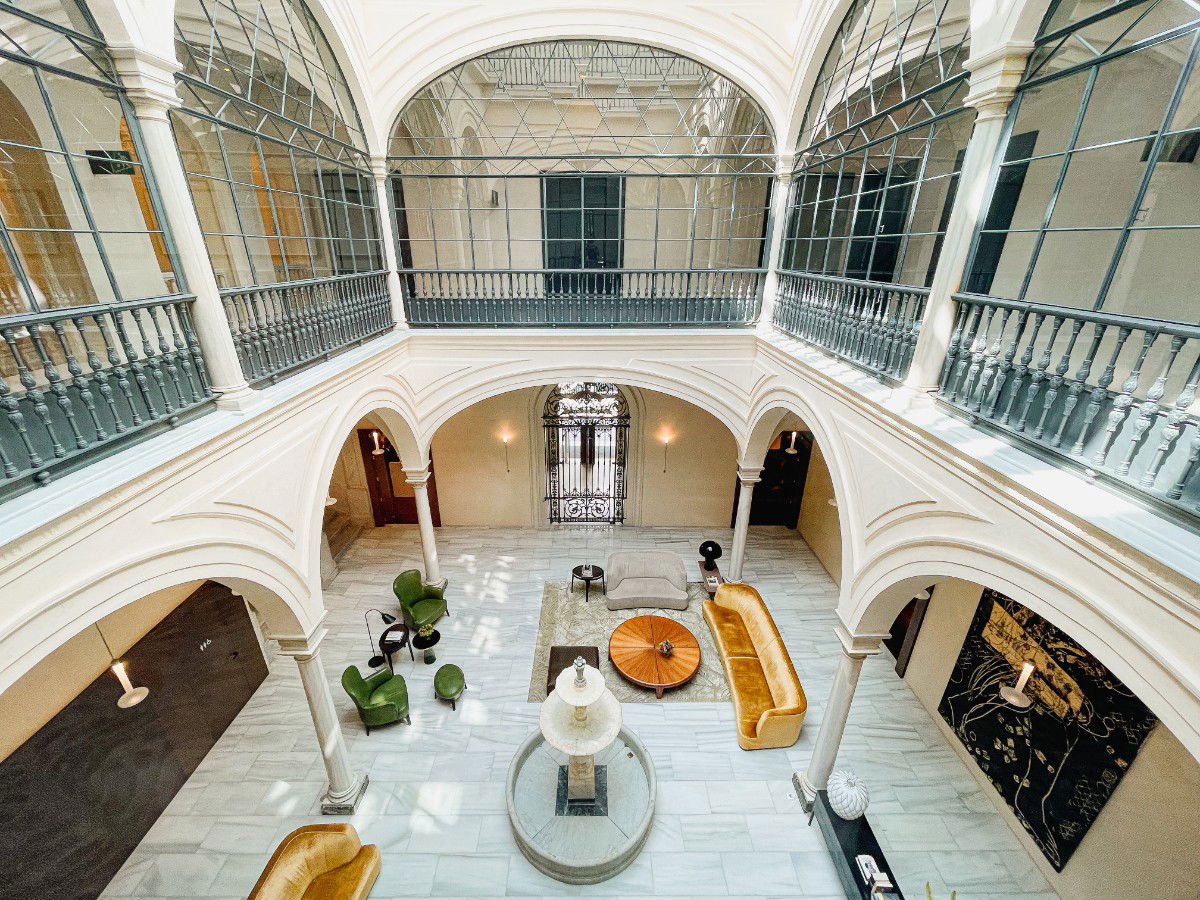
Seville's old city contains a particular type of building that keeps reappearing across its palacio stock: a compact structure organised around a central patio, with rooms opening inward rather than outward, life arranged around shade and water rather than street-facing views. The typology has roots that predate the Reconquista, and its closest living relative is the North African riad, which itself evolved from Roman courtyard house forms carried across the Mediterranean by Moorish culture. Hotel Mercer Sevilla, at Calle Castelar 26 in the Casco Antiguo, sits squarely within this tradition, and what makes it worth considering is how faithfully it respects that spatial logic while layering in design and service infrastructure that most palacio conversions do not attempt.
The building dates to the 19th century, and its architecture carries the characteristic ornamental density of that period: tiled floors, wrought-iron detailing, the kind of proportions that feel genuinely residential rather than purpose-built for hospitality. Against that backdrop, the Mercer group has placed contemporary furniture with evident care, not as contrast for its own sake but as a way of keeping the interiors from reading as a museum reconstruction. The result is a dialogue between periods that stays controlled rather than jarring.
Eleven Rooms, One Clear Commitment to Scale
The hotel holds eleven keys across four rooms and eight suites. At that count, it occupies a different tier from Seville's larger luxury operations entirely. Hotel Alfonso XIII, a Luxury Collection Hotel, Seville operates at a scale of over 100 rooms; Hotel Colón similarly functions as a full-service city hotel. The Mercer sits at the opposite end of that spectrum, closer in format and philosophy to Corral del Rey and CoolRooms Palacio Villapanés, which are also palacio conversions operating at boutique scale within the historic centre.
Advantages of that scale are practical as much as atmospheric. At eleven rooms, service ratios can be maintained at a level that larger properties struggle to deliver consistently. The Mercer group has demonstrated this capability across its other Spanish properties, and the Seville outpost carries that operational standard. Rates from $528 per night position it at the premium end of the Seville boutique market, above Hospes Las Casas del Rey de Baeza and broadly comparable to Unuk in the city's upper-tier palacio segment.
In 2024, the property received a Michelin Key, the guide's hotel-specific recognition introduced to evaluate the overall guest experience rather than food alone. The award places Hotel Mercer Sevilla within a small cohort of Seville properties that meet that standard, and it functions as a useful orientation point when comparing against the wider Hotel Las Casas de La Judería and similar historic properties that do not carry equivalent third-party endorsement.
The Courtyard and the Rooftop: Two Distinct Registers
Small luxury hotels in southern Spain tend to resolve around two spatial experiences: the interior patio and, where the building height permits, the rooftop. Hotel Mercer Sevilla manages both, and they function differently enough to serve different times of day.
The courtyard operates as the gravitational centre of the building. White-on-white surfaces allow light to move through the space without the heavy shadow that darker palacio interiors can produce, and the proportions remain human-scaled rather than theatrical. This is where the riad comparison holds most firmly: the architecture is not trying to impress through scale but through quality of shade, air movement, and material surface.
The rooftop terrace adds a pool, a bar, and views across the Casco Antiguo roofline. In a city where summer temperatures regularly exceed 40 degrees Celsius, a rooftop pool at a small property is not a standard amenity. Most of Seville's boutique palacio hotels lack it; the Mercer's inclusion at this room count is operationally deliberate.
The Restaurant and Bar: Punching Above Room Count
Eleven-room hotels in historic buildings usually settle for a breakfast room and, at leading, an honesty bar. The Mercer Sevilla runs a proper restaurant and bar operation, which positions it differently from comparably-sized local competitors. The kitchen and service infrastructure required to sustain a restaurant at a property this small is disproportionate to the room count, and the Mercer group's experience across its portfolio explains how it remains viable. For guests, this means the property functions as a full-service base rather than a place to sleep between restaurant bookings elsewhere. Those looking to map Seville's wider dining scene independently can refer to our full Seville restaurants guide.
Responsible Scale in the Casco Antiguo
The editorial angle on sustainability in heritage-zone hotels is rarely about solar panels or carbon offsetting language. In Seville's Casco Antiguo, the most consequential sustainable choice a hotel can make is one of scale. Seville's historic centre carries significant overtourism pressure, and large-format hotels that drive high visitor throughput add to that load in ways that smaller properties structurally do not. Eleven rooms means eleven check-ins, eleven sets of guests moving through a building that was originally a residence. The Mercer does not import a resort format into a neighbourhood context; it remains appropriately sized for its setting.
The preservation dimension is also material. The building's 19th-century architecture is maintained as a functioning hospitality space rather than being left to institutional deterioration or converted for higher-density use. That kind of adaptive reuse, done at a pace and scale that allows quality control, is a more durable form of heritage stewardship than any single-season environmental initiative.
For context on how this approach plays out across the wider Spanish luxury hotel market, comparable properties operating within heritage-sensitive sites include Atrio Restaurante Hotel in Cáceres, Terra Dominicata in Escaladei, and Abadía Retuerta LeDomaine in Teruel, each of which navigates the tension between historic fabric and contemporary hospitality expectation in a different way. The Mercer's urban palacio format is the most compressed version of that challenge.
Planning Your Stay
Hotel Mercer Sevilla operates from Calle Castelar 26 in the Casco Antiguo, within walking distance of the Cathedral, the Alcázar, and the Barrio de Santa Cruz. Room rates begin at $528 per night across the property's eleven keys. Given the limited inventory, reservations at this price point and with this level of Michelin-recognised quality tend to be absorbed quickly, particularly during Semana Santa (Holy Week) and the Feria de Abril, when Seville accommodation across all tiers experiences high demand. Planning well in advance for spring travel is advisable.
Guests focused on Andalusia's wider hotel circuit may find useful points of comparison in Marbella Club Hotel in Marbella, while those exploring Spain's broader luxury boutique tier might consider Hotel Can Cera in Palma, Mas de Torrent Hotel & Spa in Torrent, or Cap Rocat in Cala Blava. For the northern Spain end of the spectrum, Akelarre in San Sebastián and Casa Beatnik Hotel in A Coruña represent a distinct regional register. International comparisons at a similar scale and positioning include Aman Venice in Venice and Aman New York in New York City for those mapping the ultra-boutique luxury tier globally, or The Fifth Avenue Hotel in New York City and Mandarin Oriental Barcelona in Barcelona for a fuller-service point of reference. Mandarin Oriental Ritz, Madrid and La Residencia, A Belmond Hotel, Mallorca sit further up the scale in terms of room count and brand infrastructure, offering a sense of where Mercer Sevilla positions itself relative to the major-group luxury tier. The EME Catedral Mercer Hotel provides a further Mercer-group comparison within Seville itself, at a different scale and location. Torre del Marqués Hotel Spa & Winery in Sardoncillo rounds out the Spanish heritage-property circuit for travellers covering multiple regions.
Frequently Asked Questions
Which room offers the leading experience at Hotel Mercer Sevilla?
The property holds eight suites and four rooms across its eleven keys. The suite configuration is the stronger choice on the basis of space and proportion, particularly given that the building's 19th-century architecture tends to express itself most fully at the larger floor plans. The Michelin Key awarded in 2024 and the $528 base rate both suggest that the suite tier is where the property's design investment is most concentrated, though the database record does not confirm specific suite names or configurations. Booking the most spacious available option is the reasonable default at this price point and room count.
What is the standout thing about Hotel Mercer Sevilla?
Scale, consistently. Eleven rooms in the Casco Antiguo, a Michelin Key in 2024, a rooftop pool, and a functioning restaurant at a room count where most competitors offer none of those things. The property's ability to deliver full-service infrastructure at boutique volume, within a 19th-century palacio frame that genuinely reflects the Moorish-Andalusian architectural tradition of southern Spain, is what separates it from larger city-centre luxury hotels and from comparable palacio conversions that operate more modestly on the food and beverage side. At rates from $528, the price reflects that combination rather than simply a central Seville address.
Is Hotel Mercer Sevilla reservation-only?
As an eleven-room hotel in a high-demand city, Hotel Mercer Sevilla operates on an advance reservation basis. Seville's Casco Antiguo attracts significant pressure during Semana Santa and the Feria de Abril, and a property at this room count will sell out substantially before those periods. If you are travelling during spring, reserving several months ahead is the practical standard. The property's website and direct contact details are not published in this record; the Mercer group's central reservations channel is the appropriate starting point. Given the 2024 Michelin Key and the $528-and-above price positioning, this is not a walk-in property under any realistic travel scenario in Seville's peak calendar.
Recognized By

Related editorial
- Best Fine Dining Restaurants in ParisFrom three-Michelin-star icons to the next generation of Parisian chefs pushing boundaries, these are the restaurants that define fine dining in the world's culinary capital.
- Best Luxury Hotels in RomeFrom rooftop terraces overlooking ancient ruins to Michelin-starred hotel dining, these are the luxury hotels that make Rome unforgettable.
- Best Cocktail Bars in KyotoFrom sleek lounges to hidden speakeasies, Kyoto's cocktail scene blends Japanese precision with global influence in ways you won't find anywhere else.
Save or rate Hotel Mercer Sevilla on Pearl
Keep this venue in your Pearl passport, rate it after you visit, and track it alongside every other place you collect.