
Hotel in Riñinahue, Chile
Futangue Hotel & Spa
500ptsRainforest Reserve Lodging

About Futangue Hotel & Spa
Set within a private nature reserve on the shores of Lake Ranco in Chilean Patagonia's Los Ríos region, Futangue Hotel & Spa combines 26 rooms of contemporary-rustic design with a serious adventure program and a spa that frames the Valdivian rainforest as its primary amenity. The restaurant, Mesón del Caulle, draws from the surrounding lake and forest ecosystem under the direction of chef Karime Harcha.
Where the Valdivian Rainforest Becomes the Architecture
The road to Futangue Hotel & Spa along Ruta T-85 tells you what kind of place this is before you arrive. By the time you reach KM 22, the Valdivian temperate rainforest has closed in on both sides, the lake is glimpsed in fragments through stands of coigüe and ulmo, and the sense of having left the grid behind is complete. Northern Patagonia's Lake District operates differently from the austere, wind-scoured plains further south: the terrain here is greener, the altitude less punishing, the mood closer to the Scottish Highlands than to the end of the earth. That relative hospitality is what allows a property like Futangue to exist in a register that Torres del Paine's more exposure-driven lodges cannot quite match.
The hotel sits within Parque Futangue, a private reserve bordering Lago Ranco, and the design makes that relationship explicit. The architecture reads as a considered response to place rather than an imposition on it: heavy timber framing, materials that weather into the surroundings, and a massing that stays low against the treeline. This is the now-established idiom of high-end Patagonian hospitality, a design language developed across properties like Ecocamp Patagonia in Torres del Paine and REMOTA in Puerto Natales, and Futangue executes it at a scale that remains legible as a private retreat rather than a resort compound.
The Interior: Rustic Inspiration, Contemporary Execution
Twenty-six rooms and suites is a count that keeps Futangue firmly in the intimate tier of Chilean luxury lodges. The interiors work a deliberate contrast: contemporary spatial planning with materials drawn from the surrounding ecosystem. Bare timber, leather, and fur read as tactile references to the landscape outside rather than decorative choices imported from a design catalogue. The effect is coherent because the sources are genuinely local, a distinction that separates properties with authentic material identity from those applying a generic mountain-lodge aesthetic.
Bathrooms feature walk-in rain showers stocked with products derived from Valdivian rainforest plants, which is the kind of detail that, when genuine, sharpens the sense of place considerably. In the broader market for Chilean adventure lodges, this level of in-room specificity positions Futangue alongside andBeyond Vira Vira in Pucon and Puyuhuapi Lodge & Spa in Aisen as properties where the physical fabric of the rooms carries editorial weight, not just comfort-tier signalling.
The Spa and Pool: Framing the Panorama
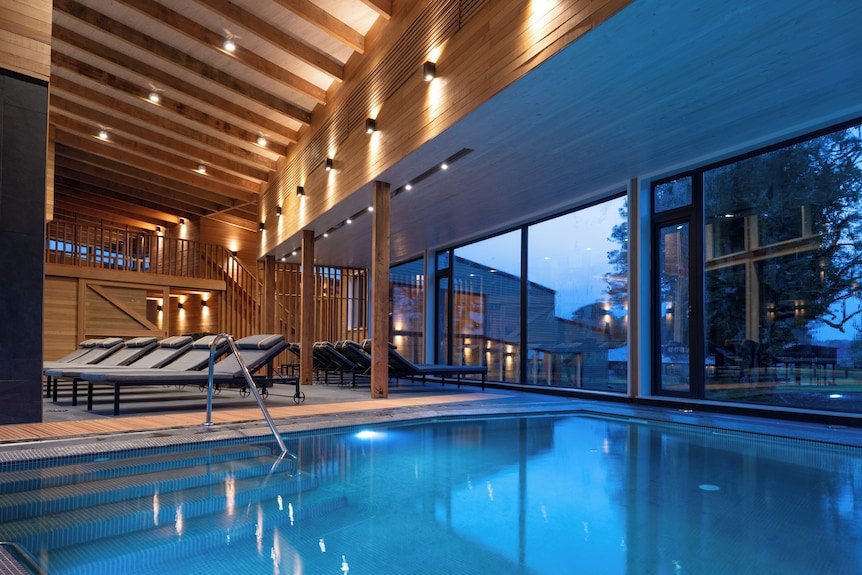
The spa at Futangue occupies a double-height volume, a spatial decision that matters here because it allows the Patagonian panorama to function as the primary visual element from within the saunas and the indoor pool. This is design operating in service of place: the architecture steps back and lets the landscape do the work. A second, half-Olympic outdoor pool extends the relationship between built and natural environment further, and in the Lake District's temperate seasons, that outdoor pool is a genuine amenity rather than a seasonal gesture.
Among Chilean lodge spas, the double-height treatment and dual-pool configuration give Futangue a physical generosity that smaller properties in the category cannot match. For comparison, the design-led sensibility here is closer to what Awasi Atacama in San Pedro de Atacama achieves with its desert-framing architecture than to the more utilitarian spa formats found at activity-first lodges.
Mesón del Caulle: Sourcing as Editorial Stance
The restaurant's name references Puyehue-Cordón Caulle, the volcanic complex that defines this part of the Andes, and the sourcing philosophy follows the geography: ingredients drawn from Lago Ranco and the broader Valdivian region. Chef Karime Harcha, described as a highly regarded local figure, oversees the kitchen, and the emphasis on hyper-regional sourcing places Mesón del Caulle within a wider Chilean dining movement that has gained ground over the past decade, in which Patagonian and southern Chilean ingredients are treated as a distinct culinary identity rather than a remote province of a Santiago-centric food culture.
For guests arriving from urban Chilean properties, the restaurant at Futangue represents a clean break from that urbanism. The contrast is sharper for those travelling from W Santiago or Debaines Hotel Santiago, where the city's restaurant scene provides abundant choice and the hotel's food is rarely the point. At Futangue, Mesón del Caulle is essentially the only option in the vicinity, which changes how it functions: not as one of many dining decisions, but as the full expression of the region's larder on a given evening.
The Activity Program: What the Hotel Is Actually For
Futangue's activity roster covers the full spectrum of what the Lake District allows: fly-fishing and kayaking on the lake, horseback riding through the reserve, mountain-biking, and trekking into the Valdivian rainforest. The breadth reflects the property's physical position at the intersection of water, mountain, and forest ecosystems, each of which opens a different programme of activity. This is the architecture that actually defines the guest experience; the rooms and spa are recovery infrastructure for the hours spent outside.
In that sense, Futangue follows the same logic as Explora Torres del Paine and Explora Patagonia National Park, where the hotel's competitive value is measured in access and guiding quality rather than room size or F&B; range. The difference is that the Lake District's landscape is less extreme, and the activities at Futangue skew toward long-form immersion, a full day on the lake or a multi-hour forest ride, rather than the altitude-testing trekking that defines the southern parks. See also Mari Mari Natural Reserve Experience in Los Muermos and Refugia Chiloé for adjacent properties working comparable terrain in the same broad region.
Planning and Access
Futangue sits at KM 22 on Ruta T-85 in the Lago Ranco area of the Los Ríos region, which places it roughly within the circuit that connects Valdivia and Osorno. The nearest commercial airport is in Osorno or Valdivia, with further connections through Puerto Montt. The property holds 26 rooms, a count that means availability is limited and forward planning matters, particularly during the southern hemisphere summer months of December through February, when the Lake District draws its largest volume of visitors. Guests considering Futangue as part of a longer Chilean itinerary might also weigh Hotel AWA in Puerto Varas or Noi Puma Lodge in Cachapoal for contrast in terrain and format. For those building a broader South American arc, Amangiri in Canyon Point offers an instructive reference point for how desert-landscape properties handle the same design-as-frame-for-nature formula in a different hemisphere. Browse our full Riñinahue restaurants guide for additional regional context.
Frequently Asked Questions
Is Futangue Hotel & Spa more low-key or high-energy?
That depends on how you use it. The design and spa infrastructure are calm and deliberately unhurried, but the activity programme is serious: fly-fishing, mountain-biking, kayaking, and multi-hour trekking are not background options. If you arrive without an activity itinerary, the property reads as a quiet lakeside retreat. If you engage the full programme, the physical demands are substantial. The hotel functions well in either register, which is part of what its 26-room format allows.
What's the leading room type at Futangue Hotel & Spa?
Without current room-category pricing in the public record, a direct comparison is difficult to make. What the database confirms is that rooms and suites are finished to a consistent standard, with contemporary layouts, local-materials interiors, and bathrooms that use Valdivian rainforest plant products. For guests prioritising space and views, suites at this type of Patagonian property typically offer a meaningful step up in sightline orientation toward the lake or forest, though specific configurations should be confirmed at booking.
What's the main draw of Futangue Hotel & Spa?
The combination of a private reserve setting on Lago Ranco, a serious multi-discipline activity programme, and a double-height spa that frames the Patagonian panorama from within. In the northern Patagonia lodge category, Futangue's position within Parque Futangue gives it a scale of access to undisturbed terrain that smaller properties on the lake's periphery cannot replicate. The restaurant, Mesón del Caulle, adds a sourcing-focused food programme that makes the property function as a complete destination rather than a base camp with rooms attached.
Do I need a reservation for Futangue Hotel & Spa?
At 26 rooms, Futangue operates at a capacity where availability tightens quickly during peak season. The southern summer window of December through February is the highest-demand period across the Lake District, and properties of this size frequently fill weeks or months in advance during those months. Booking well ahead of your travel dates is advisable. Contact the property directly or through a specialist travel agent for current availability; no direct booking link is in the current public record.
What does the Valdivian sourcing at Mesón del Caulle actually mean in practice?
The Valdivian temperate rainforest is one of the few remaining temperate rainforest ecosystems in the world, and the Lago Ranco area sits within its southern extent. For Mesón del Caulle, sourcing from Lake Ranco and the Valdivian region means working with freshwater fish, foraged forest ingredients, and local agricultural producers from an ecosystem that has no direct equivalent elsewhere in South America. Chef Karime Harcha, recognised as a significant figure in southern Chilean cooking, frames the menu around those ingredients rather than importing the conventions of Santiago's restaurant culture south.
Recognized By

Related editorial
- Best Fine Dining Restaurants in ParisFrom three-Michelin-star icons to the next generation of Parisian chefs pushing boundaries, these are the restaurants that define fine dining in the world's culinary capital.
- Best Luxury Hotels in RomeFrom rooftop terraces overlooking ancient ruins to Michelin-starred hotel dining, these are the luxury hotels that make Rome unforgettable.
- Best Cocktail Bars in KyotoFrom sleek lounges to hidden speakeasies, Kyoto's cocktail scene blends Japanese precision with global influence in ways you won't find anywhere else.
Save or rate Futangue Hotel & Spa on Pearl
Keep this venue in your Pearl passport, rate it after you visit, and track it alongside every other place you collect.