
Hotel in Madrid, Spain
Four Seasons Hotel Madrid
1,775ptsHistoric Fabric, Modern Address





About Four Seasons Hotel Madrid
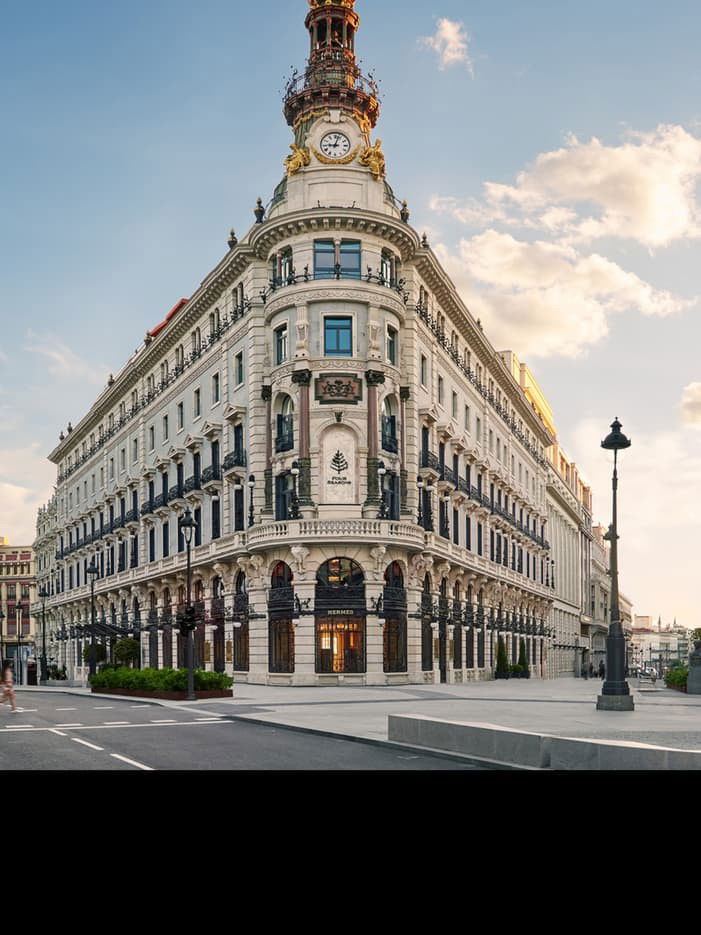
Seven interconnected heritage buildings in the heart of Madrid, Four Seasons Hotel Madrid holds a La Liste Top Hotels score of 97.5 (2026) and ranked 66th in the World's 50 Best Hotels (2025). With 200 rooms, Michelin 2 Keys recognition, rooftop dining by Dani García, and Kilometre Zero a short walk away, it sits at the centre of the city's upper luxury tier.
Where the City's History Becomes the Architecture
The approach along Calle de Sevilla gives little warning of the scale of what lies ahead. Seven separate historical buildings, each with its own structural personality, have been stitched together into a single address without erasing the seams. In the lobby, a two-story former banking hall retains its stained-glass ceiling, supplied by Casa Maumejean, a family workshop that has produced glass for Spanish churches and palaces since the 1860s. That ceiling is now listed as a protected architectural feature, which sets the tone for how the entire property treats its inheritance: not as a backdrop to be dressed over, but as load-bearing material for everything that follows.
Madrid's upper luxury tier has consolidated around a handful of addresses in the Centro and Salamanca districts. The Mandarin Oriental Ritz, Madrid and Rosewood Villa Magna represent the two dominant approaches: monumental Belle Époque ceremony on one side, residential Castellana restraint on the other. Four Seasons Hotel Madrid sits closer to the ceremonial end of that dial, but the Centro Canalejas project adds a civic dimension that neither competitor can replicate. The property is not simply a hotel; it occupies one node of a mixed-use complex that includes a gallery, luxury retail, 22 private residences, and a food market. In that sense, it has more in common with major urban regeneration projects than with a conventional hospitality conversion.
The Preservation Calculus at Centro Canalejas
The editorial angle on sustainability at most luxury hotels defaults quickly to solar panels and linen-reuse cards. The more consequential environmental act here was architectural: retaining more than 16,000 original features across the seven buildings, including lamps, slate roof sections, and original windows, rather than stripping and rebuilding. Restoration at that scale redirects enormous quantities of embodied-carbon material from demolition and landfill back into active use. The practice is increasingly recognised as one of the higher-impact choices a large-scale urban development can make, and it is rarely direct to execute when the goal is also a five-star hotel with contemporary service expectations.
For a counterpoint on how Spanish heritage properties approach this problem at smaller scale, CoolRooms Palacio de Atocha and Gran Hotel Inglés both work within protected building envelopes but with far fewer keys and correspondingly tighter adaptive constraints. The Gran Meliá Palacio de los Duques presents the most comparable heritage footprint in terms of listed-structure complexity, though its program is concentrated in a single convent building rather than a multi-structure assembly.
The Rooms and What They Face
Across 200 rooms and suites, the design brief held to a consistent instruction: grace without gratuitousness. Upholstered headboards, chrome hardware, and marble surfaces appear throughout without the floor-to-ceiling gilding that some Madrid luxury conversions have leaned into. Outlook varies considerably by room position: some face the interior courtyard, others look onto residential streets, and the upper tiers open toward the city's roofline. The Royal Suite, at 4,305 square feet and positioned at the building's triangular point, commands the widest view geometry of any room in the property. It is the room the architecture was always pointing toward, and its floor-plan corresponds to the junction where two of the seven original buildings meet.
At a rack rate beginning around $1,452, the property prices into the upper band of Madrid luxury, broadly aligned with the Mandarin Oriental Ritz tier rather than the mid-luxury bracket occupied by properties like Hotel Unico Madrid or Only YOU Boutique Hotel Madrid. The 200-key count places it among the larger luxury properties in the city centre, which has implications for booking availability: unlike the tightly allocated smaller addresses, rooms here are more consistently accessible without months of advance planning, though peak-season weekends and major trade-fair periods require the same lead time as any major-city luxury hotel.
Food Program and the Rooftop Question
The food-and-beverage operation across the property runs several distinct formats. Dani Brasserie on the leading floor is the most discussed: it delivers morning views across the Madrid skyline and transitions through lunch and dinner service with a menu under the creative direction of Andalusian chef Dani García, whose restaurant Dani in New York has built recognition alongside his flagship Spanish operations. El Patio is framed as the people-watching address within the complex, which in a hotel of this footprint means a ground-level courtyard dynamic that functions as a social hinge between the hotel and the wider Centro Canalejas. Isa handles the bar program. The division of labor across three named venues reflects the same multi-use logic that defines the broader complex: different constituencies using the same building at the same time for different purposes.
For context on what rooftop dining means in Madrid's current restaurant climate, see our full Madrid restaurants guide, which maps how the city's upper dining tier has reorganised around chef-branded hotel restaurants over the past decade.
The Spa and What Four Floors Actually Means
The spa occupies four levels, a scale the property describes as the largest in Spain. Programming covers massage, facial treatments, couples' formats, yoga, and personal training through the connected fitness centre. Four floors of spa at a 200-key urban hotel represents a ratio of wellness infrastructure to room count that positions this property closer to resort logic than pure city-hotel logic, which is worth noting for guests calibrating whether they want to be based here for museum access or for a more inward schedule.
The pool terrace operates on the sun-exposed upper section of the property. In a city where summer temperatures routinely exceed 35°C from June through August, a rooftop pool terrace at a central address functions as a meaningful amenity rather than a marketing point. Timing a stay for late spring or early autumn balances pool usability with more comfortable temperatures for the city walks that this location facilitates.
Location and the Kilometre Zero Factor
Kilometre Zero, the origin point from which all road distances in Spain are formally measured, sits directly adjacent to the property on Puerta del Sol. The Prado, the Reina Sofía, and the Royal Palace are all within a 20-minute walk. That concentration of major institutions within an unassisted walking radius is not common across Madrid's luxury addresses: Rosewood Villa Magna's Castellana position, for example, places it closer to the financial district and Retiro than to the historic core. The Four Seasons location is specifically calibrated for guests whose primary interest is the city's monumental and cultural geography.
For guests who want to extend the trip into Spain's wider territory, the hotel has mapped a Scenic Route itinerary covering the 388-mile stretch between Madrid and Lisbon, with detours through wine regions and UNESCO World Heritage Sites. Within the property, a red Porsche Panamera house car handles transfers for journeys that fall outside walking range. Elsewhere in Spain, comparable heritage-integrated luxury operates at properties including Abadía Retuerta LeDomaine in Teruel, Atrio Restaurante Hotel in Cáceres, and Akelarre in San Sebastián, each operating within a different regional and price-tier logic.
Recognition and Where It Places the Property
The awards record over recent years is directionally consistent: World's 50 Best Hotels ranked the property at 24th in 2023, 32nd in 2024, and 66th in 2025, reflecting a repositioning within the list rather than a decline in absolute quality (list composition and methodology shift year to year). The Michelin 2 Keys designation, awarded in 2024, places it in the upper tier of the Michelin hotel guide's inaugural Spanish entries. La Liste's Leading Hotels score of 97.5 points in 2026 aligns with properties that La Liste places in serious international contention. A Google review score of 4.6 across 3,339 reviews suggests that the gap between award-body recognition and guest experience is narrower here than at some properties where the two diverge significantly.
For those building an itinerary around Spain's leading hotel addresses, other properties worth comparing at different price points and formats include Cap Rocat in Cala Blava, Hotel Can Cera in Palma, La Residencia, A Belmond Hotel, Mallorca, and Marbella Club Hotel in Marbella. For international reference points in the same luxury tier, Aman New York and Aman Venice represent the other dominant approach: minimal keys, maximum discretion, lower public-venue footprint.
Planning Your Stay
The property is at Calle de Sevilla, 3, in the Centro district. Booking through the Four Seasons Hotels and Resorts direct channel typically allows access to the brand's preferred-guest rates and room-upgrade protocols, which matter at a 200-room property where room-tier differences are meaningful. The 24-hour room service, babysitting, pet-friendly policy, and meeting rooms extend the property's functional range beyond leisure travel into family and business formats. Guests prioritising spa access should note that the four-level spa operates on a treatment-booking basis, and peak-season weekends fill quickly. The art collection of 2,000 works, including eight-foot KAWS sculptures installed in the lobby lounge in September 2021, is accessible to all guests as part of the general-circulation spaces, requiring no separate arrangement.
Frequently Asked Questions
- What is the standout thing about Four Seasons Hotel Madrid? The property's position at Kilometre Zero in central Madrid, combined with La Liste's 97.5-point score (2026), a World's 50 Best Hotels ranking, and Michelin 2 Keys recognition, makes it the most credentialed large-format luxury address in the city's historic core. The preservation of 16,000 original architectural features across seven merged heritage buildings is the structural argument that separates it from competitors who have renovated rather than restored.
- What is the leading room type at Four Seasons Hotel Madrid? Awards data and room-design details both point toward the upper suite tiers for guests who want the full architectural argument of the building. The 4,305-square-foot Royal Suite at the triangular apex of the structure captures the building's geometry most directly, while courtyard-facing rooms in the mid-tier offer quieter orientation and still access the full marble-and-upholstery design language. The price entry point starts around $1,452, with suites scaling above that.
- Do they take walk-ins at Four Seasons Hotel Madrid? For hotel rooms, walk-in availability depends on occupancy and is less predictable at a property in this award tier and at this price point. Given the 200-room count, the property is more accessible on short notice than smaller-format luxury addresses, but advance booking remains advisable. Restaurant venues within the complex, particularly Dani Brasserie, function as destinations in their own right and carry separate booking logic from the hotel itself.
Recognized By


Similar venues by awards
Related editorial
- Best Fine Dining Restaurants in ParisFrom three-Michelin-star icons to the next generation of Parisian chefs pushing boundaries, these are the restaurants that define fine dining in the world's culinary capital.
- Best Luxury Hotels in RomeFrom rooftop terraces overlooking ancient ruins to Michelin-starred hotel dining, these are the luxury hotels that make Rome unforgettable.
- Best Cocktail Bars in KyotoFrom sleek lounges to hidden speakeasies, Kyoto's cocktail scene blends Japanese precision with global influence in ways you won't find anywhere else.
Save or rate Four Seasons Hotel Madrid on Pearl
Keep this venue in your Pearl passport, rate it after you visit, and track it alongside every other place you collect.