
Hotel in Rio de Janeiro, Brazil
Fairmont Rio de Janeiro Copacabana
375ptsAvenida Atlântica Beachfront Address


About Fairmont Rio de Janeiro Copacabana
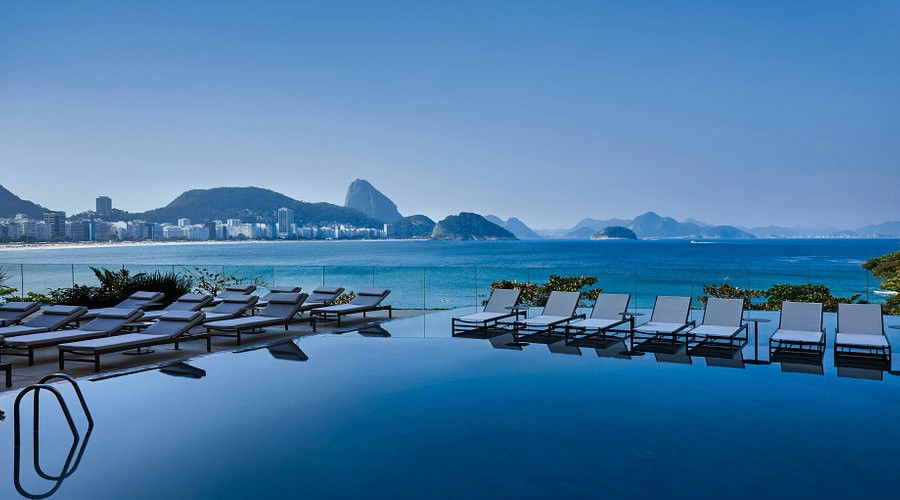
On Avenida Atlântica, facing Copacabana Beach with Sugarloaf Mountain behind it, the Fairmont Rio de Janeiro Copacabana positions itself within Rio's upper tier of beachfront hotels through a 1950s carioca design brief, four distinct food and drink venues, and a Gold Lounge tier that separates it from standard full-service competitors. Google reviewers rate it 4.7 across 3,342 responses.
Copacabana's Beachfront Address and What It Signals
Avenida Atlântica is Rio de Janeiro's most legible prestige address. The broad, mosaic-paved promenade separates Copacabana Beach from the city's hotel strip, and a property's position on it carries immediate contextual weight. The Fairmont Rio de Janeiro Copacabana occupies number 4240, a site that places it at eye level with the Atlantic and within direct sightlines of Sugarloaf Mountain. That geography is not incidental to the hotel's positioning: the building's design, by Brazilian architect Patricia Anastassiadis, draws from the 1950s glamour that made Copacabana internationally recognisable, and the physical setting reinforces that reference at every turn.
Rio's upper-tier beachfront hotel market is a narrow category. Copacabana Palace, A Belmond Hotel, Rio de Janeiro defines the historic pole of that set, while Hotel Fasano Rio de Janeiro and Emiliano Rio anchor the design-led contemporary end. The Fairmont, operating under the Accor umbrella, occupies a different register: a large-format international property with a structured tiering system (ten room categories) and a suite of facilities — two pools, a spa, a fitness centre, multiple food and drink outlets — that position it closer to the Grand Hyatt Rio de Janeiro than to the boutique properties like Casa Cool Beans or Casa Mosquito that serve a smaller-scale, neighbourhood-rooted brief.
The 1950s Design Framework and What It Delivers Inside
Anastassiadis drew from mid-century carioca aesthetics throughout the property. The rooms carry deep blue accents that reference the Atlantic, offset against creamy furnishings, dark coral touches, golden parquet floors, and warm marble bathrooms. Every accommodation includes a private balcony, and the views divide into three orientations: Copacabana Beach, Sugarloaf Mountain, or the city. That tripartite framing means the choice of room is also a choice of Rio's defining visual registers, and guests arriving for the first time would do well to consider which landscape they want to wake up to.
The Gold Rooms tier separates a subset of guests into a parallel track with private lounge access, exclusive services, and a dedicated check-in and checkout process. The Fairmont Gold model, consistent across the brand's properties globally, functions as a hotel-within-a-hotel logic: breakfast, snacks, and cocktails are included in the Gold Lounge, reducing friction around daily meals and drink costs. For stays of more than two nights, the arithmetic of that inclusion tends to recalibrate value against the room rate differential.
On Saturday and Sunday mornings, between 10 and 11 a.m., the hotel runs complimentary art and design tours around the property. The tours focus on Anastassiadis's work and the 1950s-era craftsmanship embedded throughout. It is one of the more substantive cultural programming touches among Rio's larger hotels, and it converts the design premise from backdrop to foreground.
Four Outlets, Four Distinct Briefs
Large-format hotels in this category frequently concentrate their food and drink offering into a single all-purpose restaurant. The Fairmont Rio distributes it across four venues with distinct formats, a structure that serves different dayparts and moods without requiring guests to leave the property.
Marine Restô, on the sixth floor, operates as the main restaurant. Its panoramic balcony faces the ocean, and the menu centres on seafood in forms that suit the address: raw oysters, carpaccio of the day's catch, whole fish as an entrée, and cavaquinha, the local shellfish whose flavour and texture approximate lobster without the premium freight. The approach is coastal and product-led, calibrated to a setting where the view does a proportion of the work.
Bar Spirit Copa handles the evening social function, with craft cocktails, a caipirinha made with cachaça, sugar, soda water, and lime as the non-negotiable baseline, and a shareable plates menu that includes ceviche, Brazilian fried empanadas, sausage cooked in cachaça with okra, and handmade Brazilian cheeses. The format is consistent with how bar programming at this tier has evolved in Rio: less reliant on international-standard spirits lists, more focused on local ingredients and technique as the differentiator.
Coa and Co Café handles the casual daytime brief, with coffee, sandwiches, salads, ice cream, pastries, and desserts. The traditional Brazilian cheese bread, available also stuffed with goiabada (guava jelly), is the production most likely to hold a guest's attention. Tropìk, the beach club, operates from breakfast through cocktail hour, with a Mediterranean-influenced menu that incorporates Brazilian dishes alongside it. Live shows and samba dancing at Tropìk extend the outlet's function into the evening, making it the most publicly facing of the four venues.
The Willow Stream Spa and the Question of Scale
Spa programming at large beachfront hotels in Rio tends to function as a supplementary amenity rather than a primary draw. The Willow Stream Spa here covers 4,300 square feet across five treatment rooms, a relaxation area, a steam room, and a sauna, with an adjoining beauty salon and fitness centre. For a property of this scale, that footprint is competent without being exceptional, and the spa's value to most guests will be in its convenience and consistency rather than its standing as a destination in its own right.
Fitness classes are listed among the hotel's amenities alongside the outdoor pool, 24-hour room service, and beach access. Pet-friendly policies and meeting room availability extend the property's appeal to a broader range of stay types, from leisure to corporate, a range that the Fairmont's brand architecture across its Accor portfolio is specifically structured to serve.
Rio's Broader Context and Where This Property Fits
Brazil's premium hotel sector has diversified considerably beyond its coastal anchors. Properties like Cristalino Lodge in Alta Floresta, Caiman, Pantanal in Miranda, and Atlantica Jungle Lodge in Vila Do Abraao now compete for the same traveller budget, offering immersive environmental programmes that a beachfront city hotel cannot replicate. Elsewhere, Awasi Santa Catarina, Barracuda Hotel and Villas in Itacaré, and Carmel Charme Resort in Ceará address the coastal resort demand with smaller, more locally embedded models.
The Fairmont Rio's argument is different. It is a city hotel on the most recognised beach in South America, with a 4.7 Google rating across 3,342 reviews, a track record that reflects consistent delivery at scale rather than the more variable experience typical of smaller boutique competitors. For travellers building a Brazil itinerary that includes Rio alongside, say, a stay at Hotel das Cataratas, A Belmond Hotel, Iguassu Falls or Rosewood São Paulo, the Fairmont Rio offers a recognisably international standard of operation at the Copacabana address, without the unpredictability that comes with newer or smaller properties still establishing their service model.
For the full picture of where the Fairmont sits within Rio's dining and accommodation options, our full Rio de Janeiro restaurants guide maps the city's offer across neighbourhoods and categories. Comparisons further afield, including Casa Marques Santa Teresa and JANEIRO Hotel, are worth considering for guests whose itinerary extends beyond Copacabana.
Planning Your Stay
The hotel is at Avenida Atlântica, 4240, Copacabana, Rio de Janeiro, 22070-002. Ten room categories are available, all with private balconies. Guests choosing the Gold Rooms tier gain access to the Gold Lounge with inclusive breakfast, snacks, and cocktails alongside private check-in and checkout. The Willow Stream Spa and beach club Tropìk provide the primary daytime anchors outside the room itself. Complimentary design tours run Saturday and Sunday mornings at 10 a.m., requiring no advance booking beyond hotel residency.
Frequently Asked Questions
Which room category should I book at Fairmont Rio de Janeiro Copacabana?
The Gold Rooms are the clearest recommendation for stays of two nights or more. Access to the Gold Lounge includes breakfast, snacks, and cocktails, and the private check-in and checkout process removes the friction typical of larger hotel lobbies. The choice of view orientation (beach, Sugarloaf, or city) should drive the room selection within that tier: the Sugarloaf-facing balcony offers a view available at almost no other property on the strip.
What is the standout feature of Fairmont Rio de Janeiro Copacabana?
Address on Avenida Atlântica, combined with a 4.7 Google rating across more than 3,300 reviews, is the most verifiable signal of the property's standing. In Rio's premium beachfront category, that combination of location and consistent guest satisfaction places it within a small group of properties that reliably deliver at scale. The 1950s design framework by Patricia Anastassiadis gives the property a distinct visual identity within that group.
Is Fairmont Rio de Janeiro Copacabana reservation-only?
Hotel rooms require advance booking through standard channels for the Fairmont and Accor brands. The food and drink venues, including Marine Restô, Bar Spirit Copa, and Tropìk beach club, operate as hotel amenities and are accessible to guests without separate reservations, though table availability at peak periods during Carnival or the summer high season (December through February) may require planning ahead.
What is Fairmont Rio de Janeiro Copacabana a good pick for?
It suits travellers who want a confirmed international-standard operation at Copacabana Beach, with multiple food and drink options on site, a structured room tiering system, and facilities (spa, pools, fitness, meeting rooms) that cover both leisure and business requirements. It is less suited to guests seeking a small, locally embedded property; for that brief, Casa Marques Santa Teresa or Casa Cool Beans offer a different scale and character.
Does Fairmont Rio de Janeiro Copacabana incorporate local Brazilian culture into the guest experience?
The property integrates local culture at several touchpoints beyond surface-level décor. The complimentary weekend design tours highlight specifically Brazilian mid-century craftsmanship; Bar Spirit Copa centres its drinks programme on cachaça-based cocktails and Brazilian cheeses; and Tropìk hosts live samba dancing. The design itself, executed by Patricia Anastassiadis, is rooted in 1950s carioca aesthetics rather than a generic international luxury template, giving the property a cultural grounding that a Accor property of this scale does not always achieve.
Recognized By

Related editorial
- Best Fine Dining Restaurants in ParisFrom three-Michelin-star icons to the next generation of Parisian chefs pushing boundaries, these are the restaurants that define fine dining in the world's culinary capital.
- Best Luxury Hotels in RomeFrom rooftop terraces overlooking ancient ruins to Michelin-starred hotel dining, these are the luxury hotels that make Rome unforgettable.
- Best Cocktail Bars in KyotoFrom sleek lounges to hidden speakeasies, Kyoto's cocktail scene blends Japanese precision with global influence in ways you won't find anywhere else.
Save or rate Fairmont Rio de Janeiro Copacabana on Pearl
Keep this venue in your Pearl passport, rate it after you visit, and track it alongside every other place you collect.