
Hotel in Civita di Bagnoregio, Italy
Corte della Maestà
625ptsBishop's Quarters, Four Rooms

About Corte della Maestà
A four-room guesthouse occupying a former bishop's residence in Civita di Bagnoregio, Corte della Maestà holds a Michelin 3 Keys award (2024) and rates from $507 per night. Frescoed ceilings, antique furnishings, and candlelit aperitivi in a centuries-old winery place it firmly in the category of small Italian properties where architectural character does most of the work that amenities do elsewhere.
A Village That Earned Its Nickname, and a House That Refutes It
The medieval village of Civita di Bagnoregio sits on an eroding tufa plateau roughly 120 kilometres north of Rome, connected to the modern world by a single pedestrian footbridge. Italians called it la città che muore, the dying city, and the description was earned honestly: a 1685 earthquake cracked the plateau, the bishop fled, residents followed, and the village spent centuries in slow architectural suspension. That suspension is now its defining quality. The same buildings that emptied out over three hundred years ago are what draw visitors today, and the small number of properties that have converted historic structures into accommodation operate in a category where the building's age and condition are not obstacles to comfort but the entire editorial proposition.
Corte della Maestà, which translates as Court of Majesty, occupies what was once the bishop's home and seminary. The property holds a Michelin 3 Keys distinction (2024), placing it in a small cohort of Italian small-format hotels where the recognition is less about service infrastructure and more about the quality of the experience relative to the property's scale. At four rooms and rates from $507 per night, it sits in a price tier where the comparison set is not the village's handful of rental apartments but rather Italy's broader category of architecturally significant small hotels: properties like Castelfalfi in Montaione or Borgo San Felice Resort in Castelnuovo Berardenga, where the building does the heavy lifting.
What the Architecture Actually Does
The entrance sets the register immediately. Ivy frames the doorway on Vicolo della Maestà, and once through it, guests move through arched stone passageways and brick-lined corridors that have not been opened up or smoothed over into contemporary neutrality. Frescoes cover the ceilings in several rooms. An antique fireplace anchors the communal space. Heavy glass lanterns hold candles along the approach. These are not decorative references to history but structural elements that predate the property's use as a guesthouse by centuries, preserved because the architecture demanded it rather than because a designer specified it.
The distinction matters when considering how this property compares to other premium small-format Italian hotels. Properties like Castello di Reschio in Lisciano Niccone or Castel Fragsburg in Merano also work with historic structures, but at larger key counts and with more extensive F&B; infrastructure. Corte della Maestà keeps the experience deliberately compressed: four rooms, no restaurant in the formal sense, no television, no air-conditioning. What replaces those amenities is the building itself, and the specific sequence of spaces it creates.
Library with its old volumes and the cellar housing an antique Forneris piano are the kinds of rooms that only exist because the structure was always domestic at its core. They are not amenity rooms retrofitted into a hotel floor plan but actual rooms from the bishop's residence that have been retained and made accessible to guests. That architectural continuity is what separates properties like this from larger hotels that reference history through design language rather than through preserved fabric.
The Rooms: What Four Keys Looks Like at This Scale
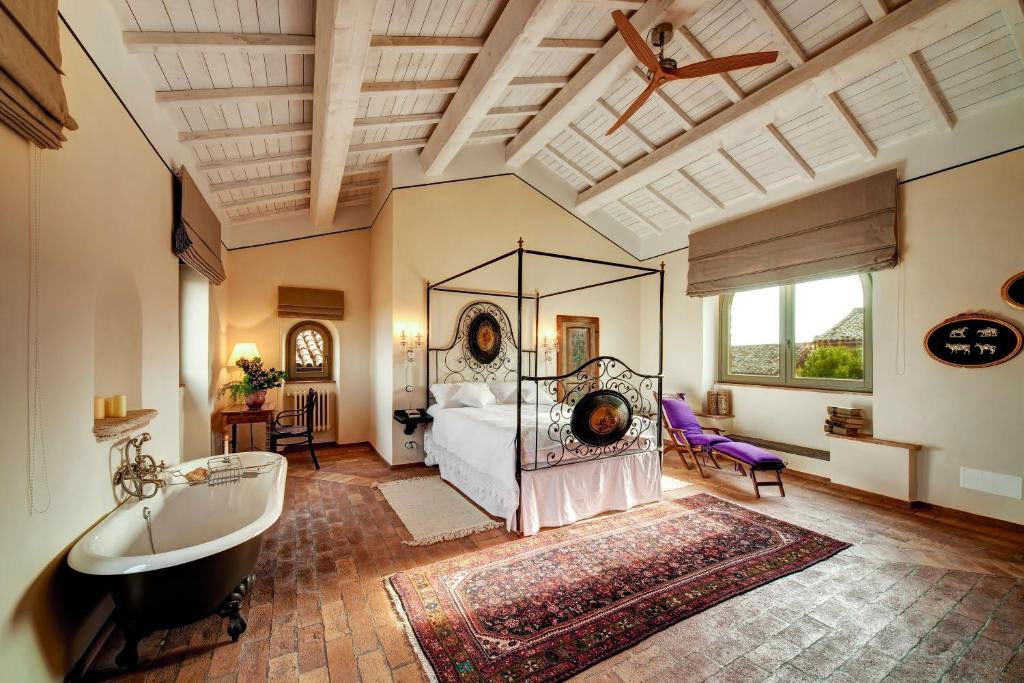
Four rooms is a small enough inventory that each can be genuinely distinct rather than differentiated by floor level or view angle. One room has a four-poster bed paired with a claw-foot iron tub, a combination that in a lesser property would read as theatrical but here sits naturally inside a building of the same period. Another room retains an original fresco as a primary wall element. A third features a headboard that originated in a 19th-century theatre production, an object specific enough in its provenance to suggest that the furnishings throughout were collected with some care rather than sourced for period effect.
All four rooms have views, which in Civita di Bagnoregio means looking out over the eroded plateau edges and the valley below. The Google rating of 4.8 across 40 reviews is consistent with the experience a property of this type delivers when it works correctly: a small enough guest count to maintain genuine attention, a physical environment strong enough to carry the stay, and expectations set honestly enough that the absence of air-conditioning and television registers as a deliberate choice rather than a deficiency.
Guests seeking larger-scale Italian hotel experiences, with multiple dining outlets, pools, and spa infrastructure, are better directed toward properties like Four Seasons Hotel Firenze in Florence, Bulgari Hotel Roma in Rome, or Borgo Egnazia in Savelletri di Fasano. Corte della Maestà operates on a different logic entirely, one closer to Passalacqua in Moltrasio in spirit, if not in scale or setting: the property is the point, and everything else is arranged around that.
Food, Wine, and What Happens After Dark
There is no formal restaurant, but there is food, which is not the same thing as saying there is no dining experience. Breakfast is served under a large fig tree when weather allows. Traditional cakes are baked each afternoon. Aperitivi and cheese boards appear by the fireplace on request, and the bishop's old winery functions as the setting for candlelit wine and cheese in the evening. Local wine features alongside local cheese, served in a space whose original purpose gives the activity a context that a purpose-built hotel wine bar would struggle to manufacture.
The village itself contributes to the evening programme. Family-run restaurants sit just off the cobblestoned piazza, close enough to reach on foot through the village's narrow lanes. Civita di Bagnoregio at night, when the day visitors have crossed back over the footbridge, becomes a different place: small, quiet, and lit in a way that makes the tufa walls read differently than they do in afternoon light. The property's position inside the village rather than adjacent to it means guests experience that shift rather than watch it from a terrace.
Logistics and the Rome Question
Civita di Bagnoregio sits close enough to Rome to read as a day trip on most itineraries, which is precisely the case the property makes against that framing. Arriving in the evening, when the footbridge empties and the lanterns come on, changes the calculation. The village after dark is a different proposition from the village at midday, and staying inside it rather than returning to Rome repositions it from excursion to destination.
At four rooms, availability will be the operative constraint rather than price. The Michelin 3 Keys recognition in 2024 will have sharpened interest in a property that was already operating in a low-volume format. Advance planning is not optional here in the way it might be negotiable at a larger property. For those considering a broader Central Italian itinerary, the region's other architecturally-led small properties, including Rosewood Castiglion Del Bosco in Montalcino, offer complementary rather than overlapping experiences.
For a fuller picture of dining and accommodation in the area, see our full Civita di Bagnoregio restaurants guide. Italy's wider small-hotel category is covered in our profiles of Casa Maria Luigia in Modena, Il Pellicano in Porto Ercole, EALA My Lakeside Dream in Limone sul Garda, Forestis Dolomites in Plose, Grand Hotel Tremezzo in Tremezzo, Grand Hotel Victoria in Menaggio, Portrait Milano in Milan, Borgo Santandrea on the Amalfi Coast, Il San Pietro di Positano in Positano, JK Place Capri in Capri, Bellevue Syrene 1820 in Sorrento, and Aman Venice in Venice. For those extending travel beyond Italy, Aman New York, The Fifth Avenue Hotel in New York City, and Amangiri in Canyon Point represent the same logic of architecture-first hospitality applied to different geographies.
Frequently Asked Questions
What is the atmosphere like at Corte della Maestà?
The atmosphere is defined by the building rather than by programmed hospitality. Guests move through stone-arched passageways, rooms with frescoed ceilings, and communal spaces anchored by an antique fireplace and an old piano. Candlelit aperitivi in the former bishop's winery and breakfast under a fig tree form the social rhythm. There is no television and no air-conditioning, which keeps the environment quiet and oriented around the physical fabric of a building that has occupied this site since the 17th century. The Michelin 3 Keys recognition (2024) and a 4.8 Google rating across 40 reviews suggest the experience lands consistently with guests who arrive with calibrated expectations. Rates begin at $507 per night across four rooms.
What is the most popular room type at Corte della Maestà?
The property holds only four rooms, each with distinct character, so the question is less about popularity within a category and more about which configuration suits a particular guest. The room with a four-poster bed and claw-foot iron tub is the most architecturally theatrical option. The room retaining an original fresco is the strongest example of the preserved historic fabric that earned the property its Michelin 3 Keys award in 2024. Rates start from $507, and at four rooms total, availability rather than preference is the variable most likely to determine which room a guest occupies. Book well in advance.
Recognized By

Related editorial
- Best Fine Dining Restaurants in ParisFrom three-Michelin-star icons to the next generation of Parisian chefs pushing boundaries, these are the restaurants that define fine dining in the world's culinary capital.
- Best Luxury Hotels in RomeFrom rooftop terraces overlooking ancient ruins to Michelin-starred hotel dining, these are the luxury hotels that make Rome unforgettable.
- Best Cocktail Bars in KyotoFrom sleek lounges to hidden speakeasies, Kyoto's cocktail scene blends Japanese precision with global influence in ways you won't find anywhere else.
Save or rate Corte della Maestà on Pearl
Keep this venue in your Pearl passport, rate it after you visit, and track it alongside every other place you collect.