
Hotel in Venice, Italy
Cipriani, A Belmond Hotel, Venice
1,600ptsLagoon-Edge Legacy Hotel





About Cipriani, A Belmond Hotel, Venice
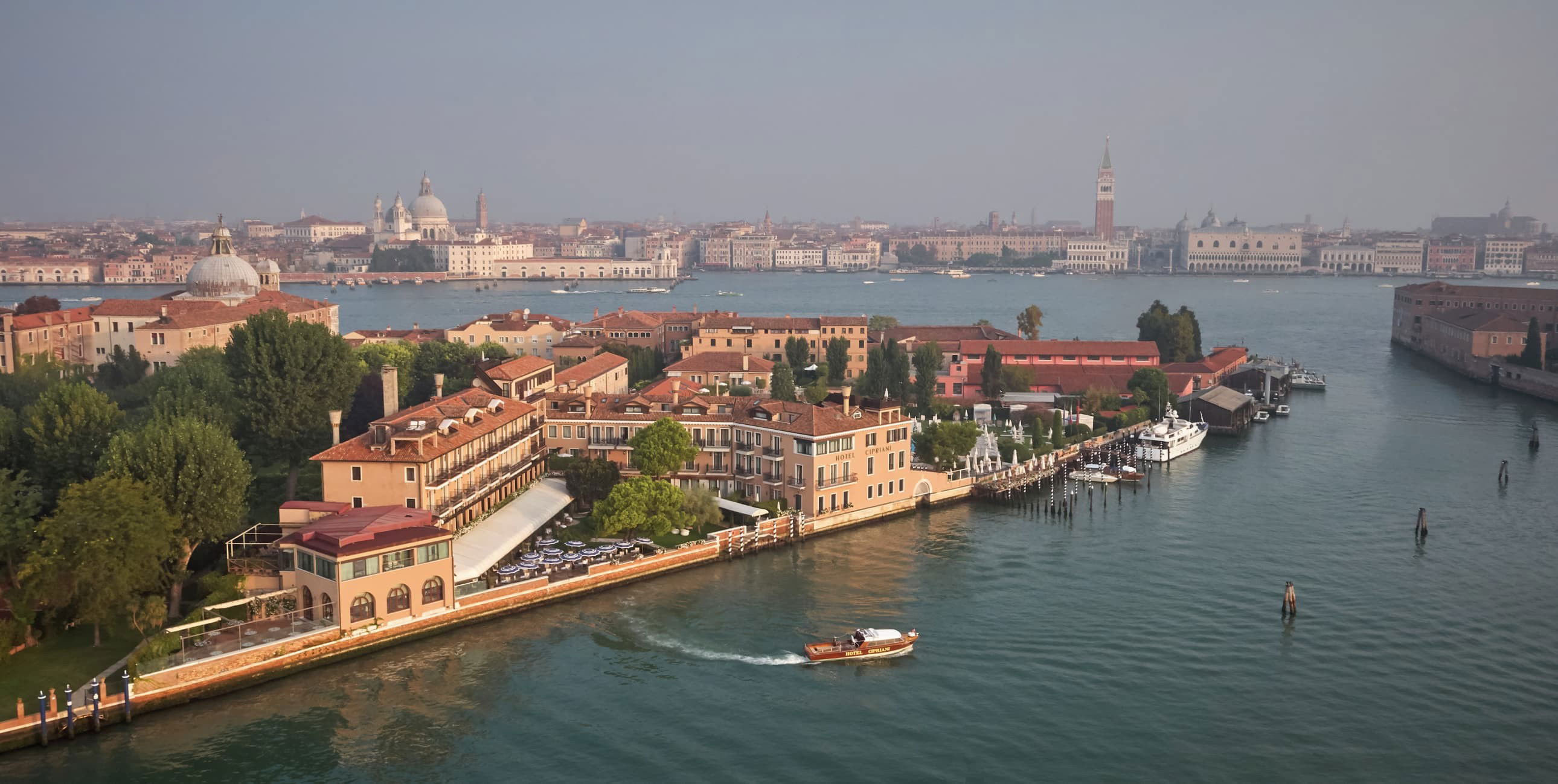
Set on Giudecca Island across the lagoon from St Mark's Square, Cipriani, A Belmond Hotel carries a lineage that runs through the invention of the Bellini and the founding of Harry's Bar. Ranked 72nd in the World's 50 Best Hotels (2025) and awarded Michelin 3 Keys (2024), it holds the only Olympic-sized pool in central Venice. The hotel closes seasonally and reopens on 23rd April 2026.
Giudecca Island and the Architecture of Venetian Escape
Venice's luxury hotel tier divides broadly into two camps: the grand canal-front palaces that trade on their Venetian Gothic facades, and a smaller number of properties that use the city's geography to create genuine separation. Cipriani, A Belmond Hotel sits firmly in the second category. Positioned on the tip of Giudecca Island, it looks back at Venice rather than sitting inside it, and that reversal of perspective is not incidental. From Giudecca, the pastel-coloured buildings of the city proper rise from the lagoon as a continuous, almost theatrical tableau. The view from a terrace or balcony here is the one most visitors to Venice spend the week trying to compose with a camera. The hotel has it from every angle, at every hour.
The crossing takes five minutes on the hotel's 24-hour complimentary water shuttle, which runs continuously until the last guest has returned for the night. That shuttle is also the first editorial statement the property makes: arriving by private launch, stepping onto a dock framed by a flowering, vine-covered awning, is a departure from the pedestrian logic that governs movement through Venice itself. It frames the stay as a deliberate withdrawal from the city rather than immersion in it, which is precisely the register that a certain category of traveller comes here to find.
The Cipriani Lineage and What It Means in Venice
Few hotels in Europe carry a founding mythology this well-documented. Giuseppe Cipriani opened Harry's Bar in 1931, a decade before the hotel existed, and the bar's guest list reads as a cross-section of mid-century literary and artistic life: Hemingway, F. Scott Fitzgerald, Noël Coward, Gertrude Stein. The Bellini cocktail, now a standard across the world's hotel bars, was invented there, a prosecco-and-white-peach-pulp combination that Cipriani named after the Venetian painter Giovanni Bellini. When the hotel opened in 1958, the same cultural gravity pulled guests of a different register: Yves Saint Laurent, Sophia Loren. That continuity of cultural association is part of what places Cipriani in a peer set that goes beyond five-star hotel classification.
The Bellini still features at the Gabbiano Bar prepared using the original method, a small but deliberate act of institutional memory in a city where authenticity is frequently commodified. The gardens, which carry their own history, supplied the grounds where Casanova arranged his appointments. Whether that detail is verified or mythologised matters less than what it signals: this is a property that understands atmosphere as a product and curates its own legend carefully. Among Venice's competitive hotel set, which includes Aman Venice, Hotel Gritti Palace, and newer arrivals like Nolinski Venezia and Il Palazzo Experimental, the Cipriani's founding story is genuinely its own.
Recognition and Where It Sits in the Market
The 2025 World's 50 Best Hotels list placed Cipriani at number 72, a ranking that positions it in the upper tier of European hotel recognition alongside properties with comparable institutional depth. The 2024 Michelin 3 Keys award, applied to hotels rather than restaurants, signals a judgement about the overall experience: architecture, service delivery, food programme, and setting considered together. La Liste's Leading Hotels rating for 2026 gives the property 99 points, a score that places it in an extremely compressed bracket at the leading of that index. Google review sentiment sits at 4.7 across 621 reviews, which for a property of this price register and expectation level is a more meaningful signal than the raw score suggests. Guests at this tier arrive with high baselines; maintaining 4.7 requires consistent delivery rather than occasional excellence.
Among comparable Italian properties, this kind of multi-index recognition is shared by a short list that includes Passalacqua in Moltrasio, Borgo Egnazia in Savelletri di Fasano, and Four Seasons Hotel Firenze in Florence. Each of those properties occupies a specific niche within Italian luxury hospitality; Cipriani's niche is the Venetian island estate with a cultural lineage that predates most of its competitors.
The Food Programme: Cip's Club and the Michelin-Starred Restaurant
Venice's dining culture has always had a complicated relationship with quality. The tourist density that fills the city's central districts creates economic conditions that reward volume over precision, and genuinely serious cooking has historically required either a local network to find it or the kind of institution that insulates itself from those pressures. The Cipriani operates in the second mode. The hotel's Michelin-starred restaurant draws on organic produce from the hotel's own vegetable gardens, which are also the source of herbs used daily in the bar programme.
Cip's Club operates at a different register: a covered waterside deck suspended over the lagoon, oriented toward St Mark's and audible to the faint ring of its bells. The format is less formal than the main restaurant but carries its own demand, with the water views and the outdoor setting making it one of the more sought-after lunch tables in the city during the season. The combination of a destination-level restaurant and a more accessible waterside venue within the same property gives the hotel two distinct food identities, which in turn supports two different types of guest occasion.
The Pool, the Rooms, and the Palladio Suite
The Olympic-sized seawater pool at Cipriani has a specific origin story: a measurement error during the original planning process, with the hotelier working in feet while the architect used metres, produced a pool considerably larger than intended. The result is the only outdoor pool of its scale in central Venice, filled with filtered seawater and heated through spring and autumn. On days when the sun holds, poolside lunch is the hotel's most casual format and its most socially animated one.
The accommodation across the hotel runs to 96 rooms and suites spread across the main building and the Palazzo Vendramin, a 15th-century aristocratic residence now integrated into the hotel and housing sixteen suites with private butler service. Room categories vary considerably in scale. The Palladio Suite represents the property's upper register: a private dock, floor-to-ceiling windows with 180-degree water views, and a heated outdoor plunge pool. The colour palette throughout is pale and deliberately restrained, the logic being that the views through the windows carry the visual weight and the interiors should not compete with them. Most rooms have private balconies or terraces. Ca' di Dio, Corte di Gabriela, Palazzo Venart, and Londra Palace Venezia each offer their own approach to Venetian accommodation, but none carry both the island separation and the institutional scale that define the Cipriani's physical proposition.
Planning Your Stay: Logistics and the Season
Hotel operates seasonally. After a renovation period, it reopens on 23rd April 2026. That reopening date marks the beginning of its annual cycle, which runs through to September. Travellers planning a first visit should weigh the early-season window, when the gardens are in flower and the city has not yet reached its summer density, against the midsummer period, which brings maximum light and the fullest programme but also the highest demand for both rooms and restaurant tables.
Arriving guests are met directly from the private launch and escorted from the dock through to the lobby, bypassing the pedestrian logistics that define movement for most visitors to Venice. The concierge programme extends to excursions that the hotel has structured around the less-visited parts of the lagoon: Sant'Erasmo Island, where a rare local honey is produced; behind-the-scenes access to artisan workshops; evening kayak tours of the canal system; and private picnic gondola arrangements. For guests who have already covered the standard Venetian circuit, the hotel's off-itinerary programming represents one of the more practical reasons to base here.
Italy's broader luxury hotel offer, from Castello di Reschio in Lisciano Niccone to Borgo Santandrea on the Amalfi Coast, Il San Pietro di Positano, Rosewood Castiglion Del Bosco in Montalcino, JK Place Capri, Bulgari Hotel Roma, Il Pellicano in Porto Ercole, Portrait Milano, Corte della Maestà in Civita di Bagnoregio, and Casa Maria Luigia in Modena, covers a wide range of formats and price registers. For a full overview of the Venice hotel and dining scene, see our Venice city guide. For reference points outside Italy, the positioning of Cipriani within Belmond's portfolio aligns it with properties like The Fifth Avenue Hotel in New York City and Aman New York in terms of the premium urban retreat proposition, and with Amangiri in Canyon Point in terms of the logic of choosing separation over centrality.
Frequently Asked Questions
- What's the leading room type at Cipriani, A Belmond Hotel, Venice?
- The Palazzo Vendramin suites represent the upper tier: sixteen rooms in the 15th-century annexe with private butler service, lagoon views, and the weight of the building's history. For the most dramatic spatial experience, the Palladio Suite adds a private dock and 180-degree water views. Guests who prioritise views of St Mark's Square should specify this when booking, as the outlook varies by room position.
- What's the defining thing about Cipriani, A Belmond Hotel, Venice?
- The combination of Giudecca Island's physical separation from the city, a founding lineage that runs through Harry's Bar and the invention of the Bellini, and multi-index recognition including World's 50 Best Hotels (number 72, 2025) and Michelin 3 Keys (2024) places this property in a category with very few direct comparators. The 24-hour private water shuttle and the city's only Olympic-scale seawater pool amplify the island-estate quality that defines the stay.
- How hard is it to get in to Cipriani, A Belmond Hotel, Venice?
- The hotel operates seasonally from late April through September, which compresses the booking window. After a renovation closure, it reopens on 23rd April 2026. Given that recognition across La Liste, World's 50 Best, and Michelin drives international demand into a limited seasonal inventory, early planning is advisable. The Cip's Club waterside restaurant is open to non-resident guests, but during peak season, securing a table at short notice is unlikely.
- Is Cipriani, A Belmond Hotel, Venice better for first-timers or repeat visitors?
- Both, but for different reasons. First-time visitors to Venice benefit from the hotel's concierge-structured access to the city, the private launch logistics, and the foundational experience of the lagoon perspective. Repeat visitors tend to find more value in the off-itinerary programming, the Sant'Erasmo excursions, the workshop access, and the quieter Giudecca setting once the standard Venetian circuit has been covered. The Palazzo Vendramin suites with butler service represent a meaningful step up for returning guests.
- What makes the dining at Cipriani distinct within Venice's restaurant scene?
- Venice's central districts face structural pressure toward high-volume, tourist-oriented cooking. The Cipriani's Michelin-starred restaurant operates outside that dynamic by sourcing from the hotel's own vegetable gardens and functioning within a closed, self-contained property. Cip's Club, the waterside venue suspended over the lagoon with direct sightlines to St Mark's, operates as a separate identity: a lunch destination in its own right, audible to the bells of the Basilica, with a covered deck format that works from late spring through the summer season.
Recognized By


Related editorial
- Best Fine Dining Restaurants in ParisFrom three-Michelin-star icons to the next generation of Parisian chefs pushing boundaries, these are the restaurants that define fine dining in the world's culinary capital.
- Best Luxury Hotels in RomeFrom rooftop terraces overlooking ancient ruins to Michelin-starred hotel dining, these are the luxury hotels that make Rome unforgettable.
- Best Cocktail Bars in KyotoFrom sleek lounges to hidden speakeasies, Kyoto's cocktail scene blends Japanese precision with global influence in ways you won't find anywhere else.
Save or rate Cipriani, A Belmond Hotel, Venice on Pearl
Keep this venue in your Pearl passport, rate it after you visit, and track it alongside every other place you collect.