
Hotel in La Romana, Dominican Republic
Casa de Campo Resort & Villas
450pts7,000-Acre Sport & Culture Estate


About Casa de Campo Resort & Villas
Spanning 7,000 tropical acres on the Dominican Republic's southeastern coast, Casa de Campo Resort & Villas operates at a scale that places it in a category of its own among Caribbean resorts. Three Pete Dye golf courses, a 370-slip marina, a polo club, and the replica 16th-century village of Altos de Chavón make it less a hotel than a self-contained destination, five minutes from La Romana International Airport.
A Resort Built Like a Small Country
The architecture of Caribbean luxury resort development has, over the past three decades, split into two recognizable models: the compact, design-led boutique property and the sprawling multi-amenity estate that functions more as a private territory than a hotel. Casa de Campo Resort & Villas, occupying 7,000 tropical acres along the southeastern Dominican coast, represents the latter format at its most ambitious. The scale here is not incidental. It is the product, and understanding it shapes how you plan, book, and move through the property.
The physical environment announces itself before you reach check-in. La Romana International Airport (LRM) sits five minutes from the resort entrance, which means the transition from aircraft to resort grounds is compressed to the point where the two feel nearly continuous. That proximity is a deliberate logistical advantage — one that properties like Amanera in Playa Grande or Eden Roc Cap Cana cannot replicate, given their greater distance from major air infrastructure. For travelers arriving via Santo Domingo (SDQ) or Punta Cana (PUJ), both of which operate daily direct flights from major U.S. airports, a transfer is still required, but La Romana's direct access remains a competitive differentiator in the Dominican market.
Design Language: Restraint Over Flash
Accommodation design philosophy at Casa de Campo runs counter to what Caribbean resorts often default to. Where many regional properties lean on vivid color saturation and maximalist tropical motifs, the rooms and casitas here use contemporary ebony wood furnishings, muted neutral tones, and native stone as their primary palette. The effect is a kind of grounded minimalism, one that keeps attention directed outward toward the tropical vistas rather than inward toward décor. Private terraces are standard across the Superior Casitas, which also include recently renovated larger bathrooms and walk-in closets.
Villa accommodations step further into a distinct tier: butler service, personalized check-in, daily in-room breakfast, and private pools separate them from the standard room categories in both amenity and experience. Villas are positioned either along the ocean or on the golf course, and the choice of orientation reflects meaningfully different daily rhythms — ocean-facing villas prioritize beach access and sea light; golf-course villas offer a different kind of seclusion. For groups and families, the villa format is the more coherent choice, given the added space and dedicated staffing.
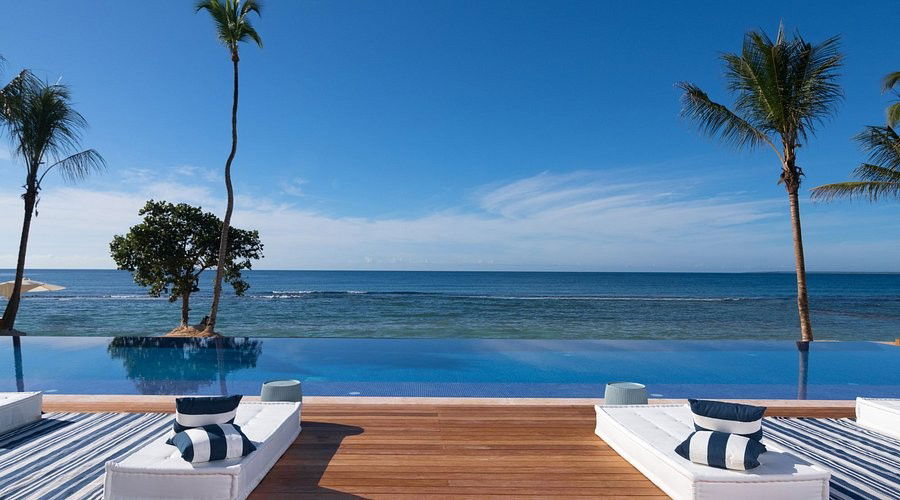
A recent renovation cycle has added a family pool complex at Minitas Beach, comprising two pools, shops, and several dining options. Two food trucks serve casual cuisine at the beachside setting, which operates as a counterweight to the resort's more formal dining infrastructure.
Altos de Chavón: Architecture as Cultural Object
The most architecturally singular element of the property is not a guestroom or a pool complex. It is Altos de Chavón, a replica 16th-century Mediterranean artisan's village built into the bluffs above the Chavón River. The village contains boutique shops, museums, and a 5,000-seat Grecian-style amphitheater that Frank Sinatra inaugurated in August 1982. As a piece of constructed heritage, Altos de Chavón occupies an unusual position: it is simultaneously a themed environment and a functioning cultural venue. The amphitheater has hosted major concerts since its opening, and the scale of the space , 5,000 seats in an open-air Grecian configuration, in the Dominican Republic , gives it a grandeur that reads as genuine rather than decorative. Few resort-integrated cultural structures anywhere in the Caribbean match this footprint.
The village's design draws on southern European stonework and street planning, which creates a formal contrast with the surrounding tropical terrain. Whether this sits comfortably with you as a design choice depends on your tolerance for constructed historical environments. As a piece of executed ambition, it is hard to dismiss.
Sport Infrastructure at Resort Scale
Athletic programming at Casa de Campo is organized around facilities that operate at a peer level with standalone specialist venues. The three Pete Dye golf courses , Teeth of the Dog, Dye Fore, and Links , represent a concentrated density of high-difficulty championship design that is unusual even among major resort golf destinations. Teeth of the Dog, the most cited of the three, consistently ranks among the leading courses in the Caribbean and Latin America. The resort has recently added a Golf Learning Center equipped with Trackman technology, which positions it at the technical end of golf instruction infrastructure.
Beyond golf, the 370-slip Marina and Yacht Club offers private charters of luxury yachts and fishing boats, with Saona Island and Catalina Island accessible by water. Catalina Island carries a specific reputation for scuba diving, with snorkeling conditions that draw independent visitors as well. The Polo and Equestrian Club, the Tennis Center (referred to in regional sporting circles as the Wimbledon of the Caribbean), and a 245-acre Shooting Center extend the athletic range in ways that few Caribbean resorts attempt at equivalent depth.
The Google review score of 4.7 across 12,604 reviews signals broad and sustained guest satisfaction at a sample size large enough to be meaningful. Properties with this volume of reviews and this rating in the luxury Caribbean segment tend to indicate consistent service delivery rather than isolated high-performance moments.
Positioning Within the Dominican Republic's Luxury Tier
The Dominican Republic's luxury accommodation market has become increasingly segmented. At one end sit properties like ANI Private Resorts in Cabrera, which operate on an ultra-private, villa-only model with full-service exclusivity. At the other, large all-inclusive formats dominate the Punta Cana corridor. Casa de Campo occupies a middle tier that is harder to categorize: it has the scale and amenity depth of a large resort but the pricing and clientele profile of a premium destination property. The A-list visitor record , including Bill and Hillary Clinton, Julio Iglesias, Jennifer Lopez, Jay-Z, and Beyoncé , reflects a guest composition more typical of boutique private resorts than mass-market all-inclusives.
For travelers comparing across the Dominican Republic, the decision often comes down to format preference. Cayo Levantado Resort and Sublime Samaná Hotel & Residences offer smaller-scale alternatives in the Samaná Peninsula. Casa Colonial Beach & Spa in Puerto Plata and Hodelpa Nicolás de Ovando in Santo Domingo offer design-led options closer to urban centers. Casa de Campo's argument rests not on intimacy but on comprehensiveness: the density of activities, facilities, and physical scale that make it a destination that does not require leaving the property to feel complete. You can find our full assessment of the Dominican hospitality market in our full La Romana restaurants guide.
For international comparisons at the estate-resort scale, properties like Amangiri in Canyon Point or Castello di Reschio in Lisciano Niccone offer different expressions of the large-format destination resort. The design philosophy and programming logic at Casa de Campo sits closer to the American estate tradition, applied to a tropical Caribbean setting, than to the European boutique model that informs properties like Cheval Blanc Paris or Aman Venice.
Planning and Access
Given the scale of the property and the range of activities that require advance coordination (yacht charters, polo, shooting, golf tee times on the more in-demand courses), booking well ahead of arrival is advisable, particularly during peak Caribbean season between December and April. Golf on Teeth of the Dog is a common bottleneck, and the new Golf Learning Center booking slots are reported to fill quickly. The resort's spa operates with local organic ingredient treatments, which can also require advance scheduling. For families, the dedicated children's programming includes supervised activities across multiple age groups, with a professional nanny service available for parents seeking unstructured time. Families considering villa accommodations should factor in the butler and personalized check-in services, which materially reduce the operational complexity of managing a large group. For reservations and current pricing, contact the resort directly at 1-800-877-3643 or visit casadecampo.com.do.
Frequently Asked Questions
- What's the atmosphere like at Casa de Campo Resort & Villas?
- The atmosphere reads as purposefully low-key given the property's scale. The design restraint in the rooms (neutral tones, native stone, ebony wood) and the spread of the 7,000-acre grounds mean the resort never feels crowded or loud in the way that large Caribbean properties sometimes do. The Altos de Chavón village adds a distinct cultural register, and the marina brings a nautical energy distinct from the beach areas. La Romana's position on the southeastern Dominican coast means the immediate surroundings are less developed than the Punta Cana corridor, which contributes to the quieter ambient tone.
- What's the most popular room type at Casa de Campo Resort & Villas?
- The Superior Casitas are the entry point for guests who want private terrace access and the recently renovated bathroom configurations. For groups or families, the villas represent a step-change in experience: private pools, butler service, and daily in-room breakfast separate them from the standard room categories. Ocean-facing villas are the most requested configuration, given the direct relationship to the waterfront, though golf-course villas suit guests whose primary itinerary centers on the Pete Dye courses.
- What is Casa de Campo Resort & Villas leading at?
- The resort's strongest argument is the depth and quality of its sport and activity programming within a single property footprint. Three championship Pete Dye golf courses (including Teeth of the Dog, consistently ranked among the leading courses in the Caribbean), a 370-slip marina with private yacht and fishing charters, a polo and equestrian club, a 245-acre shooting center, and a tennis center referred to as the Wimbledon of the Caribbean collectively represent a concentration of specialist facilities that is difficult to match in the regional market. The cultural asset of Altos de Chavón, with its 5,000-seat amphitheater, is a secondary but significant differentiator.
- How far ahead should I plan for Casa de Campo Resort & Villas?
- For travel during December through April (the primary Caribbean high season), three to four months of advance planning is advisable for preferred room and villa configurations. Tee times on Teeth of the Dog and yacht charter availability are the most time-sensitive bookings within the property. If your itinerary hinges on specific sporting or cultural events at the Altos de Chavón amphitheater, check programming schedules early, as performance dates drive significant accommodation demand. Contact the resort at 1-800-877-3643 or casadecampo.com.do for current availability.
- Is Casa de Campo Resort & Villas suitable for guests who want golf and cultural experiences in the same stay?
- Yes, and the combination is one of the clearest arguments for choosing this property over more sport-focused or culture-focused alternatives elsewhere in the Dominican Republic. The three Pete Dye courses sit within the same grounds as Altos de Chavón, the replica 16th-century Mediterranean village with its 5,000-seat amphitheater and artisan shops. A stay can move between morning rounds on Dye Fore and an evening event at the amphitheater without leaving the resort perimeter, which is logistically rare at this level of programming depth in the Caribbean.
Recognized By

Related editorial
- Best Fine Dining Restaurants in ParisFrom three-Michelin-star icons to the next generation of Parisian chefs pushing boundaries, these are the restaurants that define fine dining in the world's culinary capital.
- Best Luxury Hotels in RomeFrom rooftop terraces overlooking ancient ruins to Michelin-starred hotel dining, these are the luxury hotels that make Rome unforgettable.
- Best Cocktail Bars in KyotoFrom sleek lounges to hidden speakeasies, Kyoto's cocktail scene blends Japanese precision with global influence in ways you won't find anywhere else.
Save or rate Casa de Campo Resort & Villas on Pearl
Keep this venue in your Pearl passport, rate it after you visit, and track it alongside every other place you collect.