
Hotel in Tulum, Mexico
Bespoke Tulum
400ptsAward-Winning Beachfront Architecture

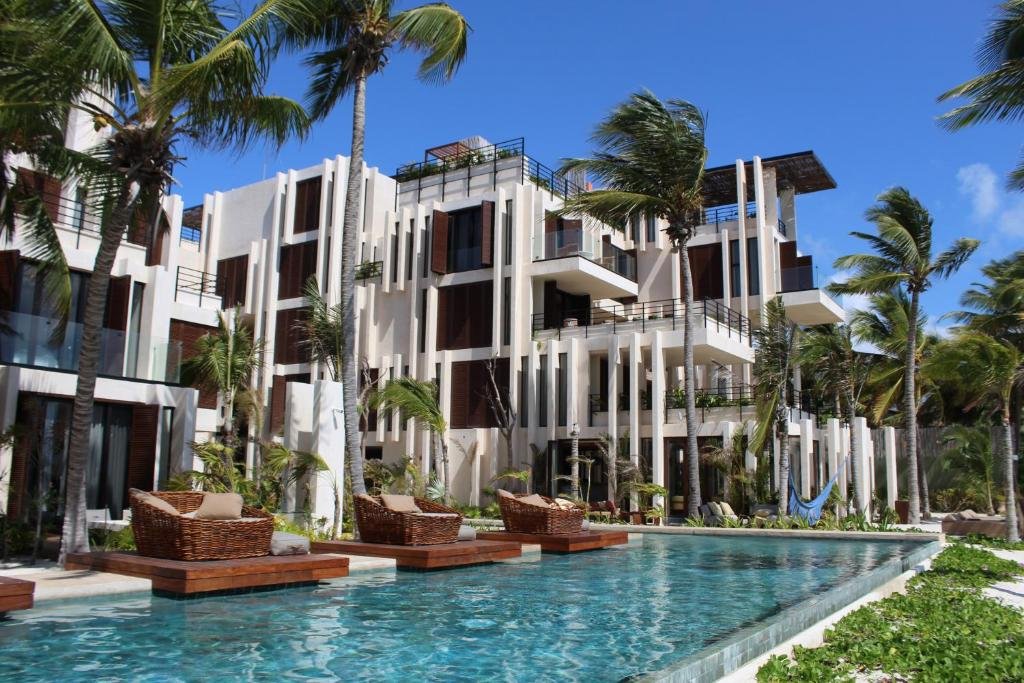
About Bespoke Tulum
Bespoke Tulum sits on Tankah Bay, a quieter stretch of the Caribbean coast roughly ten minutes from Tulum town, where award-winning architecture dissolves the line between interior and exterior across a small collection of private beach residences. The property positions itself at the far end of the Riviera Maya seclusion spectrum, trading the hotel-zone strip for direct beach access and design-led living spaces.
Tankah Bay and the Case for Leaving the Hotel Zone Behind
Tulum's hotel corridor, the famous stretch of road that runs south from the town toward the biosphere reserve, has become one of Mexico's most photographed addresses. It has also become crowded. The boutique properties that once defined the strip now compete with construction cranes and new openings on every block, and the quiet that originally drew travellers has migrated further along the coast. Tankah Bay, a small inlet roughly ten minutes north of the main drag by car, sits outside that zone entirely. The water is calmer, the beach wider in places, and the density of visitors is measurably lower. Azulik, Hotel Esencia, and Casa Malca anchor the better-known end of Tulum's design hotel scene, but Bespoke Tulum operates from a different premise: residences rather than rooms, on a beach that most visitors driving the hotel-zone road never reach.
Architecture as the Primary Amenity
The properties that have carved the most durable reputations in Tulum's premium tier share one characteristic: they treat the physical structure as integral to the stay, not as a backdrop for it. Bespoke Tulum belongs firmly in this category. The residences carry award-winning architecture credentials and are designed to dissolve the boundary between indoors and out, a design language that reads straightforwardly on a spec sheet but matters considerably when the alternative is a sealed, air-conditioned box facing a pool shared with sixty other guests.
This indoor-outdoor approach is well-suited to the Yucatán Peninsula's climate logic. The humidity and heat of the summer months, running roughly from May through September, demand either strong mechanical cooling or intelligent passive design. The architecture-led properties in this part of Mexico have increasingly moved toward the latter: cross-ventilation, shade structures, open facades, and materials that absorb and release heat slowly. Bespoke Tulum's Tankah Bay setting supports this approach, with sea breezes arriving off the Caribbean providing natural temperature management that a landlocked property cannot replicate.
For context on how design-led beach residences sit within Mexico's broader premium hospitality offer, the pattern extends coast to coast. Maroma in Riviera Maya and Etéreo, Auberge Resorts Collection in Punta Maroma occupy a similar niche on the Riviera Maya, where architecture, landscape, and beach access carry more weight in the value proposition than room count or facilities volume. On Mexico's Pacific coast, One&Only; Mandarina in Riviera Nayarit and Four Seasons Resort Punta Mita serve a comparable appetite for design-conscious, lower-density stays. Bespoke Tulum positions against the Riviera Maya cohort specifically, where proximity to the ruins, the cenotes, and the Sian Ka'an reserve defines the cultural geography.
The Seclusion Premium in the Tulum Market
Tulum operates with a clear two-tier structure in its accommodation market. The first tier is the hotel-zone strip: properties with strong social-media visibility, beach clubs open to day visitors, and a programming model built around high footfall. The second tier, smaller and harder to find, comprises properties that have deliberately opted out of that model. IKAL Tulum Hotel, Encantada Tulum, and Copal Tulum Hotel represent different expressions of that second tier. Bespoke Tulum's Tankah Bay address places it in the same category: away from the strip, operating on the logic that access and quiet are themselves amenities worth paying for.
The residence format reinforces this positioning. A private residence, even within a small development, offers a different behavioural range than a hotel room. Guests cook, or choose not to. They set their own rhythm. The property sits at address Tankah 3 M3 L-1 y 2 Ciudad Chemuyil, 77776 Tulum, Q.R., which puts Tulum town, with its restaurants, mezcal bars, and market activity, within a ten-minute drive. This is a meaningful distance in practice: close enough to access the energy of the town when wanted, far enough that the town's noise does not follow you back.
For travellers considering Tulum alongside other options in the Yucatán Peninsula, Chablé Yucatán in Merida offers a hacienda-based alternative with a different relationship to the jungle and to Mayan cultural heritage. Amansala Resort, Beachclub and Spa and Hotel Bardo round out the comparative field on the Tulum strip itself.
What the Tankah Setting Means for Local Ingredients and Regional Character
The editorial angle that runs through the better Tulum stays is the intersection between global design intelligence and a genuinely specific local environment. Tankah Bay is not a generic Caribbean beach. It sits adjacent to one of the world's largest barrier reef systems, and the surrounding area contains cenotes, mangroves, and coastal jungle that feed directly into the sensory character of any stay. Properties that engage with this geography, rather than importing a hermetically sealed luxury product onto it, deliver something the broader Riviera Maya market cannot produce at scale.
The Yucatán's food culture follows the same logic. Local ingredients, including habanero, achiote, chaya, and fresh seafood from the Caribbean, sit alongside culinary techniques that have migrated from Mexico City's international dining scene south toward the coast. The region now hosts restaurants applying European and Japanese technical frameworks to hyper-local raw materials, a pattern visible in the menus of Tulum town's better dining addresses. Staying outside the hotel zone gives guests better access to these local food environments, since the strip's captive-audience dining model tends to push prices and menus toward a generic international baseline. See our full Tulum restaurants guide for the specific addresses worth building an itinerary around.
Planning Your Stay
Dry season, running from November through April, represents the most comfortable window for a Tankah Bay stay: temperatures are manageable, humidity drops, and the Caribbean visibility for snorkelling and diving is at its clearest. December through February draws the largest volume of visitors to the Tulum area, and advance planning becomes more important across this period. For travel in shoulder months such as October or May, the trade-off is lower visitor density against a higher chance of afternoon rain, which in practice often clears quickly and leaves the beach empty.
Getting to Tankah Bay from Cancún International Airport, the primary entry point for the region, involves either a rental car or a private transfer, with journey times running roughly two hours depending on traffic. The ten-minute drive to Tulum town that the property references assumes clear road conditions on the Tulum coastal road, which can slow during peak season. A rental car is the more flexible option for guests who want to reach the cenotes at Dos Ojos or Gran Cenote, both of which sit inland from the hotel zone and reward early-morning arrival before group tours arrive.
For travellers calibrating Bespoke Tulum against Mexico's wider luxury coastal portfolio, the Los Cabos properties, including Las Ventanas al Paraíso, A Rosewood Resort, Montage Los Cabos, and Zadun, A Ritz-Carlton Reserve, operate in a higher-infrastructure, more resort-formal mode. The Tulum offer, at Bespoke and across its peer set, is structurally different: less polished in the convention-hotel sense, more engaged with the specific ecology and cultural character of the Yucatán. Which proposition fits depends less on budget category than on what a traveller actually wants from a week on the Mexican coast.
Frequently Asked Questions
What room should I choose at Bespoke Tulum?
The property operates as a collection of private beach residences rather than a conventional hotel with room categories. Given the award-winning architecture is built around blurring the indoor-outdoor boundary, any residence that offers direct beach access to Tankah Bay delivers the core proposition. The address at Tankah 3 M3 L-1 y 2 places the residences in a low-density coastal position, so the distinction between units is more likely to be size and capacity than proximity to amenities.
What is Bespoke Tulum leading at?
Bespoke Tulum's clearest strength is the combination of a secluded Tankah Bay beachfront position with architecture that treats the Caribbean setting as the main structural feature rather than a view from a window. In a Tulum market where the hotel-zone strip has become increasingly busy, the Tankah Bay address provides a genuine separation from that density, while the ten-minute drive to Tulum town keeps the restaurant scene, mezcal bars, and market culture within easy reach.
Should I book Bespoke Tulum in advance?
If your travel dates fall between December and February, when the Tulum area receives its heaviest visitor traffic, advance booking is the sensible approach for any property in this tier, and Bespoke Tulum's residence format means there are fewer units available than at a conventional hotel. Shoulder months such as October and May carry less booking pressure, though the region's popularity has compressed the window during which last-minute availability is reliably found. The property does not publish a website or direct phone contact in the current data available, so bookings are likely to run through third-party channels.
How does Bespoke Tulum compare to other design-led properties in the Tankah Bay and Tulum area?
Bespoke Tulum's residence format and award-winning architecture credentials place it in a small subset of Tulum-area properties that treat architecture and beach access as the primary offer rather than a backdrop to a conventional hotel program. Comparable properties in the region, including IKAL Tulum and Hotel Esencia, approach the same brief from different angles, with Esencia's larger garden grounds contrasting with Bespoke's more concentrated beachfront position. The Tankah Bay location is the specific differentiator: fewer properties occupy this stretch of coast than the main hotel zone, which keeps the immediate beach environment quieter across all but the busiest travel periods.
Recognized By

More hotels in Tulum
- Aloft TulumAloft Tulum is the practical, low-friction pick on the town side of Tulum — easy to book, covered by Marriott Bonvoy points, and priced below the boutique beach-zone competition. It works well for business travellers or loyalty program users, but it is not the property for a design-led or beach-first stay. For that, look elsewhere in the hotel zone.
- Amansala Resort |Beachclub | SpaAmansala combines beachclub, spa, and resort in one property at KM 5.5 on the Tulum Hotel Zone — a format that works well for guests who want beach access, wellness, and social energy in one location. Best booked November through April. Not the right call if service consistency or amenity depth is your priority.
Related editorial
- Best Fine Dining Restaurants in ParisFrom three-Michelin-star icons to the next generation of Parisian chefs pushing boundaries, these are the restaurants that define fine dining in the world's culinary capital.
- Best Luxury Hotels in RomeFrom rooftop terraces overlooking ancient ruins to Michelin-starred hotel dining, these are the luxury hotels that make Rome unforgettable.
- Best Cocktail Bars in KyotoFrom sleek lounges to hidden speakeasies, Kyoto's cocktail scene blends Japanese precision with global influence in ways you won't find anywhere else.
Save or rate Bespoke Tulum on Pearl
Keep this venue in your Pearl passport, rate it after you visit, and track it alongside every other place you collect.