
Hotel in Tulum, Mexico
Azulik
425ptsOrganic Architecture Immersion


About Azulik
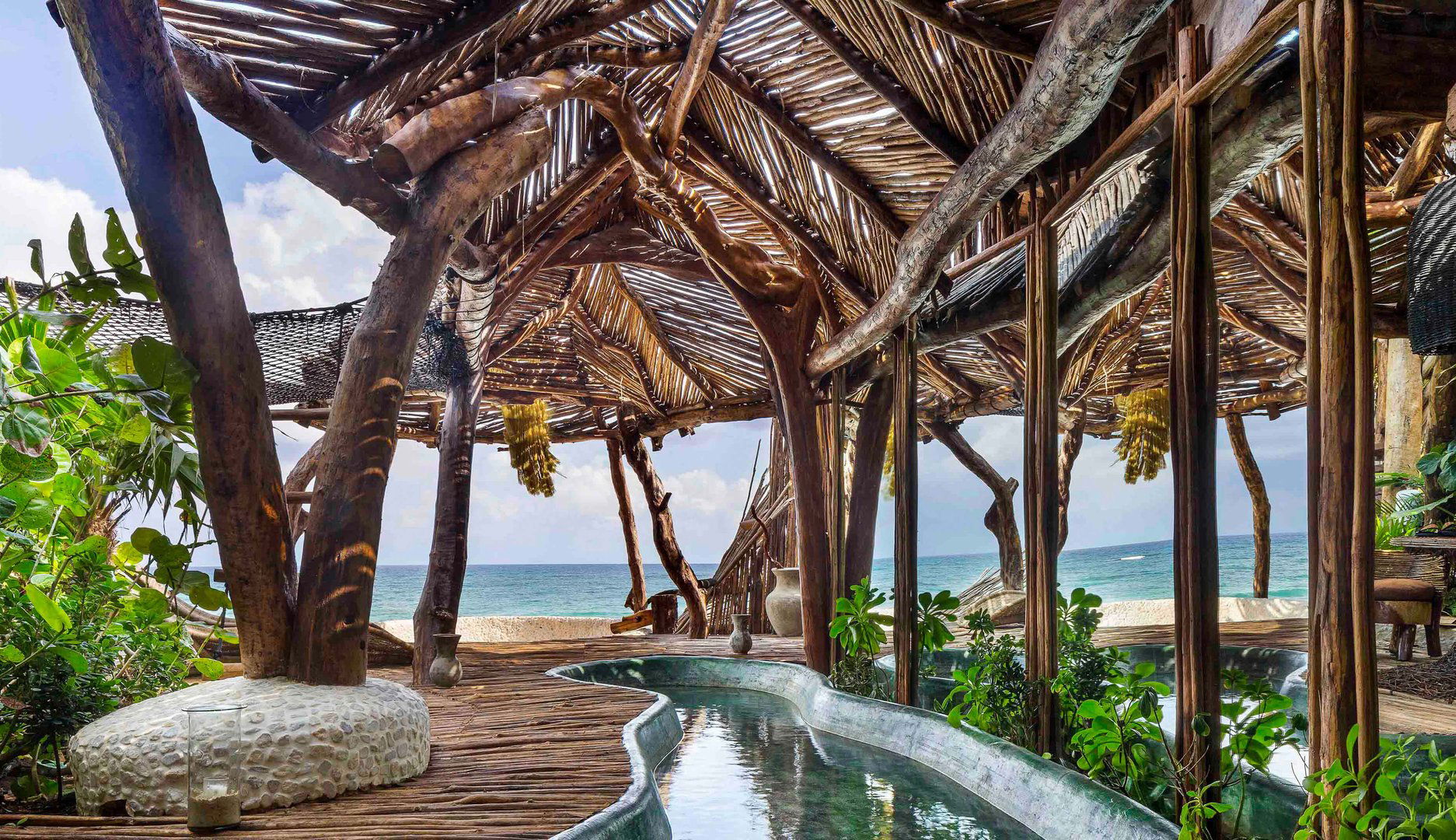
Azulik sits at kilometre five of the Tulum Hotel Zone, where the jungle meets the Caribbean in a property built almost entirely from raw wood, rope, and natural materials. Named Mexico's Most Romantic Resort at the 2025 World Travel Awards and recognised by Pearl, it occupies a distinct position in Tulum's design-led accommodation tier. The address suits travellers who want the Yucatán coast without the all-inclusive formula.
Where the Jungle Meets the Shore
The approach to Azulik along Carretera Tulum–Punta Allen already signals what kind of property this is. The road narrows, the tree canopy closes in, and the concrete certainties of the hotel zone give way to something rawer. At kilometre five, structures built from unfinished wood and organic curves emerge from the vegetation rather than interrupting it. There are no sharp angles here, no glass-and-steel lobbies, no fluorescent corridors. Tulum's design-led accommodation tier has developed a recognisable grammar over the past decade, and Azulik helped write it.
That context matters for any traveller comparing options along this stretch of coast. Properties like Hotel Esencia and Casa Malca occupy the same general zone but operate with different design philosophies and guest experiences. Azulik sits at the more architecturally theatrical end of the spectrum, where the built environment is itself the primary statement. The 2025 World Travel Awards named it Mexico's Most Romantic Resort, a designation that reflects not just aesthetics but the cumulative effect of the setting, the material palette, and the deliberate absence of televisions, clocks, and other connective infrastructure.
The Yucatán Larder and What It Means on the Plate
Tulum's position in the culinary conversation has shifted considerably since the mid-2010s. What began as a beach-town adjunct to Playa del Carmen's dining scene now draws chefs and concepts that treat the Yucatán peninsula's indigenous ingredient base as primary source material rather than background flavour. Across the hotel zone, the better kitchens draw from the same regional larder: habanero and xcatik chillies from small Yucatec growers, achiote from Campeche, black beans and heirloom corn varieties that connect directly to pre-Columbian agricultural traditions, and seafood pulled from Caribbean waters that are among the more biodiverse in the Americas.
At Azulik, the sourcing philosophy aligns with the property's broader position on the spectrum between luxury resort and ecological project. Properties in this tier of the Tulum hotel zone have broadly moved toward local procurement not as marketing posture but as a coherent extension of their design and site ethic. The jungle setting makes synthetic or imported ingredients feel incongruous; the guest who checks in here is already making a specific choice about authenticity. That expectation shapes what appears on the table.
The wider Riviera Maya restaurant scene offers useful comparison. At the northern end of the region, around Playa del Carmen, kitchens tend toward a more cosmopolitan mix. Further south toward Sian Ka'an, as at Azulik's address, the density of tourists decreases and the connection to local agricultural and fishing communities tends to be stronger. This is not sentiment; it is geography and supply chain. The markets in Tulum town, and the producers who supply them, are closer in both distance and relationship to the properties at this end of the strip. For our full breakdown of where to eat and stay across the destination, see our full Tulum restaurants guide.
Design as Discipline
The architecture at Azulik deserves its own analysis because it functions as an editorial statement about how luxury resort development can sit inside a fragile ecosystem rather than consuming it. Across the Riviera Maya, the tension between development pressure and ecological sensitivity has produced a wide range of responses, from the token gestures of large all-inclusive operators to the more rigorous approaches taken by smaller, design-led properties. Azulik belongs to the latter cohort, using local materials, open-air construction, and a layout that preserves existing vegetation rather than clearing for symmetry.
Compare this approach to what other serious properties in Mexico's luxury tier have attempted. Chablé Yucatán in Merida integrates hacienda heritage into its spatial logic. Etéreo, Auberge Resorts Collection in Punta Maroma works with the coastal topography rather than overriding it. Further afield, Xinalani in Quimixto and One&Only; Mandarina in Riviera Nayarit represent the jungle-immersion model on Mexico's Pacific side. In each case, the commitment to site-responsive design either holds or it doesn't; at Azulik, the material evidence suggests it does.
Azulik in the Context of Tulum's Hotel Zone
Tulum's hotel zone has stratified significantly over the past five years. At one end, mid-market boutique hotels serve the yoga-retreat and digital-nomad crowds. At the other, a tier of architecturally ambitious, higher-priced properties competes for guests who would previously have looked to Playa del Carmen or Cancún for comparable amenity levels. Azulik sits in this upper design tier alongside addresses like IKAL Tulum Hotel, Copal Tulum Hotel, Encantada Tulum, and Hotel Bardo.
Other properties along the strip take different positions. Amansala Resort leans into the wellness and retreat angle. Bespoke Tulum offers a more intimate, villa-scaled experience. The choice between them depends on what a traveller actually wants from the zone: social programming, design spectacle, ecological depth, or privacy. Azulik's Pearl Recommended status for 2025 and its World Travel Awards recognition position it as a reference point in the romantic and design categories specifically.
For travellers benchmarking against Mexico's broader luxury offer, the peer set extends well beyond the Yucatán. Las Ventanas al Paraíso, A Rosewood Resort in San José del Cabo, Montage Los Cabos in Cabo San Lucas, and Zadun, A Ritz-Carlton Reserve in Los Cabos represent the polished Baja end of the spectrum. Four Seasons Resort Punta Mita and Las Alamandas in Costalegre anchor the Pacific coast options. Each has its own logic; the Azulik proposition is specifically about Tulum's particular combination of jungle, reef, and Mayan archaeological context.
Planning Your Stay
Azulik sits at kilometre five of the Tulum Hotel Zone road, which places it toward the southern end of the strip and away from the louder, more commercialised section near the town access points. The nearest major airport is Cancún International, roughly two hours north by road; the newer Felipe Carrillo Puerto International Airport in Tulum itself has begun receiving flights, which may reduce transfer times depending on your departure point. The drier months from November through April represent the conventional high season, when Caribbean conditions are at their most reliable and humidity stays manageable. Book well ahead for the Christmas and New Year period, when the hotel zone operates at near capacity across all tiers.
Travellers interested in equivalent design-led properties in other contexts might look at Maroma in Riviera Maya for a different take on the same coast, or step outside Mexico entirely to compare against Aman Venice and Aman New York for the global benchmark in immersive, material-focused hotel design.
Frequently Asked Questions
Which room category should I book at Azulik?
Azulik's Pearl Recommended status and its World Travel Awards recognition as Mexico's Most Romantic Resort in 2025 both skew toward the property's more secluded, treetop-positioned accommodation. On that basis, rooms with direct Caribbean views and greater separation from communal areas are the logical priority for couples. The property's design language is consistent across categories, but elevation and position relative to the canopy change the experience materially. Book as far in advance as the high season dates allow, particularly for the November-to-April window.
What makes Azulik worth visiting?
The case rests on a specific combination of factors. In a hotel zone where the range runs from functional mid-market to architecturally ambitious, Azulik has sustained recognition in the leading design tier, validated by the 2025 World Travel Awards and Pearl's recommendation. Tulum itself offers something no other section of the Mexican Caribbean coast replicates at scale: the proximity of a Unesco-recognised archaeological zone, a functioning coral reef, and a jungle interior that feeds directly into the food and material culture of the properties on this strip. The address makes sense for travellers who want those layers rather than the managed beach-club formula available further north.
Recognized By


More hotels in Tulum
- Aloft TulumAloft Tulum is the practical, low-friction pick on the town side of Tulum — easy to book, covered by Marriott Bonvoy points, and priced below the boutique beach-zone competition. It works well for business travellers or loyalty program users, but it is not the property for a design-led or beach-first stay. For that, look elsewhere in the hotel zone.
- Amansala Resort |Beachclub | SpaAmansala combines beachclub, spa, and resort in one property at KM 5.5 on the Tulum Hotel Zone — a format that works well for guests who want beach access, wellness, and social energy in one location. Best booked November through April. Not the right call if service consistency or amenity depth is your priority.
Related editorial
- Best Fine Dining Restaurants in ParisFrom three-Michelin-star icons to the next generation of Parisian chefs pushing boundaries, these are the restaurants that define fine dining in the world's culinary capital.
- Best Luxury Hotels in RomeFrom rooftop terraces overlooking ancient ruins to Michelin-starred hotel dining, these are the luxury hotels that make Rome unforgettable.
- Best Cocktail Bars in KyotoFrom sleek lounges to hidden speakeasies, Kyoto's cocktail scene blends Japanese precision with global influence in ways you won't find anywhere else.
Save or rate Azulik on Pearl
Keep this venue in your Pearl passport, rate it after you visit, and track it alongside every other place you collect.