
Hotel in Harads, Sweden
Arctic Bath
925ptsArctic Immersion Architecture


About Arctic Bath
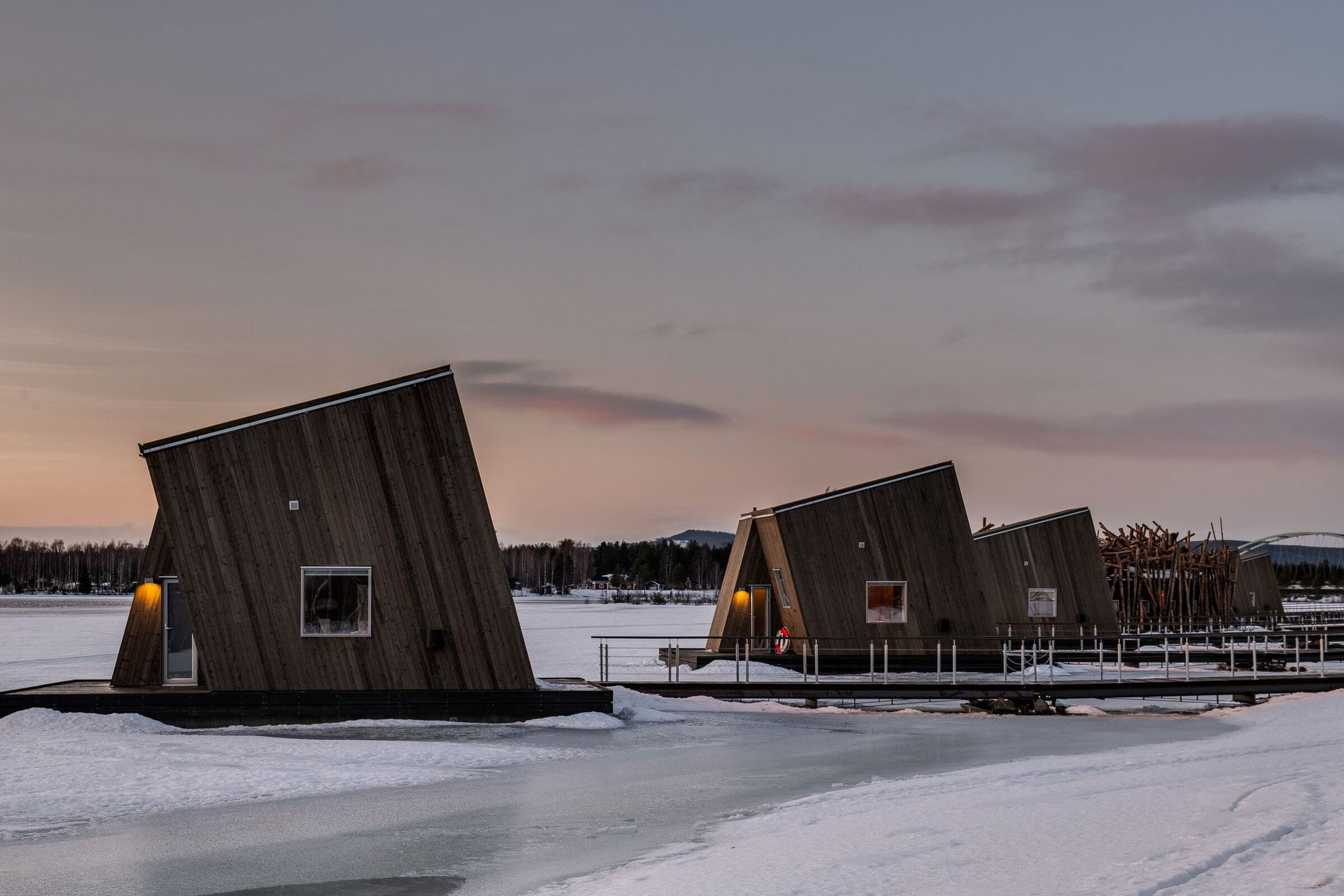
Suspended over a frozen river in the village of Harads, Swedish Lapland, Arctic Bath is a 12-room property built around a circular timber frame enclosing an ice-cold plunge pool. Days run to dog sledding, snowshoeing, and ice fishing; evenings to sauna rituals and eight-course dinners built on local game and fish. The journey north is long, and the stillness when you arrive makes it worthwhile.
A Circle of Timber on a Frozen River
The approach to Arctic Bath sets the register for everything that follows. The road into Harads, a village of a few hundred people in Swedish Lapland, narrows as the birch and pine close in, and by the time the structure comes into view — a ring of weathered timber suspended above the Lule River — the silence has already done most of the work. This is not a hotel that announces itself through grandeur. Its presence is quiet, almost formal, and entirely tied to the river beneath it.
The architecture reads as a direct response to the Arctic environment rather than an imposition on it. The circular form, which encloses an open-air ice-cold plunge pool at its centre, draws from the tradition of Scandinavian bathing culture while pushing the format into something more confrontational. Where most Nordic spa properties soften the cold-water ritual with heated corridors and indoor transitions, Arctic Bath puts the plunge pool at the literal heart of the structure, exposed to the sky and surrounded by the frozen river. The design signals a philosophy: immersion, not comfort.
The Architecture of Discomfort
Across premium cold-climate hospitality, two competing approaches have emerged. The first builds luxury inward , maximising insulation, warmth, and sensory softness to counterpoint the exterior conditions. The second turns the climate into the programme, making exposure to cold, darkness, and silence the actual product. Arctic Bath belongs firmly to the second camp, and its architecture is the clearest statement of that position.
The 12 rooms split between two configurations: cabins set among the trees on the riverbank and cabins positioned directly on the ice. The ice cabins, in particular, represent the design logic taken to its conclusion. Guests sleep above the frozen river, the building's relationship to the water literal rather than scenic. Properties in this category , where the site condition is not backdrop but structural material , occupy a distinct tier within the broader range of Scandinavian design hotels. For reference points in Sweden's wider premium accommodation scene, Ett Hem in Stockholm represents the polar opposite in sensibility: a converted townhouse offering intimate urban warmth, which is useful context for understanding how differently Swedish luxury can express itself.
The circular central structure works architecturally because it makes the plunge pool unavoidable. To move between any part of the hotel's core facilities, guests pass through or alongside it. There is no route that allows you to admire the concept from a distance. This is deliberate framing: the cold water is not an amenity available on request but a spatial condition of being there.
What the Days Look Like
Programme at Arctic Bath runs on the logic of the Arctic season. In winter, when the river is fully frozen and the surrounding forests carry snow, activities centre on the ice: dog sledding, snowshoeing, and ice fishing on the Lule River. The light shifts from deep blue to rose to gold across a short sky, and the absence of competing stimuli makes those transitions register in a way they rarely do elsewhere. The hotel's position in Harads places guests far enough from any urban light pollution that the Northern Lights become a plausible nightly event from late autumn through early spring, though sightings remain weather-dependent and should never be treated as guaranteed.
Dining format follows the same elemental logic as the architecture. An eight-course dinner built around local game and fish grounds the evening in the specific geography of Lapland, where reindeer, Arctic char, and foraged ingredients define the regional larder. This is not a kitchen performing Nordic cuisine as an international style , it is a kitchen working with what the surrounding land and water actually produce. For those tracking the broader Swedish fine dining conversation, properties like Vyn Restaurant in Ostra Nobbelov or Fjällbacka represent different regional expressions of the same commitment to Swedish produce.
The Sauna Ritual and Cold-Water Protocol
Scandinavian sauna culture has a long and specific grammar, and Arctic Bath operates within it rather than reinventing it. The sauna-to-cold-water cycle is the central ritual: heat the body in the wood-fired sauna, then enter the plunge pool at the heart of the circular structure. At Arctic Bath, the pool's open-air exposure means the surrounding temperature and the pool temperature converge in winter, which intensifies the contrast with the sauna in ways that a climate-controlled indoor pool cannot replicate. The ritual is not complicated, but the setting makes it feel serious.
This positions Arctic Bath within a small peer group of European cold-climate properties where the spa programme is architectural rather than supplementary. The comparison is less to large resort spas , even those at well-regarded properties like Badrutt's Palace Hotel in St. Moritz , and more to destination-specific formats where the treatment of the body is inseparable from the treatment of the landscape.
Planning a Stay
Arctic Bath sits at Ramdalsvägen 10 in Harads, approximately 60 kilometres from Gällivare and accessible via the Inlandsbanan rail line or by road. The nearest airport with regular domestic connections is Luleå Airport, from which Harads is roughly a 90-minute drive north. The 12-room capacity means the hotel operates at a scale where the experience is genuinely quiet , there is no critical mass of other guests to dilute the sense of isolation. That limited capacity also means advance booking is advisable, particularly for the peak winter window from December through March when the ice is fully formed and the Northern Lights are at their most reliable. For those building a broader Sweden itinerary, the contrast between Arctic Bath's remote winter setting and urban Swedish hospitality options , such as Görvälns Slott in Järfälla or Dorsia Hotel and Restaurant in Gothenburg , is worth considering as a structural itinerary choice. See our full Harads guide for broader context on the area. For those interested in how other design-forward remote properties handle the relationship between architecture and extreme environment, Amangiri in Canyon Point offers a useful desert-climate counterpoint, while Castello di Reschio in Lisciano Niccone represents the European approach to site-specific architectural restoration.
Frequently Asked Questions
- What is the vibe at Arctic Bath?
- Arctic Bath runs at a frequency that is closer to austere than luxurious in the conventional sense. The 12-room capacity and remote Harads location produce genuine quiet, and the architecture , centred on an open-air cold plunge pool on a frozen river , frames the experience around exposure to the Arctic environment rather than insulation from it. It suits travellers who want the discomfort and stillness of the far north built into the programme rather than edited out of it.
- What is the leading room type at Arctic Bath?
- The ice cabins, positioned directly on the frozen Lule River, express the hotel's architectural concept most fully. Sleeping above the ice places guests in direct relationship with the site condition the hotel is built around, which is a different proposition from the tree-set cabins on the riverbank. The tree cabins offer more visual shelter and proximity to the forest, which may suit guests who want to moderate the exposure slightly. Both configurations share the same access to the central circular structure and its plunge pool.
- What is Arctic Bath known for?
- Arctic Bath is known for its circular timber architecture suspended above the Lule River in Swedish Lapland, its open-air cold plunge pool at the centre of that structure, and its winter programme of dog sledding, snowshoeing, and ice fishing. The eight-course dinner format built around local game and fish, and the sauna ritual tied to the property's design, are the two elements most consistently cited by those who have stayed there. It operates in a small peer group of Arctic properties where the architecture and the landscape are the same argument.
- Should I book Arctic Bath in advance?
- Given the hotel's 12-room capacity and the concentration of demand in the December-to-March winter window, advance booking is strongly advisable. Peak periods , when the ice is fully formed, dog sledding is operational, and Northern Lights sightings are most probable , fill considerably ahead of time. If a specific activity or date matters to your trip, booking several months out is the practical approach.
- Does Arctic Bath operate year-round, and how does the experience differ between summer and winter?
- Arctic Bath operates across both the winter and summer seasons, and the two offer substantially different experiences within the same architecture. Winter centres on the frozen river, the Northern Lights, and the full cold-climate activity programme including dog sledding and ice fishing. Summer brings the midnight sun, when the Lule River is open water and the surrounding forest shifts to green , activities pivot toward kayaking and hiking. The architectural logic of the plunge pool and sauna ritual carries across both seasons, though the temperature contrast is more extreme in winter. Travellers choosing between seasons should note that the ice cabins are specific to winter, when the river surface is frozen solid enough to support the structures.
Recognized By


Related editorial
- Best Fine Dining Restaurants in ParisFrom three-Michelin-star icons to the next generation of Parisian chefs pushing boundaries, these are the restaurants that define fine dining in the world's culinary capital.
- Best Luxury Hotels in RomeFrom rooftop terraces overlooking ancient ruins to Michelin-starred hotel dining, these are the luxury hotels that make Rome unforgettable.
- Best Cocktail Bars in KyotoFrom sleek lounges to hidden speakeasies, Kyoto's cocktail scene blends Japanese precision with global influence in ways you won't find anywhere else.
Save or rate Arctic Bath on Pearl
Keep this venue in your Pearl passport, rate it after you visit, and track it alongside every other place you collect.