
Hotel in Oslo, Norway
Amerikalinjen
1,375ptsMaritime Heritage Reconsidered




About Amerikalinjen
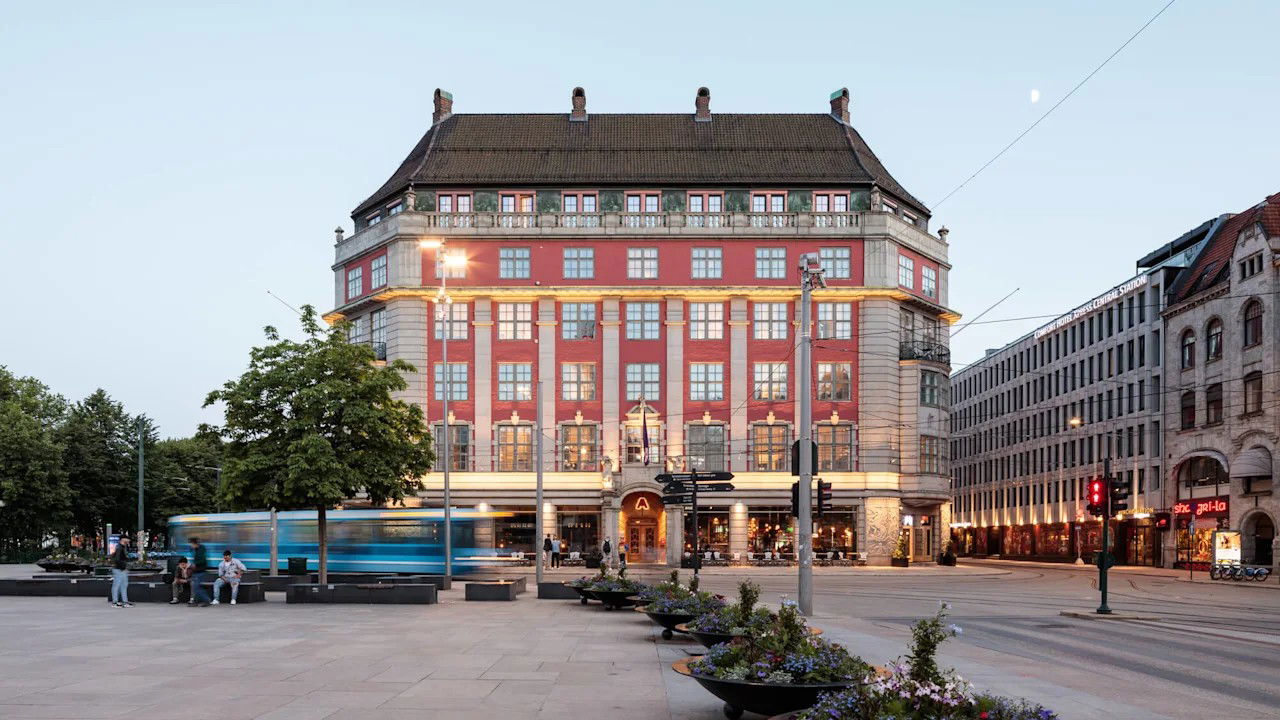
Occupying the 1919 headquarters of the Norwegian America Line, Amerikalinjen translates Oslo's seafaring past into a New York-inflected hotel with 122 rooms, a basement jazz club, and a brasserie anchored in Scandinavian produce. Recognized on La Liste's Top Hotels 2026 list with 91 points, it sits at Jernbanetorget Square, one minute from the central rail station, placing most of Oslo's centre within easy reach on foot.
A Shipping Company's Headquarters, Reconsidered as a Hotel
Jernbanetorget Square has always been Oslo's transit crossroads, and the building that anchors its northern edge was, for much of the twentieth century, the administrative nerve centre of the Norwegian America Line. The neo-baroque facade, completed in 1919, was designed to project institutional permanence: thick stone cornices, symmetrical fenestration, the kind of civic ambition that shipping companies once communicated through architecture rather than press releases. When the building reopened as Amerikalinjen, that original grammar was left largely intact. Grand staircases, parquet floors, deep-set windows, and textured plaster ceilings survive in the guest rooms and public spaces, alongside vintage elevators that still feel appropriate to the building's proportions. The restoration did not attempt to erase a century of use; it treated the original fit-out as the decorative brief.
The design decision to lean into the Norwegian America Line's transatlantic identity rather than rebrand around generic Scandinavian minimalism gives Amerikalinjen a distinct position among Oslo's hotel offerings. Where Sommerro interprets the capital through its Art Deco past and THE THIEF takes a contemporary art-collection approach, Amerikalinjen is specifically about a single historical moment: the era when Oslo faced New York across the Atlantic, and crossing that distance was the aspiration of a generation of Norwegian emigrants. Framed maps, historic dining menus, and period photographs are placed not as wallpaper but as evidence of that specific story. The result is a hotel that functions as a kind of annotated archive.
What the Rooms Communicate About the Building
The 122 rooms maintain the proportional generosity of a building that was never designed for residential occupancy. Corniced ceilings and deep window reveals are structural facts of the original construction, not added features. Birger Dahl lamps, produced by Hadeland Glassverk, appear throughout, placing Norwegian mid-century design inside the maritime-heritage framework without forcing a contrast. The aesthetic sits somewhere between a heritage property and a design hotel, and it earns that position through the quality of the retained original details rather than through decorative overlay.
Among the room categories, the superior and deluxe rooms and the Fortuna suites carry access to one specific programme worth noting before booking: a thirty-minute in-room bar cart service where a mixologist arrives with a full trolley and works through cocktails alongside a narrated version of the hotel's history. It is the kind of format that typically appears in larger suite programmes at properties like Aman New York or The Fifth Avenue Hotel, where experiential storytelling is built into the room rate. At Amerikalinjen, it functions as both service differentiator and a delivery mechanism for the property's central historical conceit.
Eating and Drinking Across the Building's Floors
Oslo's better hotels have increasingly treated their food and beverage programmes as independent draws rather than amenities. Amerikalinjen operates four distinct venues across the building, each addressing a different consumption moment and time of day.
Atlas Brasserie sits at the centre of the operation, open for breakfast and dinner to both guests and the public, with a Scandinavian-inflected menu that references wider cuisines. Grilled langoustines with tarragon butter and dry-aged beef burger with aged cheddar represent the register: familiar formats executed with good-quality primary ingredients. In warmer months, the covered courtyard and pavement tables absorb a significant share of the seating, making Atlas function as something closer to a neighbourhood brasserie than a hotel restaurant.
Haven, the cafe in the covered courtyard, doubles as a permanent showroom for local designer Eikund, where the furniture on the floor is available for purchase and shipment. The format is a relatively recent convention in Scandinavian hospitality design, where retail and hospitality merge inside the same physical envelope. The Little Bakery leans harder into the transatlantic theme: staff made a research trip to New York specifically to develop an Oslo-inflected version of the bagel, served with spreads and toppings inside Atlas or packaged to take away.
Pier 42, named after a Manhattan address, is the nightcap venue, with a cocktail menu that pairs Norwegian ingredients against New York references. The conceptual underpinning is consistent with the rest of the hotel's editorial position, though the execution, as with any pairing-format cocktail bar, will depend on the specific menu cycle. Then there is Gustav, the basement jazz club named after Gustav Henriksen, the Norwegian America Line's founder, operating live music on Fridays and Saturdays in an intimate format. Jazz-as-hotel-amenity is not an uncommon model in European properties, but naming the room after the building's founder gives it a specificity that separates it from generic basement programming. For a comparable property in Norway that uses its historical identity as actively, the Britannia Hotel in Trondheim is the closest reference point.
Where It Sits Among Oslo's Hotels
La Liste placed Amerikalinjen at 91 points in its 2026 Leading Hotels ranking, which positions it as a property with documented international recognition. Oslo's central hotel offer covers a wide band, from the long-established Hotel Continental, with its Theatercafeen heritage, to the corporate-scale Radisson Blu Oslo Plaza, which competes on height and room volume. Amerikalinjen's 122-room count and the density of its food and beverage programming place it in a middle tier by size but a higher tier by design intent. The price point, with rooms from around $347, lands it in the accessible range of Oslo's premium offering, below the Thief's art-collection positioning but above standard chain-category pricing.
The Jernbanetorget address is logistically convenient in a way that few central Oslo hotels match. The main rail station is directly adjacent, making airport transfers via the Airport Express train a matter of minutes from the hotel entrance. Youngstorget, with its bars and casual dining, is a short walk. The Kvadraturen shopping district and the opera house are both within comfortable walking distance. For travellers using Oslo as a base for wider Norwegian itineraries, the rail connection matters: onward journeys toward Bergen or Stavanger, or northern rail connections, all depart from the station next door. Properties in other Norwegian cities, including the Eilert Smith Hotel in Stavanger, Opus XVI in Bergen, and the Hotel Brosundet in Ålesund, occupy their own distinct design registers, but for those beginning or ending a Norwegian journey through Oslo, the Amerikalinjen location is difficult to argue against on practical grounds.
Wellness and the Gym
The wellness area includes a gym with modern equipment set over a multi-coloured wood floor, a Finnish sauna, and heated mosaic beds. It is not an elaborate spa programme, but the execution is more considered than most hotel gym fit-outs. The building's natural light access, including greenery visible through the gym windows, is a function of the original architecture rather than a designed feature. Staff hold route information for cycling and running in the surrounding area, which is useful given Oslo's strong cycling infrastructure and waterfront running paths.
Planning a Stay
Amerikalinjen sits at Jernbanetorget 2, 0154 Oslo, directly adjacent to Oslo Central Station. The 122-room count means availability can tighten on weekend bookings when Gustav's jazz programme draws a local crowd alongside hotel guests. Rooms from around $347 represent the entry point. For those interested in the in-room bar cart programme, booking into the superior, deluxe, or Fortuna suite category is the condition of access. The hotel's food and beverage venues are open to non-guests, so the Atlas brasserie and Pier 42 function as standalone dining and drinking destinations for Oslo visitors not staying on property. For the wider Oslo dining scene, see our full Oslo restaurants guide.
Travellers looking to extend into Norway's wider hotel landscape will find design-led properties across multiple formats: the fjord-edge Juvet Landscape Hotel in Valldal, the Arctic-positioned Aurora Lodge in Tromso, the island-isolated Manshausen, or the Lofoten fishing village setting of Nusfjord Village and Resort in Ramberg. For a historic-property comparison closer to Amerikalinjen's heritage approach, Hotel Union Øye in Norangsfjorden and the Walaker Hotel in Solvorn both operate within a similar logic of retained history as design strategy.
Frequently Asked Questions
Which room category should I book at Amerikalinjen?
The in-room bar cart experience, where a mixologist arrives with a full trolley and works through cocktails with historical context, is available only to guests in superior rooms, deluxe rooms, or one of the Fortuna suites. If that programme is part of the appeal, those categories are the relevant ones to target. Standard rooms retain the building's original architectural details, including corniced ceilings and parquet floors, so the design quality does not drop materially at the lower tier. The La Liste 2026 recognition (91 points) applies to the property overall rather than to specific room categories. At around $347 as an entry price point, the step up to superior or deluxe is likely a modest increment worth considering if the cocktail programme is a draw.
What should I know about Amerikalinjen before I go?
The hotel occupies the 1919 Norwegian America Line headquarters at Jernbanetorget 2, directly next to Oslo Central Station, which handles both the Airport Express train and mainline rail departures. Oslo is an expensive city by most international comparisons, and the $347 entry price reflects a premium-tier property in that context. The food and beverage venues, including Atlas Brasserie, Haven cafe, Pier 42 bar, and the Gustav jazz club, are open to non-guests, so locals use the building regularly. Gustav operates live jazz on Fridays and Saturdays, which adds ambient energy to those evenings but may also affect noise levels in rooms on lower floors. The covered courtyard where Haven is located also functions as a furniture showroom for Eikund, Oslo's design label, so pieces throughout the cafe are tagged for purchase. For context on how Amerikalinjen compares to other Oslo hotels in its design tier, Sommerro and THE THIEF represent the main alternatives in the heritage and contemporary-art brackets respectively.
Recognized By


Related editorial
- Best Fine Dining Restaurants in ParisFrom three-Michelin-star icons to the next generation of Parisian chefs pushing boundaries, these are the restaurants that define fine dining in the world's culinary capital.
- Best Luxury Hotels in RomeFrom rooftop terraces overlooking ancient ruins to Michelin-starred hotel dining, these are the luxury hotels that make Rome unforgettable.
- Best Cocktail Bars in KyotoFrom sleek lounges to hidden speakeasies, Kyoto's cocktail scene blends Japanese precision with global influence in ways you won't find anywhere else.
Save or rate Amerikalinjen on Pearl
Keep this venue in your Pearl passport, rate it after you visit, and track it alongside every other place you collect.