
Hotel in Vinh Hy, Vietnam
Amanoi
725ptsNational Park Seclusion


About Amanoi
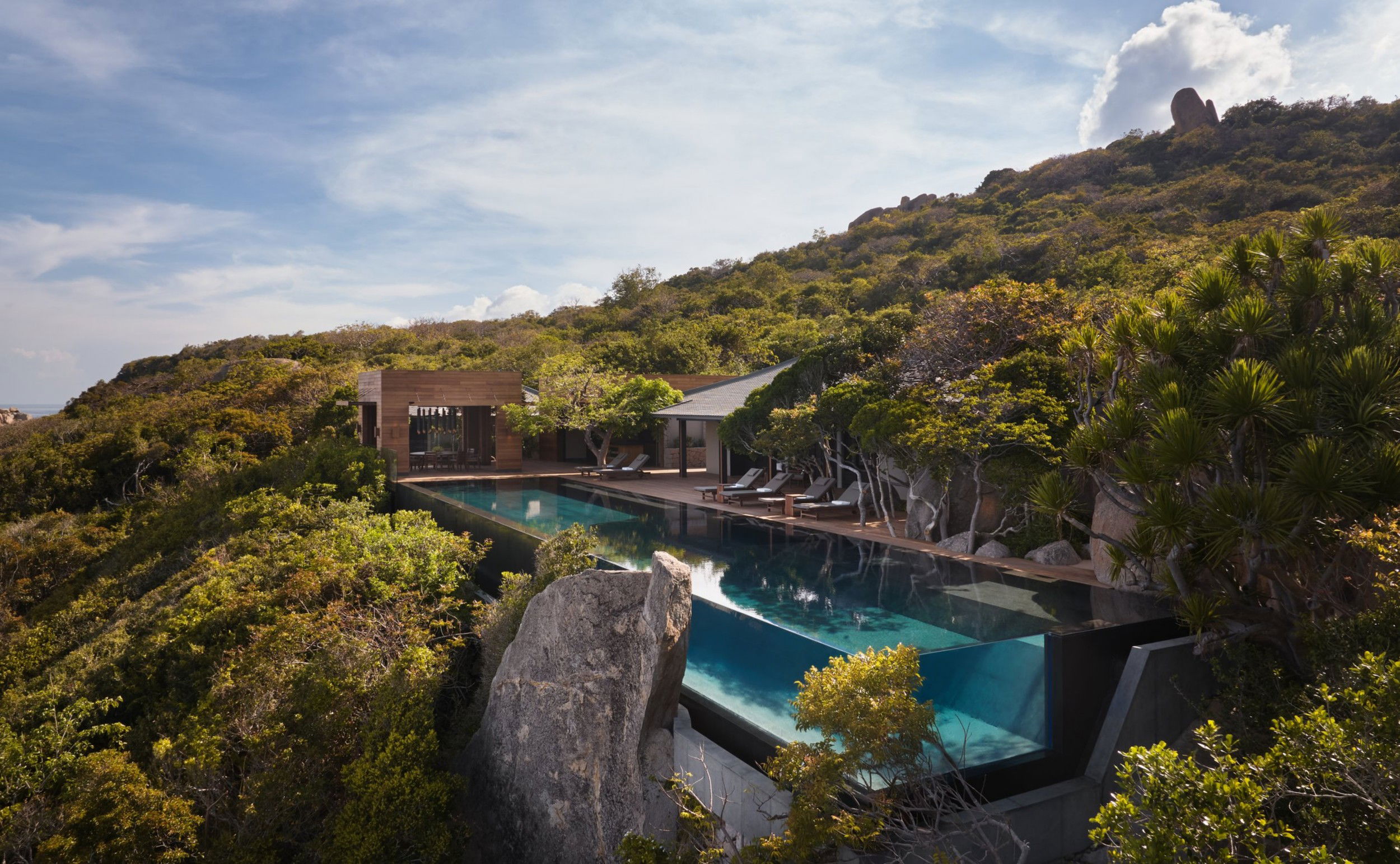
Aman's first Vietnam property occupies a dramatic clifftop position inside Nui Chua National Park, overlooking Vinh Hy Bay on Ninh Thuan Province's largely undeveloped coastline. The resort earned Michelin 3 Keys recognition in 2025, placing it among Vietnam's most formally acknowledged luxury stays. Architecture draws from the traditional Vietnamese communal hall, positioning the Central Pavilion as both social anchor and panoramic lookout across protected coastal habitat.
Where the National Park Meets the East Sea
Vietnam's central and southern coastline has attracted considerable luxury development over the past two decades, but most of it concentrates around Danang, Hoi An, and Nha Trang. Ninh Thuan Province sits further south and considerably further from the resort corridor, its shoreline largely absorbed into Nui Chua National Park, which protects more than 29,000 hectares of coastal and marine habitat. It is in this conservation zone, not on a developed beach strip, that Aman chose to establish its first Vietnam property. That decision defines everything about the experience: the site is the argument. For broader context on where Amanoi sits within Vietnam's premium accommodation options, see our full Vinh Hy restaurants guide.
The Architecture of Arrival
The design logic at Amanoi reveals itself before guests reach any room. After a drive through national park terrain, the approach delivers visitors to a broad bank of stairs ascending to the Central Pavilion at the property's summit. The spatial sequence is deliberate: the climb withholds the panorama, then releases it at the leading, where Vinh Hy Bay spreads across an unobstructed horizon. This kind of choreographed arrival is a consistent Aman technique, but the device earns its effect here because the view it reveals is genuinely of a different order, looking out over a bay enclosed by national park hills rather than a coastline dotted with competing developments.
The Central Pavilion draws its form from the dinh, the traditional Vietnamese communal hall that historically served as the civic and ceremonial centre of a village. The translation into a contemporary resort building preserves the essential spatial gesture of the form: a generous sheltered volume open to its surroundings, oriented toward a shared view rather than inward toward private amenities. The Restaurant, Bar, and expansive terrace are all housed within this structure, meaning the social life of the resort gathers at its highest point rather than dispersing across disconnected facilities. That choice reinforces the communal intention of the reference architecture.
Within the broader Aman portfolio, this approach to site-responsive design is consistent. Properties like Aman New York and Aman Venice each negotiate their physical context through architecturally specific solutions rather than applying a standardised resort template, and Amanoi follows the same methodology in a radically different landscape.
Two Pools, Two Registers
The property operates two distinct swimming pool environments, and the distinction between them maps to two different modes of engaging with the site. The Cliff Pool sits adjacent to the Central Pavilion at the hilltop, positioned to extend the panoramic relationship with Vinh Hy Bay from the water. The Beach Club pool, positioned at sea level on the white-sand beach, offers a closer, more immediate engagement with the coastline and connects to dining and lounging areas alongside water sports equipment. The vertical separation between the two is not merely topographic: guests who spend time at both encounter the bay from genuinely different spatial perspectives, which is more than most multi-pool resorts manage.
The Aman Spa as Destination Infrastructure
Aman properties tend to position their spa facilities as a secondary but structurally important offering, and at Amanoi this is particularly legible in the design. The Aman Spa sits on a separate lake, set away from the main resort cluster and surrounded by the national park's hillscape. The spatial isolation is intentional: the spa is treated as a destination within the destination rather than an amenity appended to the accommodation. A Pilates Studio, a lakeside Yoga Pavilion, and a fully equipped Gymnasium round out the fitness infrastructure, with outdoor tennis courts and a network of walking, running, and trekking routes extending the active offering into the national park itself.
This model, in which wellness facilities are given architectural and spatial autonomy from the main resort, is common in the high-end Southeast Asian market. Properties such as Almanity Hoi An Wellness Resort and Anantara Quy Nhon Villas both treat wellness as a primary programme rather than an add-on, reflecting a broader shift in how premium travellers allocate time at remote resort properties.
Michelin Recognition and the Peer Set
In 2025, Amanoi received Michelin 3 Keys, the guide's highest hotel recognition tier. The Michelin Keys system, introduced to evaluate hotels on comparable criteria to the restaurant stars, uses architectural character, spatial quality, and service coherence as primary criteria. Three Keys places Amanoi in the uppermost band of Vietnam's formally recognised properties. For reference, other Michelin-acknowledged hotels in Vietnam sit in major urban and coastal centres including Hanoi and Hoi An, making the national park coastal position of a 3 Keys property notable within the local market. Among Vietnam's luxury coastal tier, Amanoi competes in a peer set that includes large-footprint international properties at Four Seasons Resort The Nam Hai, Hoi An and design-led alternatives like Amiana Resort Nha Trang, though Amanoi's national park setting removes it from direct geographic competition with both.
Vietnam's Coastline and This Property's Position on It
Vietnam's coastline runs more than 3,200 kilometres from the Chinese border in the north to the Mekong Delta in the south, and the range of resort experiences along that stretch is correspondingly broad. Properties in Danang, Hoi An, and the central coast cluster benefit from proximity to cultural heritage sites and well-established flight connections. Further south, options like Radisson Blu Resort, Cam Ranh occupy a more accessible coastal corridor. Amanoi's position inside a protected national park on the Ninh Thuan coast represents a different proposition: the relative difficulty of reaching it is partly the point, reinforcing the seclusion the site provides. Vietnam is also drawing increasing international attention for its biodiversity and natural conservation areas, a shift that positions Nui Chua's 29,000-plus hectares of coastal habitat as a significant draw in its own right rather than merely scenic backdrop.
For travellers building a multi-stop Vietnam itinerary that connects coastal retreat with urban culture, properties across the country's geography offer distinct registers. The colonial atmosphere at Azerai La Residence, Hue, the heritage positioning of Dalat Palace Heritage Hotel, and the urban footprint of InterContinental Hanoi Westlake each address a different phase of a longer journey. Other coastal and resort options worth considering across the country's south and centre include Asteria Mui Ne Resort, Banyan Tree Lang Co, Hoiana Hotel and Suites, Ixora Ho Tram by Fusion, and Novotel Danang Premier Han River. Further north, Hotel de la Coupole MGallery in Sapa, Emeralda Resort Ninh Binh, and Oakwood Ha Long extend the range of lodging options across Vietnam's northern regions. For the island alternative, InterContinental Phu Quoc Long Beach Resort offers a high-volume international-brand counterpoint. Ho Chi Minh City travellers connecting to or from Ninh Thuan might also consider Amanaki Saigon Boutique Hotel for the urban stage of their trip. Indochine Palace in Hue and Four Points by Sheraton Danang round out the mid-to-upper tier in the central region. Hilton Quang Hanh Onsen Resort provides an onsen-focused alternative in the north. For a globally consistent frame of reference, The Fifth Avenue Hotel in New York City demonstrates how urban Aman-adjacent positioning works in a very different market context.
Planning a Stay
Amanoi is located in Vinh Hai Commune, Ninh Hai District, Ninh Thuan Province, north of Ho Chi Minh City. The nearest commercial airport is Cam Ranh (Nha Trang), roughly 60 kilometres south. The resort is an Aman property and follows Aman's direct booking model. Advance planning is recommended, particularly for peak season travel between November and April when Ninh Thuan's dry climate makes coastal conditions at their most settled. The Library, Boutique, and tennis courts are available for guests throughout the stay, with the Boutique stocking Vietnamese lacquerware, handmade jewellery, and locally produced ceramics and pottery alongside resort apparel.
Frequently Asked Questions
What is the atmosphere like at Amanoi?
The tone is deliberately quiet. Amanoi sits inside a protected national park, which eliminates the ambient noise and visual competition typical of beach resort destinations. The Central Pavilion, built on the model of a Vietnamese communal hall, gathers guests at the highest point of the property with unobstructed views over Vinh Hy Bay. Given the Michelin 3 Keys recognition it received in 2025 and the national park setting, the experience is oriented toward guests who treat seclusion and spatial quality as primary rather than secondary considerations. Families and couples both use the property, but the register is calm rather than animated. There is no organised entertainment infrastructure of the type found at larger resort operations.
Which accommodation type offers the most from Amanoi's setting?
The database record does not provide room-category detail, and it would be misleading to prescribe a specific room type without verified information. What the property's architecture makes clear is that the hilltop position of the Central Pavilion delivers the most expansive views of Vinh Hy Bay, and the design logic suggests that accommodations oriented toward the bay and the national park hillscape will capture the site's defining spatial quality more fully than beach-facing alternatives. Given Amanoi's Michelin 3 Keys standing in 2025, the property's room quality overall is formally positioned at Vietnam's upper tier, so the differentiation between categories is likely a matter of configuration and view angle rather than service or finish.
What makes Amanoi worth the visit?
Combination of site and formal recognition is difficult to replicate elsewhere on Vietnam's coastline. Nui Chua National Park's protected status means the bay and hillscape Amanoi overlooks will not change as surrounding areas are developed, which is a meaningful long-term argument for the property's positioning. The Michelin 3 Keys recognition in 2025 provides independent verification of the quality tier. For travellers comparing premium coastal Vietnam options, Amanoi's national park location provides a specific and verifiable point of difference: the guest is inside a conservation area, not merely near one.
Does Amanoi require a reservation, and how does booking work?
Yes, reservation is required. As an Aman property, Amanoi operates through Aman's direct booking channels. Specific phone and website details are not available in the current record; guests should contact Aman Resorts directly through the Aman global website to confirm rates, availability, and transfer arrangements from Cam Ranh airport. Given the property's remote location within a national park and its Michelin 3 Keys positioning, last-minute availability at preferred dates is not reliable, and planning well in advance is the standard approach for Aman properties at this tier.
Recognized By


Related editorial
- Best Fine Dining Restaurants in ParisFrom three-Michelin-star icons to the next generation of Parisian chefs pushing boundaries, these are the restaurants that define fine dining in the world's culinary capital.
- Best Luxury Hotels in RomeFrom rooftop terraces overlooking ancient ruins to Michelin-starred hotel dining, these are the luxury hotels that make Rome unforgettable.
- Best Cocktail Bars in KyotoFrom sleek lounges to hidden speakeasies, Kyoto's cocktail scene blends Japanese precision with global influence in ways you won't find anywhere else.
Save or rate Amanoi on Pearl
Keep this venue in your Pearl passport, rate it after you visit, and track it alongside every other place you collect.