
Hotel in Mie, Japan
Amanemu
975ptsSacred-Coast Onsen Immersion


About Amanemu
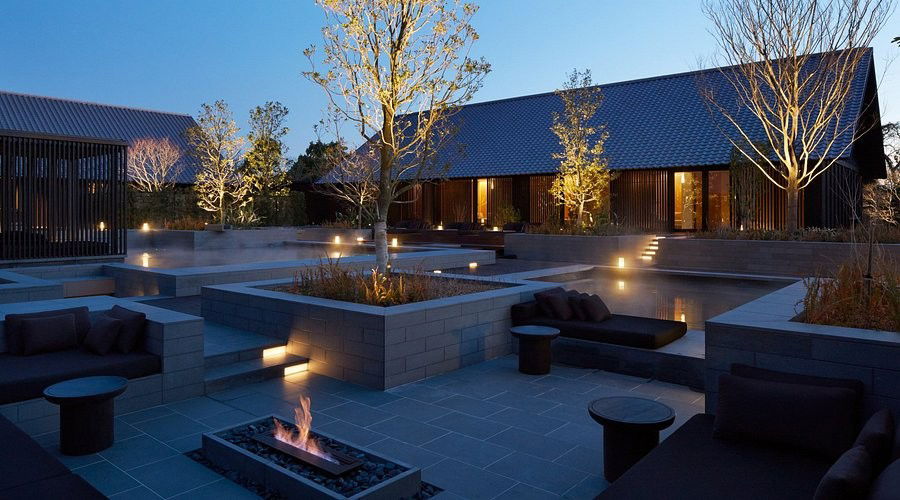
Set within Ise-Shima National Park in Mie Prefecture, Amanemu is the Aman group's interpretation of the traditional Japanese ryokan at its most architecturally considered. Kerry Hill's design places 32 suites and villas against the waters of Ago Bay, each with a private onsen. La Liste awarded the property 92.5 points in 2026, and Michelin granted it 3 Keys in 2024.
Where Kerry Hill's Architecture Meets the Kii Peninsula's Ancient Landscape
Approaching Amanemu, the first thing that registers is not the building but the water. Ago Bay spreads out below, its surface scattered with oyster rafts that have been working these depths for centuries — an industry that gave the bay its other name, the Bay of Pearls. The resort sits within Ise-Shima National Park on the Kii Peninsula, a stretch of Honshu's southwest coast that has drawn pilgrims, emperors, and fishermen for longer than most European cities have existed. Kerry Hill Architects, the Singapore-based practice responsible for several of Aman's most studied properties, designed Amanemu to read from a distance as though it belongs to the terrain rather than occupies it. Low-slung pavilions in dark timber and stone follow the contours of the hillside; the palette — charcoal, slate, the grey-green of ancient cryptomeria , repeats what the forest is already doing.
The design language Kerry Hill developed here is worth examining separately from the Aman brand context. Hill's approach, which has been analysed extensively in architectural circles since his earlier work at Amanjiwo and Amankora, treats structure as a filtering mechanism: walls and screens mediate between interior and exterior rather than sealing them apart. At Amanemu, this produces interiors that feel simultaneously sheltered and open, with framed views of the bay or the cedar slopes appearing where a wall might otherwise close a room off. The result is not dramatic in the way that, say, a cliff-edge infinity pool is dramatic. The drama here is cumulative and quiet , a Japanese architectural sensibility translated through a contemporary architect's hand.
The Architecture of Rest: Suites, Villas, and the Onsen Pavilions
Japan's premium rural accommodation has historically split between two models: the traditional ryokan, where tatami, kaiseki, and communal bathing are the core proposition, and the Western-format resort grafted onto a scenic location. Amanemu occupies a third position, one that a growing number of design-led properties in Japan are pursuing: thoroughly contemporary in material and form, but deeply informed by the spatial logic of Japanese hospitality. The 32 keys here break into 24 suites and a smaller number of villas. Each suite includes a private onsen bath, drawing from the thermal springs that make this part of the Kii Peninsula a significant destination in Japan's onsen geography. The villas, accommodating up to six guests, extend to nearly 4,000 square feet , a scale that repositions them less as hotel accommodation and more as private residences with resort services attached.
The onsen program at the property level goes beyond private in-suite soaking. Two large bathing pavilions serve as communal thermal spaces, organised around the ancient Japanese practice of onsen as physical and psychological restoration rather than mere bathing. This is a meaningful distinction in Japan, where the therapeutic tradition of mineral-spring immersion has a documented history stretching back over a millennium. Alongside the bathing pavilions, a watsu pool, four treatment suites, a gym, and a yoga studio form the wellness infrastructure. Properties positioning at this tier , Amanemu scored 92.5 points in the La Liste Leading Hotels 2026 rankings and received three Michelin Keys in 2024 , are expected to deliver a wellness program that goes past surface-level spa menus, and this one does.
For context on how Amanemu positions within Japan's broader luxury accommodation market, the comparison set is instructive. [Gora Kadan in Hakone](https://www.enprimeurclub.com/hotels/gora-kadan-hakone-hotel) and [Asaba in Izu](https://www.enprimeurclub.com/hotels/asaba-izu-hotel) represent the more traditionally rooted end of Japan's premium rural inn spectrum, where ryokan heritage and ceremony are foregrounded. [Zaborin in Kutchan](https://www.enprimeurclub.com/hotels/zaborin-hokkaido-hotel) and [ENOWA Yufu in Yufu](https://www.enprimeurclub.com/hotels/enowa-yufu-yufu-hotel) share Amanemu's interest in contemporary design within a natural-immersion framework. Amanemu sits closer to the latter group architecturally, while carrying the Aman operational standard that its peer ryokans approach through different means. Other properties in the Aman portfolio that operate on similar principles include [Aman Venice in Venice](https://www.enprimeurclub.com/hotels/aman-venice-venice-hotel) and [Aman New York in New York City](https://www.enprimeurclub.com/hotels/aman-new-york-new-york-city-hotel), though the Japanese onsen-and-nature format is distinct from either.
Dining and the Matsusaka Wagyu Context
The Restaurant at Amanemu works from a Japanese cuisine framework built on local produce. Two ingredients define the regional sourcing story most clearly. The first is seafood from Ago Bay, where the same waters visible from the suites supply fish and shellfish with a provenance guests can see directly. The second is Matsusaka Wagyu, a beef category with protected regional identity status in Japan, produced in the area around Matsusaka city in northern Mie Prefecture. Matsusaka Wagyu occupies the same tier of Japanese cattle production as Kobe and Ohmi beef, with a reputation grounded in specific breeding and feeding practices developed over several centuries. Serving it at a property in Mie is not a marketing choice so much as a geographical inevitability; this is the beef's home prefecture.
The dining format aligns with what premium Aman properties typically deliver: a kaiseki-influenced approach to multi-course Japanese dining, where seasonal produce, regional identity, and presentation are treated as inseparable. Kaiseki's structure , small courses sequenced across a meal to express the season and the chef's judgment , is the format most suited to showcasing the kind of ingredients Amanemu has access to. For guests arriving from major urban properties in Japan, the shift from city dining to this kind of ingredient-led, place-specific cooking is among the more noticeable differences in the experience.
Sacred Landscape: What the Kii Peninsula Adds
Ise-Shima National Park is not simply a scenic backdrop. The Kii Peninsula carries the highest density of designated UNESCO World Heritage pilgrimage routes in Japan, and the Ise Grand Shrines , two separate complexes, Naiku and Geku , rank among the country's most significant Shinto sites. Geku Shrine is dedicated to the deity of food, clothing, and shelter; Naiku enshrines Amaterasu, the sun goddess and central figure in the Shinto cosmological tradition. Both are within reach of the property. The broader network of ancient pilgrimage routes that crosses the peninsula's forested interior adds a dimension that very few luxury resort settings in Japan can match: genuine sacred geography, active and maintained, not museumified.
For properties in Japan's premium rural tier, this kind of cultural proximity matters to a specific guest segment, and it is one of the factors that positions Amanemu differently from comparable design-led properties in, say, Hakone or Kyoto's outskirts. [Nishimuraya Honkan in Kinosaki-cho](https://www.enprimeurclub.com/hotels/nishimuraya-honkan-kinosaki-cho-hotel) and [Araya Totoan in Kaga](https://www.enprimeurclub.com/hotels/araya-totoan-kaga-hotel) offer their own forms of cultural depth rooted in their respective regions; the Kii Peninsula offers something at a different historical scale.
Getting There and Planning Your Stay
Amanemu sits in Hamajima-cho, Shima, in Mie Prefecture , roughly 124 miles from Nagoya, which is the practical gateway city for most international arrivals. By car or highway the drive runs approximately 2.5 to 3 hours. By train, the route from Nagoya Station to Kashikojima takes around 2 hours and 10 minutes, with the journey from the airport to Nagoya adding another 20 minutes, placing total travel time in the same 2.5 to 3 hour window. For guests who find the ground-transport proposition too long given the cost of a stay that begins at $2,297 per night, the concierge can arrange helicopter transfers from Nagoya Airport, cutting the journey to approximately 30 minutes. At that price point, the helicopter option warrants serious consideration as part of the overall trip budget.
Given the property's 32-key inventory, the La Liste 92.5-point score, and its Michelin three-key recognition, forward planning is advisable for any high-demand travel period. Japan's autumn foliage season and spring cherry blossom window are the most competitive booking periods nationally; the Ise-Shima area draws additional visitors around major Shinto festival dates at the Grand Shrines. Guests exploring the broader spectrum of Japanese premium rural accommodation alongside an Amanemu stay might also consider [Fufu Kawaguchiko in Fujikawaguchiko](https://www.enprimeurclub.com/hotels/fufu-kawaguchiko-fujikawaguchiko-hotel), [Benesse House in Naoshima](https://www.enprimeurclub.com/hotels/benesse-house-naoshima-hotel), or [Azumi Setoda in Onomichi](https://www.enprimeurclub.com/hotels/azumi-setoda-onomichi-hotel) as itinerary companions covering different regional and design contexts. For the full range of dining and accommodation options in the prefecture, see [our full Mie restaurants guide](https://www.enprimeurclub.com/cities/mie).
Frequently Asked Questions
What is the atmosphere like at Amanemu?
The atmosphere is defined by deliberate quiet and spatial restraint. Kerry Hill's architecture frames rather than competes with the surroundings, and the Ise-Shima National Park setting means the view from most parts of the property is either forested hills or the pearl-oyster bay below. With 32 keys total, guest density is low, and the property earns a 4.5 Google rating across 404 reviews. The Michelin three-key recognition (2024) and La Liste 92.5-point score confirm the level of operational delivery guests encounter. If you respond well to minimal intervention design and restorative pacing, the atmosphere at Amanemu will suit you; if you want activated resort energy with poolside programming and evening entertainment, this is not that property.
Which room category should I book at Amanemu?
For most guests, the suites represent the core experience: private onsen bath, substantial square footage, and views oriented toward the gardens and Ago Bay. The villas, spanning close to 4,000 square feet and accommodating up to six, are designed for groups or families where shared private space is the priority. At a starting rate of $2,297 per night, the suite tier already positions this as a high-commitment booking; the villa category adds further scale. Both carry private onsen access, which is the architectural and experiential anchor of the property.
What is the standout thing about Amanemu?
The combination of Kerry Hill's architecture, Ise-Shima National Park's sacred landscape, and the onsen program is not replicated elsewhere in Japan at this operational standard. La Liste placed the property at 92.5 points in its 2026 Leading Hotels ranking; Michelin awarded three keys in 2024. The proximity to the Ise Grand Shrines and Kii Peninsula pilgrimage routes adds cultural weight that goes beyond the scenic. Within the Aman portfolio, Amanemu is the property most specifically rooted in Japanese bathing tradition and Shinto geography simultaneously.
How far ahead should I plan for Amanemu?
At 32 keys and $2,297 per night as a base rate, availability moves faster than at larger properties. Japan's autumn and spring peak seasons typically require booking several months in advance for preferred dates. The property's consistent award recognition , Michelin three keys and La Liste top-tier ranking , keeps demand steady across the year. For the helicopter transfer from Nagoya Airport, coordinate with the concierge at the time of booking rather than closer to arrival. Properties with comparable booking dynamics in Japan include [Bvlgari Hotel Tokyo in Tokyo](https://www.enprimeurclub.com/hotels/bvlgari-hotel-tokyo-tokyo-hotel) and [HOTEL THE MITSUI KYOTO in Kyoto](https://www.enprimeurclub.com/hotels/hotel-the-mitsui-kyoto-kyoto-hotel), where award recognition creates sustained demand across all seasons.
Recognized By


Related editorial
- Best Fine Dining Restaurants in ParisFrom three-Michelin-star icons to the next generation of Parisian chefs pushing boundaries, these are the restaurants that define fine dining in the world's culinary capital.
- Best Luxury Hotels in RomeFrom rooftop terraces overlooking ancient ruins to Michelin-starred hotel dining, these are the luxury hotels that make Rome unforgettable.
- Best Cocktail Bars in KyotoFrom sleek lounges to hidden speakeasies, Kyoto's cocktail scene blends Japanese precision with global influence in ways you won't find anywhere else.
Save or rate Amanemu on Pearl
Keep this venue in your Pearl passport, rate it after you visit, and track it alongside every other place you collect.