
Hotel in Lijiang, China
Amandayan
625ptsNakhi Courtyard Retreat


About Amandayan
Positioned above Lijiang's UNESCO-listed Old Town on Lion Hill, Amandayan translates the Nakhi architectural tradition into 35 all-suite accommodations built around calm courtyards with Yunnan pine and elm detailing. At $744 per night, it sits at the upper tier of Yunnan luxury, pairing Jade Dragon Snow Mountain views with a restaurant focused on mountain-foraged Yunnan and Cantonese fare, a traditional tea house, and a wellness suite grounded in Chinese medicinal practice.
Architecture as the Argument: How Amandayan Positions Itself Above Lijiang's Old Town
The approach to Amandayan tells you most of what you need to know before you cross the threshold. Perched on Lion Hill at the center of Dayan, Lijiang's UNESCO World Heritage-listed Old Town, the property sits above the roofline of an ancient canal and bridge system that has remained largely intact since the Naxi (Nakhi) Kingdom controlled this corner of Yunnan. From that elevation, the Jade Dragon Snow Mountain occupies the middle distance on clear days, presiding over a limestone terrain that drops sharply into gorges and river valleys. The building you're entering is not a backdrop to that landscape; it is an argument about how a contemporary luxury property should respond to it.
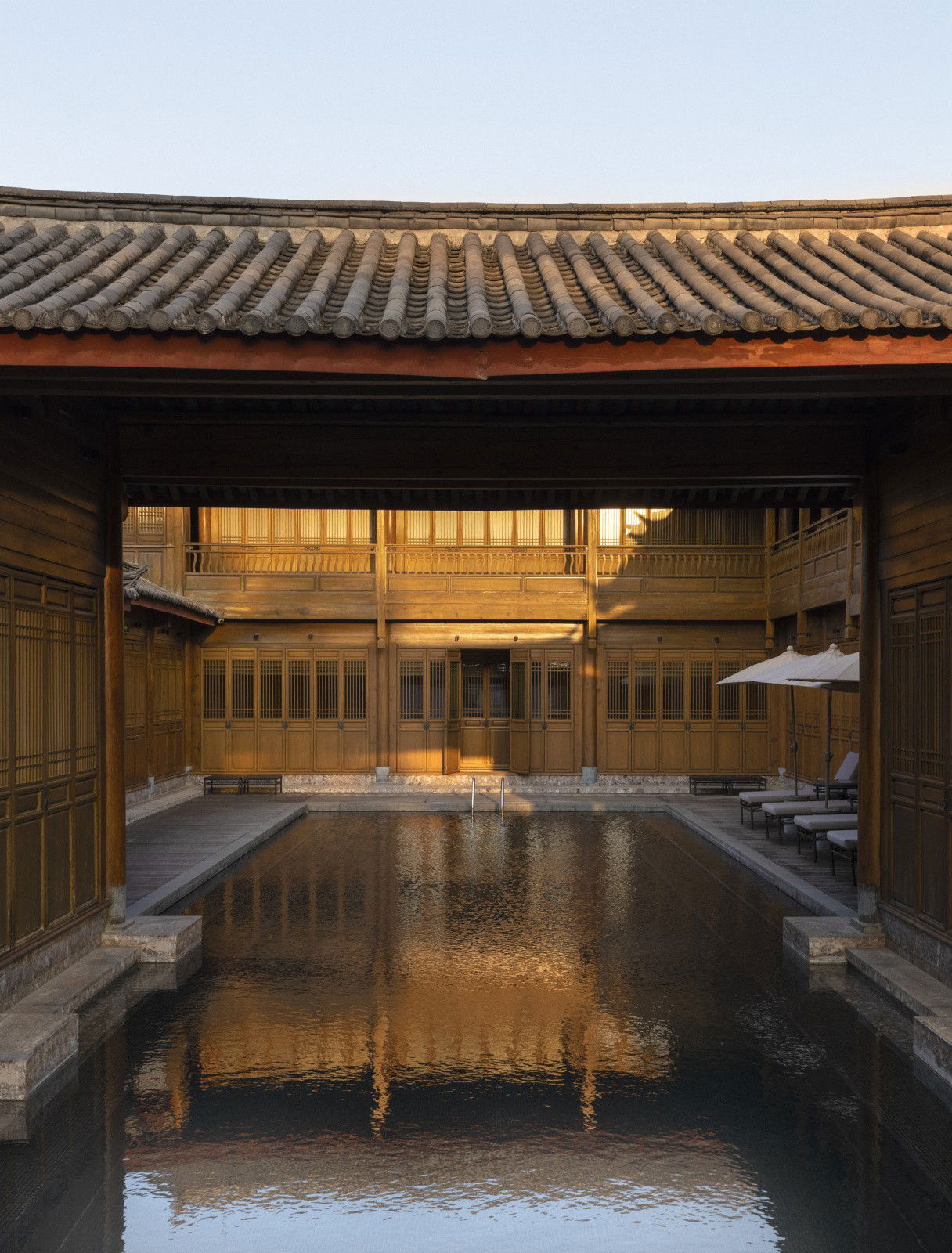
Aman's approach across its Chinese properties has consistently been to absorb the architectural language of the host context rather than impose an international template. At Aman New York that means Art Deco integration; at Aman Venice, a sixteenth-century palazzo. In Lijiang, it means the Nakhi vernacular: courtyard-centred planning, pagoda roof profiles, and carved timber screens produced in locally sourced Yunnan pine and elm from Dong Bei. The clean lines that define Nakhi domestic architecture translate into something that feels simultaneously ancient and spare, with lofty ceilings opening up internal volumes without resorting to the grand gesture for its own sake.
Thirty-Five Suites Built Around the Courtyard Principle
The property operates 35 all-suite accommodations, a count that keeps it within the small-footprint tier that Aman has maintained as its core identity since Phuket in 1988. That scale matters operationally: at 35 rooms, the staff-to-guest ratio remains high, and the public spaces do not function as hotel lobbies in the conventional sense. They function as extensions of the courtyard logic, where circulation slows and the architecture asks you to pause rather than pass through.
The interiors carry Nakhi detailing into the guest experience through expertly carved screens and ornamental woodwork in local pine and elm. Freestanding tubs sit in bathrooms that extend the same material and tonal palette as the sleeping areas. Technology, including flat-screens, integrated sound, and underfloor heating, is present throughout but kept sufficiently discreet that it does not disrupt the aesthetic continuity. The room views that take in Jade Dragon Snow Mountain shift the accommodation from comfortable to genuinely compelling; the mountain's snow-covered upper ridges at altitude above Yunnan's limestone plateau constitute one of southwestern China's more dramatic fixed points.
At $744 per night, Amandayan prices against a peer set that includes Banyan Tree Ringha in and other design-led retreats across Yunnan and the Tibetan plateau edge, not against the mid-market properties clustered closer to the Old Town gates. Travelers comparing options at a lower price point will find Hotel Indigo Lijiang Ancient Town and Hylla Vintage Hotel within the Old Town itself, both operating at significantly lower room rates and with a different relationship to the neighbourhood's street-level energy.
What Yunnan Province Means for the On-Site Dining Program
Yunnan's geographical position, sharing borders with Tibet, Myanmar, Laos, and Vietnam while sitting above subtropical lowlands, produces one of China's most botanically complex larders. The province's elevation range means that ingredients foraged at high altitude, including wild mushrooms, alpine herbs, and mountain vegetables, define a regional cuisine that differs sharply from the coastal traditions most international visitors associate with Chinese food. Amandayan's restaurant works within that framework, centering its menu on mountain-foraged plates while maintaining Cantonese options within the same program. A lounge adjacent to the main restaurant handles a broader global range for guests who want it. The tea house, positioned to take advantage of some of the property's stronger views, serves both traditional Chinese varieties and Western options, functioning as a midpoint between the formal dining room and the outdoor spaces.
The wellness operation follows the model that Aman has applied at several of its Asian properties, grounding the treatment menu in Chinese medicinal herbs and massage techniques rather than adopting a generic spa format. A heated outdoor pool, multiple treatment rooms, yoga available on request, and a fully equipped gym complete the infrastructure. In the context of a destination like Lijiang, where the altitude sits at roughly 2,400 metres and physical excursions into gorge terrain or across mountain meadows are a realistic part of the itinerary, the recovery-oriented wellness framing has practical logic behind it.
The Surrounding Region: What Positions Lijiang as a Destination
Lijiang's Old Town, Dayan, received UNESCO World Heritage designation in 1997, recognition that formalised what the city's position on the Ancient Tea Horse Road had long implied: this is a place where trade, culture, and topography converged over centuries into a physical environment that proved durable. The 354 bridges across the canal system are not ornamental; they were infrastructure for a mercantile centre that linked Yunnan's mountain communities with lowland China and the plateau cultures to the northwest. Walking the narrow cobblestone lanes now means reading that layered history in the building stock and street pattern.
The surrounding terrain gives Lijiang access to experiences that few of its competitor destinations in southwestern China can match at close range. Tiger Leaping Gorge, one of the deepest river gorges in the world, is reachable for multi-day treks. Wildflower meadows at altitude open during the warmer months for horseback access. The Jade Dragon Snow Mountain, at over 5,500 metres, anchors the northern horizon and defines the visual identity of the region from almost any refined vantage point in the Old Town. Amandayan's position on Lion Hill, above the general roofline, makes it one of the more consistently advantaged points from which to observe that skyline without leaving the property.
Logistics are direct. Amandayan is a 40-minute drive from Lijiang Sanyi Airport, which receives domestic connections from the major Chinese hubs. Travelers arriving via Beijing should note that the Mandarin Oriental Qianmen anchors the capital's luxury tier before the Yunnan leg, while those routing through Shanghai might consider JW Marriott Hotel Shanghai at Tomorrow Square as a staging point. For Aman guests routing within China, Amanfayun in Hangzhou operates the group's other significant heritage-property format in the country, built around a Song Dynasty village site rather than the Nakhi courtyard tradition. Both sit in the same price bracket and share the brand's preference for low key counts and heritage-rooted architecture, but they represent different regional traditions entirely.
Other design-conscious options across China worth noting in the same conversation include Xiamen Yunding Resort, Andaz Shenzhen Bay, Banyan Tree Chongqing Beibei, and Conrad Jiuzhaigou, each anchored in a distinct regional natural or cultural context. For Yunnan province specifically, Green Lake Hotel Kunming provides the nearest comparable reference point in the provincial capital, at a different price tier and urban format. Our full Lijiang restaurants guide covers the Old Town dining scene in more detail for guests who want to eat beyond the property.
Planning Your Stay
Yunnan's reputation as the Land of Eternal Spring holds most reliably from March through October, when temperatures in Lijiang remain mild and the surrounding terrain is accessible for outdoor activity. High summer brings the widest wildflower coverage at altitude; late spring and early autumn offer cleaner mountain visibility with fewer visitors than the peak July-August domestic travel period. The 40-minute transfer from Lijiang Sanyi Airport means arrival logistics are uncomplicated once you land. Book well in advance for the Jade Dragon Snow Mountain-facing room categories; at 35 suites total, availability at the upper end of the room tier narrows quickly during the main travel season.
Frequently Asked Questions
What should I expect atmosphere-wise at Amandayan?
If you arrive expecting the animated street-level energy of Lijiang's Old Town below, Amandayan will read as a deliberate counterpoint to it. The courtyard-centred layout absorbs sound and slows movement; the architectural palette, Yunnan pine, elm, carved screens, pagoda roof profiles, produces an environment that is quiet and considered rather than stimulating. At $744 per night and 35 suites, the property operates at a scale where the public areas never feel transactional. The tea house and lounge function more like private sitting rooms than hotel amenities. Guests who are drawn to large-footprint resort formats with poolside bars and high-volume programming will find Amandayan's register different from that expectation. Those who want a property that takes the surrounding UNESCO heritage context seriously in its architecture and pace will find it consistent throughout.
Which room category should I book at Amandayan?
Given the $744 per night entry point, the calculus shifts quickly toward securing a room with a direct Jade Dragon Snow Mountain view, which transforms the in-room experience from comfortable to genuinely site-specific. The all-suite format means that even the base category offers more floor area than a standard hotel room at this price tier. The practical differentiation between categories at a 35-suite property of this type typically comes down to outlook and courtyard proximity rather than material quality, which remains consistent across Nakhi-detailed interiors throughout. If the mountain view is available at booking, it is the more defensible choice at this price level.
Recognized By


Related editorial
- Best Fine Dining Restaurants in ParisFrom three-Michelin-star icons to the next generation of Parisian chefs pushing boundaries, these are the restaurants that define fine dining in the world's culinary capital.
- Best Luxury Hotels in RomeFrom rooftop terraces overlooking ancient ruins to Michelin-starred hotel dining, these are the luxury hotels that make Rome unforgettable.
- Best Cocktail Bars in KyotoFrom sleek lounges to hidden speakeasies, Kyoto's cocktail scene blends Japanese precision with global influence in ways you won't find anywhere else.
Save or rate Amandayan on Pearl
Keep this venue in your Pearl passport, rate it after you visit, and track it alongside every other place you collect.