
Hotel in Ajabgarh, India
Amanbagh
1,495ptsMughal Isolation Aesthetic




About Amanbagh
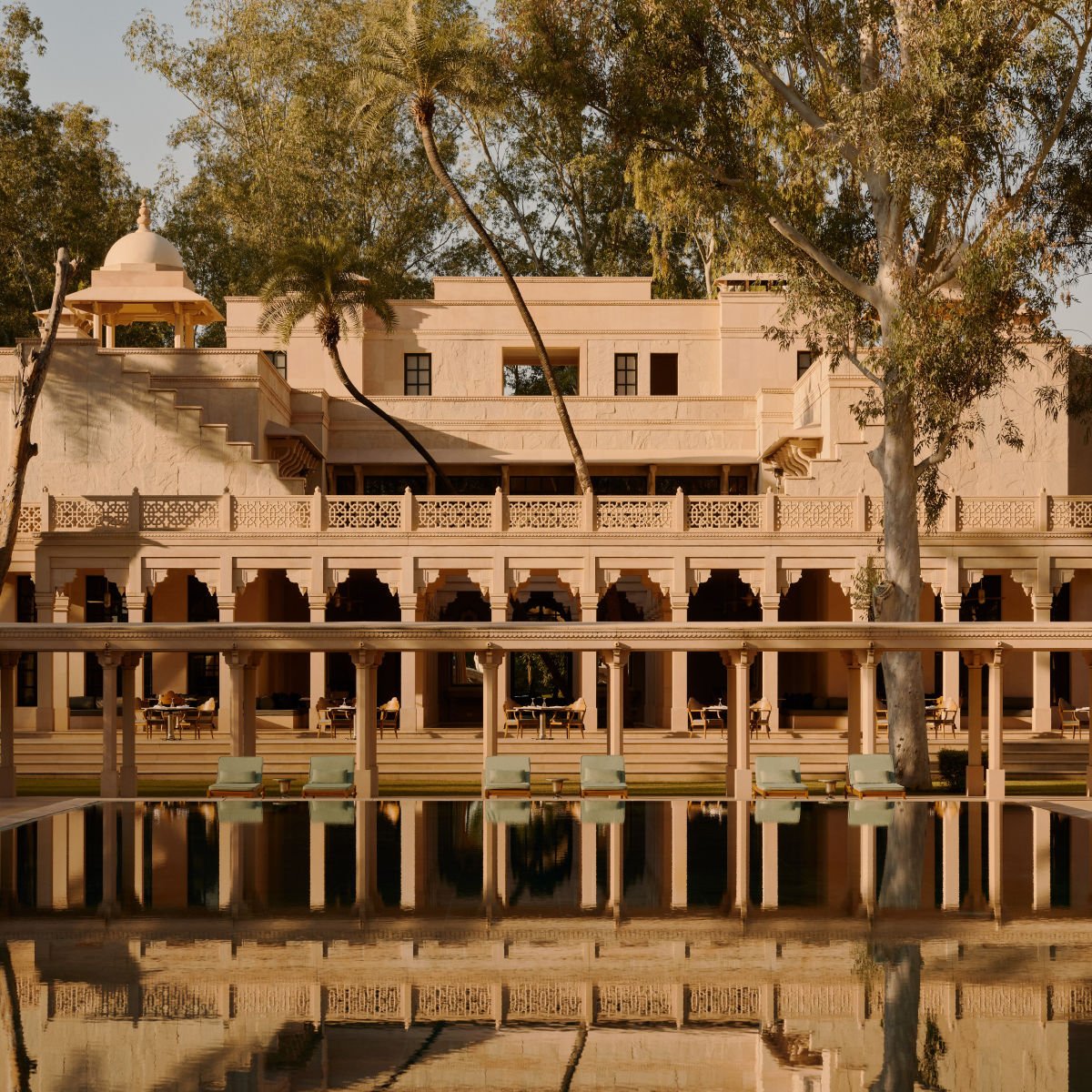
Set among the arid Aravalli Hills near Alwar, Amanbagh translates Mughal architectural language into a 37-room retreat that earned a place on the World's 50 Best Hotels list (2025) and La Liste's top hotel rankings. Pale sandstone pavilions, private courtyard havelis, and pool pavilions with personal plunge pools position it firmly in the quieter, isolation-first tier of Indian luxury hospitality, starting from $1,050 per night.
Where the Aravallis Reshape What a Hotel Can Be
The road to Amanbagh passes through territory that does not flatter the traveller. The Aravalli Hills in northern Rajasthan are among the oldest mountain ranges on earth, worn to crags and sandy plains over millennia, the scrub vegetation interrupted occasionally by a dry riverbed or a distant fort silhouette. It is deliberately unprepossessing country, and that contrast is part of the architecture. When the pale sandstone pavilions of Amanbagh emerge from behind a screen of palms and garden greenery, the effect is not accidental: the resort was conceived to read as an oasis, and the surrounding aridness is as much a design element as the carved jharokha screens on the buildings themselves.
This belongs to a recognisable tradition in premium Indian hospitality. Properties such as Aman-i-Khas in Ranthambore and Alila Fort Bishangarh in Manoharpur use geographic remoteness as a core part of their proposition, placing guests in landscapes that city-based luxury cannot replicate. Amanbagh operates in that same tier: low key count, high land-to-guest ratio, and a setting that actively resists the easy accessibility of a Jaipur city hotel. From Jaipur's airport (JAI), the drive runs approximately one hour and forty-five minutes.
American Architect, Mughal Grammar
The design credit belongs to American architect Ed Tuttle, who has shaped much of the Aman group's visual identity across its global portfolio. At Amanbagh, Tuttle worked within the architectural vocabulary of the Mughal period: onion domes, chattri pavilions, cusped arches, and the kind of spatial sequencing that draws visitors through layered thresholds before arriving at any room of consequence. The main building rises over three levels, with an arrival area that leads through a reception hall into a shaded courtyard. From there, the geometry opens: a dining room on one side, a lounge on the other, a sweeping staircase to the library and an outdoor terrace above.
What Tuttle avoided was pastiche. The Mughal Empire's peak, roughly the sixteenth and seventeenth centuries, produced some of the most refined built environments in the world. Its design vocabulary merged Persian spatial logic with Indian craft traditions, producing halls of mirrors, pietra dura inlay, and gardens conceived as earthly representations of paradise. Amanbagh references that legacy without attempting to museum-piece it. The interiors use carved stone detail, Islamic-patterned screens, and subdued colour palettes to evoke the sensibility of that era rather than reconstruct its ornament literally. It reads as contemporary restraint filtered through historical attentiveness, which is the same principle that separates the leading hotel architecture in this region from mere theme-park historicism. For a different expression of this approach in another north Indian city, The Leela Palace New Delhi applies comparable Mughal-era design references within an urban context.
The Room Tier That Matters Most
Amanbagh holds 37 rooms across several categories, a number that keeps guest density low enough for the ratio of space to person to remain generous throughout the property. The Courtyard Haveli Rooms and Garden Haveli Rooms occupy the ground levels of two two-storey structures flanking the main pool, while Terrace Haveli Rooms sit on the upper level with private terraced courtyards, outdoor dining areas, daybeds, and sun loungers. The private terrace category is worth the upgrade for those who want unmediated access to the Rajasthan sky at dawn.
At the leading of the room hierarchy sit fifteen Pool Pavilions, positioned on the perimeter of the resort, each with a private swimming pool and garden. Architecturally, these function as self-contained estates within the estate: a personal plunge pool set against the pale stone of the pavilion facade, surrounded by enough garden that the main building becomes optional rather than necessary. Inside, marble soaking tubs anchor the bathrooms. The nightly rate starting at $1,050 reflects the positioning: this is not a value-oriented Rajasthan property but a deliberate competitor to the upper bracket of Indian destination hotels, a set that includes properties such as The Oberoi Amarvilas in Agra and The Leela Palace Jaipur.
Dining in a Garden That Feeds Itself
The Dining Room occupies the lower floor of the main building beneath a double-height ceiling, structured for intimacy at a scale that most destination hotels in this category cannot achieve. The food programme centres on home-style Indian cuisine, with the kitchen supplied in part by the resort's own organic gardens. Western dishes are also available for those who require them, but the regional menu is the sharper editorial choice.
Alternative dining settings extend the options without requiring a formal seating. Poolside offers a more casual setting adjacent to the main swimming pool, while the Roof Terrace opens for dining beneath open sky. The terrace is particularly relevant in winter months, when the nights are clear and the Aravalli Hills cool quickly after dark. November and December represent the peak season for good reason: temperatures are manageable, the light is flat and golden by late afternoon, and the outdoor dining context becomes genuinely pleasurable rather than an exercise in heat endurance.
The Spa and What Lies Beyond the Property
A spa operates within the resort, staffed by therapists offering both contemporary treatments, including facials, massages, and scrubs, and Ayurvedic-influenced healing therapies. The treatment rooms are available as an alternative to in-haveli sessions, giving guests flexibility in how and where they access the programme. This kind of in-room treatment option is consistent with the Aman model globally; it appears at Aman Venice and Aman New York in different forms, always calibrated to remove friction from the wellness experience.
Rajasthan's cultural and architectural record around Alwar is substantial. The region carries early Hindu historical significance, and the surrounding area holds temples, stepwells, and fort complexes that reward exploration. The resort facilitates access to these sites through various modes of transport, including camel cart, elephant, and bicycle, each appropriate to different kinds of terrain and pacing. The approach mirrors what Suján Jawai in Pali does in its own district of Rajasthan: the property functions as a base for landscape and heritage immersion rather than as a self-contained destination designed to retain guests on-site. There is also a library on the premises for guests who want a quieter frame for the same historical context.
Where Amanbagh Sits in Its Competitive Set
The property's 2025 appearance on the World's 50 Best Hotels list at position 100, combined with a La Liste Leading Hotels score of 95.5 points and inclusion in the Tatler Asia-Pacific Leading Hotels 2025, places it in a documented tier of Indian destination properties that compete on setting, design, and service density rather than volume or amenity breadth. The Aman brand occupies a specific position in global hospitality: a subset of guests choose it categorically, across cities and continents, as the available data from properties like Aman New York and Aman Venice consistently reflects.
Within India specifically, Amanbagh represents the Aman group's most Mughal-inflected expression of that proposition. It does not attempt the monument-adjacent positioning of a property like The Oberoi Amarvilas, which uses proximity to the Taj Mahal as its primary experiential logic. Instead, Amanbagh builds its case on geographic isolation, architectural cohesion, and a 37-room scale that keeps the experience lean. For travellers routing through Rajasthan and looking to anchor at least one stop in the rural, landscape-forward tier of the state's hospitality offer, it occupies a position that most urban Jaipur hotels cannot replicate. You can find additional context on properties across the broader Indian luxury hotel market in our full Ajabgarh guide.
Planning Your Stay
Amanbagh sits in Ajabgarh, Rajasthan, reachable in approximately one hour and forty-five minutes from Jaipur International Airport (JAI), which is the practical entry point for most guests. November and December represent the strongest months for a visit, when cooler temperatures make outdoor dining and cultural excursions comfortable. The 37-room count means availability at peak season requires advance planning; the Pool Pavilion category, with its fifteen units and private pool configuration, moves first. Rates begin at $1,050 per night. The Aman group does not operate mid-market alternatives at this property, so travellers weighing price sensitivity against the Rajasthan experience may find comparators such as Haveli Dharampura in Delhi or Ananda in the Himalayas more appropriate to a different budget tier.
Frequently Asked Questions
What kind of setting is Amanbagh?
Amanbagh occupies an isolated position in the Aravalli Hills near Alwar in northern Rajasthan, approximately one hour and forty-five minutes by road from Jaipur Airport. The resort's pale sandstone architecture, designed by Ed Tuttle, references the Mughal period through courtyard structures, domed pavilions, and carved stone detail. It holds rankings on both the World's 50 Best Hotels list (position 100, 2025) and La Liste Leading Hotels (95.5 points, 2026), placing it in the documented upper tier of Indian destination hotels. At $1,050 per night from entry rate, it competes on design, setting, and guest-to-space ratio rather than amenity volume.
Which room offers the leading experience at Amanbagh?
The fifteen Pool Pavilions sit at the leading of the property's room hierarchy, each offering a private pool, garden, and marble soaking tub in a configuration that functionally separates the guest from the main property. They suit those who want maximum autonomy and outdoor access within the resort's perimeter. For guests prioritising architectural immersion over private pool access, the Terrace Haveli Rooms, with their private courtyard terraces and outdoor dining areas, offer a more direct encounter with the haveli typology that defines the property's design language. Given La Liste's 95.5 score and the property's Tatler Asia-Pacific inclusion, both categories sit within a credentialled context, but the Pool Pavilion represents the highest expression of what Amanbagh's isolation-forward proposition is built around.
Recognized By


Related editorial
- Best Fine Dining Restaurants in ParisFrom three-Michelin-star icons to the next generation of Parisian chefs pushing boundaries, these are the restaurants that define fine dining in the world's culinary capital.
- Best Luxury Hotels in RomeFrom rooftop terraces overlooking ancient ruins to Michelin-starred hotel dining, these are the luxury hotels that make Rome unforgettable.
- Best Cocktail Bars in KyotoFrom sleek lounges to hidden speakeasies, Kyoto's cocktail scene blends Japanese precision with global influence in ways you won't find anywhere else.
Save or rate Amanbagh on Pearl
Keep this venue in your Pearl passport, rate it after you visit, and track it alongside every other place you collect.