
Hotel in Allinge, Denmark
Allinge Badehotel
500ptsBaltic Badehotel Restraint

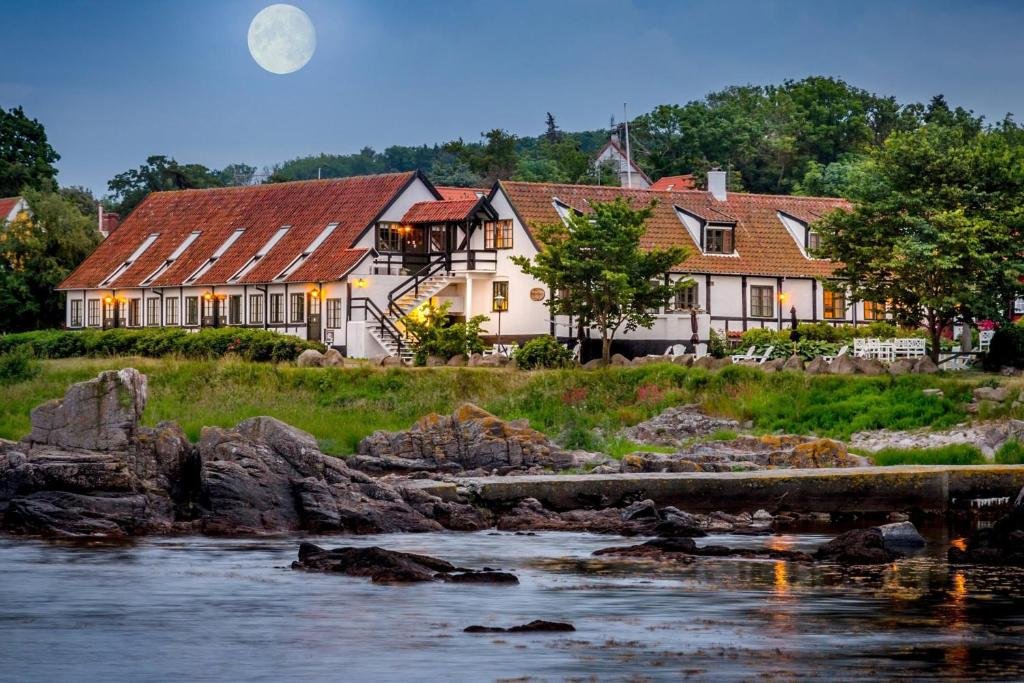
About Allinge Badehotel
On the Danish island of Bornholm in the Baltic Sea, Allinge Badehotel occupies a beautifully renovated 18th-century seaside house with 24 rooms furnished by contemporary Danish designers. It sits in a tier of small, design-conscious properties where restraint and authenticity count for more than scale, making it a reference point for low-key Scandinavian hospitality at its most considered.
An 18th-Century Frame for Contemporary Danish Design
Bornholm sits apart from mainland Denmark in more ways than geography. The island, a Danish territory in the Baltic roughly equidistant between Copenhagen and the Swedish coast, operates on its own tempo, and the architecture of its small coastal settlements reflects centuries of that self-sufficiency. Allinge, in the island's north, is one of those towns where the built environment still reads as genuinely old, and Allinge Badehotel at Løsebækgade 3 fits that fabric without apology. The building dates to the 18th century, and the renovation has treated that history as an asset rather than a problem to be solved.
What happens when a historic seaside inn is handed to contemporary Danish designers is not always predictable. The risk is always that the new work overwhelms the old shell, turning a place with genuine character into a showcase for current taste. Here, the approach reads as more disciplined. The furnishings and decorative elements are contemporary in origin but chosen for quietness rather than statement, sitting inside the older structure without competing with it. That calibration, letting the building's age remain legible while introducing present-day craft, is a defining characteristic of a certain strand of Scandinavian interior design that values timelessness over trend.
With 24 rooms, the hotel belongs to a tier of small, design-led properties that have become one of the more interesting categories in European hospitality. Properties like Dyvig Badehotel in Nordborg and Falsled Kro in Falsled occupy related ground in Denmark, each anchored by a historic structure, each operating at limited scale, and each placing design coherence at the centre of the guest proposition. At this room count, the character of a building survives; at 100 rooms, it rarely does.
The Logic of Restraint
Scandinavian hospitality has long operated with a different set of priorities than, say, grand European palace hotels. Where properties like Le Bristol Paris, Hotel Plaza Athénée, or Hôtel de Paris Monte-Carlo build identity through abundance and formality, the Nordic tradition tends to move in the opposite direction. Less surface, more substance. The Badehotel format itself has deep roots in Danish culture: these coastal inns were historically where urban Danes came to recover, to eat simply and well, and to exist in closer proximity to the sea and its rhythms. Allinge Badehotel works within that tradition rather than departing from it.
The in-room experience is described as first-rate in its comforts, which in this context means the essentials executed with care rather than amenities listed for their own sake. That distinction matters. A property like this competes on atmosphere and authenticity, not on the number of services it can enumerate. Guests who arrive expecting the frictionless impersonality of a large international brand will misread what is on offer. Those who come looking for the particular quality of a small, well-considered inn in an extraordinary coastal setting will find the register exactly right.
Breakfast In, Dinner Out
The daily breakfast service is part of the core experience, and in the Badehotel tradition it functions as one of the anchoring rituals of a stay. For dinner, the model shifts outward: Allinge itself is amply supplied with high-quality restaurants, and a short walk into town provides access to the kind of seasonal, seafood-forward cooking that Bornholm has become known for among Danish food travellers. The island's culinary reputation has grown considerably in recent years, driven partly by its distinctive local ingredients, particularly smoked herring from its traditional smokehouses, and partly by the broader elevation of Nordic regional cooking as a reference point internationally.
This eat-out-for-dinner model is common among smaller Danish inns and reflects both practical constraint and honest self-knowledge. It also places the hotel in dialogue with the town around it rather than sealing guests inside a closed hospitality environment. For context on what Allinge's restaurant scene offers, see our full Allinge restaurants guide.
Bornholm as Context
Understanding what makes a stay here work requires understanding Bornholm itself. The island is unusual within Denmark: its geology is granite rather than chalk, its light is different, its traditions of craft (ceramics, glass, smoked fish) are distinct. It draws a particular kind of traveller, one less interested in resort infrastructure and more interested in the texture of a place that has remained genuinely itself. That positioning connects Allinge Badehotel to a broader category of destination hotels where location and authenticity carry more weight than amenities lists. It sits in a different peer set from, say, Aman New York or Bvlgari Hotel Tokyo, not because it is less considered, but because the proposition is fundamentally different: this is a place defined by what it strips away rather than what it adds.
Within Denmark, the comparison set is more instructive. Kokkedal Castle Copenhagen in Horsholm and Dragsholm Slot in Hørve both represent historic Danish properties repositioned for contemporary travel, each with their own approach to the relationship between heritage and present-day comfort. Herman K in Copenhagen and Park Lane Copenhagen in Hellerup occupy the urban end of the Danish boutique spectrum. Allinge Badehotel sits at the quieter, more remote end, where the appeal is precisely the distance from the city.
Planning a Stay
Bornholm is accessible from Copenhagen by ferry, typically departing from Rønne on the island's western coast, or by a short flight. The island's population is small and its infrastructure relatively compact, making it navigable without a car for guests based in Allinge itself, though a bicycle or vehicle helps for exploring the rest of the island. One logistical note worth attention: the front desk at Allinge Badehotel closes at 6pm. Guests arriving after that time should arrange a late check-in in advance through the hotel's customer service team. This is not unusual for a small property of this type, but it rewards planning. The summer months bring longer days and warmer Baltic temperatures, making the island's coastline and outdoor spaces most accessible; the shoulder seasons offer quieter conditions and the particular quality of Nordic light in spring and autumn.
Frequently Asked Questions
What is the general vibe at Allinge Badehotel?
The atmosphere sits firmly in the low-key, unpretentious register that characterises the Danish Badehotel tradition. The building is historic, the design is contemporary but restrained, and the scale, 24 rooms in a coastal town, keeps the experience personal rather than institutional. Guests who respond well to this property tend to be looking for authentic character over curated spectacle.
What should guests know about the rooms?
The hotel runs 24 rooms in a renovated 18th-century building, furnished with pieces by contemporary Danish designers. The approach favours the quietly stylish over the showy, consistent with the broader Scandinavian design tradition of letting materials and proportion carry the room rather than decoration. In-room comforts are described as first-rate within that frame of reference. Pricing information was not available at time of publication.
What is Allinge Badehotel known for?
Property is a reference point for Scandinavian hospitality at its most considered: a historic coastal inn, sensitively renovated, operating at small scale on an island with a strong sense of its own identity. Its reputation rests on the quality of its daily breakfast, the coherence of its design, and its position in Allinge as a base for exploring one of Denmark's most distinctive island territories.
Recognized By

Related editorial
- Best Fine Dining Restaurants in ParisFrom three-Michelin-star icons to the next generation of Parisian chefs pushing boundaries, these are the restaurants that define fine dining in the world's culinary capital.
- Best Luxury Hotels in RomeFrom rooftop terraces overlooking ancient ruins to Michelin-starred hotel dining, these are the luxury hotels that make Rome unforgettable.
- Best Cocktail Bars in KyotoFrom sleek lounges to hidden speakeasies, Kyoto's cocktail scene blends Japanese precision with global influence in ways you won't find anywhere else.
Save or rate Allinge Badehotel on Pearl
Keep this venue in your Pearl passport, rate it after you visit, and track it alongside every other place you collect.