
Hotel in San Sebastián, Spain
Akelarre
1,050ptsCoastal Haute Cuisine with Boutique Rooms


About Akelarre
High on Monte Igueldo above San Sebastián, Akelarre pairs Pedro Subijana's three-Michelin-star kitchen with a 22-room boutique hotel that frames the Bay of Biscay through floor-to-ceiling glass. Rooms start at fifty square metres, rates from US$751 per night, and Michelin awarded the property two Keys in 2024. The architecture alone makes a case for the stay before the food is considered.
Where the Building and the Bay Do Equal Work
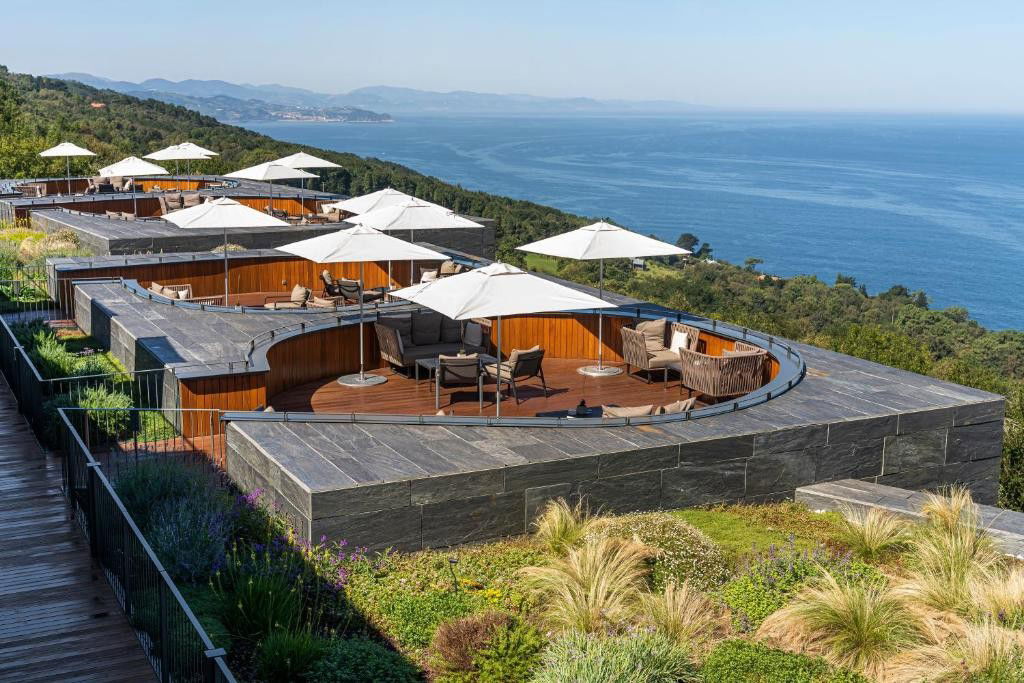
The approach to Akelarre sets the terms for everything that follows. The road climbs west along the slopes of Monte Igueldo, above the city's beach suburbs, and the building that comes into view is demonstrably not a converted farmhouse or a repurposed grand hotel. It is a purpose-built piece of contemporary architecture, designed to place the Bay of Biscay inside every significant room. The glass lines are long and uncluttered. Stone grounds the structure without making it heavy. The effect, before a single meal has been ordered or a room key collected, is of a building that has resolved a specific problem with some elegance: how do you create a destination property in one of Europe's most food-serious cities without letting the restaurant overshadow everything else, or vice versa?
Akelarre's answer is architectural integration. The hotel's 22 rooms and the three-Michelin-star restaurant share the same design logic, the same orientation toward the water, and the same restraint in their interiors. That coherence is rarer than it sounds. Many chef-led hotel projects struggle to unify a restaurant identity with a hospitality identity; they tend to resolve the tension by making the hotel feel like a guesthouse attached to the main event. Here, the two functions feel genuinely co-equal, which places Akelarre in a narrow category. In Spain, the luxury boutique hotel built around a single chef's kitchen remains unusual. Comparable models appear more readily in France and, to a lesser extent, England. Within Spain, properties like Atrio Restaurante Hotel in Cáceres or Pepe Vieira Restaurant and Hotel in Poio occupy the same conceptual bracket, though each solves the problem differently.
The Rooms: Scale, Material, and a View That Does the Decorating
San Sebastián's hotel market runs from city-centre grand dames like Hotel Maria Cristina and Hotel de Londres y de Inglaterra through contemporary options including Nobu Hotel San Sebastián and Hotel Arima and Spa. Akelarre sits apart from all of them on the simple axis of location: it is the only property in the city that puts you on the mountain rather than in it, with panoramic water views as a structural given rather than a premium upgrade.
The 22 rooms begin at fifty square metres, a floor area more common in suite categories at city-centre hotels. Suites reach one hundred square metres. The interiors favour hard materials, clean lines, and minimal colour interruption, which allows the views to function as the primary visual element in each space. Soaking tubs positioned before exterior windows appear across the standard room tier; suites add plunge pools. The logic throughout is consistent: the architecture frames the landscape, and the furnishings get out of the way.
In the wider context of design-led Spanish hotel properties, this approach has clear precedents. Properties like Cap Rocat in Cala Blava and Mas de Torrent Hotel and Spa in Torrent similarly let their physical settings carry aesthetic weight. The difference at Akelarre is that the setting is dynamic rather than static: the Bay of Biscay changes character through the day, through weather, and through season in ways that a clifftop fortress or a Catalan farmhouse simply cannot replicate. Rates begin at US$751 per night, positioning the property at the upper end of the San Sebastián market and in line with what the room scale and location justify.
Michelin added two Keys to the property's credentials in 2024, its hospitality rating running alongside the restaurant's three culinary stars. That double recognition places Akelarre in a very small group of properties worldwide where both the food and the built experience are considered by the same assessors to operate at elite level. For context, Michelin Keys were introduced globally in 2024 as the guide's formal hospitality rating, making early recipients part of a validated peer set rather than self-declared luxury properties.
The Spa and the Stone
The property's spa operates from the same material language as the rest of the building. Heavy stone architecture creates a thermal quality and visual weight that connects, in approach if not in geography, to the tradition of serious European spa design. The contrast with the lightness of the glass-and-view rooms is deliberate: the spa works through enclosure and gravity, the rooms through openness and horizon. Both are valid responses to place, and together they give the property a physical range that single-note luxury hotels often lack.
The Restaurant: Three Stars, Four Decades, One Kitchen
Pedro Subijana's three Michelin stars at Akelarre represent one of the longer continuous relationships between a chef and that level of recognition in Spain. The duration matters as context rather than merely as biography: a kitchen that has held three stars across four decades has necessarily shaped, and been shaped by, the evolution of Basque cuisine as a discipline. The New Basque Cuisine movement, which placed San Sebastián at the centre of European culinary attention from the late 1970s onward, counted Subijana among its founding generation. The restaurant is not a monument to that movement but an active kitchen, which means it sits in an interesting tension between historical authority and ongoing relevance.
San Sebastián's dining scene is among the most concentrated in the world by starred-restaurant density, and Akelarre occupies a specific position within it: it is the restaurant most physically removed from the city centre, most architecturally integrated with its setting, and most clearly positioned as a destination that rewards an overnight stay rather than a dinner reservation alone. For the city's full dining context, the EP Club San Sebastián guide covers the broader scene.
Travellers combining a Basque stay with wider Spanish itineraries will find useful reference points in properties like Mandarin Oriental Ritz in Madrid, Abadía Retuerta LeDomaine in Teruel, or Terra Dominicata in Escaladei, each of which represents a version of the gastronomy-anchored destination stay that Akelarre pioneered in its own corner of Spain.
Planning a Stay
Akelarre sits on Padre Orkolaga Ibilbidea, 56, on the slopes of Monte Igueldo, west of central San Sebastián. By car, the approach follows the A-8 motorway with exit at Ondarreta, then the Monte Igueldo road through the university district. San Sebastián's airport is approximately 20 kilometres away; Bilbao International Airport is 100 kilometres distant and carries the majority of international routes into the region; Biarritz Airport, across the French border, sits approximately 40 kilometres away and serves several European carriers. The city's main train station is 5 kilometres from the property. A car is practical for the Monte Igueldo location, particularly for exploring the surrounding coastline during a multi-day stay. Rates begin at US$751 per night. Given the restaurant's three-star status and the limited 22-room count, advance planning is strongly advised for both accommodation and dining reservations, particularly during peak summer months and the San Sebastián film festival period in September.
Visitors choosing a city-centre base who want proximity to the Parte Vieja and the beach promenade can consider Lasala Plaza Hotel, Hotel Villa Favorita, Apartamentua, or Hotel Catalonia Donosti. Each offers a different price-to-location calculation, but none replicates the on-mountain position that makes Akelarre a self-contained argument for staying where you eat.
Frequently Asked Questions
- What is the general atmosphere at Akelarre?
- The mood runs quieter and more self-contained than a city-centre property. You are on a mountain above San Sebastián, with the Bay of Biscay as the primary visual presence. The interiors are minimalist by deliberate design, which reinforces a sense of remove from the city below. It holds a 4.6 Google rating across 211 reviews and an EP Club score of 4.7/5, with Michelin Keys (2024) confirming the hospitality standard is assessed at a serious level. The price point, from US$751 per night, reflects both the coastal views and the three-star restaurant access that comes with a stay.
- Which room type is the reference choice at Akelarre?
- The property does not publish a named signature suite in its database record, but the design logic points clearly toward the hundred-square-metre suite tier, which adds a plunge pool to the soaking tub and wide exterior window configuration available in standard rooms. At a property where architecture and view are the primary amenities, the suite format gives the most interior space from which to engage both. The Michelin two-Key recognition (2024) covers the full property, not a specific category, but the suite tier delivers the most complete version of what the building is designed to offer.
- What is the central reason to choose Akelarre over other San Sebastián hotels?
- Akelarre is the city's only property where a three-Michelin-star restaurant and a Michelin two-Key hotel occupy the same building, designed as a single architectural statement with panoramic Bay of Biscay views built into every room. In San Sebastián, a city with a dense concentration of starred restaurants, this is the one address where the dining and the sleeping are formally integrated rather than geographically adjacent. If the restaurant is the reason for the trip, staying on-site removes every logistical variable and turns the meal into an overnight experience rather than an evening out.
- What is the leading way to book Akelarre?
- The venue database does not include a direct booking URL or phone number, so the reliable route is to approach the property through its official website or contact the hotel directly for both room and restaurant reservations. Given 22 rooms and three-Michelin-star demand, availability at peak periods, particularly summer and the September film festival, requires booking well in advance. If Akelarre is sold out, city-centre alternatives such as Hotel Maria Cristina or Nobu Hotel San Sebastián can serve as a base for a dinner reservation at the restaurant.
- Is Akelarre worth staying at even if the primary interest is the restaurant rather than the hotel?
- Among San Sebastián's three-star restaurants, Akelarre is the only one physically removed from the city centre and embedded in a hotel designed around the same culinary identity. Pedro Subijana's kitchen has held three Michelin stars across four decades, placing it in the founding generation of New Basque Cuisine. An overnight stay, starting from US$751, converts what would be a single meal into an extended engagement with the building, the views, and the spa, and removes the logistical pressure of returning to the city after a long tasting menu.
Recognized By


Related editorial
- Best Fine Dining Restaurants in ParisFrom three-Michelin-star icons to the next generation of Parisian chefs pushing boundaries, these are the restaurants that define fine dining in the world's culinary capital.
- Best Luxury Hotels in RomeFrom rooftop terraces overlooking ancient ruins to Michelin-starred hotel dining, these are the luxury hotels that make Rome unforgettable.
- Best Cocktail Bars in KyotoFrom sleek lounges to hidden speakeasies, Kyoto's cocktail scene blends Japanese precision with global influence in ways you won't find anywhere else.
Save or rate Akelarre on Pearl
Keep this venue in your Pearl passport, rate it after you visit, and track it alongside every other place you collect.