
Bar in Barcelona, Spain
Boadas
525ptsPre-War Cocktail Orthodoxy


About Boadas
One of Barcelona's most enduring cocktail addresses, Boadas occupies a triangular corner at the foot of Carrer dels Tallers with the quiet confidence of a bar that has never needed to announce itself. Ranked #85 in the World's 50 Best Bars 2025 and holding a Google rating of 4.3 across over 2,200 reviews, it draws a mixed crowd of locals and informed visitors who understand that brevity and precision are the house style.
A Corner Bar That Outlasted Every Trend
The triangular wedge of a room at the junction of Carrer dels Tallers and La Rambla does not look like a global reference point for cocktail craft. It looks like what it is: a bar that has been standing in roughly the same form since 1933, absorbing the noise of the Raval, the tourist flood of La Rambla, and at least three generations of Barcelona's drinking public. That continuity is the first thing the room communicates, before a single drink arrives.
Barcelona's cocktail scene has fractured considerably over the past decade, splitting between two broad tendencies: technically elaborate, concept-driven bars oriented toward international awards culture, and a smaller group of older addresses that carry genuine historical weight. Boadas sits firmly in the second category, which makes its continued appearance on the World's 50 Best Bars list — ranked #85 in 2025 and as high as #37 in 2011 — a different kind of achievement than the one earned by a bar built expressly for that purpose. The recognition reflects durability and editorial persistence rather than the launch-year momentum that drives newer entrants.
The Cocktail Programme: Economy of Movement
The bars that last in this city tend to have something in common: a cocktail programme built around clarity of execution rather than complexity for its own sake. At Boadas, that means a short, curated list anchored in pre-war classics , daiquiris, sidecars, and Martini variants that were already established canon when the bar opened. The style is closer to Havana's golden-era barmanship than to the modern molecular or fermentation-forward approach now associated with Barcelona's newer wave. The shaker and the mixing glass are the primary tools, and what changes from bar to bar at this level is the quality of the base spirits, the temperature discipline, and the ratio control. These are not theatrical variables.
That approach puts Boadas in a different conversation from neighbours like Dr. Stravinsky or Foco, both of which operate under overtly contemporary frameworks. Dry Martini, also on La Rambla's western flank and carrying its own history since 1978, represents the closest stylistic parallel in Barcelona: a bar where the Martini is treated as a structural argument, not a vehicle for garnish creativity. The comparison is instructive. Where Dry Martini performs its classicism with a degree of ceremony, Boadas delivers the same commitment in a smaller, less formal room. The gap between the two addresses tells you something about how Barcelona calibrates heritage against hospitality theatre.
Spain's wider cocktail bar culture provides additional context. In Madrid, Angelita has built its reputation around wine-bar crossover and natural fermentation influences, a very different axis. In the Balearics, addresses like La Margarete in Ciutadella and Garden Bar in Calvia operate within resort-adjacent leisure markets. Boadas, by contrast, is urban and specific: a city bar for a city that has been drinking seriously for a very long time.
What the Room Tells You
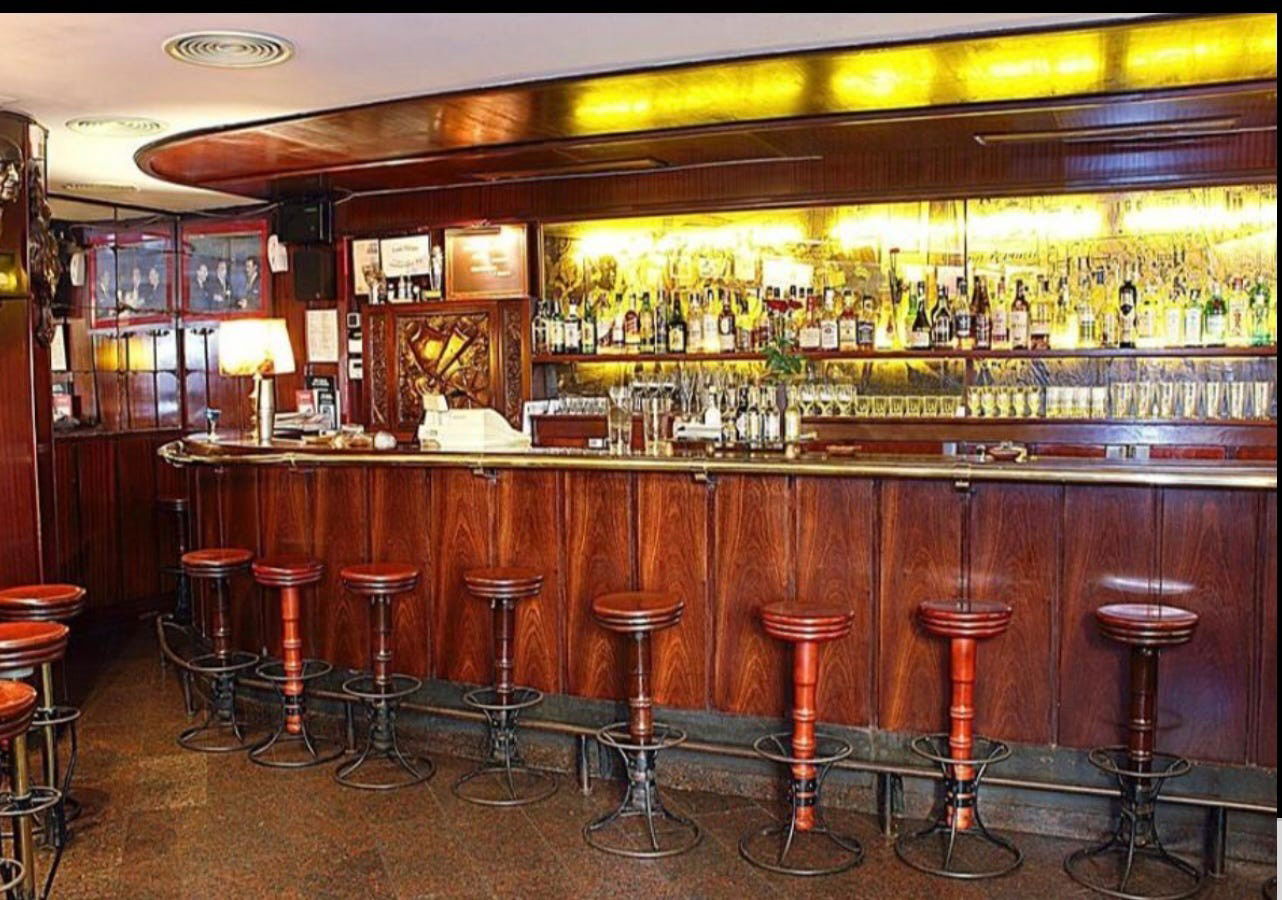
The physical environment at Boadas rewards attention. The bar counter is short enough that service is genuinely proximate , there is no dead zone at the far end where drinks go to warm up and eye contact with the bartender becomes difficult. The Art Deco interior details, maintained rather than replicated, place the space in a visual register that most newer concept bars spend considerable money trying to approximate with salvage and set-dressing. Here it is simply what accumulated over ninety years of operation.
The crowd on any given evening tends to be heterogeneous in a way that newer, concept-led bars struggle to achieve. Regulars who have been coming since the 1980s occupy the same stools as tourists who discovered the address through a travel recommendation, alongside younger Barcelona drinkers who treat pre-war classicism as an intellectual counterpoint to the fermentation bars and low-ABV programmes proliferating in the Eixample. That mix is a trust signal in itself. A bar that sustains a 4.3 rating across more than 2,200 Google reviews , a number that includes the full spectrum of visitor types , has resolved something about hospitality consistency that many technically superior bars have not.
Google rating and review volume matter here as a proxy for something specific: Boadas is not a bar that works only for a narrow, initiated audience. The formula is accessible enough that a casual visitor from outside cocktail culture reads the visit as a success. That is harder to achieve than it looks, and it is part of why the 2025 Top 500 Bars ranking of #54 reads as credible rather than anomalous.
Placed in the Barcelona Bar Order
Barcelona's cocktail map has a clear tiering. At the conceptual front, bars like Mutis and the broader cohort of technique-forward addresses in the Eixample represent the city's contribution to contemporary global cocktail conversation. They are bars where the programme is the primary act and the room is built to support it. Boadas operates on a different register: the room is the primary act, the programme is its natural expression, and the two are inseparable in a way that cannot be engineered after the fact.
For comparison, consider how Bar Sal Gorda in Seville or Bar Gallardo in Granada function within their respective cities: bars with defined local identity that carry weight precisely because they are not competing on the same terms as the international circuit. Boadas is the Barcelona version of that archetype, with the added layer of genuine awards history that distinguishes it from sentiment-only heritage addresses.
The 2011 #37 ranking in World's 50 Best Bars is worth noting specifically because it predates the current awards-culture inflation, when fewer bars were explicitly constructed for list performance. Appearing at that level in that period reflects something about the bar's actual standing in the professional community, not just its longevity. The subsequent movement to #85 in 2025 is not a decline so much as a recalibration against a much larger and more competitive field.
For a broader map of where Boadas fits within the city's full food and drink offer, see our full Barcelona restaurants guide. For an international comparison point outside Spain, the discipline-over-spectacle approach that Boadas represents also shows up in addresses like Bar Leather Apron in Honolulu, where bar programmes built around technical fidelity and restraint consistently outperform their square footage. In the Balearics, Garito Cafe in Palma de Mallorca occupies a comparable position of local cultural reference, though in a leisure-market context rather than an urban one.
Know Before You Go
- Address: Carrer dels Tallers, 1, Ciutat Vella, 08001 Barcelona
- Recognition: World's 50 Best Bars #85 (2025); Top 500 Bars #54 (2025); World's 50 Best Bars #37 (2011)
- Google Rating: 4.3 (2,230 reviews)
- Reservations: Walk-in format; no reservation details confirmed in available data
- Getting there: Positioned at the foot of Carrer dels Tallers, one block from La Rambla and within walking distance of the Liceu metro station (L3)
- Timing: The bar draws a mixed crowd throughout the evening; earlier arrivals tend to find more space at the counter
Frequently Asked Questions
What do regulars order at Boadas?
Boadas has built its reputation around pre-war classics, and the daiquiri and sidecar are among the orders most associated with the house style. The programme is anchored in the Havana-influenced barmanship tradition that informed the bar's founding, which means the short list of spirit-forward classics is where the technique is most legible. The bar's consistent placement in both the World's 50 Best Bars (currently #85 in 2025) and the Top 500 Bars (#54 in 2025) signals that the classics here are executed at a level the broader professional community recognises.
What is Boadas known for?
Boadas is known primarily as one of Barcelona's longest-running cocktail bars, operating since 1933 in its Art Deco corner room at the edge of the Raval. Its sustained presence on the World's 50 Best Bars list across more than a decade , from a high of #37 in 2011 to #85 in 2025 , has kept it on the international radar while the city around it has produced successive waves of newer, concept-driven bar openings. The combination of historical authenticity, technical consistency, and genuine neighbourhood integration is what separates it from heritage addresses that have become tourist traps.
Is Boadas reservation-only?
No confirmed reservation system appears in available records for Boadas, and the bar's long-standing format suggests a walk-in model consistent with its era and style. Given its location at the La Rambla end of Carrer dels Tallers in Ciutat Vella, foot traffic can be significant, particularly on weekend evenings. Arriving earlier in the evening is the practical approach if counter seating matters. For booking-dependent alternatives in the same city, both Dr. Stravinsky and Mutis operate more structured reservation models.
Recognized By


Related editorial
- Best Fine Dining Restaurants in ParisFrom three-Michelin-star icons to the next generation of Parisian chefs pushing boundaries, these are the restaurants that define fine dining in the world's culinary capital.
- Best Luxury Hotels in RomeFrom rooftop terraces overlooking ancient ruins to Michelin-starred hotel dining, these are the luxury hotels that make Rome unforgettable.
- Best Cocktail Bars in KyotoFrom sleek lounges to hidden speakeasies, Kyoto's cocktail scene blends Japanese precision with global influence in ways you won't find anywhere else.
Save or rate Boadas on Pearl
Keep this venue in your Pearl passport, rate it after you visit, and track it alongside every other place you collect.