
Bar in Toronto, Canada
Bar Raval
365ptsIberian Pour, Local Root


About Bar Raval
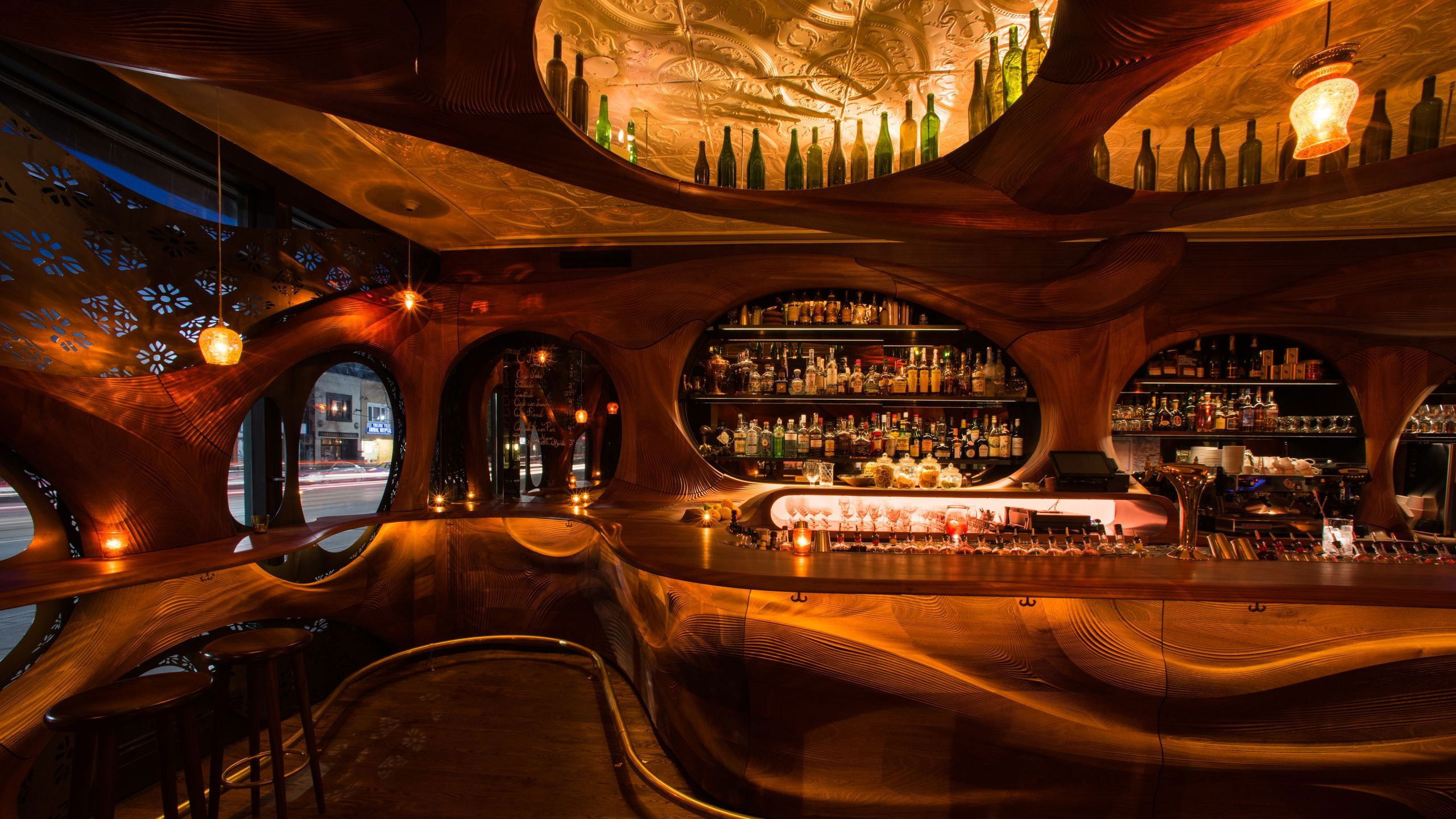
Bar Raval on College Street has held a place in the upper tier of North American bar recognition since 2022, when it placed 41st on the World's 50 Best North America's Best Bars list, and reached 84th globally in 2025. The sinuous mahogany bar and communal oak-barrel tables frame a program built on vermouth, sherry, amaro, and a sustainability-led cocktail list. Pintxos run from midday; the room runs later.
Bar Raval, Toronto
College Street's bar scene has always operated at a remove from the slicker precincts of King West or the Distillery District. The stretch around Ossington and Little Italy carries a different register: older storefronts, a more mixed crowd, less performance. Bar Raval, at 505 College St, fits that register in some ways and refuses it in others. The interior is the first thing anyone mentions, and for good reason: the mahogany millwork curves in a way that reads as Gaudí-influenced without being a replica of anything. It is a genuinely unusual room for a North American bar, and the sinuous communal oak-barrel tables reinforce the sense that the architecture is doing deliberate work, not just decoration.
Where Bar Raval Sits in the North American Bar Conversation
Recognition at the level Bar Raval holds is rare among Canadian bars. The World's 50 Best named it 41st among North America's Leading Bars in 2022, then placed it 84th globally in the Asia's Leading Bars extended ranking in 2025. That kind of sustained placement over a multi-year period signals something beyond an opening-year surge: a bar that has maintained program quality and industry attention long enough to hold position. For context, very few Canadian bars make the global 50 Best extended lists at all; appearing twice, years apart, at comparable tiers puts Raval in a small peer group nationally alongside venues like Atwater Cocktail Club in Montreal and Botanist Bar in Vancouver.
What those rankings measure is partly subjective, but they do correlate with program consistency, bartender technique, and the kind of menu coherence that industry voters notice. A Google rating of 4.4 across more than 3,000 reviews adds a different data point: the recognition is not narrowly professional. The room earns that score from a broad public audience that includes neighbourhood regulars, tourists, and the after-work crowd that has been coming since the bar opened roughly a decade ago.
The Program: Vermouth, Sherry, Amaro, and What That Signals
Toronto's cocktail bars have moved through several phases since the early 2010s: speakeasy theatre, craft spirit obsession, Japanese-influenced minimalism, and now a more fragmented scene where different bars stake distinct territory. Bar Raval staked its territory early in the Iberian-influenced, fortified-wine direction, and that positioning has aged well. The deep selection of vermouth, sherry, and amaro that defined the opening program has been described as growing stronger and better under bar manager Bex Figueiredo, which matters because fortified wine programs require genuine depth and rotation discipline to stay current.
For visitors accustomed to cocktail bars where spirits drive the list, a sherry and vermouth-led program can initially read as restraint. In practice, it reflects a different kind of ambition: building around lower-ABV, food-compatible categories requires a bar to know its producers, maintain its bottles properly, and educate its staff to a level most cocktail bars do not bother with. The fact that the program has run for a decade without the wheels coming off suggests the operational infrastructure is real.
The modern cocktail program runs alongside the fortified wine focus, and the sustainability and locavorism framing it operates under is not incidental. Produce from owner Grant van Gameren's Prince Edward County farm feeds into the menu, which gives the bar a supply relationship most venues claim rather than hold. PEC has become a serious food-production region in Ontario, and the sourcing connection is a structural one, not a seasonal marketing gesture.
Pintxos, Tapas, and the Question of What Kind of Bar This Is
One of the more useful things to understand about Bar Raval before visiting is that it does not operate on the strict cocktail-bar or restaurant binary. The Basque-influenced food format, running from midday pintxos through to late-night tapas, means the venue functions across a broader time window and for a wider range of intentions than a drinks-only program would support. You can arrive at lunch for a glass of vermouth and a few bites, or show up late and eat meaningfully. That flexibility is a real feature of the room, not just marketing copy.
The communal table format reinforces this. Oak-barrel tables designed for shared use produce a different social dynamic than reserved two-tops or a pure bar-stool configuration. The room tends to mix groups in a way that smaller, more formal venues do not, which is part of why the 3,000-plus Google reviews come from such a varied audience. The bar is not positioning itself exclusively at the cocktail enthusiast or the food tourist or the neighbourhood regular; the format accommodates all three.
Bar Raval in the Toronto Bar Peer Set
Within Toronto, Bar Raval sits in a tier of bars that have built reputations over multiple years rather than riding a single opening moment. Civil Liberties and Civil Works occupy related territory in terms of program seriousness, while Bar Mordecai and Bar Pompette represent the city's broader growth in considered bar programming. Raval distinguishes itself from that peer set primarily through the fortified wine specialisation and the food component: few Toronto bars run a comparable pintxos and tapas program alongside a drinks list of equivalent depth.
Nationally, the comparison set for a bar with Raval's combined recognition profile and longevity is short. Humboldt Bar in Victoria, Missy's in Calgary, Bearfoot Bistro in Whistler, and Grecos in Kingston each occupy distinct regional positions, but none of them combine a decade of operation with repeated global-list placement in the same way. Bar Leather Apron in Honolulu offers a useful Pacific comparison: a bar that has built international recognition through program specificity rather than volume. Raval's position is analogous in the Canadian context.
Know Before You Go
| Detail | Notes |
|---|---|
| Address | 505 College St, Toronto, ON M6G 1A5 |
| Service window | Runs from midday through late night; the room accommodates lunch, early evening, and post-dinner visits |
| Food format | Pintxos at lunch; tapas later in the evening |
| Recognition | World's 50 Best North America's Leading Bars #41 (2022); Asia's Leading Bars #84 (2025) |
| Google rating | 4.4 from 3,095 reviews |
| Program focus | Vermouth, sherry, amaro, and a sustainability-led modern cocktail list |
| Sourcing note | Produce linked to owner Grant van Gameren's Prince Edward County farm |
For a broader view of Toronto's bar and restaurant scene, see our full Toronto restaurants guide.
Frequently Asked Questions
What makes Bar Raval worth visiting?
Bar Raval holds two data points that are hard to argue with: a 41st-place finish on the World's 50 Best North America's Leading Bars list in 2022 and an 84th-place global ranking in 2025, alongside a 4.4 Google rating from more than 3,000 reviews. Those numbers represent different kinds of audiences agreeing on the same bar. The specific draw is a fortified wine program, including vermouth, sherry, and amaro at genuine depth, paired with a Basque-influenced food format that runs across most of the day. The room itself, with its curved mahogany bar and communal oak-barrel tables, is architecturally unlike most Toronto bars. Operationally, the bar has held its program quality for roughly a decade, which in the hospitality context is a real credential.
What's the must-try cocktail at Bar Raval?
The awards record and program architecture at Bar Raval both point toward the fortified wine categories as the starting point: vermouth, sherry, and amaro selections that have grown in depth under bar manager Bex Figueiredo. A well-chosen glass of vermouth or a sherry pour alongside the pintxos is where the bar's Iberian identity is clearest, and it reflects the sourcing and sustainability commitments that run through the modern cocktail program as well. The cocktail list adds a contemporary layer built around locavore produce, with ingredients sourced from the owner's Prince Edward County farm. Without naming a specific cocktail from the current menu, the safest guidance is to ask the bar team about the vermouth or amaro selection on your visit; that conversation is where the program's depth tends to surface.
Recognized By


More bars in Toronto
- Bar NeonBar Neon sits on Bloor St W in Toronto's west end, a neighbourhood bar suited to casual evenings and small groups. Detailed menu and hours data is limited, so verify before making a special trip. For groups of four or more, check capacity ahead of time — nearby options like Bar Raval and Civil Liberties offer more confirmed space and documented menus.
- 111 Queen St E111 Queen St E sits on a busy stretch of downtown Toronto where convenience is the main draw. It pulls in a local, foot-traffic crowd rather than destination-driven diners. Easy to access and easy to book, but if you are planning a dedicated outing, Toronto's more focused bar and dining spots will reward the effort more.
- 156 ONEFIVESIX156 ONEFIVESIX on Queen Street West is an easy walk-in stop for a low-key drink in one of Toronto's most bar-dense neighbourhoods. Booking is simple and the atmosphere reads as mid-tempo and conversational. Food program details are unconfirmed — if the kitchen is a priority, Bar Pompette or Civil Liberties are safer choices nearby.
- 4th and 74th and 7 on College Street is an easy-to-book neighbourhood bar in Dovercourt Village, suited to a low-key date night in a walkable part of Toronto. Public data on the programme is limited, but the location is strong and the lack of crowds makes it a friction-free option. Best for regulars who know what they are returning for rather than first-timers seeking a mapped-out evening.
- After SevenAfter Seven sits on Stephanie Street in Toronto's Kensington-adjacent west end, with easy booking making it a low-friction option for a date night or spontaneous evening out. Venue details are limited, so confirm hours and format before committing. Check our full Toronto bars guide for alternatives if you want more certainty before you book.
Related editorial
- Best Fine Dining Restaurants in ParisFrom three-Michelin-star icons to the next generation of Parisian chefs pushing boundaries, these are the restaurants that define fine dining in the world's culinary capital.
- Best Luxury Hotels in RomeFrom rooftop terraces overlooking ancient ruins to Michelin-starred hotel dining, these are the luxury hotels that make Rome unforgettable.
- Best Cocktail Bars in KyotoFrom sleek lounges to hidden speakeasies, Kyoto's cocktail scene blends Japanese precision with global influence in ways you won't find anywhere else.
Save or rate Bar Raval on Pearl
Keep this venue in your Pearl passport, rate it after you visit, and track it alongside every other place you collect.